
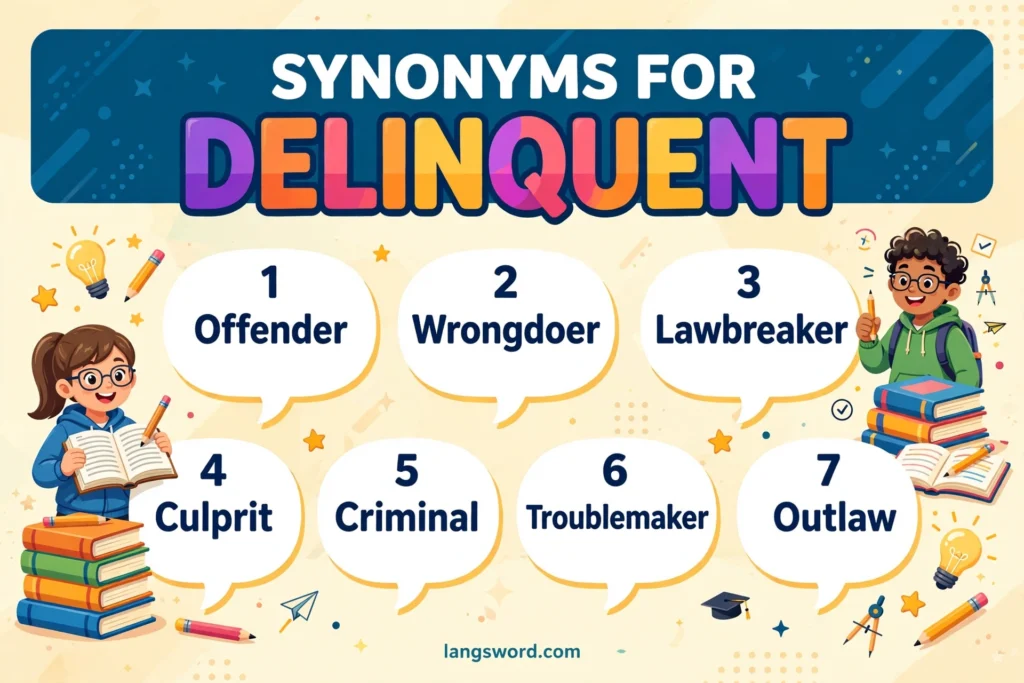

Imagine a young boy who often breaks school rules. He misses class, fights with friends, and does not listen to his teachers. People may call him a delinquent. The word delinquent means a person, often young, who breaks rules or the law. It can also mean a duty not done or a payment that is late.
We hear this word in news, court talks, and bank letters. Learning synonyms for delinquent helps you pick the right word for each case. A strong word fits a serious crime, and a soft word fits a small mistake.
In this article, you will learn the meaning of delinquent, 30 synonyms with meanings and examples, its history, pronunciation, word groups, and more.
Meaning of Delinquent
Definition
Delinquent (Noun/Adjective): As a noun, a person, often young, who breaks rules or the law. As an adjective, failing to do a duty, or late and overdue, as with a payment.
Examples
- The court gave the young delinquent a second chance.
- His rent is now delinquent by two months.
Connotative Meaning
- Positive tone: It almost never sounds positive. At best, it can sound like a call for help and a fresh start for a young person.
- Negative tone: It sounds harsh and judging. It paints a person as bad, careless, or a risk to others.
- Neutral tone: In bank and law papers, it is a plain fact word for a late payment or a missed duty.
(Connotation: the feelings and ideas a word brings to mind, apart from its plain meaning.)
Etymology
- Old English (450–1100): The word did not exist in Old English. English had no form of this word in that period.
- Middle English (1100–1500): The word still did not exist in Middle English. It only reached English at the very end of this period and just after, in the late 1400s and 1500s.
- Modern English (1500–Present): The word came from French délinquant, which came from Latin delinquere, meaning to fail or to leave undone. That Latin word joins de- with linquere, meaning to leave. In time, English also gained the money sense of a late or unpaid bill.
Pronunciation (IPA)
- IPA: /dɪˈlɪŋkwənt/
- Syllables: de · lin · quent (3 syllables)
Affixation Pattern of Delinquent
- Root: linqu (from Latin linquere, meaning to leave)
- Prefix: de- (away or down; here it shows a failure or a falling short)
- Suffix: -ent (an ending that forms adjectives and nouns for a person who does an act)
- Word formations:
- delinquency (Noun)
- delinquently (Adverb)
- delinquents (Noun, plural)
- juvenile delinquency (Noun Phrase)
- juvenile delinquent (Noun Phrase)
- delinquent account (Noun Phrase)
30 Synonyms of Delinquent With Meaning & Examples
1. Offender (Noun)
Meaning: A person who breaks a law or a rule.
Examples:
- The police caught the offender near the shop.
- A first offender may get a light warning.
2. Wrongdoer (Noun)
Meaning: A person who does bad or wrong acts.
Examples:
- The wrongdoer said sorry for his acts.
- Every wrongdoer must face the result of his deeds.
3. Lawbreaker (Noun)
Meaning: A person who breaks the law.
Examples:
- A lawbreaker cannot hide from the police for long.
- The town wants to stop each lawbreaker with fair laws.
4. Culprit (Noun)
Meaning: The person who did a wrong act or caused a problem.
Examples:
- The culprit left his shoe print in the mud.
- No one knew the culprit behind the broken gate.
5. Criminal (Noun)
Meaning: A person who does a serious crime.
Examples:
- The criminal ran from the bank with a bag of cash.
- A hard criminal spent ten years in jail.
6. Troublemaker (Noun)
Meaning: A person who often causes fights or problems.
Examples:
- The teacher sent the troublemaker out of class.
- One troublemaker can spoil a calm street.
7. Miscreant (Noun)
Meaning: A bad person who does evil or harmful acts; a formal, old word.
Examples:
- The miscreant stole food from the old man’s shop.
- Guards drove the miscreant out of the town.
8. Outlaw (Noun)
Meaning: A person who breaks the law and runs from the police, often in old tales.
Examples:
- The outlaw hid in the hills for many days.
- Old stories tell of an outlaw who robbed rich men.
9. Hooligan (Noun)
Meaning: A young person who acts in a loud, rough, and harmful way in public.
Examples:
- A hooligan broke the bus stop glass at night.
- The hooligan shouted at fans after the match.
10. Hoodlum (Noun)
Meaning: A young criminal who uses threats or force.
Examples:
- A hoodlum tried to scare the shop owner.
- The hoodlum joined a street gang at age fifteen.
11. Ruffian (Noun)
Meaning: A rough, violent person who likes to fight.
Examples:
- The ruffian pushed the old man in the market.
- No one in the village trusted the ruffian.
12. Vandal (Noun)
Meaning: A person who breaks or spoils public or private things on purpose.
Examples:
- A vandal painted the school wall at night.
- The vandal smashed the park bench for fun.
13. Rebel (Noun)
Meaning: A person who fights against rules or those in charge.
Examples:
- The young rebel refused to follow the school dress code.
- A rebel in class often tests the teacher’s patience.
14. Rule-Breaker (Noun)
Meaning: A person who does not follow the rules of a place or group.
Examples:
- The rule-breaker lost his place on the team.
- Every rule-breaker in the dorm got a warning note.
15. Transgressor (Noun)
Meaning: A person who breaks a law, a rule, or a moral limit; a formal word.
Examples:
- The court punished the transgressor for his act.
- A transgressor of the park rules must pay a fine.
16. Violator (Noun)
Meaning: A person who breaks a law, a rule, or a promise.
Examples:
- The city fined each violator of the traffic law.
- A violator of the peace treaty caused new talks.
17. Evildoer (Noun)
Meaning: A person who does bad and harmful deeds.
Examples:
- The tale says an evildoer never finds true peace.
- People in the town feared the evildoer at the old fort.
18. Felon (Noun)
Meaning: A person who has done a very serious crime, called a felony.
Examples:
- The felon lost his right to vote.
- A felon may find it hard to get a job.
19. Convict (Noun)
Meaning: A person found guilty of a crime and sent to prison.
Examples:
- The convict worked in the prison garden each day.
- An old convict told the boys to stay away from crime.
20. Rascal (Noun)
Meaning: A playful person, often a child, who does small bad tricks; a light word.
Examples:
- The little rascal hid his sister’s shoes.
- Grandpa smiled and called the boy a rascal.
21. Scoundrel (Noun)
Meaning: A dishonest and selfish man who treats others badly; an old word.
Examples:
- The scoundrel took the poor man’s land by a trick.
- No one in the town would lend cash to the scoundrel.
22. Rogue (Noun)
Meaning: A man who breaks rules and cannot be trusted, sometimes said in a playful way.
Examples:
- The rogue sold fake gold rings at the fair.
- He is a rogue, but his jokes make people laugh.
23. Truant (Noun)
Meaning: A student who stays away from school without a good reason.
Examples:
- The truant spent the school day at the river.
- A truant must meet the head teacher with his parents.
24. Juvenile Offender (Noun)
Meaning: A young person, under the legal age, who breaks the law.
Examples:
- The juvenile offender went to a special youth court.
- A kind officer helped the juvenile offender change his ways.
25. Overdue (Adjective)
Meaning: Late; not paid or not done by the agreed time, as with a bill or a book.
Examples:
- The overdue bill grew with extra fees.
- Her library book is three weeks overdue.
26. Unpaid (Adjective)
Meaning: Not paid yet; money still owed for a bill or a loan.
Examples:
- The unpaid rent caused stress for the family.
- He cleared his unpaid loan in six months.
27. Late (Adjective)
Meaning: After the set time; behind the agreed date for a payment or a task.
Examples:
- A late fee was added to his card bill.
- Late work can hurt a student’s marks.
28. Past Due (Adjective)
Meaning: Past the date when a payment should have been made; overdue.
Examples:
- The bank sent a past due notice for the loan.
- His account is past due by thirty days.
29. Negligent (Adjective)
Meaning: Failing to take proper care or to do a duty as one should.
Examples:
- A negligent guard left the gate open all night.
- The firm was negligent in its safety checks.
30. Remiss (Adjective)
Meaning: Careless and slow in doing a duty; failing to act when one should.
Examples:
- I was remiss in not writing to thank her.
- A remiss worker missed the key step in the task.
Prototype Meaning
When people hear the word delinquent, they first picture a young person in trouble with the law. He may stand before a judge, with his head down and his hands still. He has broken rules again and again, and now he must face the result. This picture of a young rule breaker who fails his duty is the heart of the word.
Prototype Categorization
- Serious law breakers: Criminal, Lawbreaker, Felon, Convict, Outlaw, Miscreant — use these for grave crimes, court reports, and news about people who run from the law.
- Everyday wrongdoers: Offender, Wrongdoer, Culprit, Transgressor, Violator, Evildoer — use these for a person blamed for a wrong act, from small faults to formal law cases.
- Young and unruly people: Juvenile Offender, Troublemaker, Hooligan, Hoodlum, Ruffian, Vandal, Truant — use these for youth who cause trouble in school, streets, or public places.
- Rebels and rogues: Rebel, Rule-Breaker, Rascal, Scoundrel, Rogue — use these for people who defy rules, from a playful child to a dishonest man in old tales.
- Late or unpaid sense: Overdue, Unpaid, Late, Past Due, Negligent, Remiss — use these for bills, loans, duties, and tasks that are late or not done with care.
These groups help writers pick the best word for each case. A court report needs a serious word like felon. A school story needs a youth word like truant. A bank letter needs a money word like past due. The right group makes the meaning sharp and clear.
Antonyms of Delinquent
Law-Abiding Citizen (Noun)
A person who obeys the law and lives by the rules of society.
Good Citizen (Noun)
A person who does his duty and helps his community.
Role Model (Noun)
A person whose good acts set an example for the young.
Responsible (Adjective)
Careful and trusty; a person who does his duty on time.
Punctual (Adjective)
Always on time; never late with tasks or payments.
On Time (Adjective)
Done or paid at the agreed time, not late at all.
Paid Up (Adjective)
Having paid all that one owes; with no debt left.
Short Questions and Answers
What does delinquent mean?
Delinquent means a person, often young, who breaks rules or the law. As an adjective, it means failing to do a duty, or late and unpaid, as with a bill or a loan.
When should delinquent be used?
Use delinquent in news, court, and school talks about young rule breakers. Use it in bank and office writing for late payments and missed duties. It is a formal word, so it fits serious topics best.
Is delinquent positive or negative?
It is negative. For a person, it judges him as a rule breaker or a law breaker. For money, it marks a late and unpaid bill. It never praises anyone.
How is it different from similar words?
A delinquent is often young and may still change his ways. A criminal or felon has done a serious crime. A culprit is just the person to blame for one act, and words like overdue only speak of time and money.
Conclusion
Delinquent is a strong word with two clear uses. It can name a person who breaks rules or the law. It can also mark a duty not done or a bill not paid on time. The 30 synonyms in this guide give you fresh choices for each use. Words like offender and lawbreaker fit news and court reports.
Words like overdue and unpaid fit money and bills. Learning these words improves your vocabulary and helps you write with care. You can show how serious an act is and avoid using the same word again and again. Keep practicing each day. Learn one new word, say it aloud, and use it in a sentence. Step by step, your English will grow clear and strong.