
Flank means the side of something or someone, especially when it is beside a person, group, or object. Imagine two friends walking beside you on a busy street. They flank you, with one person on each side.
The word is also common in sports, history, business, and everyday writing. For example, a team may attack from the flank, or trees may flank a road. Learning synonyms for flank helps English learners express the same idea in different ways.
It also helps content writers avoid repeating one word too often. However, not every synonym fits every situation. This article explains the meaning of flank and gives 30 useful alternatives with simple examples.
It also covers connotation, etymology, pronunciation, word formation, semantic categories, antonyms, grammar, and practical usage.
Meaning of Flank
Definition
Flank (noun/verb):
As a noun, flank means the side of a person, animal, object, army, or place. As a verb, it means to be or place something at the side of another thing.
Examples
- The soldiers moved around the flank of the enemy.
- Tall trees flank the narrow road.
Connotative Meaning
Connotation (the feeling or idea a word suggests beyond its basic meaning):
- Positive tone: Flank can suggest protection, support, or strong positioning.
- Negative tone: In military contexts, it can suggest danger, attack, or vulnerability.
- Neutral tone: It can simply mean the side of a person, animal, object, or place.
Etymology
The word flank entered English through French and has Germanic roots connected with the idea of the side of the body.
- Old English (450–1100): The modern form was not a common Old English word. The concept was expressed with other words for the side or body.
- Middle English (1100–1500): Flank and related forms such as flanke entered Middle English from Old French flanc, meaning “side.”
- Modern English (1500–Present): Flank developed its modern uses for the side of the body, the side of an army or formation, and later the verb meaning “to stand beside” or “to surround from the side.”
Pronunciation (IPA)
- IPA: /flæŋk/
- Syllables: flank (1 syllable)
flank (/flæŋk/)
Affixation Pattern of Flank
- Root: flank
- Prefix: None
- Suffix: None
Word formations:
- flank — noun/verb
- flanked — verb, past tense/past participle
- flanking — verb, present participle/gerund
- flanker — noun, a person or thing that flanks
- flankers — plural noun
- flankingly — adverb, rare
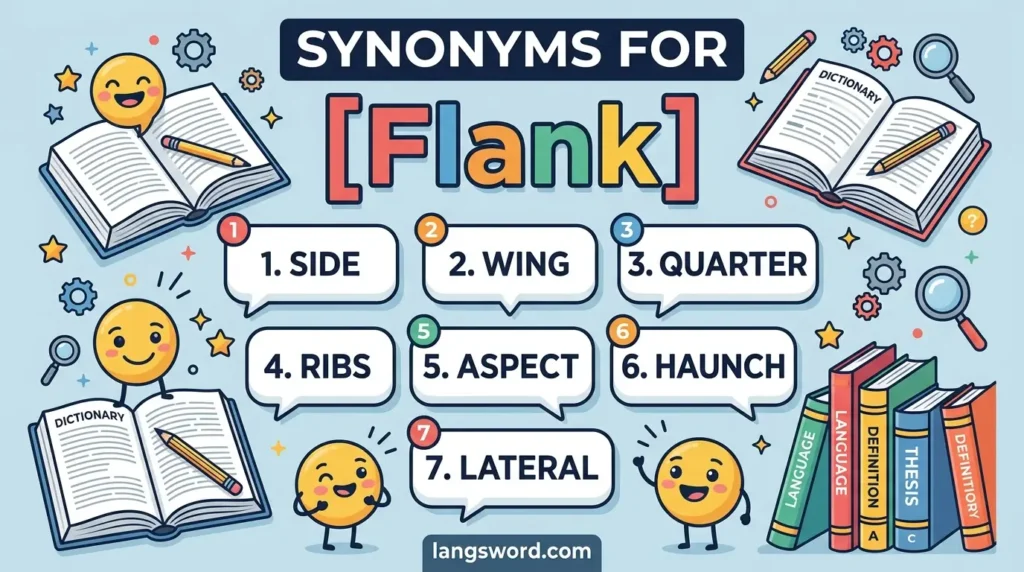
30 Synonyms of Flank With Meaning & Examples
1. Side (Noun)
Meaning: The area to the left or right of something.
Examples:
- He stood at my side.
- The house has a garden on its side.
2. Edge (Noun)
Meaning: The outer or farthest part of something.
Examples:
- They walked along the edge of the field.
- A fence runs along the edge of the property.
3. Border (Noun)
Meaning: The line or area where one place or thing meets another.
Examples:
- Trees grow along the border of the road.
- They camped near the border of the forest.
4. Margin (Noun)
Meaning: The outer area or limit of something.
Examples:
- Flowers grew along the margin of the pond.
- Notes were written in the margin of the page.
5. Periphery (Noun)
Meaning: The outer area of a place or group.
Examples:
- Small villages lie on the periphery of the city.
- The issue remained at the periphery of the discussion.
6. Lateral Side (Noun)
Meaning: A side area rather than the central area.
Examples:
- The injury affected the lateral side of his leg.
- The building has windows on its lateral side.
7. Wing (Noun)
Meaning: A side part of a group, formation, or organization.
Examples:
- The troops protected the left wing.
- She works in the political wing of the organization.
8. Verge (Noun)
Meaning: The edge of a road, area, or place.
Examples:
- We stopped at the verge of the road.
- Wild flowers grew on the verge.
9. Brink (Noun)
Meaning: The edge of a situation or place, often with a sense of danger.
Examples:
- The soldiers stood near the brink of the valley.
- The company was on the brink of failure.
10. Perimeter (Noun)
Meaning: The outer boundary of an area.
Examples:
- Guards watched the perimeter of the camp.
- A wall surrounds the perimeter of the property.
11. Beside (Preposition/Adverb)
Meaning: At or near the side of someone or something.
Examples:
- She sat beside her brother.
- A lamp stood beside the bed.
12. Alongside (Preposition/Adverb)
Meaning: Next to or beside something.
Examples:
- The car stopped alongside the bus.
- We walked alongside the river.
13. Next to (Preposition)
Meaning: Immediately beside someone or something.
Examples:
- He sat next to me.
- The shop is next to the bank.
14. Adjoin (Verb)
Meaning: To be next to or connected with something.
Examples:
- The kitchen adjoins the dining room.
- Their land adjoins the national park.
15. Abut (Verb)
Meaning: To touch or share a boundary with something.
Examples:
- Our garden abuts the school field.
- The property abuts a busy road.
16. Border (Verb)
Meaning: To be next to or form the edge of something.
Examples:
- Tall trees border the road.
- The farm borders a large lake.
17. Line (Verb)
Meaning: To form a row along the side of something.
Examples:
- Trees line the street.
- Shops line the main road.
18. Surround (Verb)
Meaning: To be or place something on all sides of another thing.
Examples:
- Mountains surround the village.
- Guards surrounded the building.
19. Enclose (Verb)
Meaning: To surround an area or object.
Examples:
- A wall encloses the garden.
- A fence encloses the playground.
20. Hem In (Phrasal Verb)
Meaning: To surround someone or something so movement is limited.
Examples:
- The mountains hemmed in the village.
- The crowd hemmed in the players.
21. Beset (Verb)
Meaning: To surround or trouble someone or something from many sides.
Examples:
- The town was beset by problems.
- The soldiers were beset by attackers.
22. Accompany (Verb)
Meaning: To go with someone or something.
Examples:
- Two guards accompanied the leader.
- Her friends accompanied her home.
23. Attend (Verb)
Meaning: To stay with or look after someone.
Examples:
- Two nurses attended the patient.
- An assistant attended the speaker.
24. Support (Verb)
Meaning: To help, strengthen, or protect someone or something.
Examples:
- The smaller team supported the main group.
- Strong evidence supports the argument.
25. Guard (Verb)
Meaning: To protect someone or something from danger.
Examples:
- Soldiers guarded the entrance.
- Trees guard the road from strong winds.
26. Protect (Verb)
Meaning: To keep someone or something safe from harm.
Examples:
- The walls protect the city.
- Guards protected the building.
27. Cover (Verb)
Meaning: To protect or watch an area or person.
Examples:
- Two soldiers covered the team’s left side.
- The officer covered the entrance.
28. Surrounding (Adjective)
Meaning: Located around or beside something.
Examples:
- The surrounding hills were green.
- We explored the surrounding area.
29. Adjacent (Adjective)
Meaning: Next to or very close to something.
Examples:
- The hotel has an adjacent parking lot.
- We entered through the adjacent door.
30. Flanking (Adjective/Participle)
Meaning: Positioned at the side of someone or something.
Examples:
- Two guards stood flanking the entrance.
- Trees were flanking the long driveway.
Prototype Meaning
The most typical meaning of flank is the side of a person, animal, object, or group. When people hear flank, they often imagine something positioned on the left or right side rather than in the center. In military or sports contexts, the word can also suggest movement or action from the side.
Prototype Categorization
The 30 alternatives can be grouped by their main meaning and use:
- Side and position: side, lateral side, beside, alongside, next to, adjacent. These work best when you mean simple physical position.
- Outer area: edge, border, margin, periphery, verge, perimeter, brink. These describe an outside area or boundary.
- Surrounding: surround, enclose, hem in, beset. These are useful when something is around another thing or limits its movement.
- Being next to something: adjoin, abut, border, line. These are useful for buildings, land, roads, and physical spaces.
- Protection and support: support, guard, protect, cover. These fit military, security, and strategic contexts.
- Accompanying or attending: accompany, attend. These focus more on being with someone than on physical position.
- Group or formation: wing, flanking, flanking. These are useful in military, sports, organizational, or strategic writing.
This grouping helps writers choose a synonym based on meaning and context, rather than simply replacing flank with any word that sounds similar.
Antonyms of Flank
Center (Noun)
The middle part of something.
Middle (Noun)
The point or area equally distant from the sides.
Interior (Noun/Adjective)
The inside part of something.
Core (Noun)
The central or most important part of something.
Central (Adjective)
Located in the middle rather than at the side.
Face (Verb)
To turn toward or confront something directly rather than approach it from the side.
Short Questions and Answers
What does flank mean?
Flank means the side of a person, animal, object, place, or group. As a verb, it means to be or place something at the side of another thing.
When should flank be used?
Use flank when you want to describe something positioned at the side of another person, object, place, or group. It is common in military, sports, geography, anatomy, and formal writing.
Is flank positive or negative?
Flank is usually neutral. Its tone depends on context. In a military context, it may suggest attack or danger, while in another context it may simply describe position or support.
How is it different from similar words?
Side is the broadest and simplest alternative. Flank is more specific and often has a strategic or positional meaning. Beside and alongside focus on position, while surround means being on several or all sides.
Conclusion
Learning flank and its synonyms can make your English more flexible and precise. The word can describe a physical side, a strategic position, or the act of placing something beside another thing.
Its alternatives include simple words such as side and beside, as well as more specific terms such as periphery, perimeter, surround, and adjoin. Knowing the difference between these words helps you choose the right expression for each situation.
It also reduces repetition in essays, articles, reports, and everyday speech. For English learners, regular synonym practice can improve vocabulary, strengthen writing and speaking, and build confidence.
Try learning a few new words each day and use them in your own sentences. Over time, this simple habit can make your English clearer, richer, and more natural.