
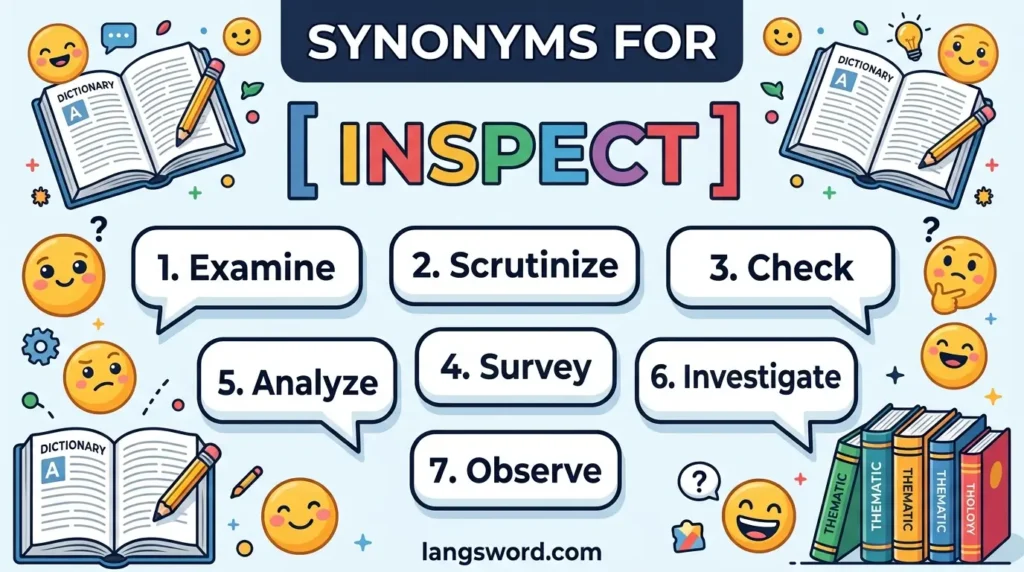

Inspect means to look at something carefully to check its condition, quality, or details. Imagine a teacher checking a student’s work before giving a grade. The teacher may inspect each answer to find mistakes.
We use inspect often in school, work, safety checks, travel, and daily life. Learning synonyms for inspect helps English learners speak and write with more variety. It also helps content writers avoid using the same word again and again.
However, not every synonym has the same meaning or tone. In this guide, we will explain the meaning of inspect, its examples, connotation, etymology, pronunciation, affixation pattern, and 30 useful synonyms.
We will also explore prototype meaning, semantic categories, antonyms, and common questions. These details can help you choose the right word for each situation.
Meaning of Inspect
Definition
Inspect (Verb):
To look at something carefully to check its condition, quality, details, or safety.
Examples
- The mechanic inspected the car before the trip.
- The officer inspected the building for safety problems.
Connotative Meaning
Connotation means the feeling or idea that a word suggests beyond its basic meaning.
- Positive tone: Inspect can suggest care, attention, and responsibility.
- Negative tone: In some contexts, it may suggest strict checking or suspicion.
- Neutral tone: It often simply means looking at something carefully to check it.
Etymology
The word inspect comes from the Latin inspicere, meaning “to look into” or “to look at.” It is formed from in- (“into”) and specere (“to look at”). The word entered English through French and Latin influence.
- Old English (450–1100): The modern word inspect was not commonly used in Old English. Native English used other expressions for looking at or examining something.
- Middle English (1100–1500): Latin-based vocabulary became more common in English through French and scholarly influence. The forms behind inspect developed from Latin inspicere.
- Modern English (1500–Present): Inspect became an established English verb meaning to examine something carefully, especially to check its condition, quality, or safety.
Pronunciation (IPA)
- IPA: /ɪnˈspekt/
- Syllables: in-spect
Affixation Pattern of Inspect
- Root: spect — related to looking or seeing
- Prefix: in- — meaning “into” or “within”
- Suffix: None in the basic word inspect
Word Formations
- Inspect — verb
- Inspection — noun
- Inspector — noun
- Inspected — past-tense verb/adjective
- Inspecting — present participle/gerund
- Inspectable — adjective
- Inspectorate — noun, meaning an official body or department that carries out inspections
30 Synonyms of Inspect With Meaning & Examples
1. Examine (Verb)
Meaning: To look at something carefully to understand or check it.
Examples:
- The doctor examined the patient carefully.
- Please examine the document before signing it.
2. Check (Verb)
Meaning: To look at something to make sure it is correct, safe, or in good condition.
Examples:
- Check the door before you leave.
- The technician checked the machine for problems.
3. Review (Verb)
Meaning: To look at something again carefully, often to judge or improve it.
Examples:
- The manager reviewed the report.
- I reviewed my notes before the test.
4. Analyze (Verb)
Meaning: To study something closely by looking at its parts and details.
Examples:
- Scientists analyzed the test results.
- The team analyzed the data carefully.
5. Scrutinize (Verb)
Meaning: To examine something very closely and carefully.
Examples:
- The lawyer scrutinized the contract.
- The committee scrutinized every application.
6. Observe (Verb)
Meaning: To watch or look at something carefully.
Examples:
- The scientist observed the animals.
- She observed the machine while it was running.
7. Study (Verb)
Meaning: To look at something carefully to learn about it.
Examples:
- He studied the map before driving.
- The student studied the painting closely.
8. Survey (Verb)
Meaning: To look carefully over an area, group, or situation.
Examples:
- The engineer surveyed the site.
- We surveyed the room before choosing a table.
9. Assess (Verb)
Meaning: To examine something and judge its quality, value, or condition.
Examples:
- The teacher assessed the students’ work.
- The doctor assessed his condition.
10. Evaluate (Verb)
Meaning: To examine something and decide how good, useful, or successful it is.
Examples:
- The company evaluated the new product.
- We need to evaluate the results.
11. Investigate (Verb)
Meaning: To examine something carefully to discover facts or find a cause.
Examples:
- The police investigated the incident.
- The team investigated the source of the problem.
12. Explore (Verb)
Meaning: To look closely at something to learn more about it.
Examples:
- The researchers explored the new method.
- We explored the causes of the problem.
13. Consider (Verb)
Meaning: To think carefully about something before making a decision.
Examples:
- She considered every option.
- The manager considered the proposal carefully.
14. Peruse (Verb)
Meaning: To read or look through something carefully.
Examples:
- He perused the menu before ordering.
- She perused the report during lunch.
15. Look Over (Phrasal Verb)
Meaning: To examine something quickly or carefully.
Examples:
- Can you look over my essay?
- The mechanic looked over the car.
16. Go Over (Phrasal Verb)
Meaning: To examine or review something carefully.
Examples:
- Let’s go over the instructions.
- The teacher went over the answers.
17. Check Out (Phrasal Verb)
Meaning: To examine or look at something to learn more about it.
Examples:
- The technician checked out the computer.
- Let’s check out the new equipment.
18. Verify (Verb)
Meaning: To check that something is true, correct, or accurate.
Examples:
- Please verify your address.
- The officer verified the information.
19. Validate (Verb)
Meaning: To check that something is acceptable, accurate, or valid.
Examples:
- The system validates each entry.
- Researchers validated the results.
20. Test (Verb)
Meaning: To examine something by using it or trying it to see if it works.
Examples:
- The engineer tested the machine.
- We tested the alarm before opening the building.
21. Audit (Verb)
Meaning: To officially examine financial records or business activities.
Examples:
- Accountants audited the company’s records.
- The agency audited the department’s finances.
22. Monitor (Verb)
Meaning: To watch something regularly to check its condition or progress.
Examples:
- Nurses monitored the patient’s condition.
- The system monitors air quality.
23. Watch (Verb)
Meaning: To look at something carefully for a period of time.
Examples:
- Watch the machine for any unusual noise.
- The guard watched the entrance.
24. View (Verb)
Meaning: To look at something, especially for a particular purpose.
Examples:
- The doctor viewed the X-ray.
- We viewed the property before making an offer.
25. Scan (Verb)
Meaning: To look over something quickly to find important information or problems.
Examples:
- She scanned the report for errors.
- I scanned the document before sending it.
26. Inspect Closely (Verb Phrase)
Meaning: To examine something with special attention to small details.
Examples:
- The jeweler inspected the stone closely.
- The officer inspected the vehicle closely.
27. Probe (Verb)
Meaning: To investigate something deeply to discover hidden facts or causes.
Examples:
- The journalist probed the issue.
- Scientists probed the cause of the failure.
28. Research (Verb)
Meaning: To study a subject carefully to discover information.
Examples:
- She researched the topic before writing.
- The team researched possible solutions.
29. Diagnose (Verb)
Meaning: To examine a problem or condition to identify its cause.
Examples:
- The mechanic diagnosed the engine problem.
- The technician diagnosed the computer fault.
30. Examine Closely (Verb Phrase)
Meaning: To study something with great care and attention.
Examples:
- The scientist examined the sample closely.
- The editor examined the article closely before publication.
Prototype Meaning
The most typical meaning of inspect is to look at something carefully because you want to check its condition, quality, safety, or accuracy. When people hear inspect, they often imagine a person examining an object, document, building, vehicle, or work product for problems. The word usually suggests more careful attention than the simple verb look.
Prototype Categorization
The 30 synonyms can be grouped by their main meaning and use. This helps writers choose a word that matches the exact situation instead of treating every synonym as identical.
- General careful examination: examine, check, study, observe, look over, go over, and examine closely are useful when someone simply needs to look at something carefully.
- Judgment and quality: assess, evaluate, and consider focus on judging quality, value, condition, or importance.
- Deep investigation: scrutinize, investigate, probe, and research suggest a deeper search for facts, causes, or hidden details.
- Accuracy and correctness: verify and validate are used when the main goal is to confirm that information or results are correct.
- Testing and performance: test, diagnose, and monitor are useful when checking how something works or changes over time.
- Official examination: audit is strongly connected with formal financial or organizational checks.
- Quick examination: scan, check out, and sometimes view can suggest a faster or less detailed look.
- Visual attention: watch, observe, and view focus more on seeing or monitoring than on finding faults.
This categorization helps writers select the best synonym based on purpose, depth, formality, and context.
Antonyms of Inspect
1. Ignore (Verb)
Meaning: To pay no attention to something.
2. Neglect (Verb)
Meaning: To fail to give something the care or attention it needs.
3. Overlook (Verb)
Meaning: To fail to notice something.
4. Disregard (Verb)
Meaning: To deliberately pay no attention to something.
5. Miss (Verb)
Meaning: To fail to notice or see something.
6. Avoid (Verb)
Meaning: To stay away from something instead of examining or dealing with it.
7. Guess (Verb)
Meaning: To form an idea without checking the facts carefully.
8. Skim (Verb)
Meaning: To read or look at something very quickly without careful examination.
Short Questions and Answers
What does inspect mean?
Inspect means to look at something carefully to check its condition, quality, safety, or details.
When should inspect be used?
Use inspect when someone makes a careful or purposeful examination. It is common for buildings, machines, vehicles, documents, products, and safety checks.
Is inspect positive or negative?
Inspect is usually neutral. Its tone depends on the situation. It can suggest care and responsibility, but it may also suggest strict checking in some contexts.
How is it different from similar words?
Inspect usually means careful checking. Scan often means a quick look, while scrutinize suggests very close examination. Evaluate focuses on judging value or quality, and verify focuses on confirming accuracy.
Conclusion
Learning inspect and its synonyms can make your English more precise and flexible. Instead of using inspect in every situation, you can choose words such as examine, check, scrutinize, assess, verify, or audit based on the meaning you need.
These differences are useful in both speaking and writing. A good vocabulary also helps you avoid repetition and express ideas more clearly. For English learners, studying synonyms gives a better understanding of word choice, tone, and context.
For content writers, it can make articles smoother and more engaging. Try to learn a few synonyms each day and use them in your own sentences. With regular practice, you can build stronger vocabulary, improve your writing and speaking, and feel more confident when using English.