
Parliament is a group of elected or appointed people who meet to discuss, debate, and make laws for a country or region. Imagine a country facing a new problem, such as rising costs or a need for better schools.
Members of parliament meet to discuss possible solutions and may create new laws. The word is common in news reports, government documents, history books, and political discussions.
Learning synonyms for parliament helps English learners understand different forms of government and express ideas with greater accuracy. It also helps content writers avoid repeating the same word.
In this article, we explore the meaning of parliament, its synonyms, examples, grammar, history, pronunciation, word formation, and semantic categories. These alternatives can help writers choose the right word for a formal, general, historical, or country-specific context.
Meaning of Parliament
Definition
Parliament (Noun):
A group or institution of representatives that meets to discuss public issues and make or change laws.
Examples
- The parliament passed a new education law.
- Members of parliament debated the proposed budget.
Connotative Meaning
Positive tone: It can suggest representation, debate, public service, and democratic decision-making.
Negative tone: In some contexts, it may suggest political conflict, delay, or disagreement.
Neutral tone: It can simply mean the formal legislative body of a country.
(Connotation: the feeling or idea that a word suggests beyond its basic meaning.)
Etymology
Old English (450–1100)
Parliament was not an Old English word. Its history begins later, so there is no established Old English form of parliament. The modern word ultimately developed from French and medieval Latin sources.
Middle English (1100–1500)
Around 1300, Middle English used parlement for a consultation, formal conference, or assembly. It came from Old French parlement, meaning a speech, talk, or discussion, from parler, meaning “to speak.” Around 1400, its spelling changed partly under the influence of Medieval Latin parliamentum.
By the middle of the 14th century, parliament developed the more specific sense of a representative assembly in England and Ireland.
Modern English (1500–Present)
In Modern English, parliament became a general term for a country’s legislative institution. It is also used for particular national bodies, such as the British Parliament or the Parliament of another country.
Pronunciation (IPA)
- IPA: /ˈpɑːrləmənt/
- Syllables: par-li-a-ment
Affixation Pattern of Parliament
- Root: parl- — related to speaking or talking, from Old French parler, “to speak.”
- Prefix: None in modern English.
- Suffix: -ment — forms nouns and is associated with an action, result, or institution.
- Word formations:
- Parliament — noun: a legislative body.
- Parliamentary — adjective: relating to parliament.
- Parliamentarian — noun: a member of parliament or a person skilled in parliamentary procedure.
- Parliamentarianism — noun: the principles or practice of parliamentary government.
- Unparliamentary — adjective: not suitable under parliamentary rules or accepted parliamentary conduct.
- Parliamentarily — adverb: in a parliamentary manner.
The adjective parliamentary dates from the early 17th century, while parliamentarian has been used since the 17th century.
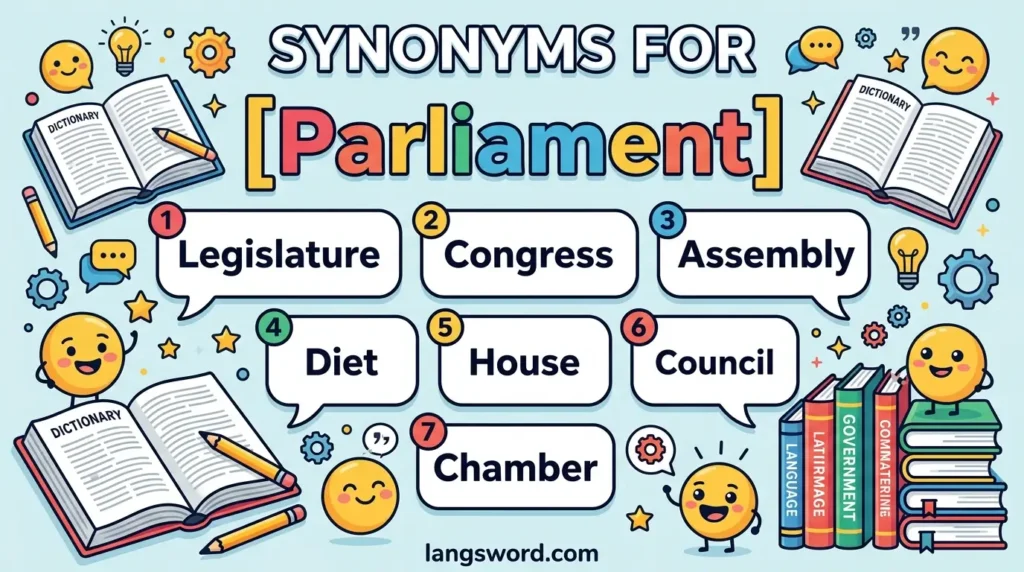
30 Synonyms of Parliament With Meaning & Examples
1. Legislature (Noun)
Meaning: An official body that makes laws.
Examples:
- The legislature approved the new bill.
- The state legislature debated the proposal.
2. Legislative Body (Noun)
Meaning: A group officially responsible for making laws.
Examples:
- The legislative body discussed tax changes.
- The country’s legislative body passed the measure.
3. Assembly (Noun)
Meaning: A group of people gathered to discuss or decide public matters.
Examples:
- The national assembly approved the bill.
- Members of the assembly met to discuss reforms.
4. Lawmaking Body (Noun)
Meaning: A group that creates and changes laws.
Examples:
- The lawmaking body considered several proposals.
- The lawmaking body voted on the new rules.
5. Legislative Assembly (Noun)
Meaning: A formal assembly with the power to make laws.
Examples:
- The legislative assembly opened its new session.
- The bill was presented to the legislative assembly.
6. Congress (Noun)
Meaning: A national legislative body, especially in some countries.
Examples:
- Congress debated the proposed law.
- The proposal was sent to Congress.
7. Chamber (Noun)
Meaning: One section or house of a legislative institution.
Examples:
- The upper chamber approved the bill.
- The chamber held a long debate.
8. House (Noun)
Meaning: A legislative chamber or branch of a parliament.
Examples:
- The House voted on the proposal.
- The bill passed through the lower House.
9. Senate (Noun)
Meaning: An upper legislative chamber in some political systems.
Examples:
- The Senate discussed the budget.
- The bill was approved by the Senate.
10. Council (Noun)
Meaning: An organized group that meets to discuss and decide public matters.
Examples:
- The council discussed the new policy.
- Members of the council voted on the proposal.
11. National Assembly (Noun)
Meaning: A country’s formal legislative assembly.
Examples:
- The National Assembly debated the bill.
- The proposal was introduced in the National Assembly.
12. Diet (Noun)
Meaning: A legislative assembly in certain countries or historical periods.
Examples:
- The Japanese Diet passed the measure.
- The Diet debated changes to the law.
13. Duma (Noun)
Meaning: A legislative assembly, especially associated with Russia.
Examples:
- The Duma considered the proposed legislation.
- Members of the Duma debated the issue.
14. Knesset (Noun)
Meaning: The parliament of Israel.
Examples:
- The Knesset debated the proposed bill.
- The measure was introduced in the Knesset.
15. Majlis (Noun)
Meaning: An assembly or council, especially in some Middle Eastern and South Asian political systems.
Examples:
- The majlis met to discuss public affairs.
- Representatives gathered in the majlis.
16. Shura (Noun)
Meaning: A consultative council or assembly in some Islamic political contexts.
Examples:
- The shura discussed the proposed policy.
- Members of the shura offered their views.
17. Convocation (Noun)
Meaning: A formal gathering of people for a specific purpose.
Examples:
- The representatives attended the convocation.
- The convocation discussed several public matters.
18. Conference (Noun)
Meaning: A formal meeting for discussion.
Examples:
- The leaders held a conference on national policy.
- The conference focused on economic reform.
19. Forum (Noun)
Meaning: A place or group for open discussion of important issues.
Examples:
- The forum discussed changes to public services.
- The meeting provided a forum for debate.
20. Convention (Noun)
Meaning: A formal meeting or assembly, often created for a particular purpose.
Examples:
- The convention discussed constitutional changes.
- Delegates attended the national convention.
21. Council of Representatives (Noun)
Meaning: A representative body that discusses and makes public decisions.
Examples:
- The council of representatives approved the proposal.
- Representatives met to review the new law.
22. Representative Assembly (Noun)
Meaning: An assembly made up of people who represent others.
Examples:
- The representative assembly debated the reform.
- Members of the representative assembly voted on the bill.
23. Governing Assembly (Noun)
Meaning: An assembly involved in governing and public decision-making.
Examples:
- The governing assembly considered the proposal.
- The governing assembly met for its annual session.
24. Lawmaking Assembly (Noun)
Meaning: An assembly whose main role includes creating laws.
Examples:
- The lawmaking assembly passed the new act.
- The lawmaking assembly began its debate.
25. Deliberative Assembly (Noun)
Meaning: A formal group that discusses issues before making decisions.
Examples:
- The deliberative assembly considered several options.
- Members spoke during the deliberative assembly.
26. Representative Body (Noun)
Meaning: An organization whose members represent a larger population.
Examples:
- The representative body reviewed the proposal.
- The representative body met to discuss public concerns.
27. Public Assembly (Noun)
Meaning: A formal gathering that discusses matters of public interest.
Examples:
- The public assembly discussed the proposed changes.
- Representatives attended the public assembly.
28. National Legislature (Noun)
Meaning: The main lawmaking institution of a country.
Examples:
- The national legislature passed the new law.
- The national legislature began its session.
29. Legislative Council (Noun)
Meaning: A formal council with legislative or lawmaking functions.
Examples:
- The legislative council debated the proposal.
- Members of the legislative council voted on the bill.
30. Legislative Chamber (Noun)
Meaning: A house or section of a legislative institution.
Examples:
- The legislative chamber began its session.
- The bill was discussed in the legislative chamber.
Usage note: These 30 alternatives are not exact substitutes in every sentence. Some are broad terms, such as assembly and representative body, while others are country-specific names, such as Knesset and Duma. Use the word that matches the political system and context.
Prototype Meaning
The most typical meaning of parliament is a formal national body made up of representatives who debate public issues and make laws. When people hear parliament, they often imagine elected members sitting in a chamber, discussing bills, questioning government officials, and voting on proposed laws. The exact structure and powers of a parliament vary from country to country.
Prototype Categorization
The 30 synonyms can be grouped by their main meaning and use:
- General legislative terms: legislature, legislative body, lawmaking body, legislative assembly, lawmaking assembly, and national legislature. These are useful when you want to describe the lawmaking function clearly.
- General assembly terms: assembly, representative assembly, governing assembly, deliberative assembly, public assembly, and representative body. These focus more on the group or meeting than on the word “parliament.”
- Chamber and branch terms: chamber, house, senate, and legislative chamber. These usually refer to one part of a larger legislative system rather than the whole parliament.
- Country-specific terms: Congress, Diet, Duma, Knesset, and Majlis. These should be used when they accurately describe a particular country’s or historical system.
- Discussion and meeting terms: conference, forum, convention, and convocation. These can describe formal gatherings but are broader than parliament.
- Consultative terms: council, legislative council, council of representatives, and shura. These emphasize consultation, representation, or public decision-making.
This categorization helps writers choose a word based on function, structure, country, history, and level of formality instead of replacing parliament with any random similar word.
Antonyms of Parliament
There is no single perfect antonym for parliament because it names an institution. However, these terms can describe systems that contrast with representative legislative government:
1. Dictatorship (Noun)
A system in which one ruler or a small group holds most political power.
2. Autocracy (Noun)
A system in which one person has extensive or unlimited political power.
3. Absolute Rule (Noun)
A system in which political authority is concentrated in one ruler.
4. One-Person Rule (Noun)
A system in which one individual controls government decision-making.
5. Despotism (Noun)
A system of government in which power is exercised by a ruler with very few limits.
6. Personal Rule (Noun)
A system in which government power is strongly concentrated in one person’s authority.
Short Questions and Answers
What does parliament mean?
Parliament means a formal legislative body whose members meet to debate public matters and make or change laws.
When should parliament be used?
Use parliament when referring to a country’s legislative institution, especially when discussing its debates, members, laws, or sessions.
Is parliament positive or negative?
Parliament is normally neutral. Its tone depends on the context. It may suggest representation and debate, or it may appear in criticism about political disagreement or delay.
How is it different from similar words?
Parliament usually refers to a country’s legislative institution. Legislature is a broader term for a lawmaking body. Assembly can mean many types of formal groups. Chamber usually means one part of a legislature, while Congress, Duma, Diet, and Knesset are names used for particular political systems.
Conclusion
Learning parliament and its synonyms can make your English more accurate and flexible. The word is important in news, government, history, education, and formal writing.
Knowing alternatives such as legislature, assembly, legislative body, and representative body helps you avoid repetition and choose words that fit the exact context. Country-specific terms such as Knesset, Duma, and Diet also help you write with greater precision when discussing particular political systems.
A strong vocabulary improves both writing and speaking because it lets you express the same basic idea in different ways. Practice one or two new words each day, write your own example sentences, and check how each word is used in real texts. With regular practice, your vocabulary and English confidence will grow.