
Employment means having a job or being engaged in paid work. Imagine a student who finishes college and starts looking for employment at a local company. Once hired, the student has a position, earns a salary, and becomes part of the workforce.
The word employment is common in job applications, business writing, news, education, and everyday English. Learning synonyms for employment helps English learners choose words that fit different situations.
It also helps content writers avoid repeating the same word and make their writing clearer and more natural. In this guide, we explore the meaning of employment, its synonyms, examples, grammar, history, pronunciation, word formation, and semantic groups.
You will also learn when words such as work, job, occupation, and career are useful and how their meanings differ.
Meaning of employment
Definition
Employment (noun):
Employment means the state of having a paid job or the work that a person does for an employer.
Examples
- She found employment at a software company.
- His employment with the firm began in 2024.
Connotative Meaning
Connotation (the feeling or idea that a word suggests beyond its basic meaning) can change with context.
- Positive tone: Employment can suggest stability, income, purpose, and professional growth.
- Negative tone: In some contexts, employment can suggest job insecurity, stress, or unwanted work.
- Neutral tone: Employment can simply mean having a job or being hired.
Etymology
The noun employment comes from Middle English emploien plus the suffix -ment. Its history is linked to Old French emploiier, meaning “to make use of” or “apply,” and ultimately to Latin implicare, meaning “to enfold, involve, or connect.”
The noun began with meanings related to spending or using and later developed the sense of a person’s regular work or occupation. By the 1640s, employment could refer to a person’s regular occupation or business.
- Old English (450–1100): The modern word employment was not yet established in Old English. Related ideas were expressed through native words for work, service, activity, and doing.
- Middle English (1100–1500): Employment developed from Middle English emploien with -ment. Its early sense was connected with spending, using, or applying something.
- Modern English (1500–Present): The meaning expanded to include an assignment, occupation, and eventually the state of having paid work. The employment sense connected with hiring became especially established in later English.
Pronunciation (IPA)
- IPA: /ɪmˈplɔɪmənt/
- Syllables: em-ploy-ment
Affixation Pattern of employment
- Root: ploy / employ
- Prefix: em- — historically related to the form of in- used in the French and Latin source
- Suffix: -ment — forms nouns referring to an action, process, or result
- Word formations:
- employ — verb: to give someone paid work or use something for a purpose
- employment — noun: paid work or the state of being employed
- employee — noun: a person who works for an employer
- employer — noun: a person or organization that hires workers
- employed — adjective: having a job
- employable — adjective: suitable for employment
- unemployed — adjective: without a job
- unemployment — noun: the state of being without a job
- underemployment — noun: employment that does not fully use a person’s skills or available working capacity
- misemployment — noun: improper or wrong employment or use
The basic word family comes from employ, while words such as employee and employable developed through later English word formation.
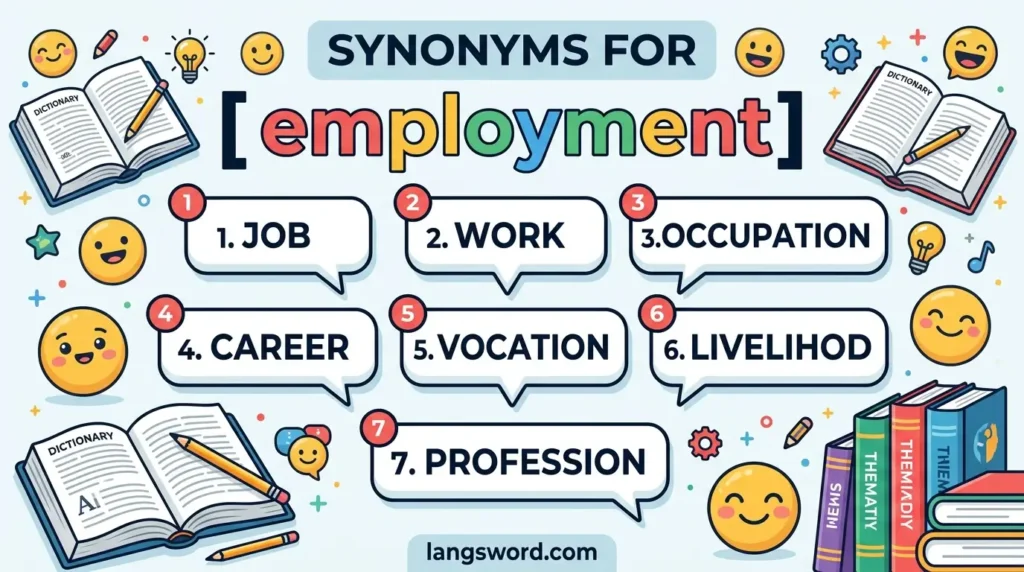
30 Synonyms of employment With Meaning & Examples
1. Work (Noun)
Meaning: Work is an activity done to earn money or achieve a useful result.
Examples:
- She is looking for work in marketing.
- He has worked hard to keep his job.
2. Job (Noun)
Meaning: A job is a specific position in which a person works, usually for pay.
Examples:
- I applied for a new job yesterday.
- Her first job was at a small bookstore.
3. Occupation (Noun)
Meaning: An occupation is the regular work or profession that a person does.
Examples:
- Teaching is her occupation.
- Please write your occupation on the form.
4. Position (Noun)
Meaning: A position is a particular job or role in an organization.
Examples:
- He applied for a management position.
- The company offered her a full-time position.
5. Career (Noun)
Meaning: A career is a person’s long-term path of work and professional development.
Examples:
- She wants a career in medicine.
- His career began in the technology industry.
6. Profession (Noun)
Meaning: A profession is a skilled occupation that often requires special education or training.
Examples:
- Law is a demanding profession.
- She chose teaching as her profession.
7. Vocation (Noun)
Meaning: A vocation is work that a person feels strongly called to do.
Examples:
- Nursing became her vocation.
- He considers teaching his vocation.
8. Calling (Noun)
Meaning: A calling is a strong feeling that a particular type of work is one’s purpose.
Examples:
- She believes medicine is her calling.
- His calling is to help young people learn.
9. Livelihood (Noun)
Meaning: A livelihood is the work or income that provides the money needed to live.
Examples:
- Farming is their main livelihood.
- Tourism provides a livelihood for many families.
10. Occupancy (Noun)
Meaning: Occupancy can mean the state of being occupied by a job, role, or activity, though it is less common as a direct synonym for employment.
Examples:
- The position requires full-time occupancy.
- His occupancy of the role lasted five years.
11. Engagement (Noun)
Meaning: Engagement can mean being hired or occupied in a particular job or activity.
Examples:
- The actor accepted a new professional engagement.
- Her engagement with the company lasted two years.
12. Appointment (Noun)
Meaning: An appointment can mean an official job or position given to a person.
Examples:
- He received an appointment at the university.
- Her appointment began in January.
13. Placement (Noun)
Meaning: Placement is the act of finding or assigning someone a suitable job.
Examples:
- The college offers job placement services.
- Her placement at the company led to a permanent role.
14. Service (Noun)
Meaning: Service can refer to work performed for an organization, employer, or community.
Examples:
- He completed thirty years of public service.
- Her service to the company was highly valued.
15. Labor (Noun)
Meaning: Labor means physical or mental work, especially work done for payment.
Examples:
- The factory depends on skilled labor.
- Manual labor can be physically demanding.
16. Toil (Noun)
Meaning: Toil means hard and tiring work.
Examples:
- Years of toil helped him build the business.
- Farming often involves long hours of toil.
17. Trade (Noun)
Meaning: A trade is a skilled type of work, often learned through training or practice.
Examples:
- Carpentry is a useful trade.
- He learned his trade from his father.
18. Craft (Noun)
Meaning: A craft is a skilled occupation involving practical or creative work.
Examples:
- Woodworking became his craft.
- She turned her craft into a business.
19. Business (Noun)
Meaning: Business can mean a person’s professional activity or commercial work.
Examples:
- He runs a small family business.
- Her business keeps her busy throughout the week.
20. Pursuit (Noun)
Meaning: A pursuit is an activity or profession followed with interest and purpose.
Examples:
- Writing became his main professional pursuit.
- She devoted herself to a career in research.
21. Profession (Noun)
Meaning: A profession is a career that involves specialized knowledge or training.
Examples:
- Engineering is his chosen profession.
- She takes pride in her profession.
22. Career Path (Noun Phrase)
Meaning: A career path is the planned or developing sequence of jobs and roles in a person’s working life.
Examples:
- She chose a career path in finance.
- The course helped him plan his career path.
23. Role (Noun)
Meaning: A role is a person’s function or position within an organization.
Examples:
- She started a new role in human resources.
- His role involves managing a small team.
24. Post (Noun)
Meaning: A post is a formal job or position, especially in an organization.
Examples:
- He was offered a senior post.
- She applied for a teaching post.
25. Assignment (Noun)
Meaning: An assignment is a particular piece of work or duty given to someone.
Examples:
- The company gave him a new assignment.
- Her overseas assignment lasted six months.
26. Duty (Noun)
Meaning: A duty is a task or responsibility that forms part of someone’s work.
Examples:
- One of his duties is training new staff.
- She completed her daily duties before leaving.
27. Activity (Noun)
Meaning: Activity is something a person does, especially as part of work or regular life.
Examples:
- Commercial activity increased this year.
- The job involves several daily activities.
28. Enterprise (Noun)
Meaning: Enterprise is a business or organized effort, especially one involving work and initiative.
Examples:
- She created a successful business enterprise.
- The enterprise provides employment for local workers.
29. Appointment (Noun)
Meaning: An appointment can refer to a formal position or job given to someone.
Examples:
- His appointment as director was announced today.
- She accepted the appointment at the university.
30. Work Placement (Noun Phrase)
Meaning: A work placement is a temporary period of practical work, often arranged for learning or training.
Examples:
- The student completed a work placement at a hospital.
- Her work placement gave her valuable experience.
Note: These words overlap with employment, but they are not interchangeable in every sentence. For example, job usually means a specific paid position, while career refers to a longer working journey.
Occupation often describes the type of work a person regularly does. Livelihood focuses more on earning a living. In formal writing, choosing the synonym that matches the exact meaning is important. Merriam-Webster similarly distinguishes employment, occupation, calling, business, pursuit, and work by their specific nuances.
Prototype Meaning
The most typical meaning of employment is paid work performed by a person for an employer. When people hear the word, they usually imagine having a job, receiving wages or a salary, and working for a company, organization, or individual.
The word can also refer to the broader state of being employed, as in full-time employment or employment opportunities.
Prototype Categorization
The 30 synonyms can be grouped by their main meaning. This helps writers select a word that matches the exact context instead of replacing employment with a word that only seems similar.
- General paid work: work, job, labor, livelihood — useful when talking about earning money or doing work.
- A specific job or position: position, role, post, appointment, assignment — useful in workplace and organizational writing.
- Long-term professional life: career, career path, profession, vocation, calling — useful when discussing professional development or purpose.
- Skilled work: trade, craft, profession — useful for work that needs training, expertise, or special skills.
- Business and commercial activity: business, enterprise, activity — useful when discussing organizations, commerce, or economic work.
- Work as a responsibility: duty, service, engagement, pursuit — useful when focusing on responsibilities, professional commitments, or activities.
- Training and entry into work: placement, work placement — useful for internships, practical training, and early career experience.
- Formal or institutional employment: appointment, post, position, service — useful in academic, government, corporate, and professional contexts.
This grouping helps writers avoid awkward substitutions. For example, job works well in everyday conversation, while occupation is often better on a formal form, and career is better when discussing someone’s long-term professional journey.
Antonyms of employment
Unemployment (Noun)
Meaning: The state of not having a job while being available for work.
Joblessness (Noun)
Meaning: The condition of having no job.
Inactivity (Noun)
Meaning: A lack of work, action, or active engagement.
Idleness (Noun)
Meaning: A state of having little or no work or activity.
Unemployment status (Noun Phrase)
Meaning: A condition in which a person is not currently employed.
Short Questions and Answers
What does employment mean?
Employment means having paid work or the state of being employed by an organization, company, or person.
When should employment be used?
Use employment when talking about paid work in a general, formal, or professional context. It is common in phrases such as employment opportunities, employment contract, and full-time employment.
Is employment positive or negative?
Employment is usually neutral. It can have a positive or negative feeling depending on the context. For example, stable employment sounds positive, while loss of employment describes a difficult situation.
How is it different from similar words?
Employment usually focuses on the state or condition of having paid work. Job often means one specific paid position. Occupation means the regular type of work a person does. Career describes a longer professional journey. Profession usually suggests specialized training or expertise.
Conclusion
Learning employment and its synonyms can make your English more accurate and flexible. Words such as work, job, occupation, position, career, and profession may look similar, but each has a slightly different use.
Understanding these differences helps you choose the right word for a job application, business document, essay, website, or everyday conversation. Synonyms also help writers avoid repetition and make their sentences sound more natural.
For English learners, building a strong vocabulary can improve both writing and speaking. The best way to remember these words is to practice them in real sentences. Learn a few synonyms each day, compare their meanings, and use them in your own writing.
With regular practice, your vocabulary will grow and your confidence will become stronger.