
Maverick describes a person who thinks and acts independently instead of following the usual rules. Imagine an employee who solves a problem in a new way while everyone else follows the old method. You might call that person a maverick.
The word is common in English because it captures the idea of someone who is different, bold, and unwilling to simply follow the crowd. Learning synonyms for maverick helps English learners express this idea with greater accuracy.
It also helps content writers avoid repeating the same word and choose language that fits the tone of a sentence. In this article, we explore the meaning of maverick, its synonyms, examples, grammar, history, pronunciation, word formation, antonyms, and semantic categories.
These details will help you understand not only what the word means, but also when each alternative works best.
Meaning of Maverick
Definition
Maverick (Noun/Adjective):
A maverick is a person who thinks and acts independently and does not easily follow accepted rules or ideas.
As an adjective, maverick describes someone or something that is independent, unusual, or unconventional.
Examples
- The young designer is a maverick who refuses to follow fashion trends.
- Her maverick approach helped the company find a new solution.
Connotative Meaning
Connotation: The feelings or ideas that a word suggests beyond its basic meaning.
- Positive tone: A maverick can seem creative, brave, original, independent, and innovative.
- Negative tone: A maverick can seem rebellious, difficult, unpredictable, or unwilling to cooperate.
- Neutral tone: The word can simply describe someone who works outside normal rules or traditions.
Etymology
The word maverick has an unusual history. Unlike many English words, it did not develop from Old English or Middle English vocabulary. It began as an American surname.
- Old English (450–1100): There is no Old English form of maverick. The word was not part of the Old English vocabulary.
- Middle English (1100–1500): There is no established Middle English form of maverick. The modern word developed much later.
- Modern English (1500–Present): Maverick came from the surname of Samuel Maverick, a 19th-century American rancher and politician. He became known for not branding his cattle. An unbranded calf came to be called a maverick. The word later developed its figurative meaning of a person who does not follow the usual rules.
Today, maverick is widely used for independent thinkers, unusual leaders, creative people, and nonconformists.
Pronunciation (IPA)
- IPA: /ˈmævərɪk/
- Syllables: MAV-er-ick
Affixation Pattern of Maverick
- Root: maverick
- Prefix: None
- Suffix: None
- Word formations:
- maverick — noun; an independent or unconventional person
- maverick — adjective; independent or unconventional
- maverickish — adjective; somewhat like a maverick
- maverickism — noun; an independent or unconventional approach or attitude
The word maverick is mainly a whole lexical form rather than a word built through normal English prefixes and suffixes.
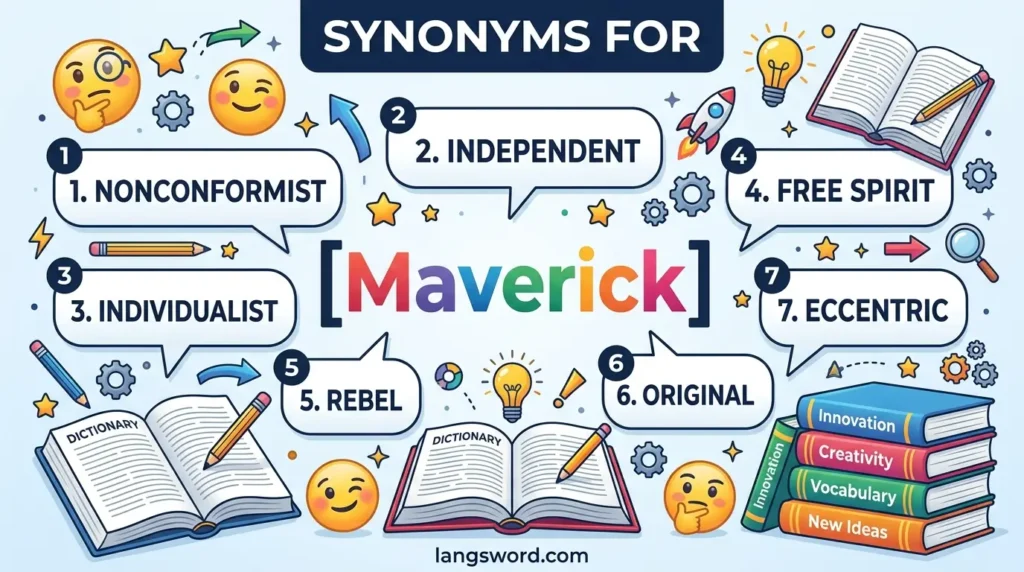
30 Synonyms of Maverick With Meaning & Examples
1. Nonconformist (Noun)
Meaning: A person who does not follow common customs, rules, or beliefs.
Examples:
- She is a nonconformist who enjoys creating her own style.
- The artist became known as a nonconformist in the local art scene.
2. Individualist (Noun)
Meaning: A person who values independence and personal choice.
Examples:
- As an individualist, he prefers to work alone.
- The writer was an individualist who developed his own methods.
3. Rebel (Noun)
Meaning: A person who resists rules, authority, or accepted ideas.
Examples:
- The young rebel refused to follow the old system.
- He became a rebel against traditional business practices.
4. Iconoclast (Noun)
Meaning: A person who challenges respected beliefs, traditions, or institutions.
Examples:
- The professor was an iconoclast who questioned old theories.
- As an iconoclast, she challenged many accepted ideas.
5. Free Thinker (Noun)
Meaning: A person who forms opinions independently rather than simply accepting traditional beliefs.
Examples:
- He is a free thinker who questions popular opinions.
- The writer was known as a free thinker.
6. Independent (Noun/Adjective)
Meaning: A person who thinks or acts without depending heavily on others.
Examples:
- She is an independent who prefers making her own decisions.
- His independent thinking impressed his teachers.
7. Individual (Noun)
Meaning: A person with a distinct personality, character, or way of thinking.
Examples:
- He is a creative individual with unusual ideas.
- Each individual should be free to choose a different path.
8. Outsider (Noun)
Meaning: A person who is not part of a particular group or does not fit into it.
Examples:
- As an outsider, she offered a fresh view of the problem.
- The young artist felt like an outsider in the traditional community.
9. Dissenter (Noun)
Meaning: A person who openly disagrees with an official or commonly accepted opinion.
Examples:
- The dissenter questioned the committee’s decision.
- He became a well-known dissenter within the organization.
10. Dissident (Noun/Adjective)
Meaning: A person who strongly disagrees with an established authority, group, or system.
Examples:
- The dissident criticized the organization’s policies.
- She was known for her dissident views.
11. Renegade (Noun)
Meaning: A person who rejects or leaves an established group, system, or set of rules.
Examples:
- The renegade designer created products unlike anything else.
- He became a renegade within the industry.
12. Maverick Thinker (Noun)
Meaning: A person who develops unusual ideas and thinks independently.
Examples:
- The scientist was a maverick thinker in his field.
- Her work shows the mind of a maverick thinker.
13. Original (Noun/Adjective)
Meaning: A person or idea that is new, unusual, and not copied from others.
Examples:
- She is an original who brings fresh ideas to every project.
- His original approach changed the way the team worked.
14. Innovator (Noun)
Meaning: A person who introduces new ideas, methods, or products.
Examples:
- The engineer was an innovator in renewable energy.
- Every successful innovator must be willing to question old methods.
15. Pioneer (Noun)
Meaning: A person who is among the first to develop or use a new idea or method.
Examples:
- She was a pioneer in online education.
- The company became a pioneer in clean technology.
16. Trailblazer (Noun)
Meaning: A person who creates a new path or leads others into a new area.
Examples:
- The entrepreneur was a trailblazer in digital publishing.
- Her research made her a trailblazer in the field.
17. Visionary (Noun/Adjective)
Meaning: A person who has bold ideas about the future.
Examples:
- The founder was a visionary who imagined new ways to serve customers.
- His visionary ideas changed the industry.
18. Free Spirit (Noun)
Meaning: A person who strongly values freedom and dislikes strict control.
Examples:
- She is a free spirit who loves traveling alone.
- His free-spirit attitude made him different from his colleagues.
19. Contrarian (Noun)
Meaning: A person who often takes a position that differs from the popular opinion.
Examples:
- The contrarian questioned the team’s popular view.
- His contrarian argument started a useful debate.
20. Agitator (Noun)
Meaning: A person who actively encourages change or challenges an existing system.
Examples:
- The social agitator demanded changes to the policy.
- He was seen as an agitator for workplace reform.
21. Revolutionary (Noun/Adjective)
Meaning: A person or idea that strongly challenges the existing system and seeks major change.
Examples:
- The inventor was a revolutionary in the technology industry.
- Her revolutionary idea changed the entire process.
22. Unconventionalist (Noun)
Meaning: A person who prefers methods or ideas that are different from normal ones.
Examples:
- The designer is an unconventionalist who avoids standard styles.
- As an unconventionalist, he often finds unusual solutions.
23. Nontraditionalist (Noun)
Meaning: A person who does not follow traditional practices or beliefs.
Examples:
- The chef is a nontraditionalist who mixes different cooking styles.
- As a nontraditionalist, she prefers modern approaches.
24. Independent Thinker (Noun)
Meaning: A person who forms ideas and opinions without simply following others.
Examples:
- He is an independent thinker who asks difficult questions.
- Every good researcher should become an independent thinker.
25. Rule-Breaker (Noun)
Meaning: A person who does not follow established rules.
Examples:
- The rule-breaker found a faster way to complete the task.
- He was considered a rule-breaker because of his unusual methods.
26. Nontraditional Thinker (Noun)
Meaning: A person who approaches problems outside normal ways of thinking.
Examples:
- The company hired a nontraditional thinker to solve the problem.
- Her work shows the creativity of a nontraditional thinker.
27. Free-Thinking Person (Noun)
Meaning: A person who thinks independently and questions accepted ideas.
Examples:
- He is a free-thinking person who enjoys challenging assumptions.
- The team needed a free-thinking person with new ideas.
28. Independent-Minded Person (Noun)
Meaning: A person who has strong personal opinions and makes decisions independently.
Examples:
- She is an independent-minded person who trusts her own judgment.
- An independent-minded person may not accept every traditional rule.
29. Adventurer (Noun)
Meaning: A person who enjoys taking risks, trying new things, or exploring unfamiliar paths.
Examples:
- The young entrepreneur was an adventurer in the business world.
- As an adventurer, he was willing to try an unusual strategy.
30. Radical (Noun/Adjective)
Meaning: A person or idea that strongly differs from established views or practices.
Examples:
- The radical thinker challenged the accepted theory.
- Her radical approach attracted both praise and criticism.
Prototype Meaning
The most typical meaning of maverick is an independent person who does not follow the usual rules or way of thinking. When people hear the word, they often imagine someone bold, original, and willing to stand apart from the group. A maverick may challenge traditions, create new ideas, or choose a path that others avoid. The word often carries a positive sense of courage and creativity, but it can also suggest that the person is difficult to control or unwilling to cooperate.
Prototype Categorization
The 30 synonyms can be grouped into semantic categories based on the exact quality they emphasize:
- Independence: individualist, independent, individual, independent thinker, independent-minded person. These words focus on self-reliance and personal judgment.
- Nonconformity: nonconformist, unconventionalist, nontraditionalist, nontraditional thinker. These are useful when someone does not follow normal customs or methods.
- Rebellion and resistance: rebel, renegade, dissenter, dissident, rule-breaker, agitator. These words suggest active resistance to rules, authority, or established systems.
- Challenging ideas: iconoclast, free thinker, free-thinking person, contrarian. These work well when someone questions accepted opinions or beliefs.
- Innovation and new ideas: innovator, pioneer, trailblazer, visionary, original. These emphasize creativity, progress, and new approaches.
- Freedom and unconventional lifestyles: free spirit, adventurer, outsider. These words highlight personal freedom, unusual choices, or separation from a group.
- Major change: revolutionary, radical. These suggest ideas or actions that challenge existing systems in a strong or fundamental way.
This categorization helps writers choose the right synonym. For example, innovator is better than rebel when the focus is on new technology, while dissenter is more suitable when the focus is disagreement with an official opinion.
Antonyms of Maverick
1. Conformist (Noun)
Meaning: A person who follows accepted customs, rules, or opinions.
2. Traditionalist (Noun)
Meaning: A person who strongly supports traditional ideas and practices.
3. Follower (Noun)
Meaning: A person who accepts or follows another person’s ideas, direction, or example.
4. Conventionalist (Noun)
Meaning: A person who prefers accepted and customary ways of thinking or acting.
5. Conventional (Adjective)
Meaning: Following normal, accepted, or traditional methods.
6. Mainstream (Adjective/Noun)
Meaning: Belonging to the ideas, practices, or opinions accepted by most people.
7. Obedient (Adjective)
Meaning: Willing to follow rules, orders, or instructions.
8. Traditional (Adjective)
Meaning: Based on long-established customs, methods, or beliefs.
Short Questions and Answers
What does maverick mean?
Maverick means a person who thinks or acts independently and does not easily follow accepted rules or ideas.
When should maverick be used?
Use maverick when describing someone who is independent, unconventional, or willing to challenge normal ways of doing things.
Is maverick positive or negative?
Maverick can be positive or negative. It may praise someone’s creativity and independence, or it may suggest that the person is difficult, rebellious, or unwilling to follow rules.
How is it different from similar words?
Maverick is broad and can suggest both independence and unconventional behavior. Innovator focuses on new ideas, rebel focuses on resistance, iconoclast focuses on challenging accepted beliefs, and individualist focuses on personal independence.
Conclusion
Learning maverick and its synonyms can make your English more precise and flexible. The word describes an independent person who often challenges normal ideas, but its alternatives highlight different qualities.
Words such as individualist stress independence, while rebel suggests resistance. Innovator, pioneer, and trailblazer focus on new ideas and progress. Knowing these differences helps you choose the right word for essays, articles, conversations, and professional writing.
It also prevents repetition and makes your sentences more natural and engaging. For English learners, studying synonyms is a simple way to build a stronger vocabulary and greater speaking confidence.
Try learning a few new words each day, write your own example sentences, and use them in real conversations. With regular practice, choosing the right synonym will become easier and more natural.