

Turtle is a noun that usually means a slow-moving reptile with a hard shell. Imagine seeing a turtle cross a quiet road. It moves slowly, carries its protective shell, and may pull its head and legs inside when it feels unsafe.
The word is common in everyday English because turtles are familiar animals and often appear in stories, nature writing, and children’s books. Learning synonyms helps English learners use more varied and natural language.
It also helps content writers avoid repeating the same word too often. However, not every alternative for turtle has exactly the same meaning. Some refer to certain types of turtles, while others are scientific, regional, or descriptive terms.
This guide explains the meaning of turtle, its synonyms, examples, grammar, history, pronunciation, word formation, and semantic categories.
Meaning of Turtle
Definition
Turtle (Noun):
A turtle is a reptile with a hard shell that protects its body; the word can refer broadly to shelled reptiles and, in some varieties of English, specifically to aquatic or marine members of the group.
Examples
- A small turtle was resting beside the pond.
- The turtle slowly crawled toward the water.
Connotative Meaning
Connotation: The feelings or ideas that a word suggests beyond its basic meaning.
- Positive tone: Turtle can suggest patience, calmness, safety, and endurance.
- Negative tone: In some contexts, it can suggest slowness or a lack of speed.
- Neutral tone: In scientific or everyday animal descriptions, turtle is simply a factual name.
Etymology
The word turtle has a long history and entered English through French.
- Old English (450–1100): The modern word turtle was not yet established in Old English. Older English used other words for shelled reptiles.
- Middle English (1100–1500): Turtle developed through Anglo-French and Old French forms related to tortue, meaning a tortoise or turtle.
- Modern English (1500–Present): Turtle became the common English word for these shelled reptiles. English later developed more specific terms such as sea turtle, terrapin, and tortoise.
Pronunciation (IPA)
- IPA: /ˈtɜːrtəl/ in a common British-style pronunciation; /ˈtɝːtəl/ in General American English
- Syllables: tur-tle
Affixation Pattern of Turtle
- Root: turtle
- Prefix: None
- Suffix: None in the basic word
- Word formations:
- turtle — noun
- turtles — plural noun
- turtle-like — adjective
- turtling — noun/verb form, depending on context
- turtled — past-tense or past-participle form in rare verb uses
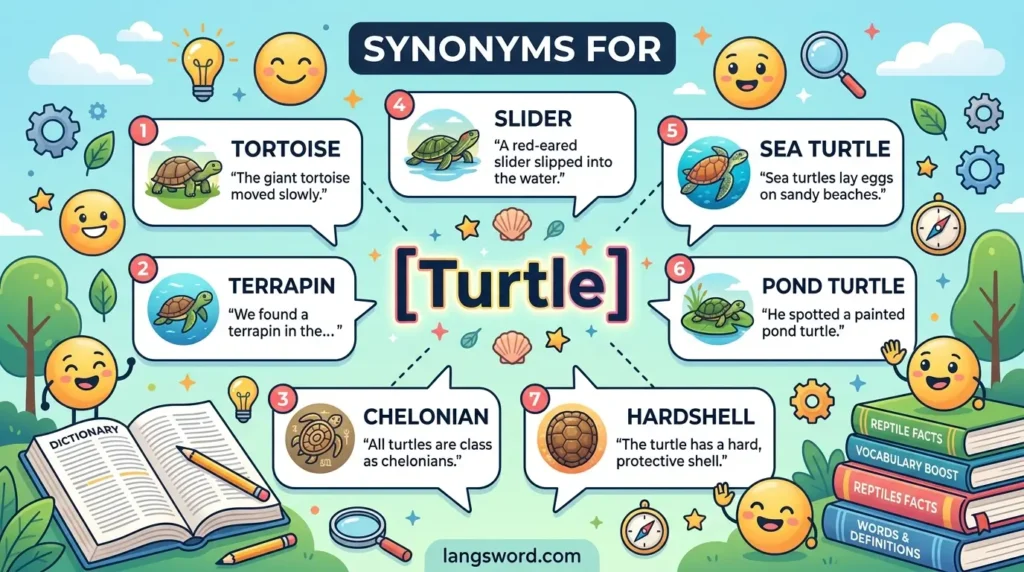
30 Synonyms of Turtle With Meaning & Examples
Note: English does not have 30 exact synonyms for turtle. Several terms below are species names, regional alternatives, scientific terms, or close contextual alternatives. Using them correctly depends on the type of turtle and the context.
1. Tortoise (Noun)
Meaning: A shelled reptile, usually living on land, that belongs to the broader turtle group.
Examples:
- The tortoise walked slowly across the garden.
- A giant tortoise can live for many decades.
2. Terrapin (Noun)
Meaning: A term used for certain turtles, especially freshwater or marsh-dwelling turtles.
Examples:
- We saw a terrapin near the marsh.
- The terrapin quickly slipped into the water.
3. Sea Turtle (Noun)
Meaning: A turtle that lives mainly in the sea.
Examples:
- A sea turtle swam near the coral reef.
- The beach is an important nesting site for sea turtles.
4. Marine Turtle (Noun)
Meaning: A scientific or formal term for a turtle that lives in marine environments.
Examples:
- The marine turtle returned to the beach to lay eggs.
- Plastic waste can harm marine turtles.
5. Chelonian (Noun)
Meaning: A scientific term for any reptile belonging to the turtle group.
Examples:
- The museum displayed a fossil chelonian.
- Researchers studied the ancient chelonian remains.
6. Chelone (Noun)
Meaning: A zoological term connected with turtles and tortoises.
Examples:
- The fossil was identified as an ancient chelonian rather than a modern turtle.
- The study examined the shell structure of a chelone.
7. Testudine (Noun)
Meaning: A formal zoological term for a turtle or tortoise.
Examples:
- The researcher recorded the testudine in the field.
- The fossil belonged to an extinct testudine.
8. Testudine (Adjective)
Meaning: Relating to turtles or tortoises.
Examples:
- The scientist examined the animal’s testudine shell.
- The museum displayed several testudine fossils.
9. Testudinate (Noun)
Meaning: A formal zoological term referring to a turtle or tortoise.
Examples:
- The fossil was identified as a testudinate.
- The researchers compared the testudinate shells.
10. Testudinate (Adjective)
Meaning: Having features or a form associated with turtles or tortoises.
Examples:
- The animal had a testudinate body shape.
- The fossil showed a testudinate shell structure.
11. Chelonian Reptile (Noun)
Meaning: A reptile with the characteristic body and shell structure of turtles and tortoises.
Examples:
- The chelonian reptile moved toward the river.
- Scientists studied the shell of the chelonian reptile.
12. Shelled Reptile (Noun)
Meaning: A reptile with a hard protective shell, such as a turtle or tortoise.
Examples:
- The shelled reptile disappeared into the bushes.
- We watched the shelled reptile cross the path.
13. Aquatic Turtle (Noun)
Meaning: A turtle that spends much of its life in water.
Examples:
- The aquatic turtle rested on a fallen branch.
- An aquatic turtle can spend hours in the water.
14. Freshwater Turtle (Noun)
Meaning: A turtle that mainly lives in freshwater habitats such as ponds, lakes, and rivers.
Examples:
- A freshwater turtle was swimming near the reeds.
- The lake provides food for many freshwater turtles.
15. Land Turtle (Noun)
Meaning: A turtle that mainly lives on land rather than in the ocean.
Examples:
- The land turtle moved through the dry grass.
- We found a land turtle near the forest.
16. Pond Turtle (Noun)
Meaning: A turtle commonly associated with ponds and similar freshwater habitats.
Examples:
- The pond turtle climbed onto a rock.
- Children watched the pond turtle from the bridge.
17. Box Turtle (Noun)
Meaning: A land-dwelling turtle known for its hinged shell that can help close its body inside.
Examples:
- The box turtle hid under the leaves.
- A box turtle crossed the woodland trail.
18. Snapping Turtle (Noun)
Meaning: A turtle known for its strong jaws and defensive behavior.
Examples:
- A snapping turtle was spotted near the river.
- The ranger warned us not to approach the snapping turtle.
19. Softshell (Noun)
Meaning: A turtle with a flexible, leathery shell rather than a typical hard shell.
Examples:
- The softshell disappeared beneath the muddy water.
- A softshell turtle was seen near the riverbank.
20. Mud Turtle (Noun)
Meaning: A small turtle commonly associated with muddy freshwater habitats.
Examples:
- The mud turtle hid beneath the wet leaves.
- We found a mud turtle near the stream.
21. Musk Turtle (Noun)
Meaning: A small freshwater turtle belonging to the musk turtle group.
Examples:
- The musk turtle moved slowly along the bottom.
- A musk turtle was living in the shallow pond.
22. Painted Turtle (Noun)
Meaning: A freshwater turtle known for colorful markings on its shell and body.
Examples:
- A painted turtle was resting on a log.
- The children watched the painted turtle enter the pond.
23. Snapping Reptile (Noun)
Meaning: A descriptive term for a turtle known for snapping with its jaws.
Examples:
- The snapping reptile remained still near the water.
- The ranger identified the animal as a snapping reptile.
24. Slow Reptile (Noun)
Meaning: A general descriptive phrase for a reptile that moves slowly, including many turtles.
Examples:
- The slow reptile crossed the garden path.
- We waited for the slow reptile to reach the grass.
25. Shelled Animal (Noun)
Meaning: An animal with a protective shell, especially a turtle or tortoise.
Examples:
- The shelled animal pulled its head inside.
- We watched the shelled animal move toward the pond.
26. Reptile (Noun)
Meaning: A cold-blooded vertebrate animal with scales or related skin structures; turtles are reptiles.
Examples:
- The turtle is a reptile.
- This reptile has a strong protective shell.
27. Testudinean (Noun)
Meaning: A formal term for a member of the turtle and tortoise group.
Examples:
- The fossil was classified as a testudinean.
- The museum contains several ancient testudineans.
28. Testudinean (Adjective)
Meaning: Relating to turtles and tortoises.
Examples:
- The researcher studied testudinean anatomy.
- The fossil had several testudinean features.
29. Turtle-like Reptile (Noun)
Meaning: A reptile that resembles a turtle in body shape or shell structure.
Examples:
- The fossil looked like a turtle-like reptile.
- Scientists found a turtle-like reptile from an ancient period.
30. Shell-backed Reptile (Noun)
Meaning: A descriptive phrase for a reptile with a protective shell on its back.
Examples:
- The shell-backed reptile moved slowly across the sand.
- A shell-backed reptile was resting beside the stream.
Prototype Meaning
The most typical meaning of turtle is a slow-moving reptile with a hard protective shell. When people hear the word, they usually imagine a small or medium-sized animal with four legs, a rounded shell, and a head that can sometimes be pulled into the shell. The exact image can vary because turtles include many different species, from freshwater turtles to large sea turtles.
Prototype Categorization
The 30 alternatives can be grouped into useful semantic categories:
- Broad animal terms: reptile, shelled animal, shelled reptile, shell-backed reptile. These work when the exact turtle type is not important.
- Scientific terms: chelonian, testudine, testudinate, testudinean. These are better for academic, zoological, and scientific writing.
- Habitat-based terms: sea turtle, marine turtle, aquatic turtle, freshwater turtle, land turtle, pond turtle. These identify where the animal normally lives.
- Type-based terms: box turtle, snapping turtle, softshell, mud turtle, musk turtle, painted turtle. These are useful when the exact type is known.
- Tortoise-related terms: tortoise is closely related but is not interchangeable with turtle in every context, especially in American English.
- Descriptive alternatives: slow reptile, turtle-like reptile, shell-backed reptile. These are useful when writing creatively or avoiding repetition without claiming that the phrase is a taxonomic synonym.
This categorization helps writers choose the right word for the situation. A science article may need chelonian, while a children’s story may sound more natural with turtle. A wildlife article may need sea turtle or freshwater turtle when habitat matters.
Antonyms of Turtle
Turtle is an animal name, so it has no single exact antonym. However, these words can contrast with common qualities associated with turtles:
1. Hare (Noun)
A fast-running animal often used as a contrast to a slow turtle.
2. Cheetah (Noun)
A very fast land animal that contrasts strongly with the turtle’s typical slow movement.
3. Sprinter (Noun)
A person or animal that moves or runs very quickly.
4. Fast-moving animal (Noun)
A general phrase for an animal that moves quickly.
Short Questions and Answers
What does turtle mean?
Turtle means a shelled reptile. Depending on the variety of English and the context, it may refer to freshwater, marine, or other members of the turtle group.
When should turtle be used?
Use turtle when you are speaking generally about the animal or when the exact type is not important. Use a more specific term, such as sea turtle or box turtle, when the type matters.
Is turtle positive or negative?
Turtle is normally neutral. It can have a positive association with patience, protection, and endurance, but it can sometimes suggest slowness when used figuratively.
How is it different from similar words?
Turtle is a broad everyday term. Tortoise usually refers to land-dwelling members of the group, while terrapin can refer to certain freshwater or marsh turtles. Scientific words such as chelonian are more formal and technical.
Conclusion
Learning turtle and its related words can make English vocabulary richer and more precise. The word turtle is useful in everyday speech, but terms such as sea turtle, freshwater turtle, terrapin, tortoise, and chelonian can give writing more detail.
Understanding the difference between exact synonyms, related words, scientific terms, and descriptive phrases is especially important for English learners and content writers. Using the right word can improve both speaking and writing, reduce unnecessary repetition, and make ideas clearer.
It also builds confidence because you can describe the same subject in several natural ways. Practice a few new words each day, write your own example sentences, and check the context before replacing turtle with another term.


