
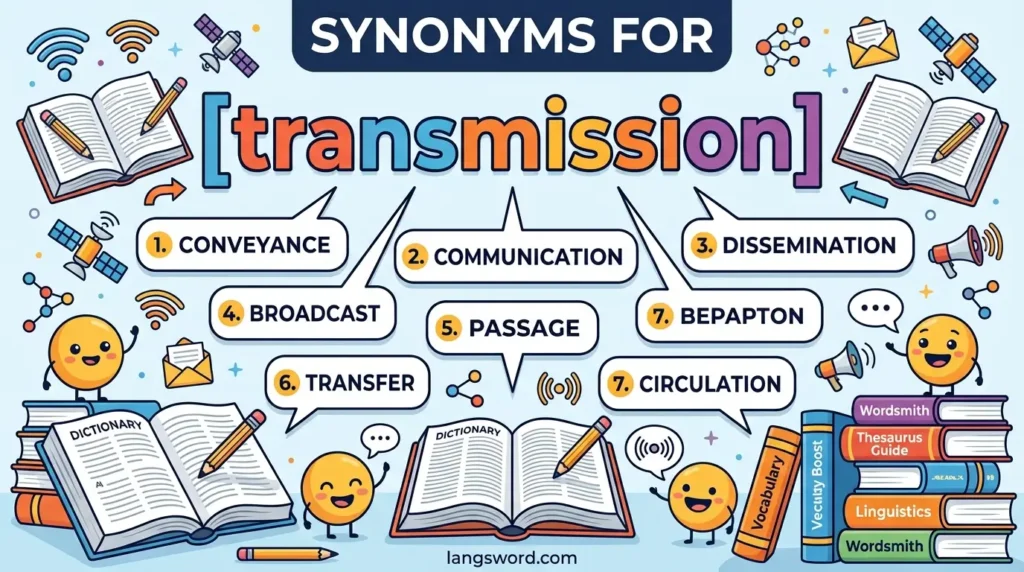

Transmission is the act of sending, passing, or transferring something from one place, person, or system to another. Imagine sending a message to a friend, moving power through a cable, or a car changing gears.
In each case, something is passed from one point to another. The word is common in science, technology, medicine, communication, and everyday English. Learning synonyms for transmission helps English learners understand small differences in meaning and choose the right word for each context.
It also helps content writers avoid repetition and make their writing more precise. This guide explains the meaning of transmission and explores 30 related words with examples.
It also covers connotation, etymology, pronunciation, word formation, prototype meaning, semantic categories, and antonyms. The examples show how these words work in real sentences and when each alternative is most useful.
Meaning of transmission
Definition
Transmission (Noun):
Transmission is the act or process of sending, passing, or transferring something from one person, place, device, or system to another.
Examples
- The transmission of radio signals allows people to communicate over long distances.
- Good hygiene can reduce the transmission of some diseases.
Connotative Meaning
Connotation: the feeling or idea that a word suggests beyond its basic meaning.
- Positive tone: Transmission can suggest successful communication, sharing, or smooth transfer.
- Negative tone: In health contexts, transmission may suggest the spread of an illness.
- Neutral tone: In technology and science, it often simply describes the movement of information, energy, signals, or other things.
Etymology
The word transmission comes from Latin transmissio, meaning “a sending across” or “a passing over.” It is related to the Latin verb transmittere, meaning “to send across.”
- Old English (450–1100): The modern noun transmission was not part of Old English. English used other native words for ideas such as sending and passing.
- Middle English (1100–1500): The word entered English through Anglo-French and Medieval Latin forms and developed the sense of sending or passing something onward.
- Modern English (1500–Present): Transmission gained many specialized meanings in science, medicine, communication, electricity, broadcasting, and automobiles.
Pronunciation (IPA)
- IPA: /trænzˈmɪʃən/
- Syllables: trans-mis-sion
Affixation Pattern of transmission
- Root: mit / miss — connected with the idea of sending
- Prefix: trans- — across, beyond, or from one place to another
- Suffix: -ion — forms a noun referring to an action, process, or result
Word formations
- transmit — verb: to send or pass something across
- transmitted — adjective/past participle: sent or passed onward
- transmitting — verb form: sending or passing something
- transmitter — noun: a person or device that sends something
- transmission — noun: the act or process of sending or passing something
- transmissible — adjective: able to be transmitted
- transmissibility — noun: the quality of being transmissible
30 Synonyms of transmission With Meaning & Examples
1. Transfer (Noun)
Meaning: The movement of something from one person, place, or system to another.
Examples:
- The transfer of data took only a few seconds.
- The bank confirmed the transfer of money.
2. Sending (Noun)
Meaning: The act of causing something to go to another person or place.
Examples:
- The sending of the email was delayed.
- The sending of signals requires a strong connection.
3. Communication (Noun)
Meaning: The exchange or passing of information between people or systems.
Examples:
- Clear communication is important in every team.
- Radio communication continued during the storm.
4. Conveyance (Noun)
Meaning: The act of carrying or passing something from one place to another.
Examples:
- The machine helps with the conveyance of materials.
- The conveyance of information must be accurate.
5. Delivery (Noun)
Meaning: The act of taking or sending something to its intended receiver.
Examples:
- The delivery of the message was quick.
- Secure delivery of the data is essential.
6. Dispatch (Noun)
Meaning: The act of sending something to a destination.
Examples:
- The dispatch of the package took place early.
- The company handles the dispatch of electronic orders.
7. Distribution (Noun)
Meaning: The process of spreading or supplying something among people or places.
Examples:
- The distribution of information was widespread.
- The company manages the distribution of digital content.
8. Dissemination (Noun)
Meaning: The spreading of information, ideas, or knowledge to many people.
Examples:
- The internet supports rapid dissemination of news.
- The dissemination of scientific knowledge benefits society.
9. Propagation (Noun)
Meaning: The spreading or movement of something through a medium or system.
Examples:
- The propagation of radio waves depends on many factors.
- Researchers studied the propagation of the signal.
10. Broadcasting (Noun)
Meaning: The sending of audio, video, or information to a large audience.
Examples:
- The broadcasting of the event began at noon.
- Television broadcasting has changed greatly over time.
11. Relay (Noun)
Meaning: The passing of a message, signal, or information from one point to another.
Examples:
- The satellite acts as a relay for the signal.
- The team used a relay system to send the information.
12. Passage (Noun)
Meaning: The movement or transfer of something from one place or person to another.
Examples:
- The passage of electricity through the wire was measured.
- The passage of information between systems was secure.
13. Spread (Noun)
Meaning: The movement of something across a wider area or among more people.
Examples:
- Scientists studied the spread of the virus.
- The spread of information was very fast.
14. Circulation (Noun)
Meaning: The movement of something continuously through a system or among people.
Examples:
- The circulation of information increased online.
- Proper air circulation is important in the building.
15. Dissemination (Noun)
Meaning: The broad spreading of information, ideas, or knowledge.
Examples:
- Digital tools support the dissemination of research.
- The dissemination of useful information can improve education.
16. Transferal (Noun)
Meaning: The act of transferring something to another person, place, or system.
Examples:
- The transferal of ownership was completed.
- The transferal of data must follow security rules.
17. Handover (Noun)
Meaning: The act of giving responsibility, information, or control to another person or group.
Examples:
- The handover of the project went smoothly.
- A clear handover of information prevented mistakes.
18. Passing (Noun)
Meaning: The act of moving or giving something from one person or place to another.
Examples:
- The passing of information was immediate.
- The passing of power between systems was carefully controlled.
19. Transference (Noun)
Meaning: The movement of something from one person, place, or system to another.
Examples:
- The transference of data must be protected.
- The study examined the transference of knowledge.
20. Transmission-line transfer (Noun)
Meaning: The movement of a signal, power, or energy through a transmission line.
Examples:
- Transmission-line transfer is important in electrical systems.
- Engineers measured power during the transfer.
21. Broadcast (Noun)
Meaning: A message, program, or signal sent to many receivers.
Examples:
- The broadcast reached millions of viewers.
- The radio broadcast contained an important announcement.
22. Signaling (Noun)
Meaning: The use of signals to send information or instructions.
Examples:
- Signaling allows the devices to exchange information.
- The signaling system controls the movement of trains.
23. Transference (Noun)
Meaning: The process of moving something from one source or situation to another.
Examples:
- The transference of responsibility happened gradually.
- The system supports the transference of information.
24. Diffusion (Noun)
Meaning: The gradual spreading of something through a space or group.
Examples:
- Diffusion allows particles to move through a medium.
- The diffusion of new ideas can take time.
25. Circulation (Noun)
Meaning: The continuous movement of something through a group, system, or area.
Examples:
- The circulation of news increased after the announcement.
- Good circulation keeps the system working efficiently.
26. Propagation (Noun)
Meaning: The process by which a signal, wave, idea, or effect spreads.
Examples:
- The propagation of sound changes in different environments.
- Scientists measured wave propagation across the surface.
27. Conveying (Noun)
Meaning: The act of communicating, carrying, or passing something.
Examples:
- Conveying complex ideas clearly takes practice.
- The machine is used for conveying materials.
28. Transmission of disease → Spread (Noun)
Meaning: The movement of an infectious disease from one person or source to another.
Examples:
- Handwashing can reduce the spread of infection.
- Researchers studied the spread of the disease.
29. Gear change (Noun)
Meaning: The process of changing the gear used by a vehicle’s transmission system.
Examples:
- The car makes a smooth gear change.
- A sudden gear change can affect the vehicle’s movement.
30. Transfer of power (Noun)
Meaning: The movement of electrical or mechanical power from one part of a system to another.
Examples:
- Efficient transfer of power reduces energy loss.
- The system controls the transfer of power between components.
Note: These 30 words are related to transmission, but they are not interchangeable in every sentence. For example, broadcast fits mass media, propagation fits waves and signals, spread often fits disease, and gear change fits vehicles. Context determines the best choice.
Prototype Meaning
The most typical meaning of transmission is the sending or passing of something from one point to another. When people hear the word, they may imagine a message, signal, disease, sound, power, or information moving between two points.
In everyday technology, they may also think of a car’s transmission, which transfers engine power to the wheels.
Prototype Categorization
The 30 related terms can be grouped into several semantic categories. This helps writers select a word that matches the exact meaning instead of using a synonym that sounds unnatural.
- General transfer: transfer, sending, transference, transferal, passing, and handover describe something moving from one person, place, or system to another.
- Communication and information: communication, conveyance, conveying, relay, signaling, and delivery focus on sending information or messages.
- Mass communication: broadcast and broadcasting are best when information, audio, or video is sent to a large audience.
- Spreading: spread, dissemination, diffusion, and circulation describe something becoming more widely distributed.
- Signals and waves: propagation and relay are common in technical contexts involving signals, waves, or electronic systems.
- Physical or system movement: passage, transfer of power, and transmission-line transfer fit technical or engineering contexts.
- Medical transmission: spread is especially common when discussing the movement of disease or infection.
- Automotive meaning: gear change relates to the vehicle meaning of transmission rather than the general meaning of sending or passing.
Understanding these categories helps writers avoid repetition while keeping the exact meaning clear.
Antonyms of transmission
1. Reception (Noun)
Meaning: The act of receiving something that has been sent.
2. Retention (Noun)
Meaning: The act of keeping something rather than passing it on.
3. Withholding (Noun)
Meaning: The act of refusing to give or send something.
4. Prevention (Noun)
Meaning: The act of stopping something from happening or spreading.
5. Interruption (Noun)
Meaning: A break that stops a process or flow.
6. Containment (Noun)
Meaning: The act of keeping something within a limited area or system.
Short Questions and Answers
What does transmission mean?
Transmission means the act or process of sending, passing, or transferring something from one person, place, device, or system to another.
When should transmission be used?
Use transmission when you are talking about the movement of information, signals, energy, disease, power, or similar things from one point to another. It is also used for the mechanical system in a vehicle.
Is transmission positive or negative?
Transmission is usually neutral. Its tone depends on context. It can describe useful communication or harmful disease transmission.
How is it different from similar words?
Transmission is a broad term. Transfer usually focuses on moving something from one owner, place, or system to another. Broadcast suggests sending information to many receivers. Propagation often describes the spreading of waves, signals, or effects. Spread is common for diseases and other things that become more widespread.
Conclusion
Learning transmission and its synonyms can make English more accurate and flexible. The word has several meanings, so choosing the right alternative depends on context.
Words such as transfer and transference work well for general movement, while broadcasting suits mass communication and propagation fits technical discussions about waves and signals.
In health writing, spread can often express the idea clearly. Knowing these differences helps writers avoid repetition and choose precise words. It also strengthens speaking and reading skills because learners begin to recognize meaning from context. Regular vocabulary practice can build confidence over time.
Try learning a few related words each day, then use them in your own sentences. This simple habit can improve both everyday English and professional writing.