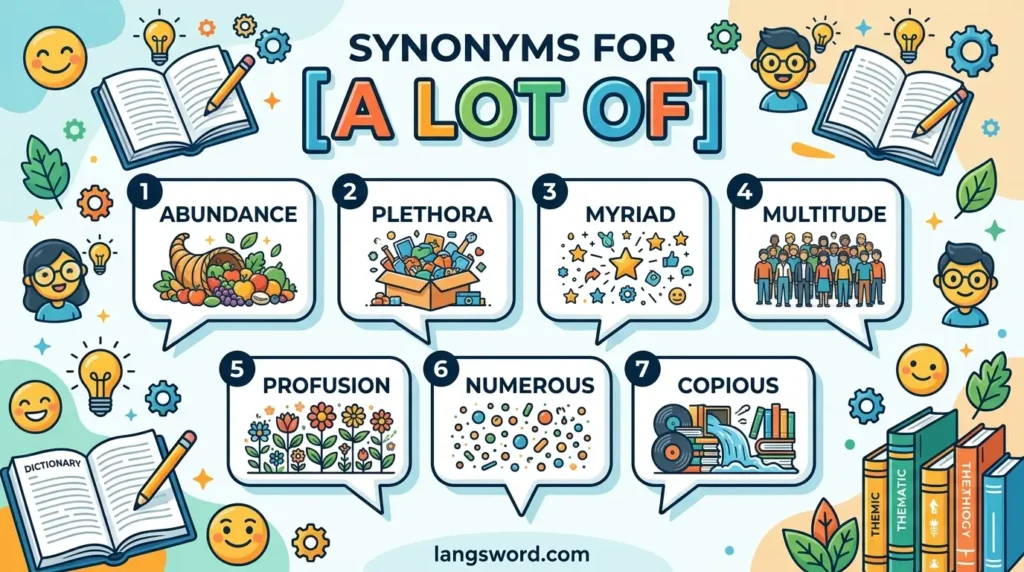

When you have a lot of something, you have a large amount or number of it. For example, you may have a lot of books on your desk, a lot of work to do, or a lot of people at a party.
The phrase “a lot of” is very common because it is simple, natural, and useful in everyday English. However, using the same phrase again and again can make your writing sound repetitive.
Learning synonyms for a lot of something helps English learners speak and write with more variety. It also helps content writers choose words that match the exact meaning and tone they need.
In this guide, we will explore the meaning of “a lot of something,” its synonyms, grammar, history, pronunciation, word formation, and semantic categories. You will also see clear examples to help you use each alternative correctly.
Meaning of synonyms for a lot of something
Definition
A lot of something (Quantifier/Phrase):
A large amount or number of something.
Examples
- I have a lot of work to finish today.
- There were a lot of people at the concert.
Connotative Meaning
Connotation (the feeling or idea a word suggests beyond its basic meaning):
- Positive tone: It can suggest plenty, richness, or abundance.
- Negative tone: It can suggest excess, difficulty, or an unwanted amount.
- Neutral tone: It can simply mean a large amount or number without a strong feeling.
Etymology
The phrase “a lot of” comes from the older noun lot, which originally referred to an object used to decide something by chance.
- Old English (450–1100): Hlot meant a share, portion, or object used in casting lots.
- Middle English (1100–1500): Lot developed meanings connected with one’s share, portion, or fate.
- Modern English (1500–Present): Lot continued to mean a portion or quantity. The phrase “a lot of” gradually became a common informal way to mean “a large amount or number of.”
The modern phrase no longer normally refers to chance. In everyday English, “a lot of” is mainly a quantifier meaning “many” or “much.”
Pronunciation (IPA)
- IPA: /ə ˈlɑːt əv/
- Syllables: a lot of
The exact vowel in lot varies by English accent. In connected speech, “of” is usually pronounced with a weak vowel.
Affixation Pattern of a lot of something
- Root: lot
- Prefix: None
- Suffix: None
- Word formations:
- lot — noun
- lots — plural noun
- lottery — noun, historically related to the idea of drawing lots
- allot — verb, meaning to give or distribute a share
- allotment — noun, meaning a share or assigned amount
The phrase “a lot of” itself is not formed by adding a prefix or suffix. It is a multi-word quantifier.
30 Synonyms of a lot of something With Meaning & Examples
1. Plenty (Noun/Quantifier)
Meaning: A large amount or number that is enough or more than enough.
Examples:
- We have plenty of food for everyone.
- There are plenty of reasons to stay.
2. Abundance (Noun)
Meaning: A very large amount of something.
Examples:
- The garden produces an abundance of vegetables.
- The region has an abundance of natural resources.
3. Abundant (Adjective)
Meaning: Existing in large amounts or numbers.
Examples:
- Fresh water is abundant in this area.
- The forest has abundant wildlife.
4. Plenty of (Quantifier)
Meaning: More than enough of something.
Examples:
- We have plenty of time.
- She brought plenty of snacks.
5. A great deal of (Quantifier)
Meaning: A large amount of something, especially an uncountable thing.
Examples:
- He spent a great deal of money.
- This project requires a great deal of effort.
6. A large amount of (Quantifier)
Meaning: A big quantity of something.
Examples:
- They used a large amount of water.
- The company spends a large amount of money on research.
7. A large number of (Quantifier)
Meaning: Many individual people or things.
Examples:
- A large number of students joined the program.
- A large number of cars use this road every day.
8. Numerous (Adjective)
Meaning: Existing in a large number.
Examples:
- The museum has numerous paintings.
- She has received numerous awards.
9. Many (Determiner/Pronoun)
Meaning: A large number of countable things or people.
Examples:
- Many people enjoy this tradition.
- We visited many interesting places.
10. Much (Determiner/Pronoun)
Meaning: A large amount of an uncountable thing.
Examples:
- We do not have much time.
- She does not need much help.
11. Loads of (Informal Quantifier)
Meaning: A very large amount or number of something.
Examples:
- We have loads of work today.
- There were loads of people at the event.
12. Tons of (Informal Quantifier)
Meaning: A very large amount or number.
Examples:
- She has tons of books.
- There are tons of things to do.
13. Heaps of (Informal Quantifier)
Meaning: A large amount or number of something.
Examples:
- We have heaps of food left.
- He received heaps of praise.
14. Masses of (Quantifier)
Meaning: A very large amount or number of something.
Examples:
- Masses of people attended the festival.
- There are masses of information online.
15. A multitude of (Noun Phrase)
Meaning: A very large number of people or things.
Examples:
- A multitude of visitors came to the museum.
- The website offers a multitude of options.
16. A plethora of (Noun Phrase)
Meaning: A very large number or amount of something.
Examples:
- The internet provides a plethora of resources.
- The store has a plethora of choices.
17. A profusion of (Noun Phrase)
Meaning: A large and often impressive amount of something.
Examples:
- The garden has a profusion of flowers.
- The report contains a profusion of details.
18. Copious (Adjective)
Meaning: Existing or produced in large amounts.
Examples:
- The researcher collected copious notes.
- The report contains copious evidence.
19. Ample (Adjective)
Meaning: Enough or more than enough for a particular need.
Examples:
- We have ample time to finish.
- The room has ample space for everyone.
20. Plentiful (Adjective)
Meaning: Available in large amounts or numbers.
Examples:
- Fresh fruit is plentiful in summer.
- Job opportunities are plentiful in the city.
21. A wealth of (Noun Phrase)
Meaning: A large and valuable amount of something.
Examples:
- The library contains a wealth of information.
- She has a wealth of experience.
22. A host of (Noun Phrase)
Meaning: A large number of people or things.
Examples:
- The plan offers a host of benefits.
- A host of problems appeared after the change.
23. A slew of (Noun Phrase)
Meaning: A large number of things or people, often used in informal or journalistic English.
Examples:
- The company launched a slew of new products.
- He received a slew of messages.
24. A stack of (Noun Phrase)
Meaning: A large pile or collection of things.
Examples:
- I have a stack of papers on my desk.
- She brought a stack of books home.
25. A pile of (Noun Phrase)
Meaning: A large collection of things placed together.
Examples:
- There is a pile of clothes on the chair.
- He has a pile of work to finish.
26. A bunch of (Informal Noun Phrase)
Meaning: A group or large amount of things or people.
Examples:
- I bought a bunch of bananas.
- A bunch of friends came over.
27. A sea of (Noun Phrase)
Meaning: A very large number of people or things spread across an area.
Examples:
- We saw a sea of people outside the stadium.
- The field was covered by a sea of flowers.
28. A vast amount of (Quantifier)
Meaning: An extremely large quantity of something.
Examples:
- The project requires a vast amount of data.
- They spent a vast amount of money.
29. A considerable amount of (Quantifier)
Meaning: A fairly large or significant quantity.
Examples:
- The project needs a considerable amount of time.
- She invested a considerable amount of money.
30. A substantial amount of (Quantifier)
Meaning: A large and important quantity.
Examples:
- The company made a substantial amount of profit.
- The work requires a substantial amount of effort.
Prototype Meaning
The most typical meaning of “a lot of something” is simply a large amount or a large number. When people hear this phrase, they usually imagine more than the normal or expected quantity.
For example, “a lot of books” suggests many books, while “a lot of water” suggests a large quantity of water. The phrase is broad and flexible, so it works with both countable and uncountable nouns.
Prototype Categorization
The 30 synonyms can be grouped by their main meaning, grammar, and level of formality:
- Everyday and simple: plenty, many, much, plenty of, a large amount of, a large number of. These are useful for normal conversation and clear writing.
- Informal expressions: loads of, tons of, heaps of, masses of, a bunch of. These sound friendly and conversational.
- Formal or academic expressions: a great deal of, numerous, copious, a considerable amount of, a substantial amount of. These are useful in reports, essays, and professional writing.
- Strong quantity expressions: abundance, abundant, a multitude of, a plethora of, a profusion of, a vast amount of. These stress that the quantity is especially large.
- Positive or valuable abundance: a wealth of, ample, plentiful. These often suggest that the amount is useful, sufficient, or desirable.
- Collection or group expressions: a host of, a slew of, a stack of, a pile of, a sea of. These can add a more specific image to the large quantity.
This categorization helps writers choose a synonym based not only on quantity but also on formality, tone, grammar, and context. For example, tons of works well in casual speech, while a substantial amount of is better suited to formal writing.
Antonyms of a lot of something
- A little (Determiner/Quantifier): A small amount of something.
- A few (Determiner/Quantifier): A small number of countable things or people.
- Little (Determiner/Pronoun): A small amount, often suggesting that it is not enough.
- Few (Determiner/Pronoun): A small number, often suggesting that it is not enough.
- Scarcity (Noun): A situation in which something is available only in small amounts.
- Lack (Noun): The absence or shortage of something.
- Shortage (Noun): A situation where there is less of something than needed.
- Minimal (Adjective): Very small in amount or degree.
Short Questions and Answers
What does a lot of something mean?
It means a large amount or number of something. It can describe both countable and uncountable nouns.
When should a lot of be used?
Use “a lot of” when you want to say that there is a large amount or number of something. It is common in everyday English and works with both countable and uncountable nouns.
Is a lot of positive or negative?
It is neutral by itself. The meaning can become positive or negative depending on the noun and context. For example, “a lot of opportunities” may sound positive, while “a lot of problems” may sound negative.
How is it different from similar words?
Different synonyms have different grammar and tones. Many is used with countable nouns, while much is used with uncountable nouns. Plenty of often means more than enough, while tons of and loads of are informal. Formal phrases such as a substantial amount of suit professional and academic writing better.
Conclusion
Learning “a lot of something” and its synonyms can greatly improve your English vocabulary. The phrase is useful because it clearly shows that something exists in a large amount or number, but repeating it too often can make writing less varied.
Words such as plenty, numerous, abundant, plentiful, loads of, a wealth of, a multitude of, and a substantial amount of give you more choices. They also help you match your language to the situation.
Some expressions are casual, while others are better for formal or academic writing. Practice using a few new alternatives each day. Read them in real sentences, write your own examples, and notice whether the noun is countable or uncountable.
With regular practice, you can make your speaking and writing clearer, richer, and more confident.