
Recipe means a set of instructions for making a dish or achieving a particular result. For example, when you want to bake a cake, you may follow a recipe that tells you what ingredients to use and what steps to take.
The word is very common in cooking, but it can also describe a method for success, such as “a recipe for success.” Learning synonyms for recipe helps English learners express ideas with greater accuracy and variety.
It also helps content writers avoid repeating the same word in articles, blogs, menus, and guides. In this article, we will explore the meaning of recipe, its synonyms, examples, grammar, history, pronunciation, word formation, and semantic categories.
Understanding these related words will help you choose the right term for cooking, processes, plans, formulas, and figurative situations.
Meaning of recipe
Definition
Recipe (Noun):
A recipe is a set of instructions that explains how to prepare a food or achieve a particular result.
Examples
- I found a simple recipe for chocolate cake.
- This recipe requires three eggs and two cups of flour.
Connotative Meaning
Connotation: The feelings or ideas that a word suggests beyond its basic meaning.
- Positive tone: A recipe can suggest skill, success, creativity, or careful preparation.
- Negative tone: In some contexts, “recipe” can suggest a fixed or overly strict method.
- Neutral tone: It can simply mean instructions for preparing food or completing a process.
Etymology
The word recipe comes from Latin recipere, meaning “to take” or “receive.” Latin recipe was an imperative form meaning “take,” traditionally used at the beginning of medical prescriptions.
- Old English (450–1100): The modern word recipe was not commonly used in Old English. Cooking instructions were expressed through other words and descriptions.
- Middle English (1100–1500): The Latin form recipe entered English through medical and prescription language. It was used to introduce directions for preparing medicine.
- Modern English (1500–Present): Recipe gradually developed its modern meaning of written instructions for preparing food. It later gained a figurative meaning, such as “a recipe for success.”
Pronunciation (IPA)
- IPA: /ˈresəpi/
- Syllables: rec-i-pe (3 syllables)
Affixation Pattern of recipe
- Root: recip- / Latin recipere
- Prefix: None in modern English
- Suffix: -e is part of the inherited word form rather than a productive English suffix.
- Word formations:
- recipe — noun
- recipes — plural noun
- recipe-like — adjective
- recipe-based — adjective
- recipe book — noun phrase
- recipe card — noun phrase
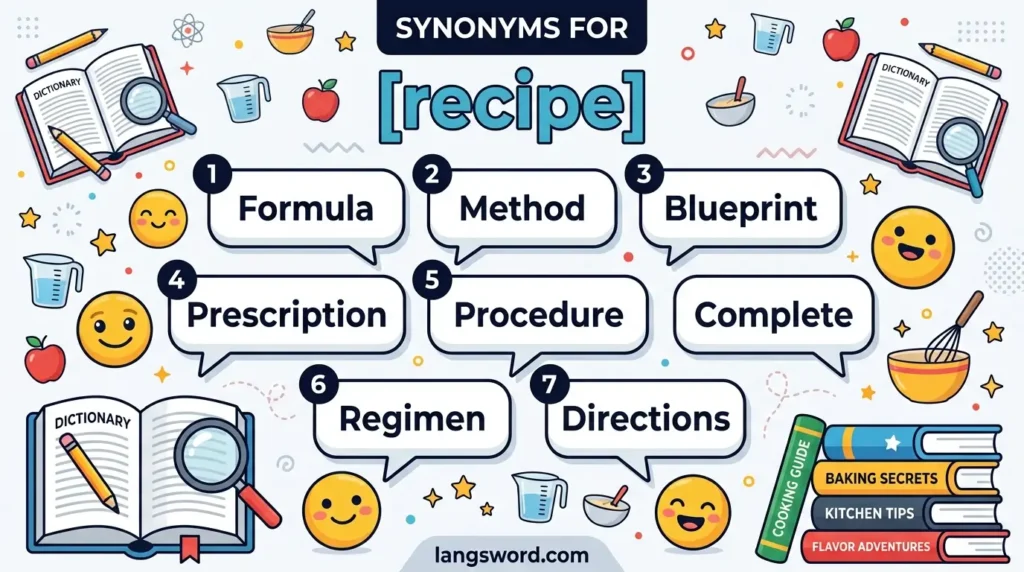
30 Synonyms of recipe With Meaning & Examples
1. Formula (Noun)
Meaning: A set of ingredients, rules, or steps used to produce a particular result.
Examples:
- This formula makes a soft and fluffy cake.
- Hard work and patience are a good formula for success.
2. Method (Noun)
Meaning: A particular way of doing or making something.
Examples:
- This method makes the vegetables taste better.
- She taught me her method for making bread.
3. Instructions (Noun)
Meaning: Information that tells someone how to do or make something.
Examples:
- Follow the instructions carefully.
- The instructions explain how to prepare the sauce.
4. Directions (Noun)
Meaning: Steps that tell someone how to prepare or complete something.
Examples:
- The package includes directions for cooking the rice.
- I followed the directions on the cake mix.
5. Guide (Noun)
Meaning: Information that helps someone complete a task correctly.
Examples:
- This guide explains how to make homemade pasta.
- The guide helped me prepare the meal.
6. Procedure (Noun)
Meaning: An established series of steps for doing something.
Examples:
- The cooking procedure is easy to follow.
- Use the correct procedure when preparing the mixture.
7. Process (Noun)
Meaning: A series of actions used to achieve a result.
Examples:
- The bread-making process takes several hours.
- She explained the process step by step.
8. Technique (Noun)
Meaning: A particular skill or way of doing something.
Examples:
- This technique gives the chicken a crispy surface.
- He learned a new technique for decorating cakes.
9. Plan (Noun)
Meaning: An organized idea or set of steps for achieving something.
Examples:
- We need a good plan for preparing dinner.
- Her plan for the meal worked perfectly.
10. Blueprint (Noun)
Meaning: A detailed plan for creating or achieving something.
Examples:
- The recipe is a blueprint for making the dish.
- The manager created a blueprint for the project.
11. Protocol (Noun)
Meaning: A formal set of rules or steps for carrying out an activity.
Examples:
- The kitchen follows a strict food-safety protocol.
- The protocol explains how the ingredients should be handled.
12. Regimen (Noun)
Meaning: A planned system of activities or actions followed regularly.
Examples:
- The nutritionist gave her a healthy eating regimen.
- His daily cooking regimen includes fresh vegetables.
13. Prescription (Noun)
Meaning: A recommended method or course of action for achieving a result.
Examples:
- The chef’s prescription for a perfect soup includes fresh herbs.
- Patience can be a useful prescription for solving problems.
14. Approach (Noun)
Meaning: A particular way of dealing with or doing something.
Examples:
- This approach makes the recipe easier to follow.
- She uses a simple approach to meal preparation.
15. System (Noun)
Meaning: An organized set of methods or rules used to achieve a goal.
Examples:
- The chef developed a simple system for preparing meals.
- Their system helps them cook several dishes quickly.
16. Framework (Noun)
Meaning: A basic structure that guides how something is done.
Examples:
- The recipe provides a useful framework for the dish.
- We need a clear framework for planning the menu.
17. Pattern (Noun)
Meaning: A repeated or established way of doing something.
Examples:
- The recipe follows a traditional pattern.
- This cooking pattern is common in the region.
18. Blueprint (Noun)
Meaning: A detailed plan that serves as a model for creating something.
Examples:
- The recipe acts as a blueprint for the dessert.
- The chef created a blueprint for the new menu.
19. Outline (Noun)
Meaning: A general description of the main steps or parts of something.
Examples:
- The recipe gives a clear outline of the cooking process.
- She wrote an outline before preparing the meal.
20. Specification (Noun)
Meaning: A detailed description of what is required.
Examples:
- The recipe provides exact specifications for each ingredient.
- Follow the specifications when preparing the mixture.
21. Instructional Guide (Noun)
Meaning: A resource that teaches someone how to complete a task.
Examples:
- The instructional guide explains how to make the dish.
- I used an instructional guide to learn bread-making.
22. Cookbook Formula (Noun)
Meaning: A standard combination of ingredients and steps used to prepare a dish.
Examples:
- The chef created a simple cookbook formula for the sauce.
- This cookbook formula works well for beginners.
23. Concoction (Noun)
Meaning: A mixture made by combining different ingredients.
Examples:
- She created a spicy concoction with fresh peppers.
- His unusual concoction became popular with guests.
24. Mixture (Noun)
Meaning: A combination of different ingredients or substances.
Examples:
- Add the flour to the mixture slowly.
- The recipe produces a smooth mixture.
25. Preparation (Noun)
Meaning: The act or process of getting something ready.
Examples:
- Meal preparation can save time during the week.
- The recipe makes food preparation easier.
26. Cookery Instructions (Noun Phrase)
Meaning: Directions that explain how to prepare food.
Examples:
- The book contains detailed cookery instructions.
- These cookery instructions are easy for beginners.
27. Cooking Instructions (Noun Phrase)
Meaning: Steps that explain how to cook a particular dish.
Examples:
- Read the cooking instructions before starting.
- The cooking instructions are printed on the package.
28. How-To (Noun)
Meaning: A set of instructions explaining how to do something.
Examples:
- I found a useful how-to for making homemade pizza.
- The website has a how-to for preparing the sauce.
29. Blueprint for Success (Noun Phrase)
Meaning: A plan or set of actions believed to help produce a successful result.
Examples:
- The book presents a blueprint for success.
- Discipline can become a blueprint for success.
30. Roadmap (Noun)
Meaning: A clear plan showing the steps needed to reach a goal.
Examples:
- The recipe provides a roadmap for making the dish.
- The training plan became a roadmap for his progress.
Prototype Meaning
The most typical meaning of recipe is a written set of instructions for preparing food. When people hear the word, they usually imagine ingredients, quantities, cooking steps, and a finished dish. A typical recipe might tell you what ingredients to use, how much of each ingredient is needed, how to combine them, and how long to cook them.
The word can also be used figuratively when a particular combination of actions or qualities is expected to create a result, as in “a recipe for success.”
Prototype Categorization
The 30 synonyms can be grouped by their main semantic use. This helps writers choose a word that matches the exact context instead of treating every synonym as interchangeable.
- Cooking and food preparation: instructions, directions, cookery instructions, cooking instructions, preparation, mixture, concoction, and cookbook formula. These work best when discussing food, ingredients, or cooking.
- General methods: method, process, procedure, technique, approach, and system. These are useful when recipe means a way of doing something.
- Plans and structures: plan, blueprint, framework, outline, pattern, and roadmap. These are useful when describing a structured way to reach a goal.
- Rules and formal systems: protocol, regimen, and specification. These words fit professional, technical, medical, or organized contexts.
- Guidance and teaching: guide, instructions, directions, instructional guide, and how-to. These emphasize helping someone complete a task.
- Figurative expressions: formula, prescription, and blueprint for success. These are especially useful when recipe describes a combination of actions or qualities that may produce an outcome.
Choosing by category helps writers avoid awkward substitutions. For example, instructions sounds natural for cooking, while protocol is more suitable for a formal procedure.
Antonyms of recipe
There is no single exact antonym for recipe. The closest opposites describe acting without a fixed set of instructions.
Improvisation (Noun)
Meaning: Creating or doing something without a prepared plan.
Spontaneity (Noun)
Meaning: Acting naturally without a fixed plan or preparation.
Guesswork (Noun)
Meaning: Trying to reach an answer without enough information or clear instructions.
Randomness (Noun)
Meaning: A lack of a predictable plan, order, or method.
Unstructured Approach (Noun Phrase)
Meaning: A way of working without an organized set of steps.
Short Questions and Answers
What does recipe mean?
Recipe usually means a set of instructions and ingredients for preparing a particular dish. It can also mean a method for achieving a result.
When should recipe be used?
Use recipe when discussing food preparation or a combination of actions that is expected to produce a particular result.
Is recipe positive or negative?
Recipe is usually neutral. Its tone depends on context. For example, “a recipe for success” has a positive tone, while “a recipe for disaster” has a negative tone.
How is it different from similar words?
Recipe is strongly connected with food and ingredients. Formula is broader and often describes a method for producing a result. Method focuses on a way of doing something, while instructions focus on directions that tell someone what to do.
Conclusion
Learning recipe and its synonyms can make English vocabulary more flexible and useful. The word usually refers to instructions for preparing food, but it can also describe a method, plan, or combination of actions that produces a result.
Words such as formula, method, instructions, directions, guide, procedure, technique, and roadmap can replace recipe in specific contexts, but each has its own meaning and tone.
Understanding these differences helps writers avoid repetition and choose more precise words. For English learners, studying synonyms also strengthens speaking and writing skills and builds confidence.
Try learning a few related words each day and use them in your own sentences. With regular practice, you will naturally develop a richer vocabulary and communicate your ideas more clearly.