
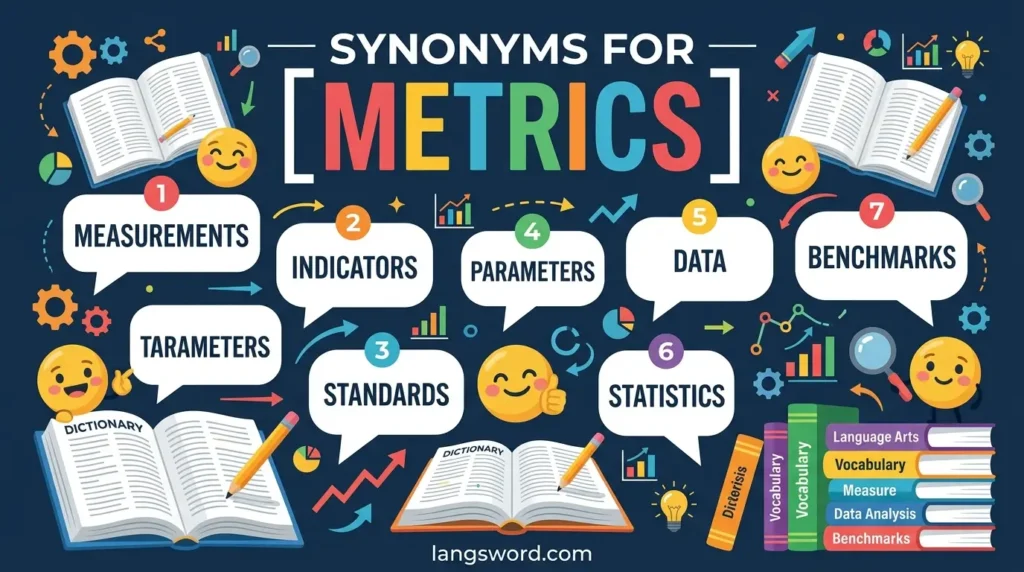

Metrics are numbers or measures used to understand how well something works. Imagine a website owner checking visitors, clicks, and sales at the end of the month. These numbers are metrics because they help show what is happening and where change may be needed.
The word is common in business, science, education, marketing, technology, and sports. Learning synonyms for metrics helps English learners use more precise words in different situations. It also helps content writers avoid repeating the same word too often.
In this guide, we will explore the meaning of metrics, its synonyms, examples, grammar, history, pronunciation, word formation, and semantic categories. By understanding these related words, you can choose the right term for reports, articles, conversations, and professional writing.
Meaning of Metrics
Definition
Metrics (Noun, plural):
Metrics are measurements or numerical values used to assess, compare, or understand the performance, condition, or progress of something.
Examples
- The marketing team reviewed its social media metrics every week.
- Sales metrics showed that the new product was performing well.
Connotative Meaning
Positive tone: Metrics can suggest progress, success, growth, and clear results.
Negative tone: Metrics can sometimes suggest excessive focus on numbers or pressure to meet targets.
Neutral tone: Metrics can simply mean measurements or data used for analysis.
(Connotation means the feeling or idea that a word suggests beyond its basic meaning.)
Etymology
The word metrics comes from metric, which is related to measurement. Its deeper origin can be traced to Greek metron, meaning “measure.” The word entered English through forms connected with Latin and French.
- Old English (450–1100): The modern word metric was not part of everyday Old English. English used other words related to measuring, counting, and size.
- Middle English (1100–1500): Forms related to Latin and French terms for measurement and poetic meter influenced English vocabulary.
- Modern English (1500–Present): Metric developed meanings connected with measurement, rhythm, and the metric system. The plural metrics later became common for sets of measurements used to judge performance, especially in business, science, and technology.
Pronunciation (IPA)
- IPA: /ˈmetrɪks/
- Syllables: met-rics
Affixation Pattern of Metrics
- Root: metr- — related to measure
- Prefix: None
- Suffix: -ic in metric, forming an adjective or noun related to measurement
- Plural ending: -s in metrics
Word formations
- meter (noun/verb): a unit or system of measurement; to measure
- metric (noun/adjective): a measurement or related to measurement
- metrics (plural noun): several measurements or performance indicators
- metrically (adverb): in a metric or measured manner
- metrical (adjective): related to meter or measurement
30 Synonyms of Metrics With Meaning & Examples
1. Measurements (Noun)
Meaning: Numbers or values that show the size, amount, or level of something.
Examples:
- The report contains measurements of customer activity.
- We recorded several measurements during the test.
2. Measures (Noun)
Meaning: Values or methods used to assess something.
Examples:
- The company uses several measures of success.
- These measures help us track progress.
3. Indicators (Noun)
Meaning: Signs or values that show a condition, trend, or result.
Examples:
- Sales are useful indicators of market demand.
- The report includes key health indicators.
4. Statistics (Noun)
Meaning: Numerical facts collected and analyzed to understand something.
Examples:
- The latest statistics show higher website traffic.
- We used statistics to study customer behavior.
5. Figures (Noun)
Meaning: Numbers that provide information about an activity or result.
Examples:
- The sales figures improved this quarter.
- The report gives figures for each department.
6. Data Points (Noun)
Meaning: Individual pieces of information used for analysis.
Examples:
- Each survey answer provides a useful data point.
- The analyst compared thousands of data points.
7. Benchmarks (Noun)
Meaning: Standards or reference points used for comparison.
Examples:
- The company set benchmarks for customer service.
- Our results were compared with industry benchmarks.
8. Standards (Noun)
Meaning: Accepted levels or rules used to judge quality or performance.
Examples:
- The school uses clear standards to measure progress.
- The product meets international standards.
9. Gauges (Noun)
Meaning: Measurements or tools that show the level or condition of something.
Examples:
- Customer reviews can be useful gauges of satisfaction.
- These figures gauge the success of the campaign.
10. Scores (Noun)
Meaning: Numbers that represent performance, quality, or achievement.
Examples:
- The website received high engagement scores.
- Students received scores based on their performance.
11. Rates (Noun)
Meaning: Numbers that show how often or how quickly something happens.
Examples:
- The company tracks customer retention rates.
- Unemployment rates changed during the year.
12. Ratios (Noun)
Meaning: Numbers that compare two quantities.
Examples:
- The report shows the ratio of visitors to buyers.
- We calculated the conversion ratio.
13. Indices (Noun)
Meaning: Numerical measures that represent changes or conditions.
Examples:
- Economic indices can show changes in prices.
- The researcher compared several market indices.
14. KPIs (Noun)
Meaning: Key performance indicators used to measure important goals.
Examples:
- The manager reviewed the team’s KPIs.
- Sales growth is one of our main KPIs.
15. Performance Indicators (Noun)
Meaning: Measurements that show how well a person, system, or organization performs.
Examples:
- Customer retention is an important performance indicator.
- The team created new performance indicators.
16. Variables (Noun)
Meaning: Factors or values that can change and affect an outcome.
Examples:
- Researchers studied several variables.
- Price was an important variable in the experiment.
17. Values (Noun)
Meaning: Numerical amounts assigned to something.
Examples:
- The system records values for each measurement.
- The values changed after the update.
18. Quantities (Noun)
Meaning: Amounts that can be counted or measured.
Examples:
- The experiment used different quantities of water.
- We recorded the quantities of materials used.
19. Assessments (Noun)
Meaning: Judgments or evaluations based on information.
Examples:
- The manager completed assessments of team performance.
- These assessments help identify areas for improvement.
20. Evaluations (Noun)
Meaning: Detailed judgments about quality, value, or performance.
Examples:
- The company conducts regular evaluations.
- Customer evaluations helped improve the service.
21. Results (Noun)
Meaning: Outcomes produced by an action, test, or process.
Examples:
- The campaign produced strong results.
- We reviewed the results before making a decision.
22. Outcomes (Noun)
Meaning: Final results of an action, process, or event.
Examples:
- The study measured several health outcomes.
- Better training can improve outcomes.
23. Statistics (Noun)
Meaning: Numerical information that describes a group, event, or trend.
Examples:
- The statistics reveal a rise in online purchases.
- We analyzed the statistics before writing the report.
24. Readings (Noun)
Meaning: Numbers shown by an instrument or measurement system.
Examples:
- The device produced accurate readings.
- We recorded the temperature readings every hour.
25. Records (Noun)
Meaning: Stored information about past events, activities, or results.
Examples:
- The company keeps records of monthly sales.
- The records show steady growth.
26. Data (Noun)
Meaning: Facts or information collected for study or analysis.
Examples:
- The team collected data from customers.
- The data supports the research findings.
27. Evidence (Noun)
Meaning: Information that helps show whether something is true or effective.
Examples:
- The metrics provided evidence of improvement.
- Researchers looked for evidence of a change.
28. Benchmarks (Noun)
Meaning: Reference points used to compare performance or progress.
Examples:
- The team exceeded its previous benchmarks.
- Industry benchmarks helped set realistic goals.
29. Targets (Noun)
Meaning: Specific results or levels that someone aims to reach.
Examples:
- The sales team reached its monthly targets.
- Managers created targets for customer growth.
30. Performance Measures (Noun)
Meaning: Specific measurements used to judge how well something works.
Examples:
- The report lists several performance measures.
- Managers use performance measures to track progress.
Prototype Meaning
The most typical meaning of metrics is numerical measurements used to track performance, progress, or results. When people hear the word, they often imagine numbers on a report, dashboard, spreadsheet, or chart.
Common examples include sales, website visits, conversion rates, customer retention, test scores, and response times. The exact meaning depends on the field and the goal being measured.
Prototype Categorization
The 30 synonyms can be grouped into several semantic categories:
- General measurement words: measurements, measures, values, quantities, readings — useful when talking about numbers or amounts.
- Performance words: indicators, KPIs, performance indicators, performance measures, scores — common in business, education, sports, and technology.
- Statistical words: statistics, figures, data, data points, indices, ratios, rates — useful for research, reports, and numerical analysis.
- Comparison words: benchmarks, standards, targets — useful when comparing actual results with a desired or accepted level.
- Evaluation words: assessments, evaluations, results, outcomes, evidence — useful when discussing judgment, effectiveness, or final effects.
- Tracking words: records, readings, gauges, variables — useful for monitoring changes over time.
This categorization helps writers choose a word that fits the exact situation. For example, KPIs suits business goals, while readings suits measurements from a device.
Antonyms of Metrics
1. Qualitative Factors (Noun)
Information based on qualities, opinions, or experiences rather than numerical measurements.
2. Subjective Judgment (Noun)
An opinion based mainly on personal feelings or views.
3. Intuition (Noun)
An understanding based on instinct rather than measured evidence.
4. Guesswork (Noun)
An attempt to reach an answer without enough reliable information.
5. Anecdote (Noun)
A short personal story used as information instead of numerical evidence.
6. Immeasurability (Noun)
The quality of being impossible or difficult to measure.
Short Questions and Answers
What does metrics mean?
Metrics means numerical measurements used to track, assess, compare, or understand performance, progress, or results.
When should metrics be used?
Use metrics when discussing measurable information, especially in business, science, marketing, education, sports, technology, and research.
Is metrics positive or negative?
Metrics is neutral by itself. Its tone depends on context. It can suggest useful measurement, but it may also suggest too much focus on numbers in some contexts.
How is it different from similar words?
Metrics is a broad term for measurements used to assess something. KPIs usually refer to especially important performance measures. Statistics focuses on numerical data and analysis. Benchmarks are reference points for comparison, while targets are results someone aims to reach.
Conclusion
Learning metrics and its synonyms can make your English more precise and flexible. Words such as measurements, indicators, statistics, KPIs, benchmarks, figures, and performance measures can describe related ideas while fitting different contexts.
This variety helps you avoid repetition in articles, reports, emails, and conversations. It also makes your writing clearer because you can select a word that matches your exact meaning. English learners can build confidence by studying these words in real sentences instead of memorizing isolated lists.
Content writers can also use semantic groups to choose natural alternatives and improve readability. Practice a few new words each day. Read them, write your own examples, and use them in conversation. Regular practice will gradually strengthen your vocabulary, writing, and speaking skills.