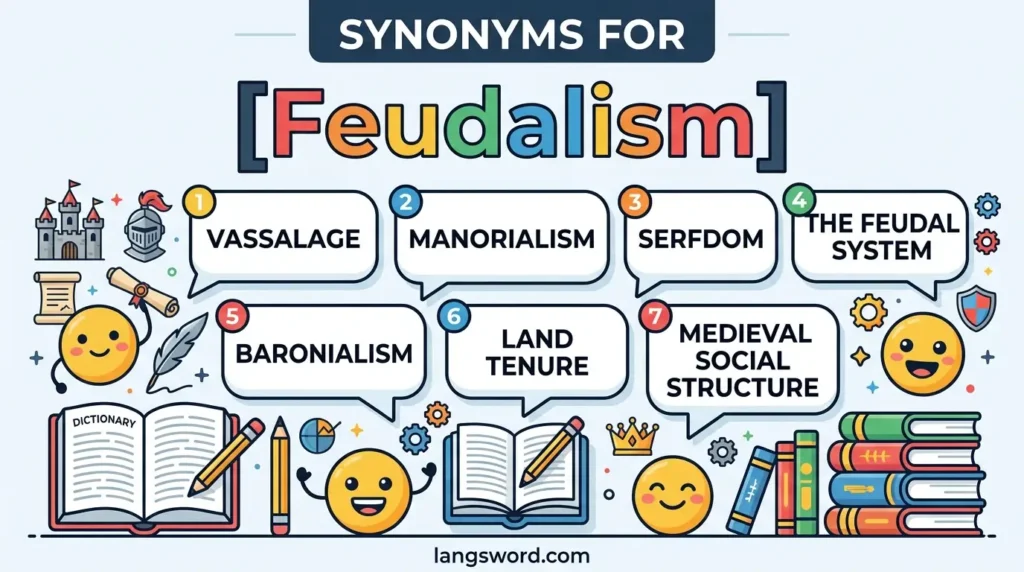

Feudalism is a social, political, and economic system based on land, loyalty, and unequal power. Imagine a medieval lord who controls a large estate while knights protect the land and peasants work the fields.
In return, people receive protection or the right to use land. This system is commonly called feudalism. The word is often used when people discuss medieval Europe, land ownership, social classes, and systems built on personal loyalty.
Learning synonyms for feudalism helps English learners understand history-related texts and gives content writers more ways to describe systems of power without repeating the same word. Some alternatives have similar meanings, while others describe one part or feature of feudal society.
This article explains the meaning, history, pronunciation, grammar, and semantic categories of feudalism. It also gives 30 useful synonyms and related terms with simple meanings and examples.
Meaning of Feudalism
Definition
Feudalism (Noun):
A medieval social, political, and economic system in which land, protection, service, and loyalty were exchanged within a strict hierarchy.
Examples
- Feudalism shaped social and political life in much of medieval Europe.
- Under feudalism, powerful landowners controlled large estates and depended on lower-ranking people for labor and military service.
Connotative Meaning
Connotation means the feelings or ideas that a word suggests beyond its basic dictionary meaning.
- Positive tone: Feudalism can suggest order, loyalty, duty, protection, and social stability when viewed from certain historical perspectives.
- Negative tone: It can suggest inequality, oppression, rigid social classes, exploitation, and concentrated power.
- Neutral tone: In historical writing, feudalism is often used as a neutral term for a system of social and political relationships based on land and service.
Etymology
The word feudalism is relatively modern, even though it describes medieval institutions.
- Old English (450–1100): The word feudalism was not part of Old English. The medieval institutions later described as feudal were developing during this broad historical period, but the English term came much later.
- Middle English (1100–1500): English borrowed related words connected with landholding and feudal relationships from French and Latin. The forms feudal and related terms developed from Medieval Latin and Old French.
- Modern English (1500–Present): Feudalism developed from feudal + -ism. Feudal ultimately comes through French féodal from Medieval Latin feudalis, meaning “of a fief.” The element feudum referred to a fief or landed property held under conditions of service. The noun feudalism became established as a term for the system associated with such relationships.
The modern historical label feudalism was created after the medieval period rather than being the name medieval Europeans universally used for their own society.
Pronunciation (IPA)
- IPA: /ˈfjuːdəlɪzəm/
- Syllables: feu-da-lism
Affixation Pattern of Feudalism
- Root: feud- / feudum — historically connected with a fief or land held under a feudal relationship.
- Prefix: None.
- Suffix: -al forms the adjective feudal; -ism forms the noun feudalism.
- Word formations:
- feud — noun/verb; historically related to a fief in some etymological contexts, though modern English feud meaning “long disagreement” has a different sense.
- feudal — adjective; relating to feudalism.
- feudally — adverb; in a feudal manner.
- feudalism — noun; a feudal social and political system.
- feudalistic — adjective; relating to or resembling feudalism.
- feudalist — noun; a person associated with or studying feudal systems.
30 Synonyms of Feudalism With Meaning & Examples
Note: Feudalism is a specialized historical term, so many words below are near-synonyms, related concepts, or context-based alternatives, rather than exact dictionary synonyms.
1. Feudal system (Noun)
Meaning: A social and political system based on landholding, hierarchy, loyalty, and service.
Examples:
- The feudal system shaped medieval political relationships.
- Knights had important roles within the feudal system.
2. Feudal society (Noun)
Meaning: A society organized around feudal relationships and social ranks.
Examples:
- Medieval Europe contained many features of a feudal society.
- Life in a feudal society was strongly influenced by social class.
3. Manorialism (Noun)
Meaning: A medieval economic and social system centered on a lord’s estate or manor.
Examples:
- Manorialism organized much of rural economic life.
- Farmers worked within the local manorial system.
4. Seigneurialism (Noun)
Meaning: A system in which lords exercised economic and social control over rural estates and their inhabitants.
Examples:
- Seigneurialism was important in parts of medieval Europe.
- The study examined landholding under seigneurialism.
5. Lordship (Noun)
Meaning: The authority or control exercised by a lord over land or people.
Examples:
- The village remained under the lordship of a powerful noble.
- His lordship included control over several estates.
6. Landed hierarchy (Noun)
Meaning: A social order in which power and status are strongly connected to land ownership.
Examples:
- The landed hierarchy gave wealthy landowners great influence.
- Social status was closely tied to the landed hierarchy.
7. Land-based hierarchy (Noun)
Meaning: A social structure in which land determines much of a person’s wealth and power.
Examples:
- A land-based hierarchy shaped medieval political life.
- The kingdom developed a strict land-based hierarchy.
8. Agrarian hierarchy (Noun)
Meaning: A social order built largely around farming, land, and control of agricultural production.
Examples:
- The kingdom had an agrarian hierarchy dominated by large landowners.
- An agrarian hierarchy affected both wealth and social status.
9. Aristocratic rule (Noun)
Meaning: Government or social control exercised mainly by members of a wealthy noble class.
Examples:
- Aristocratic rule gave nobles major political influence.
- The region remained under aristocratic rule for generations.
10. Noble rule (Noun)
Meaning: A system in which nobles hold much of the political and economic power.
Examples:
- Noble rule influenced taxation and land ownership.
- The king depended on powerful families during noble rule.
11. Landlordism (Noun)
Meaning: A system in which landowners have significant control over land and those who work or rent it.
Examples:
- Landlordism can create large differences in economic power.
- The novel criticizes the effects of landlordism on rural workers.
12. Estate system (Noun)
Meaning: A social and economic arrangement organized around large estates and their owners.
Examples:
- The estate system influenced rural life.
- Workers depended on the local estate system for access to land.
13. Manorial system (Noun)
Meaning: An organization of rural life around a lord’s manor and agricultural estate.
Examples:
- The manorial system shaped medieval farming.
- Villagers performed duties within the manorial system.
14. Vassalage (Noun)
Meaning: A relationship in which a vassal gives loyalty and service to a higher-ranking lord.
Examples:
- Vassalage created bonds between nobles and their superiors.
- Military service was often connected with vassalage.
15. Fealty (Noun)
Meaning: Formal loyalty or allegiance to a lord or ruler.
Examples:
- The knight swore fealty to his lord.
- Fealty was an important part of medieval relationships.
16. Fief-based system (Noun)
Meaning: A system organized around fiefs, or lands granted in return for service or loyalty.
Examples:
- The kingdom used a fief-based system to organize landholding.
- A fief-based system connected land with military obligations.
17. Fiefdom (Noun)
Meaning: A territory controlled by a powerful person, especially when that person acts independently.
Examples:
- The duke treated the region like his personal fiefdom.
- The manager turned the department into a private fiefdom.
18. Patronage system (Noun)
Meaning: A system in which powerful people give protection, jobs, land, or benefits in return for loyalty or support.
Examples:
- The ruler depended on a broad patronage system.
- Political power grew through the patronage system.
19. Dependency system (Noun)
Meaning: A social structure in which less powerful people depend on stronger individuals for protection or resources.
Examples:
- The village operated within a dependency system.
- A dependency system connected landowners with dependent workers.
20. Hierarchical society (Noun)
Meaning: A society organized into different levels of status and power.
Examples:
- Medieval Europe was strongly hierarchical in many respects.
- A hierarchical society gives different groups different levels of authority.
21. Social hierarchy (Noun)
Meaning: A ranked social structure in which some groups have greater status or power than others.
Examples:
- Land ownership affected the social hierarchy.
- The medieval social hierarchy placed nobles near the top.
22. Class hierarchy (Noun)
Meaning: A social structure in which groups are ranked according to wealth, status, or power.
Examples:
- The class hierarchy affected people’s opportunities.
- Wealth helped determine position in the class hierarchy.
23. Noble hierarchy (Noun)
Meaning: A ranked system among nobles and other members of the ruling elite.
Examples:
- The noble hierarchy included several levels of status.
- Military duties were linked to the noble hierarchy.
24. Serfdom (Noun)
Meaning: A system in which agricultural workers were legally tied to land controlled by a lord.
Examples:
- Serfdom restricted the freedom of many medieval peasants.
- The history course examined serfdom and rural labor.
25. Manorial economy (Noun)
Meaning: An economic system centered on a self-contained manor and agricultural production.
Examples:
- The manorial economy depended heavily on farming.
- A manorial economy often relied on the labor of peasants.
26. Land tenure system (Noun)
Meaning: A system that defines how people hold, use, and control land.
Examples:
- The kingdom had a complex land tenure system.
- Changes in the land tenure system affected rural society.
27. Tenurial system (Noun)
Meaning: A system concerning the legal holding and use of land.
Examples:
- The study focuses on the medieval tenurial system.
- The tenurial system influenced relationships between landowners and tenants.
28. Feudal order (Noun)
Meaning: A social and political order based on feudal relationships and rank.
Examples:
- The king attempted to strengthen the feudal order.
- Social status was central to the feudal order.
29. Feudal structure (Noun)
Meaning: The organized pattern of social, economic, and political relationships associated with feudalism.
Examples:
- The kingdom developed a complex feudal structure.
- The feudal structure connected landholding with political power.
30. Medieval landholding system (Noun)
Meaning: A medieval arrangement in which land ownership and land use were closely connected to social and political power.
Examples:
- The medieval landholding system shaped rural communities.
- Historians study the medieval landholding system to understand social power.
Prototype Meaning
The prototype meaning of feudalism is a medieval system in which land, power, loyalty, protection, and service were closely connected. When people hear the word, they often imagine a medieval king, powerful nobles, knights, large estates, peasants, and a strict social hierarchy. The basic idea is that land and political power were distributed through relationships of dependence and obligation.
Prototype Categorization
The 30 synonyms and related terms can be divided into several semantic groups. This helps writers choose a word based on the exact idea they want to express.
- General system terms: feudal system, feudal society, feudal order, and feudal structure describe feudalism as a whole. They are useful when discussing the complete social and political system.
- Economic and land terms: manorialism, manorial system, manorial economy, landlordism, land tenure system, tenurial system, and medieval landholding system focus on land, farming, estates, and economic organization.
- Power and social hierarchy terms: landed hierarchy, land-based hierarchy, agrarian hierarchy, aristocratic rule, noble rule, hierarchical society, social hierarchy, class hierarchy, and noble hierarchy emphasize differences in wealth, status, and authority.
- Personal relationship terms: vassalage and fealty focus on loyalty and service between people of different ranks. These words are narrower than feudalism.
- Labor and dependency terms: serfdom and dependency system emphasize the position of people who depended on powerful landowners or were tied to agricultural work.
- Territory and authority terms: lordship, fiefdom, and fief-based system focus on control of land and territory.
- Broader relationship terms: patronage system describes relationships based on benefits and loyalty. It can resemble aspects of feudalism but is not limited to medieval feudal society.
- Descriptive historical terms: feudalistic, feudal structure, and medieval landholding system are useful when a writer wants to describe historical features without claiming that every part of a society was strictly “feudal.”
This categorization helps writers avoid using a near-synonym in the wrong context. For example, serfdom is more specific than feudalism, while vassalage focuses on personal loyalty. Manorialism emphasizes the manor and rural economy. Choosing the right term makes historical writing more precise.
Antonyms of Feudalism
Because feudalism describes a complex social system, it has no single perfect antonym. However, these terms can describe systems with contrasting features:
1. Egalitarianism (Noun)
A belief or system that promotes greater social and political equality.
2. Democracy (Noun)
A system in which political power is exercised by the people, usually through voting.
3. Social equality (Noun)
A condition in which people have equal social status and rights.
4. Meritocracy (Noun)
A system in which status or advancement is based mainly on ability or achievement.
5. Free-market system (Noun)
An economic system in which voluntary exchange and market forces play a major role.
6. Republicanism (Noun)
A political system based on representative government rather than hereditary monarchy.
7. Individualism (Noun)
A social or political idea that places strong importance on individual freedom and independence.
8. Social mobility (Noun)
The ability of people to move between different social or economic levels.
Short Questions and Answers
What does feudalism mean?
Feudalism refers to a historical social, political, and economic system strongly associated with medieval Europe, involving landholding, hierarchy, loyalty, protection, and service.
When should feudalism be used?
Use feudalism when discussing the historical system or describing a society that has characteristics associated with feudal relationships. In historical writing, it is best to use the term carefully because historians debate how accurately the label describes different medieval societies.
Is feudalism positive or negative?
It depends on context. In neutral historical writing, feudalism is mainly descriptive. In other contexts, it may carry negative associations with inequality, rigid class structures, exploitation, or concentrated power.
How is it different from similar words?
Feudalism describes a broad system. Serfdom focuses on the legal and social condition of agricultural workers tied to land.
Vassalage focuses on relationships of loyalty and service. Manorialism focuses more on the economic and social organization of the manor. Lordship refers to a lord’s authority, while fealty means loyalty or allegiance.
Conclusion
Learning feudalism and its synonyms can greatly improve English vocabulary, especially for students, researchers, history learners, and content writers. The word describes a complex system connected with land, loyalty, social rank, protection, and power.
Its related terms, such as feudal system, manorialism, vassalage, serfdom, and land tenure system, help writers describe specific parts of that system with greater accuracy. Understanding these differences also helps avoid repetition and makes historical writing clearer and more precise.
For English learners, studying synonyms provides more ways to express ideas in speaking and writing. It also builds confidence when reading difficult texts. Practice one new word each day, write a few sentences with it, and compare it with related words. Regular vocabulary practice is a simple way to develop stronger English skills.