
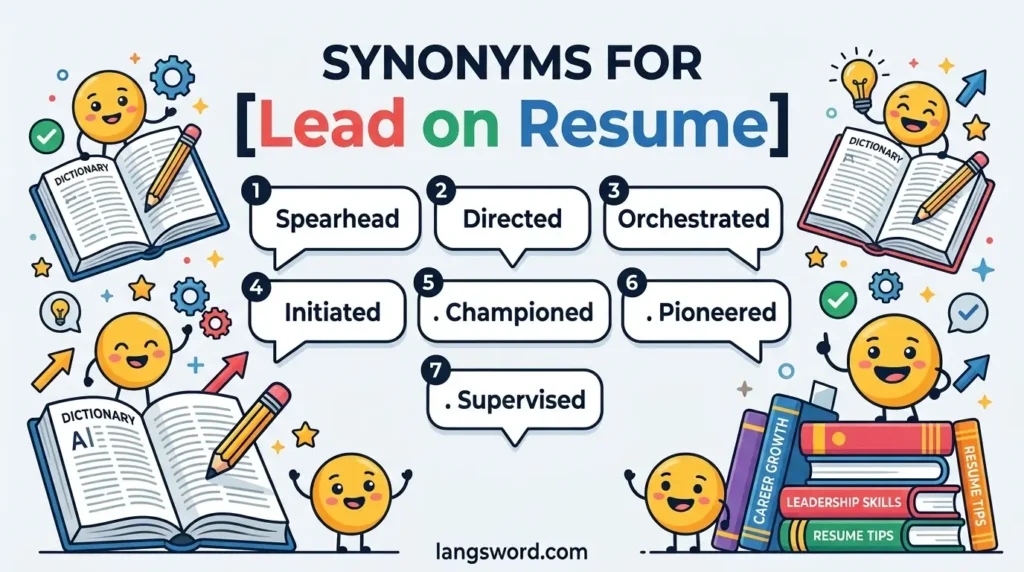

When you write a resume, the word lead often shows that you guided people, managed work, or took charge of an important task. For example, you might write, “I led a team of five designers during a major project.”
The word is common because it quickly shows responsibility and action. However, using lead again and again can make a resume sound repetitive.
Learning synonyms for lead on resume can help English learners and content writers build stronger vocabulary and choose more precise words. Different synonyms can show different skills, such as managing people, directing projects, guiding a team, or taking charge of an activity.
In this article, we will explain the meaning of lead on resume, its synonyms, examples, grammar, history, pronunciation, word formation, antonyms, and semantic categories.
Meaning of Lead on Resume
Definition
Lead (Verb):
To guide, manage, direct, or take responsibility for a person, team, project, or activity.
On a resume, lead usually describes an action where you had responsibility and helped others or a project move toward a goal.
Examples
- I led a team of 10 employees to complete the project on time.
- She led the marketing campaign and increased customer engagement.
Connotative Meaning
Connotation: The feeling or idea that a word suggests beyond its basic meaning.
- Positive tone: Shows responsibility, confidence, initiative, and leadership.
- Negative tone: In some contexts, it may suggest being overly controlling or forceful.
- Neutral tone: Simply describes guiding or directing people, work, or activities.
Etymology
The verb lead comes from Old English lǣdan, meaning “to guide,” “to conduct,” or “to bring.” It is related to the idea of showing someone a way or taking someone toward a place or goal.
- Old English (450–1100): Lǣdan meant to guide, bring, conduct, or cause to go.
- Middle English (1100–1500): The word developed into forms such as leden and continued to mean guide or direct.
- Modern English (1500–Present): Lead developed its modern meanings, including guiding people, managing teams, directing projects, and being first or most important.
Pronunciation (IPA)
- IPA: See the pronunciation card for the exact phrase.
- Syllables: lead / on / res-u-mé
Affixation Pattern of Lead
- Root: lead
- Prefix: None
- Suffix: None
- Word formations:
- lead — verb/noun
- leads — verb/noun
- led — past-tense verb
- leading — adjective/verb/noun
- leader — noun
- leadership — noun
- leaderless — adjective
30 Synonyms of Lead on Resume With Meaning & Examples
1. Manage (Verb)
Meaning: To control, organize, and be responsible for people or work.
Examples:
- I managed a team of eight sales representatives.
- She managed several projects at the same time.
2. Direct (Verb)
Meaning: To guide people or activities toward a specific goal.
Examples:
- I directed a team during a company-wide project.
- He directed daily operations for the department.
3. Head (Verb)
Meaning: To be the person in charge of a group, department, or project.
Examples:
- I headed the product development team.
- She headed a successful recruitment campaign.
4. Supervise (Verb)
Meaning: To watch, guide, and manage the work of others.
Examples:
- I supervised 12 employees across two shifts.
- He supervised daily warehouse operations.
5. Oversee (Verb)
Meaning: To be responsible for checking and managing a process or activity.
Examples:
- I oversaw the company’s customer service operations.
- She oversaw the project from planning to completion.
6. Guide (Verb)
Meaning: To help people or a team move toward a goal.
Examples:
- I guided a team through a major software upgrade.
- She guided new employees during their first month.
7. Coordinate (Verb)
Meaning: To organize people or activities so they work well together.
Examples:
- I coordinated a team of designers and developers.
- He coordinated several departments during the event.
8. Directed (Verb)
Meaning: To managed or controlled a project, team, or activity.
Examples:
- I directed a customer service improvement project.
- She directed the company’s digital marketing efforts.
9. Administer (Verb)
Meaning: To manage or organize a system, process, or program.
Examples:
- I administered the company’s employee training program.
- She administered daily office operations.
10. Govern (Verb)
Meaning: To control or manage an organization, system, or process.
Examples:
- I governed internal procedures for the department.
- The manager governed the team’s quality standards.
11. Steer (Verb)
Meaning: To guide a project, team, or organization toward a desired result.
Examples:
- I steered the project toward successful completion.
- She steered the team through a period of rapid growth.
12. Drive (Verb)
Meaning: To strongly push an activity, project, or change forward.
Examples:
- I drove improvements in customer satisfaction.
- He drove the company’s digital transformation strategy.
13. Champion (Verb)
Meaning: To strongly support and promote an idea, project, or cause.
Examples:
- I championed a new employee training program.
- She championed improvements in workplace communication.
14. Spearhead (Verb)
Meaning: To be the main person responsible for starting or leading an important activity.
Examples:
- I spearheaded a new customer retention program.
- She spearheaded the company’s website redesign.
15. Initiate (Verb)
Meaning: To start a project, process, or activity.
Examples:
- I initiated a new employee development program.
- He initiated improvements to the sales process.
16. Launch (Verb)
Meaning: To officially start a project, product, service, or campaign.
Examples:
- I launched a new digital marketing campaign.
- She launched the company’s first online training program.
17. Organize (Verb)
Meaning: To arrange people, tasks, or activities in an effective way.
Examples:
- I organized a cross-functional project team.
- She organized several company training events.
18. Facilitate (Verb)
Meaning: To make a process, meeting, or activity easier and more effective.
Examples:
- I facilitated weekly team meetings.
- He facilitated communication between technical and sales teams.
19. Mentor (Verb)
Meaning: To guide and support someone in developing skills or knowledge.
Examples:
- I mentored five junior employees.
- She mentored new team members throughout the year.
20. Coach (Verb)
Meaning: To train and guide someone to improve performance or skills.
Examples:
- I coached new employees on sales techniques.
- He coached junior managers on team leadership.
21. Train (Verb)
Meaning: To teach people the skills and knowledge they need for a job.
Examples:
- I trained a team of new customer service agents.
- She trained employees on the new software system.
22. Delegate (Verb)
Meaning: To give tasks or responsibilities to other people.
Examples:
- I delegated tasks across a team of eight employees.
- He delegated project responsibilities to team members.
23. Mobilize (Verb)
Meaning: To organize people or resources for a particular purpose.
Examples:
- I mobilized a team to respond to customer needs.
- She mobilized staff during the company’s annual event.
24. Orchestrate (Verb)
Meaning: To carefully organize several people or activities to achieve a result.
Examples:
- I orchestrated a successful product launch.
- She orchestrated collaboration between five departments.
25. Manage (Verb)
Meaning: To handle people, resources, or tasks in an organized way.
Examples:
- I managed multiple client accounts.
- He managed a busy operations team.
26. Control (Verb)
Meaning: To have responsibility and authority over a process or activity.
Examples:
- I controlled project budgets and schedules.
- She controlled inventory operations across three locations.
27. Command (Verb)
Meaning: To have authority over a team or group.
Examples:
- I commanded a team responsible for field operations.
- He commanded a large operations unit.
28. Advise (Verb)
Meaning: To give guidance that helps someone make a decision or take action.
Examples:
- I advised team members on project priorities.
- She advised senior managers on operational issues.
29. Empower (Verb)
Meaning: To give people the confidence, authority, or resources to act.
Examples:
- I empowered team members to make customer decisions.
- She empowered employees to suggest process improvements.
30. Take Charge of (Verb Phrase)
Meaning: To accept responsibility and become responsible for an activity or situation.
Examples:
- I took charge of the company’s onboarding process.
- She took charge of a team during a critical project.
Prototype Meaning
The most typical meaning of lead on a resume is to guide or manage people, projects, or activities toward a goal. When recruiters see the word lead, they often imagine someone who takes responsibility, makes decisions, organizes work, and helps a team achieve results.
The exact meaning depends on the context. For example, lead a team focuses on people, while lead a project focuses on responsibility for an activity or outcome.
Prototype Categorization
The 30 synonyms can be grouped into semantic categories. This helps writers choose a word that matches the exact skill they want to show.
- Management and responsibility: Manage, oversee, administer, govern, and control describe responsibility for people, systems, or operations.
- Direction and guidance: Direct, guide, steer, command, and take charge of emphasize giving direction.
- Project leadership: Spearhead, drive, champion, initiate, launch, and orchestrate work well when describing major projects or changes.
- Team development: Mentor, coach, train, advise, and empower focus on helping people learn, improve, or perform better.
- Organization and teamwork: Coordinate, organize, facilitate, delegate, and mobilize emphasize arranging people, tasks, and resources.
- Formal authority: Head, command, and govern can suggest a higher level of formal responsibility.
- Change and action: Drive, champion, spearhead, initiate, and launch can show that you actively started or pushed an important effort forward.
Choosing the right category helps writers avoid using a synonym simply because it sounds impressive. The best word should match the actual responsibility described in the resume.
Antonyms of Lead
1. Follow (Verb)
Meaning: To accept direction from another person rather than giving it.
2. Assist (Verb)
Meaning: To help another person who has primary responsibility.
3. Support (Verb)
Meaning: To help a person, team, or project without being the main leader.
4. Obey (Verb)
Meaning: To follow instructions or orders from someone with authority.
5. Trail (Verb)
Meaning: To come behind another person or group rather than being ahead.
6. Yield (Verb)
Meaning: To give control or authority to another person.
Short Questions and Answers
What does lead mean?
Lead means to guide, manage, direct, or take responsibility for people, projects, or activities. On a resume, it often shows leadership and responsibility.
When should lead be used?
Use lead when you were responsible for guiding a team, project, process, campaign, or important activity. Use a more specific synonym when it better describes what you actually did.
Is lead positive or negative?
Lead is usually neutral to positive on a resume because it can show responsibility and initiative. Its effect depends on the sentence and the context.
How is it different from similar words?
Lead is a broad word. Manage focuses on handling people or resources. Supervise emphasizes monitoring employees.
Coordinate focuses on organizing people or activities. Mentor focuses on developing people, while spearhead suggests taking the main role in starting or driving an important project.
Conclusion
Learning synonyms for lead on resume can make your professional writing clearer and more precise. Instead of repeating lead, you can choose words such as manage, direct, oversee, coordinate, mentor, spearhead, or champion based on your actual role.
These words help show different skills, from managing employees to starting projects and developing team members. Strong vocabulary also helps English learners communicate with more confidence in professional settings.
For resume writers, varied action verbs can make job descriptions more specific and easier to understand. However, the best synonym is not always the strongest-sounding word.
It should accurately describe what you did. Practice using a few new leadership verbs each day, and your English vocabulary, speaking, and professional writing will become stronger over time.