
Met is the past tense and past participle of meet. We use it when talking about seeing, joining, encountering, or being introduced to someone. For example, you may say, “I met my new teacher yesterday,” or “We met at the station after work.”
The word is common because meeting people, places, needs, goals, and challenges is part of daily life. Learning synonyms for met helps English learners use more precise words and avoid repeating the same term.
It also helps content writers make their writing clearer and more varied. In this guide, we will explore the meaning of met, its synonyms, examples, grammar, history, pronunciation, word formation, antonyms, and semantic categories.
These alternatives can help you choose the right word for different situations, from meeting a person to fulfilling a need or facing a challenge.
Meaning of Met
Definition
Met (Verb):
Met is the past tense and past participle of meet, meaning to come together with someone, encounter someone or something, or satisfy a need, condition, or goal.
Examples
- I met my best friend at school.
- We met the deadline before Friday.
Connotative Meaning
Connotation means the feeling or idea that a word suggests beyond its basic meaning.
- Positive tone: It can suggest a pleasant encounter, such as meeting a friend or an inspiring person.
- Negative tone: In some contexts, it can suggest an unwanted encounter, such as meeting an enemy or a difficult problem.
- Neutral tone: It can simply describe two people coming together without showing any strong feeling.
Etymology
The word met comes from the verb meet, which has a long history in English.
- Old English (450–1100): Meet developed from Old English mētan, meaning “to meet, find, or come upon.”
- Middle English (1100–1500): Forms such as meten and mete were used for coming together, encountering, or finding.
- Modern English (1500–Present): Meet became the standard modern form, while met developed as its irregular past tense and past participle.
Pronunciation (IPA)
- IPA: /met/
- Syllables: one syllable — met
Affixation Pattern of Met
- Root: meet
- Prefix: None
- Suffix: None
- Word formation: met is an irregular inflected form of meet, formed through a historical vowel change rather than by adding a normal suffix.
Related forms include:
- meet — verb
- met — past tense and past participle of the verb
- meeting — noun/verb form
- meets — third-person singular verb
- meetable — adjective, meaning capable of being met or satisfied
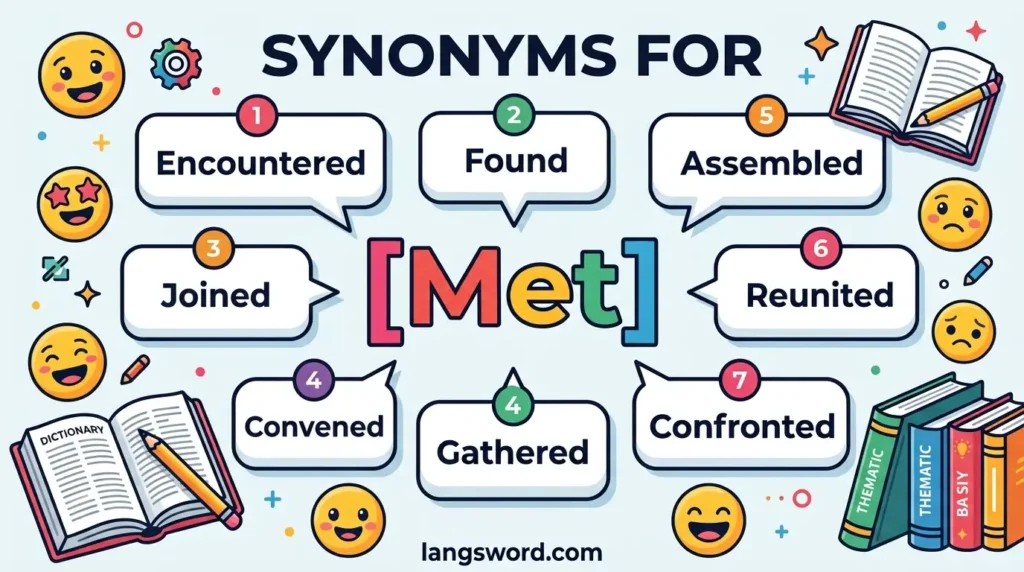
30 Synonyms of Met With Meaning & Examples
1. Encountered (Verb)
Meaning: Came across or came into contact with someone or something.
Examples:
- I encountered an old friend downtown.
- She encountered several problems at work.
2. Saw (Verb)
Meaning: Came into the presence of or viewed someone or something.
Examples:
- I saw my teacher at the market.
- We saw each other after many years.
3. Visited (Verb)
Meaning: Went to see a person or place.
Examples:
- I visited my uncle last weekend.
- They visited their friends during the holidays.
4. Joined (Verb)
Meaning: Came together with others for an activity or event.
Examples:
- She joined us for dinner.
- He joined the team for the meeting.
5. Gathered (Verb)
Meaning: Came together in one place.
Examples:
- The students gathered in the hall.
- We gathered at the restaurant at noon.
6. Assembled (Verb)
Meaning: Came together as a group.
Examples:
- The committee assembled for an important discussion.
- The workers assembled in the main office.
7. Convened (Verb)
Meaning: Came together for a formal meeting.
Examples:
- The board convened on Monday.
- The judges convened to discuss the case.
8. Encountered (Verb)
Meaning: Came into contact with a person, situation, or problem.
Examples:
- We encountered a friendly guide.
- They encountered a serious obstacle.
9. Came Across (Phrasal Verb)
Meaning: Found or met someone or something unexpectedly.
Examples:
- I came across an old classmate online.
- She came across an interesting article.
10. Ran Into (Phrasal Verb)
Meaning: Met someone unexpectedly.
Examples:
- I ran into my cousin at the mall.
- We ran into our old neighbors yesterday.
11. Crossed Paths With (Phrase)
Meaning: Met or encountered someone during life or a particular situation.
Examples:
- I crossed paths with him at university.
- She crossed paths with many talented artists.
12. Encountered Personally (Verb Phrase)
Meaning: Met or experienced someone directly.
Examples:
- I encountered personally the leader I had read about.
- She had encountered personally many famous writers.
13. Consulted (Verb)
Meaning: Met or spoke with someone to get advice or information.
Examples:
- We consulted an expert before making a decision.
- She consulted her lawyer about the issue.
14. Conferred With (Verb Phrase)
Meaning: Discussed something with another person, usually formally.
Examples:
- The manager conferred with the staff.
- She conferred with her adviser before applying.
15. Interviewed (Verb)
Meaning: Met someone to ask questions, often for work or research.
Examples:
- The reporter interviewed the actor.
- I interviewed three candidates yesterday.
16. Introduced Yourself to (Verb Phrase)
Meaning: Met someone for the first time and told them who you were.
Examples:
- I introduced myself to the new student.
- She introduced herself to the manager.
17. Encountered for the First Time (Verb Phrase)
Meaning: Met or experienced someone or something for the first time.
Examples:
- I encountered him for the first time in college.
- We encountered this problem for the first time last year.
18. Faced (Verb)
Meaning: Came into direct contact with a problem, challenge, or situation.
Examples:
- The company faced a serious challenge.
- We faced many difficulties during the project.
19. Confronted (Verb)
Meaning: Met or dealt directly with a difficult person, problem, or situation.
Examples:
- She confronted the problem calmly.
- The team confronted several challenges.
20. Experienced (Verb)
Meaning: Went through or came into contact with something.
Examples:
- He experienced many difficulties abroad.
- I experienced a similar problem last year.
21. Fulfilled (Verb)
Meaning: Satisfied a requirement, promise, need, or expectation.
Examples:
- The project fulfilled all the requirements.
- She fulfilled her promise.
22. Satisfied (Verb)
Meaning: Provided what was needed or required.
Examples:
- The product satisfied the customer’s needs.
- He satisfied all the conditions.
23. Achieved (Verb)
Meaning: Successfully reached a goal or result.
Examples:
- The team achieved its target.
- She achieved her goal after years of work.
24. Reached (Verb)
Meaning: Successfully arrived at or attained a goal, standard, or level.
Examples:
- We reached our sales target.
- The company reached its annual goal.
25. Attained (Verb)
Meaning: Successfully gained or reached something desired.
Examples:
- He attained a high level of skill.
- The organization attained its target.
26. Fulfilled the Requirements (Verb Phrase)
Meaning: Did everything necessary to satisfy stated conditions.
Examples:
- The applicant fulfilled the requirements for the job.
- The building fulfilled the requirements of the new law.
27. Observed (Verb)
Meaning: Acted according to a rule, condition, or requirement.
Examples:
- The company observed all safety requirements.
- The researchers observed the required standards.
28. Kept (Verb)
Meaning: Followed or honored a promise, agreement, or commitment.
Examples:
- She kept her promise.
- He kept his commitment to the team.
29. Honored (Verb)
Meaning: Followed through on a promise, agreement, or obligation.
Examples:
- The company honored its agreement.
- He honored his promise to help.
30. Dealt With (Phrasal Verb)
Meaning: Handled or faced a person, problem, or situation.
Examples:
- We dealt with the problem quickly.
- She dealt with a difficult customer.
Prototype Meaning
The most typical meaning of met is came together with or encountered someone, usually in the past. When people hear met, they often imagine two or more people coming together for the first time or seeing each other after some time.
For example, “I met Sarah yesterday” usually means that the speaker saw or spent time with Sarah. However, met can also describe satisfying a requirement, reaching a goal, or dealing with a challenge.
Prototype Categorization
The 30 alternatives above cover several related meanings. This grouping helps writers choose a word that fits the exact situation instead of treating every synonym as interchangeable.
- Meeting or encountering people: encountered, saw, visited, came across, ran into, crossed paths with, and introduced yourself to describe personal contact.
- Formal meetings: joined, gathered, assembled, convened, consulted, and conferred with work well for planned or professional situations.
- First-time contact: introduced yourself to and encountered for the first time focus on a new personal experience.
- Facing problems or situations: faced, confronted, experienced, and dealt with are useful when met refers to a challenge rather than a person.
- Satisfying requirements: fulfilled, satisfied, observed, and fulfilled the requirements describe rules, conditions, or needs.
- Reaching goals: achieved, reached, and attained are useful when met means successfully reaching a target.
- Keeping promises or commitments: kept and honored fit situations involving promises, agreements, or obligations.
Antonyms of Met
1. Avoided (Verb)
Meaning: Stayed away from someone or something.
2. Missed (Verb)
Meaning: Failed to meet, see, catch, or reach someone or something.
3. Ignored (Verb)
Meaning: Chose not to notice or respond to someone or something.
4. Avoided Contact With (Verb Phrase)
Meaning: Deliberately stayed away from another person.
5. Failed (Verb)
Meaning: Did not achieve a goal or satisfy a requirement.
6. Rejected (Verb)
Meaning: Refused to accept or agree to something.
7. Separated (Verb)
Meaning: Moved apart instead of coming together.
8. Departed (Verb)
Meaning: Left instead of staying together or meeting.
Short Questions and Answers
What does met mean?
Met is the past tense and past participle of meet. It can mean came together with someone, encountered something, satisfied a requirement, or reached a goal.
When should met be used?
Use met when talking about a past meeting, encounter, or successful fulfillment of a condition or goal. For example, “I met my friend yesterday” describes a past meeting.
Is met positive or negative?
Met is usually neutral. Its emotional meaning depends on the context. Meeting a friend may feel positive, while meeting a serious problem may feel negative.
How is it different from similar words?
Met is broad and common. Encountered often suggests an unexpected experience, convened suggests a formal meeting, faced focuses on a challenge, and fulfilled focuses on satisfying a need or requirement.
Conclusion
Learning met and its synonyms can make English communication more flexible and precise. The word met has several meanings, so the best alternative depends on the situation. Words such as encountered, gathered, and convened can describe different types of meetings.
Words such as faced and confronted work better for challenges, while fulfilled, satisfied, and achieved can describe requirements or goals. Knowing these differences helps English learners avoid repetition and choose words that match their meaning.
It also helps writers create clearer and more natural content. Regular vocabulary practice is one of the easiest ways to build confidence. Try learning a few alternatives each day and use them in your own sentences.