
Oligarchy means a system in which a small group of powerful people controls a country, organization, or institution. Imagine a company where three wealthy owners make every major decision while thousands of workers have little say.
That situation can be described as an oligarchy when power stays in the hands of a small group. The word is commonly used in politics, history, business, and social studies.
Learning synonyms for oligarchy helps English learners understand different shades of meaning and avoid using the same word again and again. It also helps content writers choose precise words for different contexts.
In this guide, we explore the meaning, examples, grammar, history, pronunciation, word formation, and semantic categories of oligarchy. We also examine 30 synonyms and related terms with simple meanings and examples.
Meaning of Oligarchy
Definition
Oligarchy (Noun):
A system of government or control in which a small group of powerful people holds most of the power.
Examples
- The country was ruled by an oligarchy of wealthy families.
- Critics said that the company had become an oligarchy controlled by a few executives.
Connotative Meaning
Positive tone: In rare contexts, it may suggest stable leadership by a small group of experienced people.
Negative tone: It often suggests unfair concentration of power, wealth, or influence.
Neutral tone: It can simply describe rule or control by a small group without judging that system.
(Connotation: the feeling or idea that a word suggests beyond its basic meaning.)
Etymology
The word oligarchy comes from Ancient Greek oligarkhia, meaning “government by the few.” It combines oligos, meaning “few” or “small,” with arkhein, meaning “to rule” or “to govern.”
- Old English (450–1100): The word oligarchy was not part of ordinary Old English vocabulary. The concept was known through other ideas about rule by a small group.
- Middle English (1100–1500): The Greek-derived term entered English much later through learned and Latin-influenced vocabulary.
- Modern English (1500–Present): Oligarchy became established as a political and social term meaning government or control by a small group.
Pronunciation (IPA)
- IPA: /ˈɒlɪɡɑːrki/
- Syllables: ol-i-gar-chy
Affixation Pattern of oligarchy
- Root: Greek olig- / oligos, meaning “few” or “little”
- Prefix: None in modern English
- Suffix: -archy, a combining form related to “rule” or “government”
- Word formations:
- oligarchy — noun: rule or control by a small group
- oligarch — noun: a person who belongs to or benefits from an oligarchy
- oligarchic — adjective: relating to oligarchy
- oligarchical — adjective: relating to or resembling an oligarchy
- oligarchically — adverb: in an oligarchic way
- oligarchism — noun: the practice or system of oligarchic rule
- oligarchize — verb: to make oligarchic; rare usage
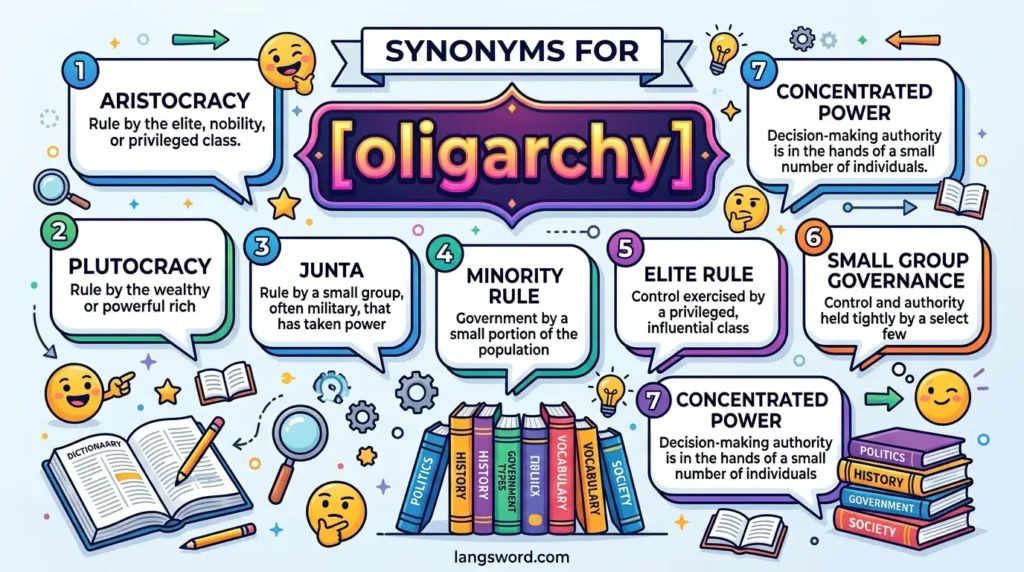
30 Synonyms of oligarchy With Meaning & Examples
1. Plutocracy (Noun)
Meaning: A system in which wealthy people hold most of the political power.
Examples:
- The writer described the government as a plutocracy dominated by wealthy families.
- Critics argued that the system had developed into a plutocracy.
2. Aristocracy (Noun)
Meaning: A system in which a privileged upper class holds major power.
Examples:
- The old kingdom was governed by an aristocracy.
- The aristocracy controlled much of the country’s land.
3. Elite rule (Noun Phrase)
Meaning: A system in which a small, powerful social group controls important decisions.
Examples:
- The reform movement opposed years of elite rule.
- The country had a long history of elite rule.
4. Minority rule (Noun Phrase)
Meaning: A situation in which a small group has political power over the larger population.
Examples:
- The constitution was criticized for allowing minority rule.
- The people demanded an end to minority rule.
5. Rule by the few (Noun Phrase)
Meaning: Government or control exercised by a small number of people.
Examples:
- The philosopher described oligarchy as rule by the few.
- Rule by the few can limit broad public participation.
6. Elite government (Noun Phrase)
Meaning: Government controlled mainly by a powerful social or economic elite.
Examples:
- The nation moved from elite government toward wider participation.
- Elite government gave wealthy families strong influence.
7. Autocracy (Noun)
Meaning: A system in which one person has very great or complete power.
Examples:
- The country changed from oligarchy to autocracy.
- Under the autocracy, political power was highly centralized.
8. Tyranny (Noun)
Meaning: Cruel or oppressive rule by a person or small group.
Examples:
- The people rebelled against years of tyranny.
- The novel presents the council’s rule as tyranny.
9. Despotism (Noun)
Meaning: A system of government in which power is used in a harsh and unrestricted way.
Examples:
- The revolution challenged decades of despotism.
- The ruler was accused of creating a system of despotism.
10. Dictatorship (Noun)
Meaning: A system in which one person or a small group holds extensive political power.
Examples:
- The nation lived under a military dictatorship.
- The dictatorship restricted political opposition.
11. Junta (Noun)
Meaning: A small group, often military leaders, that takes control of a government.
Examples:
- A military junta took control after the crisis.
- The junta announced new political measures.
12. Coterie (Noun)
Meaning: A small, closely connected group that shares influence or interests.
Examples:
- A powerful coterie influenced the ruler’s decisions.
- The leader depended on a small coterie of advisers.
13. Cabal (Noun)
Meaning: A small secretive group that works together to control or influence events.
Examples:
- The newspaper claimed that a political cabal controlled the decisions.
- A small cabal gained unusual influence over the council.
14. Clique (Noun)
Meaning: A small, exclusive group that controls access, influence, or social power.
Examples:
- A powerful clique controlled the organization.
- The ruling clique resisted changes to the system.
15. Power elite (Noun Phrase)
Meaning: A small group of people with great political, economic, or social influence.
Examples:
- The power elite played a major role in national policy.
- Many workers felt excluded from the decisions of the power elite.
16. Ruling elite (Noun Phrase)
Meaning: The small group that holds the main positions of power.
Examples:
- The ruling elite controlled important institutions.
- Reformers called for greater participation beyond the ruling elite.
17. Governing elite (Noun Phrase)
Meaning: A small group that directs the government or major institutions.
Examples:
- The governing elite introduced several new laws.
- Public pressure forced the governing elite to consider reform.
18. Dominant class (Noun Phrase)
Meaning: A social or economic class with greater power and influence than others.
Examples:
- The dominant class controlled much of the nation’s wealth.
- The novel explores conflict between the dominant class and workers.
19. Privileged class (Noun Phrase)
Meaning: A social group with special advantages, rights, or access to power.
Examples:
- The privileged class enjoyed special political rights.
- Reformers challenged the influence of the privileged class.
20. Ruling class (Noun Phrase)
Meaning: The social group that controls or strongly influences a government or society.
Examples:
- The ruling class opposed the proposed reforms.
- Much of the country’s wealth belonged to the ruling class.
21. Oligarchic rule (Noun Phrase)
Meaning: A form of rule in which power is concentrated among a small group.
Examples:
- The constitution was designed to prevent oligarchic rule.
- Historians debate the extent of oligarchic rule in the period.
22. Concentrated rule (Noun Phrase)
Meaning: A system in which political or organizational power is held by very few people.
Examples:
- Concentrated rule can reduce public participation.
- The movement opposed concentrated rule by a small leadership group.
23. Concentrated power (Noun Phrase)
Meaning: A situation in which a small number of people hold a large amount of power.
Examples:
- The reform aimed to reduce concentrated power.
- Concentrated power can make institutions less open to public influence.
24. Power monopoly (Noun Phrase)
Meaning: A situation in which control or influence is held almost entirely by one group.
Examples:
- The party was accused of creating a power monopoly.
- The new law was intended to break the group’s power monopoly.
25. Political monopoly (Noun Phrase)
Meaning: A situation in which one group has nearly complete control over political power.
Examples:
- The opposition challenged the ruling party’s political monopoly.
- Years of political monopoly limited competition.
26. Minority government (Noun Phrase)
Meaning: A government that does not hold a majority of seats in a legislature.
Examples:
- The minority government needed support from other parties.
- The country operated under a minority government for several years.
27. Timocracy (Noun)
Meaning: A form of government in which political power is linked to property, honor, or wealth.
Examples:
- The philosopher compared timocracy with other forms of government.
- Timocracy has a specific meaning in classical political theory.
28. Aristocratic rule (Noun Phrase)
Meaning: Government or control by members of an aristocratic or privileged class.
Examples:
- Aristocratic rule lasted for generations.
- The revolution challenged aristocratic rule.
29. Oligarchism (Noun)
Meaning: The practice or system of organizing power around a small ruling group.
Examples:
- The historian examined oligarchism in ancient political systems.
- The article discusses the dangers associated with oligarchism.
30. Small-group rule (Noun Phrase)
Meaning: A system in which a small number of people make most important decisions.
Examples:
- The organization moved away from small-group rule.
- Small-group rule can leave ordinary members with little influence.
Prototype Meaning
The most typical meaning of oligarchy is rule by a small and powerful group. When people hear the word, they often imagine a few wealthy, influential, or politically connected people making major decisions while most citizens have limited influence. The group may gain power through wealth, family connections, military influence, political positions, or control of important institutions.
Prototype Categorization
The 30 synonyms and related terms can be grouped by their main meaning. This helps writers choose a word that matches the exact situation instead of treating every term as identical.
- Wealth-based rule: plutocracy, power elite, privileged class, and dominant class focus on wealth or economic status.
- Class-based rule: aristocracy, aristocratic rule, ruling class, and privileged class emphasize social class and inherited or established status.
- Small-group control: elite rule, minority rule, rule by the few, elite government, and small-group rule highlight the number of people holding power.
- Political concentration: oligarchic rule, concentrated rule, concentrated power, political monopoly, and power monopoly emphasize the centralization of influence.
- Secretive or exclusive groups: coterie, cabal, and clique describe small groups with strong influence, often outside formal government.
- Strong or oppressive government: autocracy, tyranny, despotism, dictatorship, and junta describe forms of concentrated rule that may involve one ruler or a small group. They are related to oligarchy but are not exact synonyms.
- Historical or theoretical terms: timocracy and oligarchism are more specialized terms used in political theory or historical discussion.
This categorization helps writers select words based on whether they want to emphasize wealth, social class, group size, political control, secrecy, or oppressive power.
Antonyms of oligarchy
Democracy (Noun)
Meaning: A system in which political power is exercised by the people, directly or through elected representatives.
Popular rule (Noun Phrase)
Meaning: Government in which ordinary citizens have a broad role in political power.
Majority rule (Noun Phrase)
Meaning: A decision-making system in which the choice supported by more than half of the participants prevails.
Egalitarianism (Noun)
Meaning: The belief that people should have equal rights, status, or opportunities.
Political equality (Noun Phrase)
Meaning: The principle that citizens should have equal political rights and influence.
Participatory government (Noun Phrase)
Meaning: Government that gives citizens broad opportunities to take part in political decisions.
Representative democracy (Noun Phrase)
Meaning: A democratic system in which citizens choose representatives to make political decisions for them.
Short Questions and Answers
What does oligarchy mean?
Oligarchy means a system in which a small group of people holds most of the power or control.
When should oligarchy be used?
Use oligarchy when describing political, social, economic, or organizational power that is concentrated in the hands of a small group.
Is oligarchy positive or negative?
The word is usually negative in everyday use because it often suggests unfair or excessive concentration of power. However, its basic meaning is descriptive and can be used neutrally in academic or historical writing.
How is it different from similar words?
Oligarchy focuses on rule by a small group. Plutocracy focuses on wealthy people holding power. Aristocracy focuses on a privileged social class. Autocracy focuses mainly on one person having extensive power, while dictatorship describes a system of highly concentrated political authority. Therefore, these words overlap but are not interchangeable in every sentence.
Conclusion
Learning oligarchy and its synonyms gives English learners more ways to discuss power, government, society, and leadership. Words such as plutocracy, aristocracy, minority rule, and elite rule can express different parts of the idea, while terms such as autocracy and dictatorship describe related but distinct systems.
Knowing these differences improves vocabulary and helps writers avoid repetition. It also makes writing more accurate because the writer can choose a word that fits the exact meaning and tone. For English learners, studying synonyms strengthens both writing and speaking skills.
It also builds confidence when discussing complex topics. Try learning a few new words each day, then use them in your own sentences. Regular practice is one of the best ways to make new vocabulary active and natural.