
Along with means “together with” or “in addition to.” Imagine saying, “I went to the park along with my sister.” The phrase shows that your sister went with you. Along with is common in everyday English because it connects people, things, or ideas in a simple way.
However, using the same phrase again and again can make writing sound dull. Learning synonyms helps English learners speak and write with more variety. It also helps content writers choose words that fit the exact meaning, tone, and context.
In this guide, we will explain the meaning of along with, its synonyms, examples, grammar, etymology, pronunciation, word formation, antonyms, and semantic categories. These details will help you understand not only what the phrase means, but also when each alternative sounds natural.
Meaning of Along With
Definition
Along with (Prepositional phrase):
Means together with someone or something, or in addition to someone or something.
Examples
- Sarah went to the meeting along with her manager.
- Please send the application along with your documents.
Connotative Meaning
Connotation: The feeling or idea that a word or phrase suggests beyond its basic meaning.
- Positive tone: It can suggest cooperation, company, or inclusion.
- Negative tone: It may sometimes suggest an unwanted extra, depending on context.
- Neutral tone: It usually means that two people or things are present or included together.
Etymology
The phrase along with is made from the older words along and with.
- Old English (450–1100): Along developed from forms related to Old English andlang, meaning “extended” or “throughout the length of.” With came from Old English wið, meaning “against,” “toward,” or “in opposition to.”
- Middle English (1100–1500): The forms of along and with changed over time. Along developed meanings connected with movement beside or through something.
- Modern English (1500–Present): Along with became an established phrase meaning “together with” or “in addition to.”
Pronunciation (IPA)
- IPA: /əˈlɔːŋ wɪð/
- Syllables: a-long with
Affixation Pattern of Along With
Along with is a multi-word phrase rather than a single word, so it does not have a normal prefix-and-suffix pattern.
- Root: along + with
- Prefix: None
- Suffix: None
- Word formations:
- along — adverb/preposition
- with — preposition
- along with — prepositional phrase
30 Synonyms of Along With With Meaning & Examples
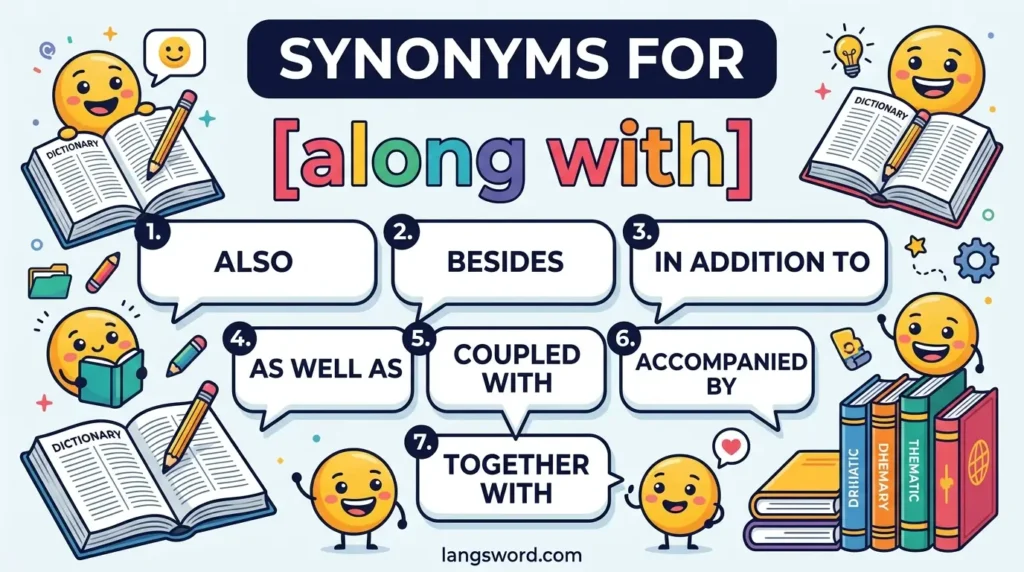
1. Together With (Prepositional Phrase)
Meaning: Means in the company of someone or something.
Examples:
- She arrived together with her friends.
- He submitted the form together with his passport.
2. As Well As (Conjunction/Prepositional Phrase)
Meaning: Means in addition to someone or something.
Examples:
- She speaks French as well as English.
- The package includes a charger as well as a cable.
3. In Addition To (Prepositional Phrase)
Meaning: Means added to something already mentioned.
Examples:
- In addition to coffee, we serve tea.
- In addition to his salary, he receives a bonus.
4. Accompanied By (Participial Phrase)
Meaning: Means being together with or attended by someone or something.
Examples:
- The singer was accompanied by a pianist.
- The letter was accompanied by several photographs.
5. Alongside (Preposition/Adverb)
Meaning: Means beside or together with someone or something.
Examples:
- She worked alongside experienced teachers.
- The new system operates alongside the old one.
6. With (Preposition)
Meaning: Means together with or in the company of someone or something.
Examples:
- I went with my brother.
- She brought her laptop with her.
7. Plus (Preposition/Conjunction)
Meaning: Means in addition to something.
Examples:
- The price is $20, plus tax.
- We need chairs plus two large tables.
8. And (Conjunction)
Meaning: Connects two or more people, things, or ideas.
Examples:
- Tom and Jerry went outside.
- Bring your passport and your ticket.
9. In Conjunction With (Prepositional Phrase)
Meaning: Means together with, especially for a shared action or purpose.
Examples:
- The project was completed in conjunction with local schools.
- The treatment works in conjunction with regular exercise.
10. In Combination With (Prepositional Phrase)
Meaning: Means used or occurring together with something else.
Examples:
- Use this cream in combination with sunscreen.
- The drug works in combination with other treatments.
11. Coupled With (Participial Phrase)
Meaning: Means joined or combined with something else.
Examples:
- Hard work, coupled with patience, can bring success.
- High demand, coupled with low supply, raised prices.
12. In Company With (Prepositional Phrase)
Meaning: Means together with another person or group.
Examples:
- He traveled in company with his colleagues.
- She attended the event in company with her parents.
13. In the Company of (Prepositional Phrase)
Meaning: Means while being with another person or group.
Examples:
- He felt relaxed in the company of his friends.
- She enjoyed dinner in the company of her family.
14. Hand in Hand With (Prepositional Phrase)
Meaning: Means closely connected or happening together.
Examples:
- Education goes hand in hand with opportunity.
- Economic growth often comes hand in hand with social change.
15. Side by Side With (Prepositional Phrase)
Meaning: Means next to or working closely with someone or something.
Examples:
- The two teams worked side by side with local volunteers.
- She sat side by side with her sister.
16. In Tandem With (Prepositional Phrase)
Meaning: Means working or happening together.
Examples:
- The two systems operate in tandem with each other.
- The campaign runs in tandem with a public education program.
17. In Partnership With (Prepositional Phrase)
Meaning: Means working together with another person or organization.
Examples:
- The charity works in partnership with local hospitals.
- The company launched the project in partnership with a university.
18. In Collaboration With (Prepositional Phrase)
Meaning: Means working together to achieve a shared goal.
Examples:
- The report was written in collaboration with several researchers.
- We created the course in collaboration with teachers.
19. In Association With (Prepositional Phrase)
Meaning: Means connected or working together with someone or something.
Examples:
- The event was organized in association with a local charity.
- The study was completed in association with a university.
20. In Concert With (Prepositional Phrase)
Meaning: Means acting together or in agreement with someone or something.
Examples:
- The agencies worked in concert with local officials.
- The changes were made in concert with community groups.
21. Joined By (Participial Phrase)
Meaning: Means accompanied or met by another person or group.
Examples:
- She was joined by her brother at lunch.
- The speaker was joined by two experts.
22. Accompanied With (Prepositional Phrase)
Meaning: Means provided or presented together with something else.
Examples:
- The meal was accompanied with fresh vegetables.
- The gift came accompanied with a short note.
23. Together Alongside (Adverbial Phrase)
Meaning: Means together beside or in cooperation with something or someone.
Examples:
- The new system works together alongside existing tools.
- Volunteers worked together alongside local residents.
24. Besides (Preposition/Adverb)
Meaning: Means in addition to someone or something.
Examples:
- Besides English, she studies Spanish.
- Who came besides John?
25. Additionally (Adverb)
Meaning: Means also or in addition.
Examples:
- The course is affordable. Additionally, it is easy to access.
- Additionally, students receive free materials.
26. Also (Adverb)
Meaning: Means in addition or too.
Examples:
- She is a teacher and also a writer.
- He also brought some food.
27. Moreover (Adverb)
Meaning: Means in addition to what has already been said, often in formal writing.
Examples:
- The plan is affordable. Moreover, it is easy to use.
- The product is strong. Moreover, it is lightweight.
28. Over and Above (Prepositional Phrase)
Meaning: Means in addition to something else.
Examples:
- She received benefits over and above her regular salary.
- Over and above the basic fee, there was a service charge.
29. On Top of (Prepositional Phrase)
Meaning: Means in addition to something, often with an idea of an extra item or burden.
Examples:
- On top of the rent, we pay a service fee.
- He had to finish his homework on top of his chores.
30. Not to Mention (Phrase)
Meaning: Means adding another important point or item to what has already been discussed.
Examples:
- The trip was expensive, not to mention exhausting.
- She has experience, not to mention excellent communication skills.
Prototype Meaning
The most typical meaning of along with is “together with” or “in addition to.” When people hear this phrase, they usually imagine two or more people, objects, or ideas being connected or included together. For example, “Ali came along with his friend” clearly shows that Ali and his friend came together.
Prototype Categorization
The 30 synonyms can be grouped into useful semantic categories:
- Direct companionship: together with, with, accompanied by, in company with, in the company of, joined by — these focus on people or things being together.
- Addition: as well as, in addition to, plus, besides, also, additionally, moreover, over and above, on top of — these emphasize adding another item or idea.
- Cooperation: in conjunction with, in partnership with, in collaboration with, in association with, in concert with, in tandem with — these show people or groups working together.
- Combination: in combination with, coupled with, together alongside — these stress two things being combined.
- Close connection: alongside, hand in hand with, side by side with — these suggest closeness, parallel action, or strong connection.
- Extra information: not to mention — this adds another point that the speaker considers important.
This categorization helps writers choose a synonym based on meaning. A phrase about teamwork may need in collaboration with, while a simple list may need as well as or in addition to.
Antonyms of Along With
1. Without (Preposition)
Meaning: Not having or being accompanied by someone or something.
2. Apart From (Prepositional Phrase)
Meaning: Separate from or excluding something.
3. Separately (Adverb)
Meaning: In a separate way rather than together.
4. Alone (Adverb/Adjective)
Meaning: Without another person or group.
5. Instead Of (Prepositional Phrase)
Meaning: Used as a replacement for someone or something.
Short Questions and Answers
What does along with mean?
Along with means “together with” or “in addition to.” It connects people, things, or ideas.
When should along with be used?
Use along with when you want to show that someone or something is included with another person or thing.
Is along with positive or negative?
Along with is usually neutral. Its tone depends on the sentence and the situation.
How is it different from similar words?
Along with often shows inclusion or companionship. As well as focuses more on addition, while in collaboration with focuses on people working together.
Conclusion
Learning along with and its synonyms can make your English more flexible and natural. The phrase is useful for showing companionship, inclusion, or addition, but repeating it too often can make your writing sound less varied.
Words and phrases such as together with, as well as, in addition to, alongside, plus, in conjunction with, and in collaboration with give you more choices. Each synonym has its own meaning, tone, and best use.
Understanding these differences can improve both speaking and writing. It can also help content writers create clearer and more engaging text without unnecessary repetition.
Practice a few synonyms each day, use them in your own sentences, and notice how native speakers use them. With regular practice, your vocabulary will grow and your English confidence will become stronger.