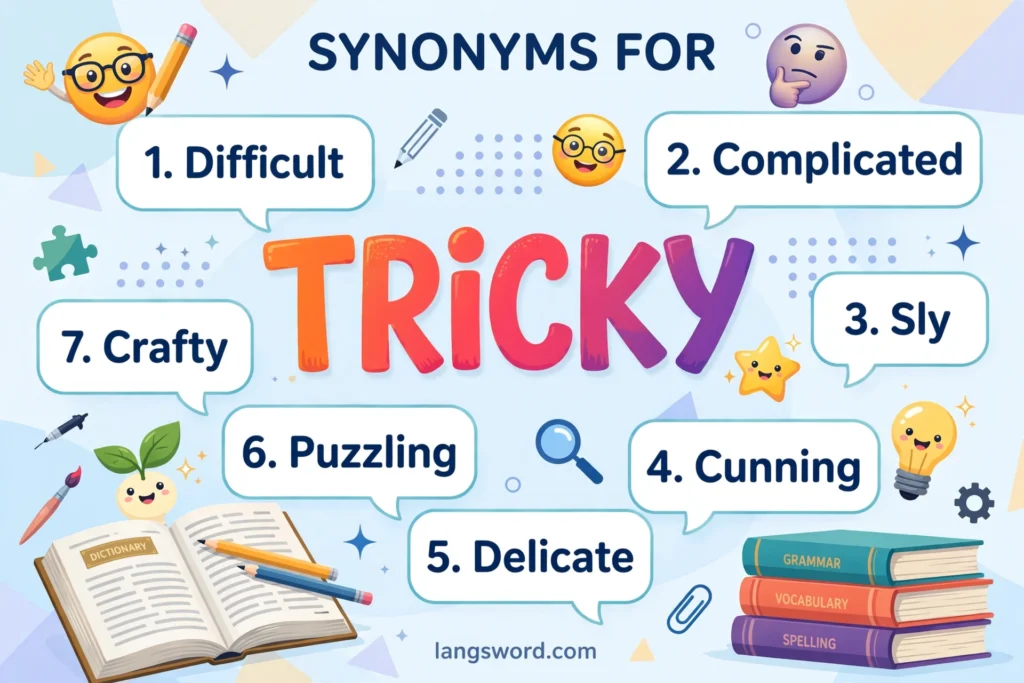

Tricky means hard to do or hard to deal with. Think of a tricky exam question. You read it twice, but the answer is still not clear. Or think of a tricky knot in a rope. You pull and pull, yet it will not open. Life is full of such moments. That is why people use this word so often. We use it for hard tasks, tough problems, and even sly people. Learning synonyms for tricky helps English learners speak with more color and choice. It also helps writers avoid the same dull words again and again. In this article, you will learn the meaning of tricky. You will study 30 synonyms with meanings and examples. We will also cover its grammar, history, pronunciation, and word groups in a simple way.
Meaning of Tricky
Definition
Tricky (Adjective): Hard to do or deal with; something that needs care and skill. It can also describe a person who is sly or not fully honest.
Examples
- The last question on the test was very tricky.
- Be careful with that old lock; it is a bit tricky to open.
Connotative Meaning
- Positive tone: It can sound fun and clever, like a tricky puzzle that tests your brain in a good way.
- Negative tone: It can suggest risk or dishonesty, like a tricky salesman who hides the truth.
- Neutral tone: It can simply mean that a task needs care, with no good or bad feeling.
(Connotation: the feelings and ideas a word brings to mind, apart from its plain meaning.)
Etymology
- Old English (450–1100): The word tricky did not exist in Old English. English speakers of that time had no such word.
- Middle English (1100–1500): The base word trick entered English in this period, from Old North French trique, which meant deceit or trickery.
- Modern English (1500–Present): The adjective tricky was formed by adding the suffix -y to trick. It came into common use in the 1700s and 1800s, first for sly people and later for hard tasks.
Pronunciation (IPA)
- IPA: /ˈtrɪki/
- Syllables: trick · y (2 syllables)
Affixation Pattern of Tricky
- Root: trick
- Prefix: None
- Suffix: -y (an adjective suffix that means “full of” or “having the quality of”)
- Word formations:
- trickier (Comparative Adjective)
- trickiest (Superlative Adjective)
- trickily (Adverb)
- trickiness (Noun)
- trick (Verb)
- trick (Noun)
- trickster (Noun)
30 Synonyms of Tricky With Meaning & Examples
1. Difficult (Adjective)
Meaning: Not easy; hard to do, understand, or deal with.
Examples:
- This math problem is difficult for young students.
- It was a difficult decision for the whole family.
2. Hard (Adjective)
Meaning: Not easy; needing much effort or skill.
Examples:
- The exam was hard, but she passed it.
- This wood is hard to cut with a small knife.
3. Challenging (Adjective)
Meaning: Hard in a way that tests your skill and effort.
Examples:
- Climbing the steep hill was challenging but fun.
- Her new job is challenging, and she loves it.
4. Tough (Adjective)
Meaning: Hard to do or deal with; strong and not easy to beat.
Examples:
- The team faced a tough match on Saturday.
- He asked a tough question in class today.
5. Complex (Adjective)
Meaning: Made of many parts that are hard to understand.
Examples:
- The machine has a complex design.
- Rules of the game are complex for new players.
6. Complicated (Adjective)
Meaning: Hard to understand because of many parts or steps.
Examples:
- The form is long and complicated to fill in.
- Their plan sounds too complicated to work.
7. Delicate (Adjective)
Meaning: Needing careful and gentle handling.
Examples:
- It was a delicate talk with her angry boss.
- The glass art is delicate, so hold it with care.
8. Awkward (Adjective)
Meaning: Hard to handle or deal with in a smooth way.
Examples:
- The box is an awkward shape to carry.
- He fell into an awkward silence at the party.
9. Problematic (Adjective)
Meaning: Full of problems; hard to fix or deal with.
Examples:
- The old car is problematic and breaks down often.
- His rude tone was problematic for the team.
10. Thorny (Adjective)
Meaning: Full of hard problems, like a bush full of thorns.
Examples:
- Money is a thorny issue in their marriage.
- The leaders met to solve the thorny dispute.
11. Knotty (Adjective)
Meaning: Full of knots or hard problems that are tough to solve.
Examples:
- The lawyer faced a knotty legal case.
- We spent hours on one knotty math puzzle.
12. Perplexing (Adjective)
Meaning: Very confusing and hard to understand.
Examples:
- The strange noise was perplexing to everyone.
- She gave a perplexing answer to a simple question.
13. Puzzling (Adjective)
Meaning: Hard to understand, like a puzzle with no clear answer.
Examples:
- His sudden exit was puzzling to his friends.
- The map shows a puzzling path through the hills.
14. Confusing (Adjective)
Meaning: Hard to follow or understand clearly.
Examples:
- The road signs are confusing for new drivers.
- His long speech was confusing and dull.
15. Demanding (Adjective)
Meaning: Needing much time, care, skill, or effort.
Examples:
- Nursing is a demanding job with long hours.
- The course is demanding but worth the effort.
16. Sly (Adjective)
Meaning: Clever in a secret and dishonest way.
Examples:
- The sly fox stole the hen at night.
- He gave a sly smile and said nothing.
17. Cunning (Adjective)
Meaning: Skilled at fooling others to get what one wants.
Examples:
- The cunning thief planned each step with care.
- She used a cunning trick to win the game.
18. Crafty (Adjective)
Meaning: Skilled at tricks and clever plans, often to fool others.
Examples:
- The crafty seller raised the price at the last minute.
- A crafty old cat waited near the fish bowl.
19. Deceitful (Adjective)
Meaning: Not honest; likely to lie or hide the truth.
Examples:
- His deceitful words hurt his best friend.
- A deceitful ad can fool many buyers.
20. Deceptive (Adjective)
Meaning: Likely to make you believe something that is not true.
Examples:
- The calm sea can be deceptive in a storm season.
- His kind face was deceptive; he was not kind at all.
21. Slippery (Adjective)
Meaning: Hard to trust or catch; avoiding the truth.
Examples:
- The slippery salesman changed his story twice.
- She is slippery in talks and never gives a clear answer.
22. Sneaky (Adjective)
Meaning: Doing things in secret, often in a dishonest way.
Examples:
- The sneaky cat took food from the table.
- He took a sneaky look at her test paper.
23. Wily (Adjective)
Meaning: Full of clever tricks to fool or beat others.
Examples:
- The wily general won with a smart plan.
- A wily negotiator knows when to stay silent.
24. Devious (Adjective)
Meaning: Not direct or honest; using hidden plans.
Examples:
- The devious clerk stole money in small parts.
- She took a devious path to reach her goal.
25. Scheming (Adjective)
Meaning: Always making secret plans to gain power or profit.
Examples:
- The scheming manager tried to push his rival out.
- In the story, a scheming uncle wants the family land.
26. Artful (Adjective)
Meaning: Clever and skilled, sometimes in a sly way.
Examples:
- He gave an artful answer that pleased both sides.
- The artful dodger slipped away from the police.
27. Foxy (Adjective)
Meaning: Sly and clever like a fox.
Examples:
- The foxy trader always finds a hidden deal.
- She is foxy in business and hard to fool.
28. Shifty (Adjective)
Meaning: Looking or acting dishonest; not to be trusted.
Examples:
- The shifty man kept looking at the door.
- His shifty eyes made the guard watch him closely.
29. Underhanded (Adjective)
Meaning: Secret and unfair; not open or honest.
Examples:
- He used underhanded tricks to win the contract.
- An underhanded move in the game made fans angry.
30. Evasive (Adjective)
Meaning: Avoiding a clear answer or the truth.
Examples:
- The leader was evasive when asked about the cost.
- Her evasive reply made the teacher ask again.
Prototype Meaning
When people hear the word tricky, they first think of a task that looks easy but is not. They picture a hard puzzle, a tough exam question, or a knot that will not open. The thing needs careful thought and a slow, skilled hand. This is the core image of the word: a problem that can fool you if you rush or fail to pay attention.
Prototype Categorization
- Hard tasks: difficult, hard, tough, challenging, demanding. Use these for work, exams, and jobs that need effort.
- Complex and confusing: complex, complicated, knotty, perplexing, puzzling, confusing. Use these when a thing has many parts or is hard to understand.
- Needs care: delicate, awkward, problematic, thorny. Use these for talks, issues, and things that can go wrong if handled badly.
- Clever and sly: sly, cunning, crafty, wily, artful, foxy. Use these for smart people or plans that use tricks.
- Dishonest and secretive: deceitful, deceptive, sneaky, devious, scheming, slippery, shifty, underhanded, evasive. Use these when a person hides the truth or acts in secret.
These groups help writers pick the exact word for each moment. A test can be challenging, a talk can be delicate, and a person can be sly — one group for each kind of idea.
Antonyms of Tricky
Easy (Adjective)
Simple to do; needing little effort.
Simple (Adjective)
Easy to understand or do; not complex.
Straightforward (Adjective)
Clear and direct, with no hidden problems.
Honest (Adjective)
Truthful and fair; not hiding anything.
Clear (Adjective)
Easy to see or understand.
Plain (Adjective)
Simple and easy to understand, with nothing hidden.
Uncomplicated (Adjective)
Not complex; free of hard parts or problems.
Direct (Adjective)
Going in a straight line; open and without tricks.
Short Questions and Answers
What does tricky mean?
Tricky means hard to do or deal with. A tricky thing needs care and skill. It can also describe a sly person who is not fully honest.
When should tricky be used?
Use it for hard tasks, tough questions, and problems that need care. You can also use it for a person who uses clever tricks and hides the truth.
Is tricky positive or negative?
It can be both. It is positive for a fun puzzle or a clever plan. It is negative when it means risky, dishonest, or hard in a bad way.
How is it different from similar words?
Difficult is the plain word for something hard. Tricky adds the idea of a catch or a trap — it can fool you. That is why a question can be both difficult and tricky.
Conclusion
In the end, tricky is a small word with rich use in daily life. Its 30 synonyms give you many ways to name hard tasks and sly people. Learning these words will grow your vocabulary bit by bit. They will also make your writing and speaking fresh, clear, and strong. You will no longer repeat the same words in every line. Each new word adds power to your English and builds your confidence. So make it a daily habit. Learn one new word each day, say it aloud, and use it in a sentence of your own. Small steps each day will turn your English into a skill you can trust.