
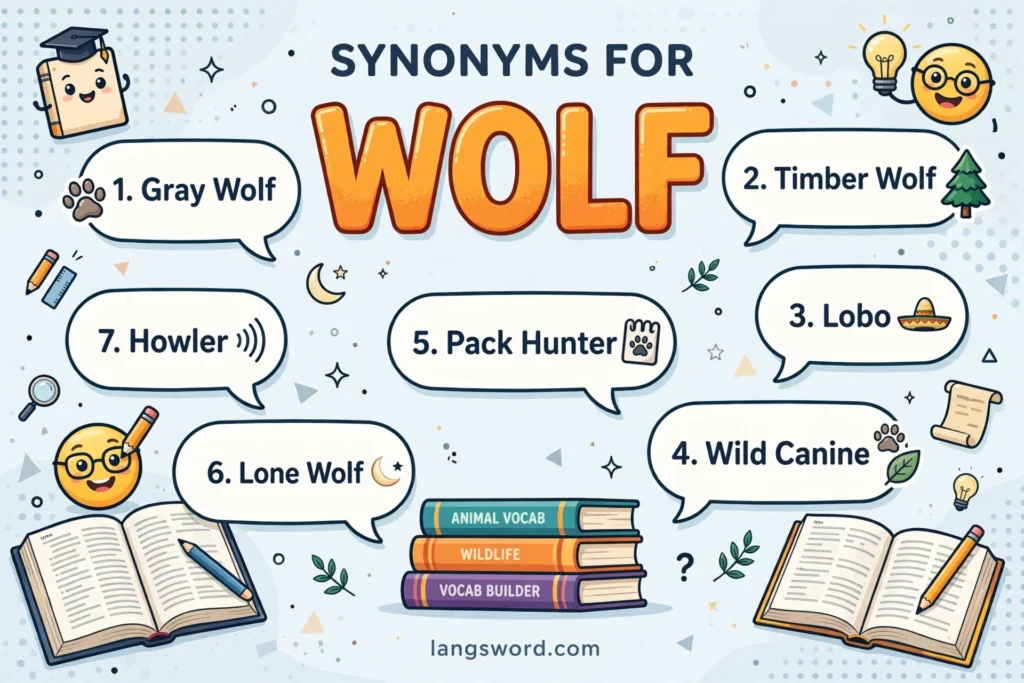

A wolf is a wild animal. It looks like a big dog, and it lives in forests and cold lands. On a dark night, a wolf lifts its head and howls at the moon. Children hear this sound in stories, like the tale of the boy who cried wolf. People use this word a lot in books, films, and daily talk. It can mean a brave pack animal, or a greedy and sly person. Learning synonyms for wolf helps English learners grow their vocabulary. It also helps writers pick the best word and avoid dull repeats. In this article, you will learn the meaning of wolf. You will also learn 30 synonyms with meanings and examples. We will look at grammar, history, pronunciation, and word groups in a clear and simple way.
Meaning of Wolf
Definition
Wolf (Noun): A wild animal like a large dog that lives in forests and hunts in groups called packs.
Examples
- A wolf ran through the snow in search of food.
- We heard a wolf howl far away in the night.
Connotative Meaning
- Positive tone: A wolf can suggest loyalty, strength, and freedom. Wolves care for their pack and never give up.
- Negative tone: A wolf can also mean a greedy or dangerous person. The phrase “a wolf in sheep’s clothing” warns us about a bad person who acts kind.
- Neutral tone: In science and nature books, the word is plain. It just names the animal, with no good or bad feeling.
(Connotation: the feelings and ideas a word brings to mind, apart from its plain meaning.)
Etymology
- Old English (450–1100): The word comes from Old English wulf, which came from Proto-Germanic *wulfaz. It named the same wild animal we know today.
- Middle English (1100–1500): The word took the form wolf. Its plural became wolves, with the f sound changing to v.
- Modern English (1500–Present): The word keeps its old form. It also gains wide figurative uses, like “lone wolf” for a person who likes to work alone.
Pronunciation (IPA)
- IPA: /wʊlf/
- Syllables: wolf (1 syllable)
Affixation Pattern of Wolf
- Root: wolf
- Prefix: None
- Suffix: None
- Word formations:
- wolfish (Adjective)
- wolf-like (Adjective)
- wolves (Noun, plural)
- wolfhound (Noun)
- she-wolf (Noun)
- wolfpack (Noun)
- wolf whistle (Noun)
- wolf down (Verb phrase)
30 Synonyms of Wolf With Meaning & Examples
1. Gray Wolf (Noun)
Meaning: The most common type of wolf, with gray fur, found in North America and Europe.
Examples:
- The gray wolf is the largest wild member of the dog family.
- A gray wolf can weigh as much as a grown man.
2. Timber Wolf (Noun)
Meaning: Another name for the gray wolf that lives in deep forests.
Examples:
- The timber wolf hunts deer in the thick woods.
- We saw tracks of a timber wolf near the lake.
3. Canis Lupus (Noun)
Meaning: The scientific name of the wolf, used by scientists around the world.
Examples:
- In science books, the wolf is called Canis lupus.
- Canis lupus lives in many cold parts of the world.
4. Lobo (Noun)
Meaning: A Spanish word for wolf, used in the south-west of the United States for the gray wolf.
Examples:
- The old cowboys feared the lobo on the plains.
- A lobo howled near the ranch at night.
5. Wild Dog (Noun)
Meaning: A wild member of the dog family, such as the wolf, that lives free in nature.
Examples:
- The wolf is a wild dog that no one tames.
- A wild dog must hunt to stay alive.
6. Wild Canine (Noun)
Meaning: A wild animal from the dog family, which includes wolves, foxes, and coyotes.
Examples:
- The wolf is the largest wild canine in the forest.
- Every wild canine has sharp teeth and a strong nose.
7. Canine (Noun)
Meaning: An animal of the dog family; the wolf is the biggest wild canine.
Examples:
- The wolf is a canine, just like the pet dog.
- This canine hunts in a pack of six or more.
8. Pack Hunter (Noun)
Meaning: An animal that hunts with its group to catch large prey.
Examples:
- The wolf is a pack hunter, so it can kill a huge deer.
- As a pack hunter, it shares food with the whole group.
9. Pack Animal (Noun)
Meaning: An animal that lives and travels with its own group or pack.
Examples:
- A wolf is a pack animal and hates to live alone.
- This pack animal cares for its young as a team.
10. Pack Leader (Noun)
Meaning: The wolf that leads the pack and makes the key choices for the group.
Examples:
- The pack leader walks in front on the trail.
- Every wolf in the group obeys the pack leader.
11. Alpha Wolf (Noun)
Meaning: The top wolf in a pack, male or female, that leads the others.
Examples:
- The alpha wolf eats first after a hunt.
- An alpha wolf keeps peace inside the pack.
12. Alpha Male (Noun)
Meaning: The strongest male wolf that leads the pack.
Examples:
- The alpha male guards the den day and night.
- A young wolf may fight the alpha male one day.
13. Alpha Female (Noun)
Meaning: The top female wolf in a pack, often the mother of the pups.
Examples:
- The alpha female teaches the pups how to hunt.
- The alpha female chose a safe cave for her young.
14. She-Wolf (Noun)
Meaning: A female wolf.
Examples:
- The she-wolf fed her pups near the den.
- A she-wolf will fight hard to save her young.
15. Lone Wolf (Noun)
Meaning: A wolf that lives and hunts alone, away from a pack; also a person who likes to be alone.
Examples:
- A lone wolf left the pack to find a new home.
- He is a lone wolf and does his work by himself.
16. Predator (Noun)
Meaning: An animal that hunts and eats other animals; the wolf is a top predator.
Examples:
- The wolf is a skilled predator of deer and elk.
- A predator must be fast, smart, and quiet.
17. Hunter (Noun)
Meaning: An animal or person that chases and catches wild animals for food.
Examples:
- The wolf is a patient hunter that can run for hours.
- This hunter follows the smell of its prey in the snow.
18. Carnivore (Noun)
Meaning: An animal that eats meat; the wolf lives mostly on meat.
Examples:
- The wolf is a carnivore with strong jaws.
- A carnivore has sharp teeth for tearing meat.
19. Forest Hunter (Noun)
Meaning: A name for the wolf as a hunter that lives and hunts in the woods.
Examples:
- The forest hunter moved through the trees without a sound.
- Every forest hunter knows the paths of the deer.
20. Night Hunter (Noun)
Meaning: A name for the wolf as an animal that hunts mostly at night.
Examples:
- The night hunter woke as the sun went down.
- A night hunter has eyes that shine in the dark.
21. Howler (Noun)
Meaning: A name for the wolf, from its long, loud call that sounds like “awoo.”
Examples:
- The howler lifted its head and called to the pack.
- We named the old wolf the howler of the hill.
22. Beast (Noun)
Meaning: A large or wild animal; people often call the wolf a beast in stories.
Examples:
- The beast ran off into the dark forest.
- In the tale, a great beast lived near the village.
23. Brute (Noun)
Meaning: A rough, strong animal; used for a wolf to stress its wild power.
Examples:
- The brute pulled down a deer with ease.
- They saw the brute standing on the rock.
24. Prairie Wolf (Noun)
Meaning: An old name for the coyote, a smaller cousin of the wolf that lives on open plains.
Examples:
- The prairie wolf is smaller than the true wolf.
- Farmers once called the coyote a prairie wolf.
25. Cub (Noun)
Meaning: A young wolf; baby wolves are also called cubs, like young bears and lions.
Examples:
- The cub played outside the den in the sun.
- A cub stays close to its mother for months.
26. Pup (Noun)
Meaning: A baby wolf, like a baby dog.
Examples:
- The pup opened its eyes after ten days.
- Four pups slept in a warm pile in the den.
27. Whelp (Noun)
Meaning: An old word for a young wolf or a young dog.
Examples:
- The whelp learned to howl from its mother.
- In old books, a wolf’s baby is called a whelp.
28. Mammal (Noun)
Meaning: A warm-blooded animal with fur that feeds its young with milk; the wolf is a mammal.
Examples:
- The wolf is a mammal, not a bird or a fish.
- A mammal like the wolf has fur to stay warm.
29. Animal (Noun)
Meaning: A living creature that is not a plant; the wolf is a wild animal.
Examples:
- The wolf is my favorite wild animal.
- Every animal in the forest fears the wolf’s hunt.
30. Dog (Noun)
Meaning: The wolf’s close cousin; pet dogs came from wolves long ago, so “dog” is a plain family word for it.
Examples:
- A wolf is like a dog, but it is wild and free.
- The dog in your home shares blood with the wolf.
Prototype Meaning
When people hear the word wolf, they first picture a gray wild wolf in a cold forest. It stands on a rock under a full moon. Its head is high, and it howls a long, sad song. It has thick fur, sharp ears, and bright eyes. It lives with its pack and hunts deer in the snow. This strong, free, and loyal animal is the image that comes to mind at once.
Prototype Categorization
- True names for the animal: Gray Wolf, Timber Wolf, Canis Lupus, Lobo — use these when you need the exact name of the wolf in science, news, or nature writing.
- Family words: Wild Dog, Wild Canine, Canine, Mammal, Animal, Dog — use these when you place the wolf in its wider animal family, from close to broad.
- Hunting-role words: Pack Hunter, Predator, Hunter, Carnivore, Forest Hunter, Night Hunter — use these when the focus is on how the wolf hunts and eats.
- Pack-role words: Pack Animal, Pack Leader, Alpha Wolf, Alpha Male, Alpha Female, She-Wolf, Lone Wolf — use these when you talk about the wolf’s place and rank in its group.
- Story and feeling words: Howler, Beast, Brute — use these in stories and poems when you want sound, fear, or wild power.
- Young-wolf and cousin words: Cub, Pup, Whelp, Prairie Wolf — use these for baby wolves or for the wolf’s smaller cousin, the coyote.
These groups help writers pick the right word fast. A science report needs a true name, a hunting scene needs a role word, and a story needs a word with feeling.
Antonyms of Wolf
These words are not strict opposites, but they stand against the wolf in spirit: it is the hunter, and they are the hunted or the tame.
Prey (Noun)
An animal that is hunted and eaten by other animals — the thing the wolf chases.
Sheep (Noun)
A soft, gentle farm animal that wolves often hunt; a symbol of peace and weakness.
Lamb (Noun)
A young sheep, seen as pure and harmless — the far opposite of the fierce wolf.
Deer (Noun)
A swift wild animal with long legs; it is the wolf’s main food in many forests.
Domestic Dog (Noun)
The tame pet from the wolf’s own family that lives safe in a home, not wild in the woods.
Tame Animal (Noun)
An animal that lives calmly with people and has no need to hunt.
Victim (Noun)
A creature harmed or killed by another; in stories, the wolf is the hunter and others are its victims.
Herbivore (Noun)
An animal that eats only plants; unlike the meat-eating wolf, it never hunts.
Short Questions and Answers
What does wolf mean?
A wolf is a wild animal like a big dog. It has gray fur, lives in forests, and hunts in a group called a pack.
When should wolf be used?
Use wolf when you talk about the wild animal itself, its pack, or its hunt. People also use it in phrases like “lone wolf” for a person who works alone, or “wolf down” for eating fast.
Is wolf positive or negative?
It can be both. It sounds positive when it means loyal, strong, and free. It sounds negative when it means greedy or sly, as in “a wolf in sheep’s clothing.”
How is it different from similar words?
A dog is the wolf’s tame cousin that lives with people. A coyote is a smaller, lighter relative that often hunts alone. A fox is much smaller, with red fur and a thick tail, and it hunts small prey.
Conclusion
In short, the wolf is a word full of life, strength, and story. Its 30 synonyms open many doors for your English. True names help you write science with care. Role words make hunting scenes clear and rich. Story words add feeling and color to your tales. When you know these words, you can pick the best one each time. Your writing gets sharp, your speech gets bold, and you stop using the same words again and again. Best of all, your confidence in English grows day by day. So learn one new word each day. Read it, say it out loud, and use it in a line of your own.