
Faced is a common English word used when someone meets, experiences, or deals with a person, problem, situation, or challenge. Imagine a student who faced a difficult exam but stayed calm and finished it.
The word is useful because it can describe both real situations and difficult experiences. However, using the same word again and again can make writing sound repetitive.
Learning synonyms for faced helps English learners choose words that fit different situations and express ideas more clearly. It also helps content writers make their work more varied and natural.
In this article, we will explore the meaning of faced, its synonyms, examples, grammar, history, pronunciation, word formation, and semantic categories. These examples will help you understand which alternative works best in each context.
Meaning of Faced
Definition
Faced (Verb):
Faced is the past tense and past participle of face. It means to meet, experience, deal with, or confront a person, problem, situation, or challenge.
Examples
- She faced many problems during her first year at college.
- The team faced a strong opponent in the final match.
Connotative Meaning
Connotation means the feeling or idea that a word suggests beyond its basic meaning.
- Positive tone: Can suggest courage, strength, or readiness, as in “She faced the challenge bravely.”
- Negative tone: Can suggest difficulty, danger, fear, or trouble, as in “He faced serious financial problems.”
- Neutral tone: Can simply mean encountering or dealing with something, as in “The students faced a new task.”
Etymology
The word faced comes from the verb face, which developed from the noun face.
- Old English (450–1100): The word has roots in Old French face, from Latin facies, meaning “form,” “appearance,” or “face.”
- Middle English (1100–1500): Face entered English through Old French and was used mainly for the front part of the head or a person’s appearance. Its use as a verb developed as English evolved.
- Modern English (1500–Present): Face gained wider figurative meanings, including meeting a problem, accepting a situation, or confronting a challenge. Faced is its regular past-tense and past-participle form.
Pronunciation (IPA)
- IPA: /feɪst/
- Syllables: faced (1 syllable)
Affixation Pattern of Faced
- Root: face
- Prefix: None
- Suffix: -ed
- Word formations:
- face — verb/noun
- faced — verb, past tense/past participle
- faces — verb, third-person singular; noun, plural
- facing — verb, present participle/gerund
- faceless — adjective
- face-to-face — adjective/adverb
- surface — noun/verb, historically related to face through French sur- + face
30 Synonyms of Faced With Meaning & Examples
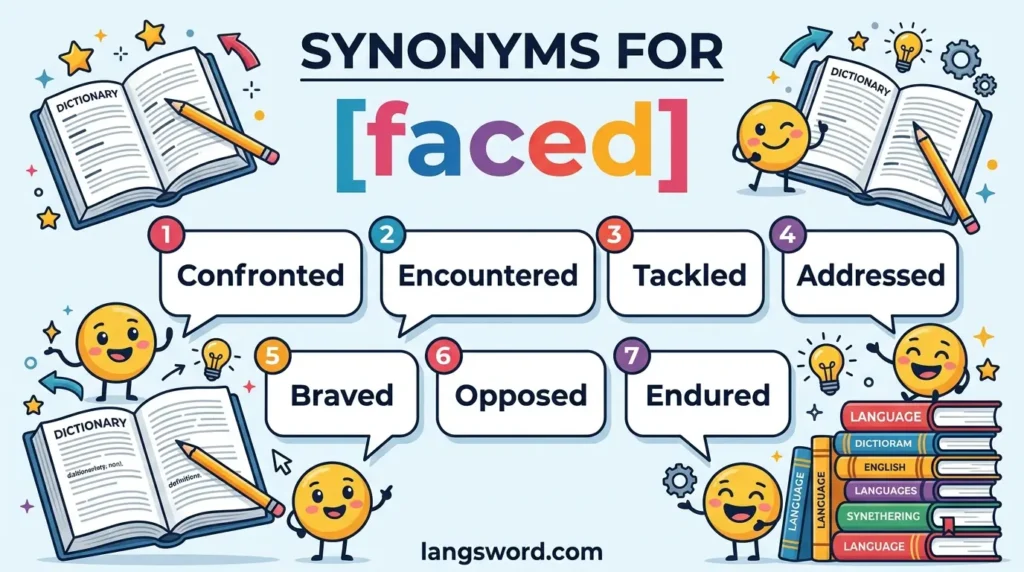
1. Confronted (Verb)
Meaning: Met a difficult person, problem, or situation directly.
Examples:
- She confronted a serious problem at work.
- The company confronted several legal challenges.
2. Encountered (Verb)
Meaning: Met or experienced something, often unexpectedly.
Examples:
- We encountered many problems during the journey.
- He encountered an old friend at the station.
3. Met (Verb)
Meaning: Came into contact with a person, situation, problem, or challenge.
Examples:
- She met many challenges during her career.
- The team met strong resistance.
4. Experienced (Verb)
Meaning: Went through or lived through something.
Examples:
- He experienced many difficulties after moving abroad.
- The city experienced heavy rain last week.
5. Dealt With (Verb)
Meaning: Took action to manage or handle a problem or situation.
Examples:
- She dealt with the complaint politely.
- They dealt with several issues before opening the store.
6. Handled (Verb)
Meaning: Managed a situation, task, or problem successfully.
Examples:
- He handled the difficult customer well.
- She handled the crisis calmly.
7. Tackled (Verb)
Meaning: Tried to solve or deal with a difficult problem.
Examples:
- The government tackled the housing problem.
- We tackled the hardest question first.
8. Addressed (Verb)
Meaning: Gave attention to a problem or issue and tried to solve it.
Examples:
- The manager addressed the workers’ concerns.
- The report addressed several important issues.
9. Challenged (Verb)
Meaning: Was put in a difficult situation that required effort.
Examples:
- She was challenged by the difficult assignment.
- The new job challenged him to learn quickly.
10. Endured (Verb)
Meaning: Suffered or continued through something difficult.
Examples:
- They endured many hardships during the war.
- He endured years of financial difficulty.
11. Suffered (Verb)
Meaning: Experienced pain, loss, damage, or hardship.
Examples:
- The family suffered great losses.
- The business suffered serious damage during the storm.
12. Underwent (Verb)
Meaning: Experienced something, especially a process, treatment, or major change.
Examples:
- She underwent surgery last year.
- The building underwent major repairs.
13. Experienced Firsthand (Verb Phrase)
Meaning: Personally went through a particular event or situation.
Examples:
- He experienced firsthand the difficulties of rural life.
- She experienced firsthand the effects of the economic crisis.
14. Ran Into (Phrasal Verb)
Meaning: Unexpectedly encountered a problem or difficulty.
Examples:
- We ran into several problems on the way.
- She ran into trouble while completing the project.
15. Came Across (Phrasal Verb)
Meaning: Found or encountered someone or something unexpectedly.
Examples:
- I came across an interesting problem while researching.
- She came across an old photograph.
16. Went Through (Phrasal Verb)
Meaning: Experienced a difficult or important period or event.
Examples:
- He went through a difficult time last year.
- They went through many changes after the move.
17. Encountered Difficulties (Verb Phrase)
Meaning: Experienced problems or obstacles.
Examples:
- The project encountered difficulties during construction.
- We encountered difficulties while testing the system.
18. Struggled With (Verb Phrase)
Meaning: Had difficulty dealing with or completing something.
Examples:
- She struggled with the complex problem.
- He struggled with stress at work.
19. Battled (Verb)
Meaning: Fought against or worked hard to overcome a serious problem.
Examples:
- The town battled severe flooding.
- He battled illness for many years.
20. Opposed (Verb)
Meaning: Met resistance or acted against something.
Examples:
- The proposal faced several groups that opposed it.
- The leader opposed the new policy.
21. Resisted (Verb)
Meaning: Fought against something or refused to accept it.
Examples:
- The workers resisted the new rules.
- She resisted pressure from her colleagues.
22. Confronted Withstood (Verb Phrase)
Meaning: Continued to deal with something difficult without giving up.
Examples:
- The village withstood severe weather.
- The company withstood strong market pressure.
23. Encountered (Verb)
Meaning: Came into contact with someone, something, or a situation.
Examples:
- The travelers encountered several obstacles.
- We encountered unexpected delays.
24. Accepted (Verb)
Meaning: Recognized or acknowledged a difficult fact or situation.
Examples:
- She accepted the difficult truth.
- He finally accepted the consequences of his decision.
25. Acknowledged (Verb)
Meaning: Recognized that something exists or is true.
Examples:
- The manager acknowledged the problem.
- She acknowledged the risks before starting.
26. Took On (Phrasal Verb)
Meaning: Accepted a task, responsibility, or challenge.
Examples:
- He took on a difficult new project.
- She took on more responsibility at work.
27. Undertook (Verb)
Meaning: Accepted and began a task or responsibility.
Examples:
- The team undertook a major research project.
- She undertook the difficult task alone.
28. Experienced Hardship (Verb Phrase)
Meaning: Went through difficult living or working conditions.
Examples:
- Many families experienced hardship during the recession.
- The workers experienced hardship after the factory closed.
29. Faced Up To (Phrasal Verb)
Meaning: Accepted and dealt with an unpleasant fact or problem.
Examples:
- He finally faced up to his mistake.
- She faced up to the difficult truth.
30. Grappled With (Verb Phrase)
Meaning: Tried hard to understand, solve, or manage something difficult.
Examples:
- Scientists grappled with a complex problem.
- She grappled with the decision for weeks.
Prototype Meaning
The most typical meaning of faced is encountered or had to deal with something, especially a problem, challenge, danger, or difficult situation. When people hear “faced a challenge,” they usually imagine a person standing before a difficult situation and needing to respond to it. The word can describe both ordinary problems and serious life events.
Prototype Categorization
The 30 synonyms can be grouped by their main meaning. This helps writers choose a word that matches the exact situation instead of replacing faced with a word that sounds unnatural.
- Direct confrontation: confronted, challenged, opposed, resisted, battled — useful when someone actively meets conflict, opposition, or difficulty.
- General experience: encountered, met, experienced, underwent, went through — useful when someone simply experiences an event or situation.
- Problem management: dealt with, handled, tackled, addressed, grappled with — useful when someone takes action to solve or manage a problem.
- Unexpected experience: ran into, came across, encountered — useful when something happens unexpectedly.
- Endurance and hardship: endured, suffered, battled, experienced hardship, withstood — useful when the situation involves pain, loss, pressure, or difficulty.
- Acceptance and recognition: accepted, acknowledged, faced up to — useful when someone recognizes an unpleasant fact or responsibility.
- Responsibility and action: took on, undertook — useful when someone accepts a task, duty, or challenge.
Choosing the right category makes writing more precise and prevents synonyms from sounding interchangeable when they are not.
Antonyms of Faced
1. Avoided (Verb)
Meaning: Stayed away from a person, problem, or situation.
2. Escaped (Verb)
Meaning: Got away from a difficult or dangerous situation.
3. Evaded (Verb)
Meaning: Avoided something deliberately, especially a responsibility or difficult issue.
4. Ignored (Verb)
Meaning: Chose not to give attention to something.
5. Avoided Confrontation (Verb Phrase)
Meaning: Chose not to deal directly with a conflict or difficult situation.
6. Withdrew (Verb)
Meaning: Moved away from a situation instead of continuing to deal with it.
Short Questions and Answers
What does faced mean?
Faced means encountered, experienced, or dealt with a person, problem, challenge, or situation.
When should faced be used?
Use faced when talking about something that a person or group encountered or had to deal with. It is especially common with words such as problem, challenge, difficulty, danger, and crisis.
Is faced positive or negative?
Faced is neutral by itself. Its tone depends on the situation. “She faced a challenge bravely” has a positive feeling, while “He faced serious problems” has a negative feeling.
How is it different from similar words?
Faced is broad and can mean simply encountering or dealing with something. Confronted often suggests direct action or conflict, experienced focuses on going through something, handled suggests managing something, and endured emphasizes suffering through difficulty.
Conclusion
Learning faced and its synonyms can make your English more flexible and precise. Words such as confronted, encountered, experienced, handled, tackled, addressed, endured, and grappled with can express different shades of meaning.
Knowing these differences helps you avoid repetition in essays, articles, emails, conversations, and other forms of writing. It also helps you choose a word that matches the exact situation.
For example, handled works well for managing a problem, while endured focuses more on suffering through difficulty. Regular vocabulary practice can improve both writing and speaking skills.
Try learning a few synonyms each day and use them in your own sentences. With steady practice, you can build stronger vocabulary, write with greater variety, and speak English with more confidence.