
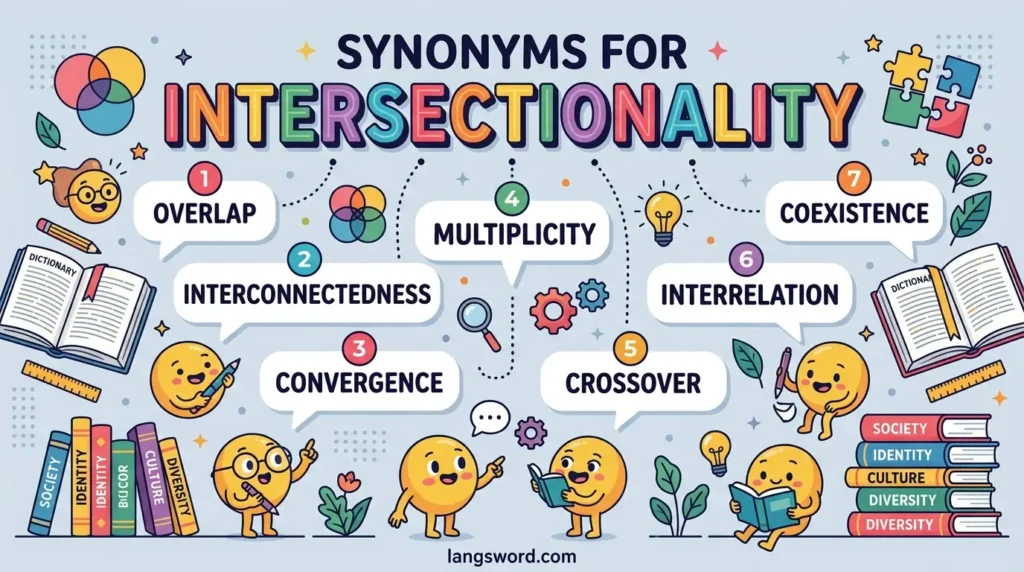

Intersectionality is the way different parts of a person’s identity can overlap and shape their life. These parts may include race, gender, class, age, and disability. For example, a woman with a disability may face challenges that differ from those faced by other women or people with disabilities. The term helps explain how these experiences connect.
The word is often used in social studies, education, law, and discussions about fairness. Learning synonyms for intersectionality can help English learners build vocabulary and help content writers express complex ideas more clearly.
However, not every synonym has exactly the same meaning. Some words focus on identity, while others describe social systems, inequality, or overlapping experiences. This guide explains the meaning of intersectionality, its history, pronunciation, grammar, and 30 related terms with simple definitions and examples.
Meaning of Intersectionality
Definition
Intersectionality (noun): A way of understanding how different parts of a person’s identity and social position overlap and affect their experiences, opportunities, and challenges.
Examples
- Intersectionality helps us understand how race and gender can shape a person’s life.
- The teacher used intersectionality to explain why people may face different forms of unfair treatment.
Connotative Meaning
(Connotation: the feelings or ideas that a word brings to mind beyond its basic meaning.)
- Positive tone: Suggests understanding, inclusion, fairness, and respect for different experiences.
- Negative tone: In some debates, it may be linked to conflict, division, or political disagreement.
- Neutral tone: Refers to a framework for studying how identities and social systems interact.
Etymology
The term intersectionality was coined by American legal scholar Kimberlé Crenshaw in 1989. It grew from the word intersection, which describes a place where lines or roads meet.
Crenshaw used the term to explain how systems such as racism and sexism can overlap, creating experiences that may not be understood by examining each system alone.
- Old English (450–1100): The modern word intersectionality did not exist. The word cross and related terms described meeting or crossing points.
- Middle English (1100–1500): Words related to crossing and meeting developed through English and French influences. The Latin root intersect- means to cut across.
- Modern English (1500–Present): Intersection developed from Latin roots. Intersectionality entered academic discussion in 1989 and later became common in social science, law, education, and public debate.
Pronunciation (IPA)
- IPA: /ˌɪn.tər. sek.ʃəˈnæl.ə.ti/
- Syllables: in-ter-sec-tion-al-i-ty
- Part of speech: Noun
Affixation Pattern of Intersectionality
- Root: Intersect — to cross or overlap.
- Prefix: Inter- — between or among.
- Suffixes: -ion — forms a noun; -al — forms an adjective; -ity — forms a noun that expresses a state or quality.
Word formations
- Intersect (verb): To cross or meet.
- Intersection (noun): A point where things cross.
- Intersecting (adjective/verb form): Crossing or overlapping.
- Intersectional (adjective): Relating to overlapping identities or systems of inequality.
- Intersectionality (noun): The framework for studying these overlaps.
- Intersectionally (adverb): In a way that considers intersectionality; used mainly in academic writing.
30 Synonyms of Intersectionality With Meaning & Examples
Note: Intersectionality is a specific academic concept, so it has few exact synonyms. The following words and phrases are related alternatives. The best choice depends on the context.
1. Interconnectedness (Noun)
Meaning: The state of being linked so that different things affect one another.
Examples:
- Interconnectedness helps explain how gender and class shape life experiences.
- The report shows the interconnectedness of social problems.
2. Interrelatedness (Noun)
Meaning: The condition of having a connection between two or more things.
Examples:
- The study explores the interrelatedness of race and income.
- Interrelatedness is important when studying social inequality.
3. Overlapping Identities (Noun Phrase)
Meaning: Different parts of a person’s identity that exist together and influence their experiences.
Examples:
- Overlapping identities can affect how people experience discrimination.
- The lesson focused on overlapping identities in modern society.
4. Multiple Identities (Noun Phrase)
Meaning: The different personal and social identities a person holds.
Examples:
- Multiple identities shape how people see themselves.
- The survey explored how multiple identities affect belonging.
5. Social Complexity (Noun Phrase)
Meaning: The condition of having many connected social factors.
Examples:
- Social complexity makes inequality difficult to explain with one cause.
- The research examines the social complexity of modern cities.
6. Identity Overlap (Noun Phrase)
Meaning: The way different parts of a person’s identity meet and interact.
Examples:
- Identity overlap can shape a person’s experience at work.
- The article explains identity overlap in schools.
7. Interdependence (Noun)
Meaning: A situation in which people or things depend on one another.
Examples:
- Interdependence can shape relationships between social groups.
- The project studies the interdependence of class and education.
8. Social Interaction (Noun Phrase)
Meaning: The way people communicate and act with one another in society.
Examples:
- Social interaction can reveal unfair treatment.
- The study looks at social interaction across cultural groups.
9. Identity Dynamics (Noun Phrase)
Meaning: The ways a person’s identities change or influence one another across situations.
Examples:
- Identity dynamics may affect how a person feels at work.
- The course explores identity dynamics in diverse communities.
10. Intersecting Identities (Noun Phrase)
Meaning: Different identities that meet and influence a person’s social experience.
Examples:
- Intersecting identities can shape access to education.
- The researcher examined intersecting identities in healthcare.
11. Social Inequality (Noun Phrase)
Meaning: Unfair differences in rights, resources, or opportunities between people or groups.
Examples:
- Social inequality can affect access to good schools.
- The report explores social inequality across communities.
12. Multiple Discrimination (Noun Phrase)
Meaning: Unfair treatment linked to more than one identity or social characteristic.
Examples:
- Multiple discrimination can create barriers in the workplace.
- The research examines multiple discrimination in public services.
13. Combined Discrimination (Noun Phrase)
Meaning: Discrimination that involves more than one factor at the same time.
Examples:
- Combined discrimination may affect a person’s chance of finding work.
- The policy aims to prevent combined discrimination.
14. Overlapping Oppression (Noun Phrase)
Meaning: The way different forms of unfair control or disadvantage work together.
Examples:
- Overlapping oppression can limit access to education.
- The book explores overlapping oppression in society.
15. Social Stratification (Noun Phrase)
Meaning: The division of society into groups with different levels of power, wealth, or status.
Examples:
- Social stratification can affect access to healthcare.
- The class studied social stratification in urban areas.
16. Systems of Inequality (Noun Phrase)
Meaning: Social structures and practices that create or maintain unfair differences.
Examples:
- Systems of inequality can affect people in different ways.
- The research examines systems of inequality in education.
17. Structural Inequality (Noun Phrase)
Meaning: Unfair differences built into social rules, institutions, or practices.
Examples:
- Structural inequality can limit job opportunities.
- The report explains structural inequality in housing.
18. Social Disadvantage (Noun Phrase)
Meaning: A lack of resources, rights, or opportunities that makes life harder.
Examples:
- Social disadvantage can affect a child’s education.
- The program supports people facing social disadvantage.
19. Compounded Disadvantage (Noun Phrase)
Meaning: A situation in which several disadvantages combine and make hardship greater.
Examples:
- Compounded disadvantage can make finding work more difficult.
- The study focuses on compounded disadvantage among low-income families.
20. Identity-Based Inequality (Noun Phrase)
Meaning: Unfair treatment or unequal opportunities linked to a person’s identity.
Examples:
- Identity-based inequality can affect access to public services.
- The report examines identity-based inequality in the workplace.
21. Diversity of Experience (Noun Phrase)
Meaning: The range of different experiences people have because of their backgrounds and circumstances.
Examples:
- Diversity of experience helps teachers understand their students.
- The study highlights the diversity of experience in local communities.
22. Social Context (Noun Phrase)
Meaning: The social conditions and circumstances that shape an event or experience.
Examples:
- Social context helps explain why people face different barriers.
- The researcher considered social context before drawing conclusions.
23. Contextual Identity (Noun Phrase)
Meaning: An identity understood in relation to the setting or circumstances in which it appears.
Examples:
- Contextual identity may shape how people act in different places.
- The article explores contextual identity in family and work life.
24. Multidimensional Identity (Noun Phrase)
Meaning: An identity made up of several different parts or characteristics.
Examples:
- Multidimensional identity includes culture, gender, and social background.
- The project studies multidimensional identity among young adults.
25. Social Positioning (Noun Phrase)
Meaning: The place a person holds within a social structure or group.
Examples:
- Social positioning can affect how others treat a person.
- The research examines social positioning in the workplace.
26. Power Relations (Noun Phrase)
Meaning: The ways power is shared or used between people and groups.
Examples:
- Power relations can shape access to public resources.
- The study explores power relations in schools.
27. Inclusive Analysis (Noun Phrase)
Meaning: An approach that considers different groups and experiences rather than focusing on only one.
Examples:
- Inclusive analysis can reveal overlooked barriers.
- The team used inclusive analysis to review its policies.
28. Holistic Social Analysis (Noun Phrase)
Meaning: The study of social issues by considering many connected factors together.
Examples:
- Holistic social analysis considers income, gender, and culture.
- The report uses holistic social analysis to explain inequality.
29. Social Justice Framework (Noun Phrase)
Meaning: A way of studying or addressing fairness, rights, and unequal treatment in society.
Examples:
- The group used a social justice framework to review its plans.
- A social justice framework can help guide public policy.
30. Cross-Cutting Inequality (Noun Phrase)
Meaning: Inequality that spans different social groups or connects several forms of disadvantage.
Examples:
- Cross-cutting inequality can affect people in different communities.
- The report examines cross-cutting inequality in education and employment.
Prototype Meaning
The most typical meaning of intersectionality is the idea that different parts of a person’s identity overlap and can shape their experiences together. When people hear the word, they often think of race, gender, class, disability, or other social factors interacting.
For example, a low-income woman with a disability may face barriers that cannot be fully explained by looking at gender, income, or disability alone. Intersectionality helps explain these connected experiences without assuming that everyone in the same group faces the same challenges.
Prototype Categorization
The 30 related terms can be grouped by their main meanings. These groups help writers select words that fit their purpose and avoid using a related term as if it were an exact synonym.
– Identity and overlap: Overlapping identities, multiple identities, identity overlap, intersecting identities, identity dynamics, multidimensional identity, and contextual identity. Use these terms when discussing how personal identities meet and interact.
– Connection and relationships: Interconnectedness, interrelatedness, interdependence, and social interaction. These terms focus on links between people, ideas, or social factors.
– Discrimination and oppression: Multiple discrimination, combined discrimination, overlapping oppression, and identity-based inequality. Use these terms when discussing unfair treatment linked to identity.
– Inequality and disadvantage: Social inequality, social stratification, systems of inequality, structural inequality, social disadvantage, compounded disadvantage, and cross-cutting inequality. These terms focus on social barriers and unequal outcomes.
– Social context and power: Social complexity, social context, social positioning, and power relations. These terms help explain how a person’s situation and place in society affect their experiences.
– Research and solutions: Diversity of experience, inclusive analysis, holistic social analysis, and social justice framework. Use these phrases when discussing research methods, policy, or ways to improve fairness.
This categorization helps writers choose accurate words. For example, overlapping identities focuses on identity, while structural inequality focuses on unfair systems. The terms are related, but they are not interchangeable in every sentence.
Antonyms of Intersectionality
There is no exact antonym for intersectionality. However, the following terms describe approaches that contrast with its focus on overlapping identities and connected social factors.
1. Single-Axis Analysis (Noun Phrase)
Meaning: An approach that studies one social factor at a time.
2. Monocausal Analysis (Noun Phrase)
Meaning: An approach that explains an issue through only one cause.
3. Reductionism (Noun)
Meaning: The practice of explaining a complex issue by focusing on only a few parts.
4. Oversimplification (Noun)
Meaning: Making a complex issue seem much simpler than it really is.
5. Homogeneity (Noun)
Meaning: The state of being alike or having few differences.
6. Segregation of Factors (Noun Phrase)
Meaning: Treating social factors as separate rather than examining how they interact.
Short Questions and Answers
What does intersectionality mean?
Intersectionality is a way to understand how different parts of identity, such as race, gender, and class, overlap and shape a person’s experiences.
When should intersectionality be used?
Use the term when discussing how several identities or social systems interact to affect opportunities, treatment, or disadvantage.
Is intersectionality positive or negative?
The word is generally neutral. It is often used in discussions about inclusion and fairness, but opinions about the concept can differ.
How is intersectionality different from similar words?
Intersectionality specifically examines how different identities and systems of inequality interact. Terms such as diversity focus on differences, while social inequality focuses on unfair gaps between groups.
Conclusion
Learning intersectionality and its related terms can improve your English vocabulary and help you express complex social ideas with greater care. Words such as interconnectedness, overlapping identities, and structural inequality can make your writing clearer when used in the right context.
These terms are not exact substitutes, so it is important to understand their meanings before using them. A strong vocabulary also helps you avoid repetition, explain ideas in a simple way, and speak with greater confidence.
If you are an English learner or content writer, practise using one new word each day. Write a short sentence, compare it with a similar term, and check whether it fits your meaning. With daily practice, your writing and speaking will become clearer and more precise.