

A small dog followed its owner all the way home. It walked behind him, step by step, and never left his side. The word “followed” is the past form of “follow.” It tells us that someone or something went behind a person, an animal, or a thing in the past. We use this word every day. We say a car followed a bus, a child followed her mother, or spring followed winter. Learning synonyms for followed helps English learners speak and write with more color. It also helps writers avoid using the same word again and again. In this article, you will learn the meaning of followed, 30 synonyms with meanings and examples, its grammar, history, pronunciation, and semantic categories in simple words.
Meaning of Followed
Definition
Followed (Verb, past tense of follow): Went after or behind someone or something. It can also mean came after in order, or obeyed a rule, a person, or an example.
Examples
- The little cat followed the girl into the garden.
- He followed the doctor’s advice and got well soon.
Connotative Meaning
- Positive tone: Followed can feel loyal and faithful, like a true friend or a brave dog that stays close to its owner.
- Negative tone: It can feel dark and scary when it means stalking, or weak when it means copying others with no mind of your own.
- Neutral tone: It is often a plain word that just tells the order of things, like night followed day.
(Connotation: the feelings and ideas a word brings to mind, apart from its plain meaning.)
Etymology
- Old English (450–1100): The verb comes from Old English folgian, which meant to go after, to serve, or to obey. It is a true old word of the English language.
- Middle English (1100–1500): The word took the form folwen in Middle English. People used it for walking behind a leader and for obeying laws and customs.
- Modern English (1500–Present): The word settled into its present form, “follow,” with the past form “followed.” Its uses grew wider. Today we follow rules, follow the news, follow a road, and follow people on social media.
Pronunciation (IPA)
- IPA: /ˈfɒloʊd/
- Syllables: fol · lowed (2 syllables)
Affixation Pattern of Followed
- Root: follow
- Prefix: None
- Suffix: -ed (the past tense ending)
- Word formations:
- follows (Verb)
- following (Verb)
- following (Adjective)
- following (Noun)
- follower (Noun)
- follow-up (Noun)
- follow-up (Adjective)
- unfollow (Verb)
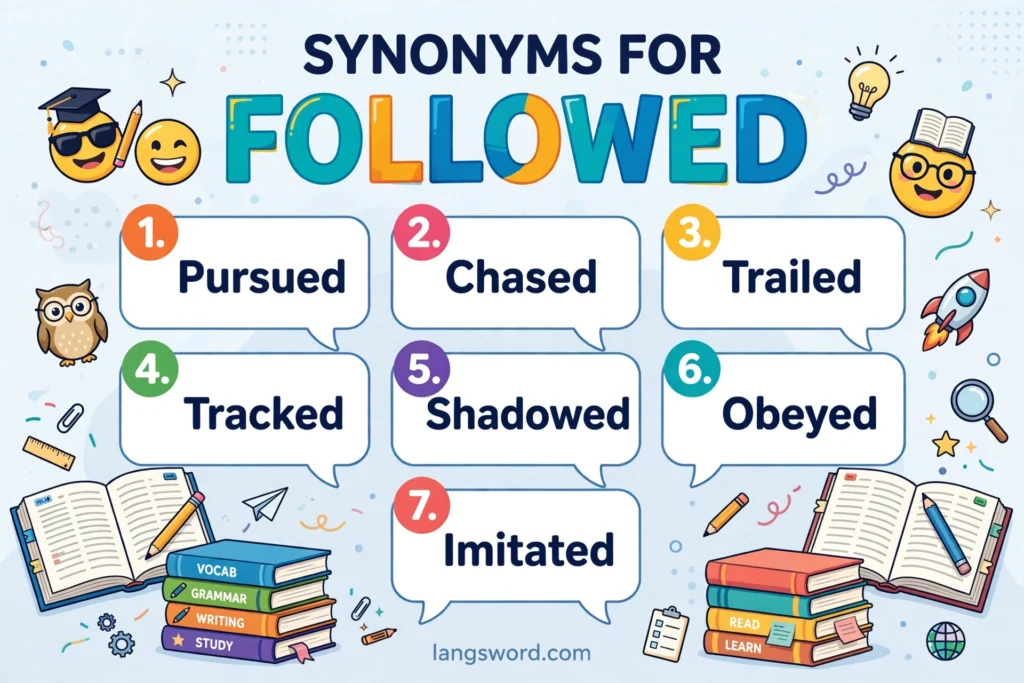
30 Synonyms of Followed With Meaning & Examples
1. Pursued (Verb)
Meaning: Chased someone or something with the goal of catching it.
Examples:
- The police pursued the thief through the busy market.
- The lion pursued the deer across the open field.
2. Chased (Verb)
Meaning: Ran after someone or something to catch it.
Examples:
- The boy chased his runaway ball down the hill.
- Our dog chased the cat up the tree.
3. Trailed (Verb)
Meaning: Followed slowly and quietly behind, often to watch in secret.
Examples:
- The detective trailed the suspect all day.
- A small duckling trailed its mother across the pond.
4. Tracked (Verb)
Meaning: Followed the marks, prints, or signs left behind by a person or animal.
Examples:
- The hunter tracked the bear by its footprints in the snow.
- She tracked the lost ship on the map.
5. Shadowed (Verb)
Meaning: Followed someone closely and secretly, like a shadow.
Examples:
- A guard shadowed the famous singer at the airport.
- The spy shadowed his target from street to street.
6. Stalked (Verb)
Meaning: Followed quietly and carefully, often with a bad or scary purpose.
Examples:
- The tiger stalked the goats in the tall grass.
- She felt afraid when a stranger stalked her online.
7. Hunted (Verb)
Meaning: Searched for and chased animals or people to catch or kill them.
Examples:
- Wolves hunted in a pack during the cold night.
- The team hunted for clues at the old house.
8. Tailed (Verb)
Meaning: Followed someone closely to watch what they did, often in secret.
Examples:
- The reporter tailed the famous actor for a story.
- Two men tailed the truck to its hidden garage.
9. Dogged (Verb)
Meaning: Followed with strong will and never gave up, like a dog on a trail.
Examples:
- Bad luck dogged him for many years.
- The young player dogged the star and took the ball.
10. Hounded (Verb)
Meaning: Followed again and again and kept asking or chasing without rest.
Examples:
- Fans hounded the singer for photos after the show.
- Reporters hounded the mayor with hard questions.
11. Accompanied (Verb)
Meaning: Went with someone to the same place, as a friend or helper.
Examples:
- She accompanied her grandmother to the hospital.
- A soft song accompanied the dancers on stage.
12. Escorted (Verb)
Meaning: Went with someone to guard them or to show them the way.
Examples:
- Two guards escorted the king to his car.
- He escorted the guests to the front door.
13. Attended (Verb)
Meaning: Went with someone as a helper, or was present with them at a place or event.
Examples:
- A nurse attended the sick man all night.
- The bride attended her friend at the wedding.
14. Succeeded (Verb)
Meaning: Came after someone in a job, a place, or a line of order.
Examples:
- The young prince succeeded the old king.
- A loud cheer succeeded her sweet song.
15. Ensued (Verb)
Meaning: Happened right after something else, often as a result of it.
Examples:
- A long silence ensued after his sad words.
- A great fight ensued when the money was lost.
16. Came After (Verb)
Meaning: Happened or arrived later than something else in time or order.
Examples:
- Spring came after the long, cold winter.
- The letter B came after the letter A.
17. Resulted (Verb)
Meaning: Happened as the final effect of an earlier action.
Examples:
- His hard work resulted in a big win.
- The flood resulted from days of heavy rain.
18. Obeyed (Verb)
Meaning: Did what a rule, a law, or a person asked you to do.
Examples:
- The soldiers obeyed their captain at once.
- She obeyed the traffic rules and drove with care.
19. Imitated (Verb)
Meaning: Copied the way someone else spoke, moved, or behaved.
Examples:
- The baby imitated her mother’s smile.
- He imitated the teacher’s voice and made us laugh.
20. Copied (Verb)
Meaning: Did or made the same thing as someone or something else.
Examples:
- She copied her friend’s dance steps.
- The artist copied the old painting with great skill.
21. Mirrored (Verb)
Meaning: Showed or matched something in the same way, like a mirror.
Examples:
- His face mirrored her fear and pain.
- The calm lake mirrored the tall green hills.
22. Adopted (Verb)
Meaning: Took up and began to use an idea, a plan, or a way of doing things.
Examples:
- The school adopted a new way of teaching.
- They adopted the kind habits of their new town.
23. Practiced (Verb)
Meaning: Did something again and again as a habit, a faith, or a rule of life.
Examples:
- She practiced kindness every single day.
- He practiced his grandfather’s trade with pride.
24. Observed (Verb)
Meaning: Followed a rule, law, or custom with care and respect.
Examples:
- The family observed the day of rest in silence.
- All drivers observed the new speed limit.
25. Heeded (Verb)
Meaning: Listened to advice or a warning and acted on it with care.
Examples:
- He heeded his father’s wise words.
- The sailors heeded the storm warning and stayed home.
26. Complied With (Verb)
Meaning: Did what a rule, law, or order demanded, often in a formal way.
Examples:
- The shop complied with the new safety law.
- She complied with the request and sent the form.
27. Stuck To (Verb)
Meaning: Stayed true to a plan, a promise, or a rule and did not leave it.
Examples:
- He stuck to his study plan and passed the test.
- The team stuck to the rules of the game.
28. Emulated (Verb)
Meaning: Tried to copy and match someone great, in order to be like them.
Examples:
- Young players emulated their hero on the field.
- She emulated her teacher’s fair and kind ways.
29. Tagged Along (Verb)
Meaning: Went with a person or group in a casual way, without being asked in a formal way.
Examples:
- His little brother tagged along to the park.
- She tagged along with her friends to the fair.
30. Kept To (Verb)
Meaning: Stayed on a path, a plan, or a rule without turning away from it.
Examples:
- The hikers kept to the safe forest path.
- He kept to his word and came on time.
Prototype Meaning
When people hear the word “followed,” they first picture a person walking behind another person, step by step, on a road or path. One walks in front and leads the way. The other walks behind and stays close, watching and matching each step. This simple picture of going behind someone in the past is the heart of the word.
Prototype Categorization
- Chasing and hunting words: Pursued, Chased, Trailed, Tracked, Shadowed, Stalked, Hunted, Tailed, Dogged, Hounded. Use these when someone goes after a person or animal to catch, watch, or learn about them.
- Going-with words: Accompanied, Escorted, Attended, Tagged Along. Use these when a person goes with someone as a friend, guard, or helper.
- Order and result words: Succeeded, Ensued, Came After, Resulted. Use these when one event, person, or thing comes later than another in time or rank.
- Obeying words: Obeyed, Observed, Heeded, Complied With, Stuck To, Kept To. Use these when a person does what a rule, law, order, or promise asks.
- Copying words: Imitated, Copied, Mirrored, Adopted, Practiced, Emulated. Use these when a person copies an action, a habit, or a way of life.
These groups help writers choose the best word for each scene. A police story needs a chasing word, a school essay needs an obeying word, and a happy tale may need a friendly going-with word. The right group gives you the right word every time.
Antonyms of Followed
Led (Verb)
Went in front and showed others the way.
Preceded (Verb)
Came or went before someone or something in time or order.
Guided (Verb)
Showed the way to others and helped them reach a place.
Avoided (Verb)
Stayed away from a person, place, or thing on purpose.
Fled (Verb)
Ran away quickly from danger or from someone.
Ignored (Verb)
Paid no attention to a person, rule, or call.
Disobeyed (Verb)
Refused to do what a rule, law, or person asked.
Short Questions and Answers
What does followed mean?
Followed is the past form of follow. It means a person or thing went behind someone or something. It can also mean that a thing came later in order, or that a person obeyed a rule.
When should followed be used?
Use followed when you tell a story about the past. It fits tales, news, and reports where someone went after a person, an animal came behind its owner, a season came after another, or a person obeyed a rule.
Is followed positive or negative?
It can be both. It is positive when it shows loyalty, care, or respect for rules. It is negative when it means stalking, chasing with bad aims, or copying others like a shadow with no mind of your own.
How is it different from similar words?
Followed is the plain and common word. Chased and pursued add speed and a goal to catch. Accompanied adds the warm feeling of going with a friend. Succeeded is about taking a place after someone, not walking behind them.
Conclusion
Learning the word followed and its many synonyms is a smart step for every English learner. These words improve your vocabulary and give you fresh choices for every story you tell. They strengthen your writing and speaking, because you can pick the exact word for a chase, a walk with a friend, or an act of respect for a rule. They help you avoid dull repetition, so your sentences stay bright and clear. Each new word also builds your English confidence, little by little, day by day. So keep up the good habit. Learn one new word daily, say it aloud, write it in a line, and use it with joy. Soon, your English will shine.