
Surreal describes something that feels strange, dreamlike, or far from normal reality. Imagine walking into a familiar room and finding the walls covered with stars while fish swim through the air. The scene feels real, yet it also feels impossible.
That is a surreal experience. The word is common in everyday speech, books, films, art, and online writing because it helps describe unusual moments in a vivid way. Learning synonyms for surreal helps English learners express ideas with greater detail and avoid using the same word again and again.
It also helps content writers choose words that match the exact mood of a scene. In this article, we explore the meaning, examples, grammar, history, pronunciation, word formation, and semantic categories of surreal, along with 30 useful synonyms and their meanings.
Meaning of Surreal
Definition
Surreal (adjective):
Very strange, dreamlike, or unlike ordinary reality.
Examples
- The empty city looked surreal after the heavy snowfall.
- It was a surreal moment when she met her childhood hero.
Connotative Meaning
Connotation (the feelings or ideas that a word suggests beyond its basic meaning):
- Positive tone: Can suggest wonder, beauty, creativity, or magical strangeness.
- Negative tone: Can suggest confusion, discomfort, fear, or something unsettling.
- Neutral tone: Can simply describe something that feels strange or unreal.
Etymology
The word surreal comes from the French surréel, meaning “above” or “beyond real.” It is linked to the French word sur (“above, over”) and réel (“real”). The idea became strongly connected with Surrealism, an artistic and literary movement that explored dreams, imagination, and the unconscious.
- Old English (450–1100): The modern word surreal did not exist in Old English. Its key idea, however, relates to older English words connected with what is real and true.
- Middle English (1100–1500): English continued to develop words related to reality and truth, but surreal was still not part of the vocabulary.
- Modern English (1500–Present): Surreal entered English through French and became closely associated with Surrealist art and literature in the 20th century. It later became a common word for anything that seems dreamlike, bizarre, or unreal.
Pronunciation (IPA)
- IPA: /səˈriːəl/
- Syllables: su-re-al
Affixation Pattern of Surreal
- Root: real
- Prefix: sur- — from French sur, meaning “above” or “beyond”
- Suffix: None in the basic word surreal
Word formations
- surreal — adjective: strange or dreamlike
- surreally — adverb: in a surreal manner
- surrealism — noun: an artistic and literary movement focused on dreams and the unconscious
- surrealist — noun/adjective: a person connected with Surrealism or something related to it
- surrealistic — adjective: resembling Surrealism or having dreamlike qualities
30 Synonyms of Surreal With Meaning & Examples
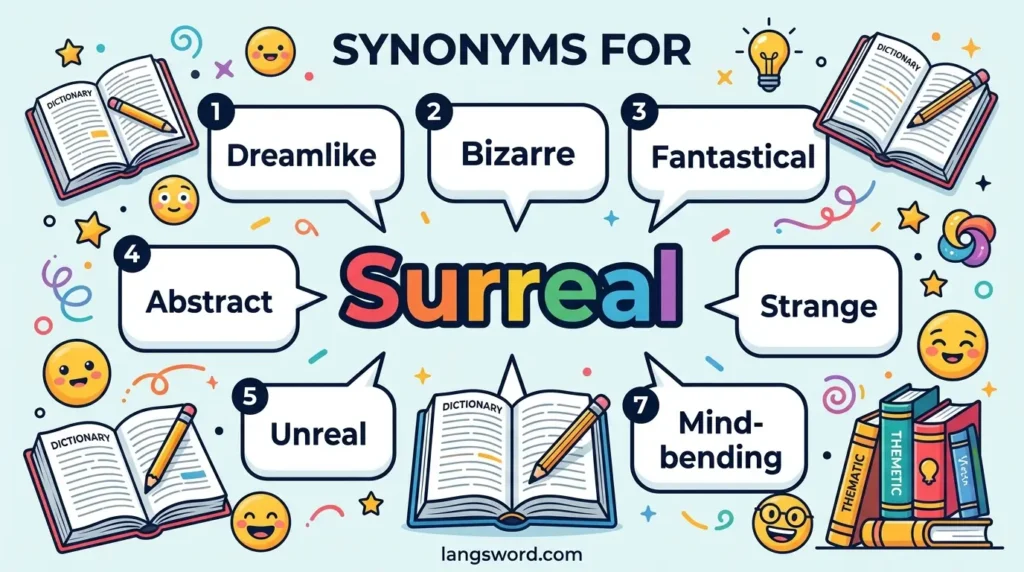
1. Dreamlike (Adjective)
Meaning: Like something seen in a dream rather than ordinary life.
Examples:
- The soft lights created a dreamlike atmosphere.
- The quiet forest looked dreamlike at sunset.
2. Unreal (Adjective)
Meaning: So strange or unusual that it does not seem real.
Examples:
- The view from the mountain was almost unreal.
- Winning the award felt unreal to her.
3. Bizarre (Adjective)
Meaning: Very strange or unusual.
Examples:
- He told us a bizarre story about his trip.
- The museum displayed some bizarre objects.
4. Strange (Adjective)
Meaning: Unusual or different from what is normal.
Examples:
- There was a strange silence in the room.
- I had a strange dream last night.
5. Uncanny (Adjective)
Meaning: Strange in a way that feels mysterious or slightly unsettling.
Examples:
- The empty house had an uncanny feeling.
- She noticed an uncanny similarity between the two paintings.
6. Fantastical (Adjective)
Meaning: Imaginative, magical, or very unlikely to happen in real life.
Examples:
- The film takes place in a fantastical world.
- She wrote a fantastical story about flying cities.
7. Fantastic (Adjective)
Meaning: Extremely unusual, imaginative, or seemingly impossible.
Examples:
- The novel tells a fantastic tale of another world.
- We saw a fantastic sight in the desert.
8. Otherworldly (Adjective)
Meaning: Seeming to belong to another world.
Examples:
- The blue light gave the cave an otherworldly appearance.
- Her voice had an otherworldly quality.
9. Weird (Adjective)
Meaning: Very unusual, unexpected, or difficult to explain.
Examples:
- I had a weird feeling about the place.
- That was a weird dream.
10. Peculiar (Adjective)
Meaning: Unusual or different from what is expected.
Examples:
- He noticed a peculiar shape in the clouds.
- There was something peculiar about the old house.
11. Baffling (Adjective)
Meaning: Very confusing or difficult to understand.
Examples:
- The sudden change was baffling.
- Police found the case baffling.
12. Bewildering (Adjective)
Meaning: Extremely confusing or difficult to make sense of.
Examples:
- The dream was bewildering and hard to remember.
- The strange message was bewildering.
13. Surprising (Adjective)
Meaning: Unexpected or not anticipated.
Examples:
- Her sudden arrival was surprising.
- The ending of the film was surprising.
14. Astonishing (Adjective)
Meaning: Extremely surprising or impressive.
Examples:
- The view was astonishing.
- His sudden success was astonishing.
15. Extraordinary (Adjective)
Meaning: Very unusual, special, or beyond what is normal.
Examples:
- They witnessed an extraordinary event.
- The artist created an extraordinary scene.
16. Unusual (Adjective)
Meaning: Not common or not normal.
Examples:
- We saw an unusual cloud formation.
- Her idea was unusual but creative.
17. Imaginative (Adjective)
Meaning: Showing a strong ability to create new and unusual ideas.
Examples:
- The artist has an imaginative style.
- She created an imaginative fantasy world.
18. Fantasmagorical (Adjective)
Meaning: Dreamlike, strange, and full of changing or fantastic images.
Examples:
- The stage show had a fantasmagorical design.
- The painting presents a fantasmagorical landscape.
19. Oneiric (Adjective)
Meaning: Related to dreams or having the quality of a dream.
Examples:
- The movie has an oneiric atmosphere.
- The artist uses oneiric images in her work.
20. Hallucinatory (Adjective)
Meaning: Seeming like a hallucination rather than normal reality.
Examples:
- The desert scene had a hallucinatory quality.
- The novel creates a hallucinatory world.
21. Trippy (Adjective)
Meaning: Strange, colorful, or mind-bending in a way that resembles an unusual mental experience.
Examples:
- The music video has a trippy visual style.
- The colorful lights created a trippy effect.
22. Absurd (Adjective)
Meaning: Completely unreasonable, illogical, or ridiculous.
Examples:
- The situation became absurd very quickly.
- It was absurd to see a penguin in the desert.
23. Eerie (Adjective)
Meaning: Strange and frightening in a quiet or mysterious way.
Examples:
- An eerie fog covered the village.
- The empty school looked eerie at night.
24. Mysterious (Adjective)
Meaning: Difficult to explain, understand, or identify.
Examples:
- A mysterious light appeared in the sky.
- The old painting has a mysterious quality.
25. Enigmatic (Adjective)
Meaning: Difficult to understand or explain because it is mysterious.
Examples:
- The character has an enigmatic smile.
- His answer was enigmatic and unclear.
26. Fantastical (Adjective)
Meaning: Full of imagination, fantasy, or impossible ideas.
Examples:
- The book describes a fantastical kingdom.
- The designer created a fantastical costume.
27. Marvelous (Adjective)
Meaning: Wonderful, surprising, or impressive.
Examples:
- We experienced a marvelous sunset.
- The strange garden looked marvelous at night.
28. Magical (Adjective)
Meaning: Having a special beauty or quality that seems beyond normal explanation.
Examples:
- The forest looked magical under the moonlight.
- The concert created a magical atmosphere.
29. Extraordinary (Adjective)
Meaning: Very unusual or far beyond what is ordinary.
Examples:
- The event was an extraordinary experience.
- She witnessed an extraordinary scene.
30. Impossible (Adjective)
Meaning: Not able to happen in normal reality.
Examples:
- The picture showed an impossible landscape.
- The story is filled with impossible events.
Note: Some words above are close synonyms rather than exact replacements in every sentence. For example, eerie adds fear, magical adds wonder, bizarre stresses unusualness, and oneiric specifically relates to dreams.
Prototype Meaning
The prototype meaning of surreal is something that looks or feels like a dream while appearing to exist in the real world.
When people hear surreal, they often imagine an unusual scene that breaks normal rules, such as a floating building, a talking animal, or a familiar place behaving in an impossible way. The word often combines reality with strange or dreamlike elements.
Prototype Categorization
The 30 synonyms can be grouped by their main semantic meaning. This helps writers select a word based on the exact feeling they want to create.
- Dream and fantasy: dreamlike, fantastical, oneiric, otherworldly, magical, imaginative — useful when the scene feels like a dream or fantasy.
- Strangeness: strange, bizarre, weird, peculiar, unusual — useful when something simply differs from normal life.
- Mystery and discomfort: uncanny, eerie, mysterious, enigmatic, baffling, bewildering — useful when something feels unclear, mysterious, or unsettling.
- Impossibility and unreality: unreal, impossible, absurd, hallucinatory — useful when normal reality seems to break down.
- Wonder and surprise: astonishing, surprising, extraordinary, marvelous, fantastic — useful when the unusual event creates amazement.
- Artistic and altered reality: surrealistic, trippy, fantasmagorical — useful when describing unusual visual, artistic, or imaginative experiences.
Choosing a synonym from the right category makes writing more precise. A writer can show fear with eerie, wonder with magical, confusion with baffling, or dream quality with oneiric instead of using surreal every time.
Antonyms of Surreal
1. Real (Adjective)
Meaning: Existing in reality rather than being imagined.
2. Realistic (Adjective)
Meaning: Showing life or events as they normally appear.
3. Normal (Adjective)
Meaning: Usual, ordinary, or expected.
4. Ordinary (Adjective)
Meaning: Common and not unusual.
5. Natural (Adjective)
Meaning: Existing or happening in a normal way.
6. Practical (Adjective)
Meaning: Based on real situations and useful action.
7. Rational (Adjective)
Meaning: Based on clear thought and reason.
8. Conventional (Adjective)
Meaning: Following common ideas, methods, or standards.
Short Questions and Answers
What does surreal mean?
Surreal means strange, dreamlike, or very different from normal reality.
When should surreal be used?
Use surreal when something feels unusually strange, dreamlike, impossible, or disconnected from everyday reality.
Is surreal positive or negative?
It depends on the context. It can suggest beauty and wonder, or it can suggest confusion and discomfort.
How is it different from similar words?
Surreal often combines reality with dreamlike or impossible qualities. Bizarre focuses on strangeness, eerie suggests fear or unease, magical suggests wonder, and unreal focuses more directly on a lack of apparent reality.
Conclusion
Learning surreal and its synonyms can make English vocabulary richer and more flexible. Instead of repeating surreal, you can choose dreamlike for a dream quality, bizarre for unusual behavior, eerie for quiet fear, magical for beauty, or oneiric for a clear connection to dreams.
These small differences help writers express ideas more accurately. They also make speaking and writing more interesting. For English learners, studying synonyms is a useful way to build vocabulary and gain confidence.
Try learning a few new words each day and use them in your own sentences. Over time, this simple habit can improve word choice, reduce repetition, strengthen communication, and make your English sound more natural.