
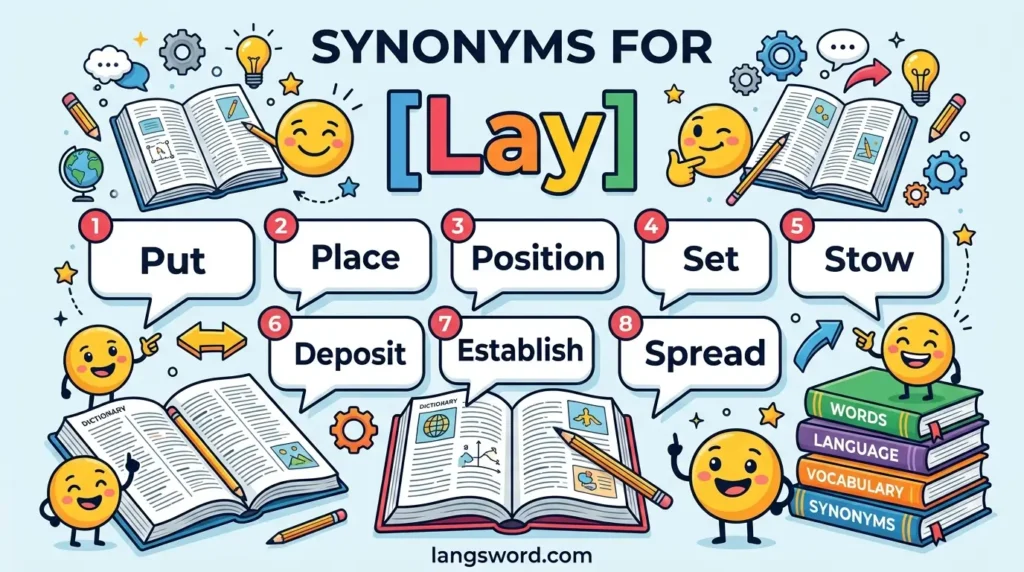

Lay is a common English word that can mean to put something down, place something somewhere, or arrange it in a certain position. For example, imagine setting a book on a table before going to bed.
You can say, “I laid the book on the table.” The word is common because it works in many everyday expressions, such as “lay the table,” “lay a foundation,” and “lay an egg.” Learning synonyms for lay helps English learners express ideas with greater accuracy and variety.
It also helps content writers avoid using the same word again and again. However, not every synonym fits every meaning of lay. This article explains the meaning, grammar, history, pronunciation, word formation, and semantic categories of lay. It also gives 30 useful synonyms with simple meanings and examples.
Meaning of Lay
Definition
Lay (Verb):
To put, place, or set something or someone in a particular position.
Lay (Adjective):
Not belonging to a religious profession or, more generally, not professionally trained in a particular field.
Lay (Noun):
A short song or poem, or the act or manner of laying something, depending on context.
Examples
- Please lay the book on the desk.
- She laid the baby gently in the crib.
Connotative Meaning
Connotation: The feeling or idea that a word suggests beyond its basic meaning.
- Positive tone: Lay can suggest care and order, as in “lay the flowers on the table.”
- Negative tone: In some expressions, it can suggest defeat or burden, as in “lay blame on someone.”
- Neutral tone: In most basic uses, lay simply means to put or place something somewhere.
Etymology
Old English (450–1100)
The main verb lay comes from Old English lecgan, meaning “to place on the ground or another surface” or “to put down.” It was related to the idea of causing something to lie in a particular position.
Middle English (1100–1500)
In Middle English, the word developed forms such as leien and continued to mean “put,” “place,” or “set down.” Many familiar expressions developed from the verb over time.
Modern English (1500–Present)
Modern English lay retains its basic sense of placing or putting something down. It has also developed many extended meanings, including laying plans, laying foundations, laying eggs, laying blame, and laying rules or conditions.
The adjective lay, meaning “non-clerical” or “not professionally trained,” has a different history. It came through Old French and Late Latin from Greek. The noun lay, meaning a short song or poem, also has a separate origin.
Pronunciation (IPA)
- IPA: /leɪ/
- Syllables: one syllable — lay
Affixation Pattern of Lay
- Root: lay
- Prefix: none in the basic word
- Suffix: none in the basic word
Word Formations
- lay — verb
- lays — verb, third-person singular
- laid — verb, past tense and past participle
- laying — verb, present participle
- layer — noun, something or someone that lays or a level of material
- layered — adjective/verb
- layering — noun/verb
- layout — noun, an arrangement or design
- laying — noun, the act of placing
- outlay — noun, money spent
- inlay — verb/noun, to place material inside another surface
- underlay — verb/noun, to place underneath
- mislay — verb, to put something somewhere and later be unable to find it
- layabout — noun, a person who avoids work
30 Synonyms of Lay With Meaning & Examples
1. Put (Verb)
Meaning: To move or place something in a particular position.
Examples:
- Please put the keys on the table.
- She put the baby in the crib.
2. Place (Verb)
Meaning: To put something carefully in a particular position.
Examples:
- Place the glass on the shelf.
- He placed the flowers beside the window.
3. Set (Verb)
Meaning: To put something somewhere, especially in a steady or deliberate way.
Examples:
- Set the plates on the table.
- She set the box near the door.
4. Position (Verb)
Meaning: To put someone or something in a specific location or arrangement.
Examples:
- Position the chair near the window.
- The nurse positioned the patient comfortably.
5. Arrange (Verb)
Meaning: To put things in a planned or organized order.
Examples:
- She arranged the books on the shelf.
- We arranged the chairs in a circle.
6. Deposit (Verb)
Meaning: To put something down or leave it in a particular place.
Examples:
- He deposited the documents on my desk.
- The bird deposits its eggs in a nest.
7. Rest (Verb)
Meaning: To place something so that it is supported.
Examples:
- She rested her hand on the table.
- He rested the ladder against the wall.
8. Spread (Verb)
Meaning: To put something over a surface or area.
Examples:
- Spread the blanket on the grass.
- They spread the cloth over the table.
9. Settle (Verb)
Meaning: To place something or someone in a comfortable or fixed position.
Examples:
- She settled the child in bed.
- He settled the books on the lower shelf.
10. Install (Verb)
Meaning: To put equipment or material into its proper position for use.
Examples:
- Workers installed the new floor.
- They installed tiles in the kitchen.
11. Impose (Verb)
Meaning: To place a rule, duty, tax, or burden on someone.
Examples:
- The school imposed new rules.
- The government imposed a tax on imports.
12. Establish (Verb)
Meaning: To create or set something firmly, such as a rule, system, or foundation.
Examples:
- The company established new safety rules.
- The team established a strong foundation for the project.
13. Formulate (Verb)
Meaning: To carefully create a plan, idea, or policy.
Examples:
- The committee formulated a new plan.
- They formulated a strategy for the campaign.
14. Devise (Verb)
Meaning: To create a plan or method after careful thought.
Examples:
- We devised a simple solution.
- She devised a plan to save time.
15. Construct (Verb)
Meaning: To build or create something by putting parts together.
Examples:
- Workers constructed the foundation.
- They constructed a new bridge.
16. Build (Verb)
Meaning: To make or develop something by putting parts together.
Examples:
- They built a strong foundation.
- The workers built a wall around the garden.
17. Spread Out (Verb)
Meaning: To arrange things over a wider area.
Examples:
- Spread out the papers on the desk.
- She spread out the clothes to dry.
18. Extend (Verb)
Meaning: To stretch or place something over a larger area.
Examples:
- The workers extended the carpet across the floor.
- The branches extended over the roof.
19. Lower (Verb)
Meaning: To move something downward into a lower position.
Examples:
- They lowered the box onto the floor.
- He lowered the flag carefully.
20. Place Down (Verb)
Meaning: To put something onto a surface.
Examples:
- Place down the cup carefully.
- She placed down the package beside the door.
21. Attribute (Verb)
Meaning: To say that something is caused by or belongs to a particular person or thing.
Examples:
- They attributed the success to hard work.
- The report attributed the problem to poor planning.
22. Assign (Verb)
Meaning: To give a task, responsibility, or blame to someone.
Examples:
- The manager assigned the task to me.
- Do not assign blame without evidence.
23. Prescribe (Verb)
Meaning: To officially state a rule, condition, or required action.
Examples:
- The law prescribes strict safety standards.
- The policy prescribes a clear procedure.
24. Stipulate (Verb)
Meaning: To state a condition or requirement clearly.
Examples:
- The contract stipulates a payment date.
- The agreement stipulated several conditions.
25. Lodge (Verb)
Meaning: To formally present or submit something, such as a complaint or claim.
Examples:
- She lodged a formal complaint.
- The customer lodged a claim with the company.
26. Plant (Verb)
Meaning: To put something firmly into the ground or another place.
Examples:
- They planted the seeds in the soil.
- He planted the pole near the gate.
27. Bury (Verb)
Meaning: To put something below the ground or under another material.
Examples:
- They buried the treasure underground.
- The workers buried the cable beneath the road.
28. Oviposit (Verb)
Meaning: To deposit eggs, especially when speaking in scientific or biological terms.
Examples:
- The insect oviposits its eggs on leaves.
- Female insects oviposit in suitable locations.
29. Produce (Verb)
Meaning: To create or give birth to something, including eggs.
Examples:
- The hen produces several eggs each week.
- The farm produces fresh eggs daily.
30. Devote (Verb)
Meaning: To give time, effort, or attention to a purpose.
Examples:
- She devoted her time to the project.
- He devoted several hours to study.
Prototype Meaning
The most typical meaning of lay is to put or place something in a particular position. When people hear the word in this sense, they often imagine someone placing an object on a flat surface, such as laying a book on a desk, laying clothes on a bed, or laying a baby in a crib.
From this basic physical idea, English developed many figurative uses, such as laying a foundation, laying plans, laying blame, and laying down rules.
Prototype Categorization
The 30 synonyms can be grouped into several semantic categories. This helps writers select a word based on the exact meaning they want.
- Basic placement: put, place, set, position, deposit — useful when something is moved to a particular location.
- Careful arrangement: arrange, settle, spread, spread out, position — useful when order, comfort, or distribution matters.
- Construction and installation: install, construct, build, plant, bury — useful when something is physically established or placed as part of a structure.
- Rules and authority: impose, establish, prescribe, stipulate — useful for laws, conditions, duties, and formal requirements.
- Planning and creation: formulate, devise, construct, build — useful when lay refers to creating plans, systems, or foundations.
- Blame and responsibility: attribute, assign — useful in expressions such as “lay blame” or “lay responsibility.”
- Egg production: deposit, oviposit, produce — useful when lay refers to animals producing or depositing eggs.
- Formal submission: lodge — useful for complaints, claims, objections, or formal documents.
- Personal commitment: devote — useful when lay appears in an older or specialized sense involving giving effort or attention.
These categories show why synonyms are not always exact substitutes. A writer should first identify the meaning of lay, then choose the synonym that matches the context, grammar, and level of formality.
Antonyms of Lay
1. Pick Up (Phrasal Verb)
Meaning: To lift something from a surface or place.
2. Lift (Verb)
Meaning: To move something upward.
3. Remove (Verb)
Meaning: To take something away from a place.
4. Take Away (Phrasal Verb)
Meaning: To move something from its current location.
5. Raise (Verb)
Meaning: To move something to a higher position.
6. Retrieve (Verb)
Meaning: To get something back or bring it from another place.
7. Scatter (Verb)
Meaning: To throw or distribute things in different directions instead of placing them together.
8. Displace (Verb)
Meaning: To move something from its usual or original position.
Short Questions and Answers
What does lay mean?
Lay usually means to put or place something somewhere. It can also have different meanings in expressions such as “lay a plan,” “lay blame,” “lay an egg,” and “lay down a rule.”
When should lay be used?
Use lay when the verb takes an object and means “put” or “place.” For example, “Lay the book on the desk.” Remember that lay normally needs an object in this basic sense.
Is lay positive or negative?
Lay is generally neutral. Its emotional tone depends on the expression and context. “Lay flowers on the grave” may sound respectful, while “lay blame on someone” may sound critical.
How is it different from similar words?
Lay is often close to put, place, and set, but the best choice depends on context. Place can sound more formal, put is very common in everyday speech, and set often suggests putting something in a stable or deliberate position.
Conclusion
Learning lay and its synonyms can make English more flexible and precise. The word has many uses, from placing an object on a table to creating a plan, establishing a rule, producing an egg, or assigning blame.
Understanding these different meanings helps learners choose the right synonym for each situation. Words such as put, place, set, position, arrange, establish, formulate, impose, attribute, and oviposit can replace lay in specific contexts, but they do not all have the same meaning.
Using the right synonym also makes writing clearer, avoids repetition, and improves speaking skills. For English learners and content writers, regular vocabulary practice is a simple way to build confidence. Try learning a few new synonyms each day and use them in your own sentences.