
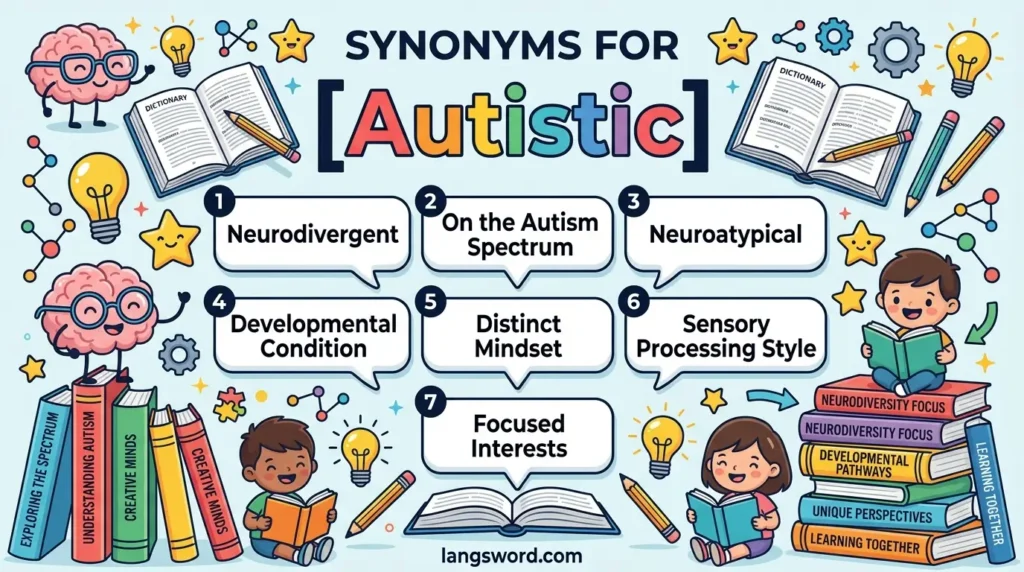

Autistic describes a person who has autism, a developmental condition that can affect communication, social interaction, sensory experiences, learning, and behavior. For example, you might say, “My brother is autistic, and he enjoys learning about trains.”
The word is commonly used in medical, educational, social, and everyday settings. Learning alternatives for autistic can help English learners and content writers avoid repetition and choose language that fits a specific context.
However, not every alternative has exactly the same meaning. Some are person-first phrases, some are clinical terms, and some are broader words related to neurodiversity. This article explains the meaning of autistic, its history, pronunciation, word formation, and 30 useful alternatives.
It also shows examples, semantic categories, and common antonyms so readers can choose respectful and accurate language.
Meaning of Autistic
Definition
Autistic (adjective):
Describing a person who has autism or who is part of the autism spectrum.
Autism is a developmental disability associated with differences in social communication and interaction and with restricted or repetitive behaviors, interests, or activities. The abilities and support needs of autistic people can vary widely.
Examples
- My sister is autistic and enjoys drawing detailed pictures.
- The school provides extra support for autistic students.
Connotative Meaning
Positive tone: In many contexts, autistic is a neutral or positive identity term. Many autistic people prefer identity-first language such as “autistic person.”
Negative tone: The word itself is not inherently negative, but it can sound negative when used as an insult or when autism is wrongly presented as a defect or personal failing.
Neutral tone: In medical, educational, and general writing, autistic can simply describe a person’s neurotype or diagnosis.
(Connotation: the feeling or idea that a word suggests in addition to its basic meaning.)
Etymology
The word autistic comes from autism. The term autism was coined in 1912 by Swiss psychiatrist Paul Bleuler from German Autismus, based on Greek autos, meaning “self,” with the suffix -ismos, referring to a state or condition. Autistic also dates from 1912.
Old English (450–1100)
The modern word autistic did not exist in Old English. Its roots come from Greek and later German medical terminology.
Middle English (1100–1500)
The modern term was still not in use during Middle English. English medical vocabulary later developed many terms from Greek and Latin.
Modern English (1500–Present)
Autism entered modern medical vocabulary in 1912, and autistic was formed from it. The noun autist, meaning a person with autism, appeared later, but it is now uncommon and can sound outdated or inappropriate.
Pronunciation (IPA)
- IPA: /ɔːˈtɪstɪk/
- Syllables: au-tis-tic
Affixation Pattern of Autistic
- Root: aut- / auto- from Greek autos, meaning “self”
- Prefix: auto- is the historical Greek word-forming element
- Suffix: -istic, forming an adjective
- Related word formations:
- autism — noun
- autistic — adjective
- autistically — adverb
- autist — noun, historical/uncommon term for an autistic person
The modern adjective autistic is derived from autism.
30 Synonyms of Autistic With Meaning & Examples
Important note: The following list contains synonyms and context-based alternatives. Some are not exact dictionary synonyms. For example, neurodivergent is broader than autistic, while person with autism is a person-first alternative rather than a single-word synonym. Language preferences can differ, so when writing about a particular person, follow their preferred terminology. The National Autistic Society notes that many autistic people prefer identity-first language, while some prefer person-first language.
1. Autistic Person (Noun Phrase)
Meaning: A person who is autistic.
Examples:
- She is an autistic person who enjoys music.
- The organization creates resources for autistic people.
2. Person with Autism (Noun Phrase)
Meaning: A person who has autism; this is a person-first alternative.
Examples:
- He is a person with autism who communicates through writing.
- The program supports people with autism.
3. Person on the Autism Spectrum (Noun Phrase)
Meaning: A person who is part of the autism spectrum.
Examples:
- She is a person on the autism spectrum.
- The teacher has experience working with people on the autism spectrum.
4. Person on the Spectrum (Noun Phrase)
Meaning: A shorter informal way to refer to a person on the autism spectrum.
Examples:
- My cousin is on the spectrum.
- The group welcomes people on the spectrum.
5. Autistic Individual (Noun Phrase)
Meaning: An individual who is autistic.
Examples:
- Each autistic individual may have different support needs.
- The study included several autistic individuals.
6. Autistic Adult (Noun Phrase)
Meaning: An adult who is autistic.
Examples:
- The center provides services for autistic adults.
- Many autistic adults develop strong professional skills.
7. Autistic Child (Noun Phrase)
Meaning: A child who is autistic.
Examples:
- The teacher supports each autistic child in the classroom.
- Every autistic child may learn in a different way.
8. Autistic Student (Noun Phrase)
Meaning: A student who is autistic.
Examples:
- The school offers support for autistic students.
- The teacher created a quiet space for an autistic student.
9. Autistic Learner (Noun Phrase)
Meaning: A learner who is autistic.
Examples:
- The course includes flexible activities for autistic learners.
- Teachers can adapt lessons for autistic learners.
10. Autistic Person with ASD (Noun Phrase)
Meaning: An autistic person described using the abbreviation for autism spectrum disorder.
Examples:
- The clinic provides support for autistic people with ASD.
- Researchers studied communication among autistic people with ASD.
11. Person with Autism Spectrum Disorder (Noun Phrase)
Meaning: A person diagnosed with autism spectrum disorder.
Examples:
- The service is available to people with autism spectrum disorder.
- A person with autism spectrum disorder may have different communication needs.
12. Individual with Autism Spectrum Disorder (Noun Phrase)
Meaning: A formal way to describe an individual diagnosed with autism spectrum disorder.
Examples:
- The report discusses individuals with autism spectrum disorder.
- Each individual with autism spectrum disorder may have different strengths.
13. Person with ASD (Noun Phrase)
Meaning: A shorter clinical or formal expression for a person with autism spectrum disorder.
Examples:
- The clinic supports people with ASD.
- The study included children with ASD.
14. Individual with ASD (Noun Phrase)
Meaning: A formal term for an individual with autism spectrum disorder.
Examples:
- The researchers interviewed individuals with ASD.
- Each individual with ASD received an assessment.
15. ASD Individual (Noun Phrase)
Meaning: A highly formal and less natural phrase referring to an individual with ASD.
Examples:
- The report describes the needs of ASD individuals.
- Researchers examined communication among ASD individuals.
Usage note: Person with ASD or individual with ASD is usually more natural English.
16. Autism-Spectrum Person (Noun Phrase)
Meaning: A person who is described as being on the autism spectrum.
Examples:
- The project includes several autism-spectrum people.
- The article discusses experiences of autism-spectrum people.
Usage note: This expression is understandable but less natural than autistic person or person on the autism spectrum.
17. Neurodivergent Person (Noun Phrase)
Meaning: A person whose brain processes information in ways that differ from what is considered typical.
Examples:
- An autistic person may also identify as neurodivergent.
- The workplace supports neurodivergent people.
Usage note: Neurodivergent is broader than autistic, so it is not an exact synonym.
18. Neurodivergent Individual (Noun Phrase)
Meaning: An individual with a neurological difference from typical patterns.
Examples:
- The company supports neurodivergent individuals.
- Neurodivergent individuals may have different communication preferences.
19. Neurodiverse Person (Noun Phrase)
Meaning: A person who is part of a group with varied neurological characteristics.
Examples:
- The organization promotes inclusion for neurodiverse people.
- Neurodiverse people may bring different perspectives to a workplace.
Usage note: Neurodiverse properly describes a group or population more often than one individual, so neurodivergent person is usually more precise for an individual.
20. Neuroatypical Person (Noun Phrase)
Meaning: A person whose neurological development or functioning differs from common patterns.
Examples:
- The program welcomes neuroatypical people.
- Neuroatypical individuals may use different learning strategies.
Usage note: This is broader than autistic and is less common in everyday English.
21. Person with a Neurodevelopmental Difference (Noun Phrase)
Meaning: A person whose neurological development differs from typical development.
Examples:
- The school supports people with neurodevelopmental differences.
- A person with a neurodevelopmental difference may benefit from flexible teaching.
22. Person with a Developmental Disability (Noun Phrase)
Meaning: A person with a disability that affects development.
Examples:
- The center provides services for people with developmental disabilities.
- A person with a developmental disability may need different types of support.
Usage note: This is broader than autistic because many developmental disabilities are not autism.
23. Neurodivergent Learner (Noun Phrase)
Meaning: A learner whose neurological development differs from typical patterns.
Examples:
- Teachers can use flexible methods with neurodivergent learners.
- The course was designed to support neurodivergent learners.
24. Neurodivergent Student (Noun Phrase)
Meaning: A student with a neurological difference, including autism in some cases.
Examples:
- The school provides quiet spaces for neurodivergent students.
- Teachers receive training to support neurodivergent students.
25. Person with Autistic Traits (Noun Phrase)
Meaning: A person who has characteristics associated with autism.
Examples:
- The researcher described participants with autistic traits.
- Some people may show autistic traits without receiving an autism diagnosis.
Usage note: This does not mean the same thing as being autistic.
26. Individual with Autistic Characteristics (Noun Phrase)
Meaning: A formal description of someone who shows characteristics associated with autism.
Examples:
- The report discusses individuals with autistic characteristics.
- Some individuals with autistic characteristics may benefit from tailored support.
Usage note: This describes characteristics and should not automatically be treated as a diagnosis.
27. Person with Autistic Features (Noun Phrase)
Meaning: A person who shows features associated with autism.
Examples:
- The assessment noted several autistic features.
- The clinician documented features associated with autism.
Usage note: This is mainly suitable for clinical or descriptive contexts and is not a direct synonym for autistic.
28. Person with an Autism Diagnosis (Noun Phrase)
Meaning: A person who has received a diagnosis of autism.
Examples:
- The study included people with an autism diagnosis.
- Support was offered to adults with an autism diagnosis.
29. Autistic Individual with Support Needs (Noun Phrase)
Meaning: An autistic individual who needs some form of support.
Examples:
- The service works with autistic individuals with different support needs.
- Each autistic individual with support needs may require a personal plan.
30. Autistic Community Member (Noun Phrase)
Meaning: An autistic person who is part of an autistic community.
Examples:
- The project included several autistic community members.
- Autistic community members shared their experiences.
Prototype Meaning
The most typical meaning of autistic is “relating to a person who has autism.” When people hear the word, they usually think of someone whose social communication, interaction, sensory experiences, or patterns of behavior may differ from those of non-autistic people. However, autism is a spectrum, and autistic people can have very different abilities, communication styles, interests, and support needs.
Prototype Categorization
The 30 alternatives can be grouped by meaning and use. This helps writers select a term that fits the audience instead of treating every alternative as an exact synonym.
- Identity-first terms: autistic person, autistic individual, autistic adult, autistic child, autistic student, autistic learner. These directly describe someone as autistic. Many autistic people prefer identity-first language, although individual preferences vary.
- Person-first terms: person with autism, person with ASD, person with autism spectrum disorder, individual with ASD, individual with autism spectrum disorder, person with an autism diagnosis. These put the word person first and can be preferred by some individuals.
- Spectrum-based terms: person on the autism spectrum, person on the spectrum, autism-spectrum person. These emphasize the spectrum nature of autism.
- Neurodiversity terms: neurodivergent person, neurodivergent individual, neuroatypical person, neurodivergent learner, neurodivergent student. These are broader terms and should not be used as exact replacements for autistic.
- Clinical or descriptive terms: person with autistic traits, individual with autistic characteristics, person with autistic features. These describe characteristics rather than necessarily stating that someone has an autism diagnosis.
- Support-focused terms: autistic individual with support needs, autistic community member. These add information about a person’s needs or community identity rather than simply replacing the word autistic.
This categorization helps writers avoid repetition while also preventing them from using a broad term such as neurodivergent when they specifically mean autistic.
Antonyms of Autistic
There is no perfect one-word antonym for autistic. The most useful contrasting terms depend on the context.
1. Non-autistic (Adjective)
Meaning: Not autistic.
- The study compared autistic and non-autistic participants.
2. Non-autistic person (Noun Phrase)
Meaning: A person who is not autistic.
- The research included both autistic and non-autistic people.
3. Neurotypical (Adjective/Noun)
Meaning: Describing a person whose neurological development is considered typical within a particular social or clinical context.
- The workshop included autistic and neurotypical participants.
4. Neurotypical person (Noun Phrase)
Meaning: A person described as neurotypical.
- Neurotypical people may experience communication differently from autistic people.
Usage note: Neurotypical is broader than a strict opposite of autistic, so it should be used with care.
Short Questions and Answers
What does autistic mean?
Autistic is an adjective describing a person who has autism. Autism is a developmental disability associated with differences in social communication, interaction, behavior, interests, and sensory experiences.
When should autistic be used?
Use autistic when you are specifically referring to autism. It is widely used in medical, educational, social, and everyday contexts. When writing about a particular person, use the language that person prefers.
Is autistic positive or negative?
Autistic is generally a neutral descriptive term. It can have a positive or negative feeling depending on the surrounding words and context. Many autistic people use it as an identity term.
How is it different from similar words?
Autistic specifically refers to autism. Neurodivergent is broader and can include people with many different neurological differences. Person with autism has the same basic reference but uses person-first language. Person on the spectrum is another common alternative.
Conclusion
Learning the word autistic and its related alternatives can improve English vocabulary, writing, and speaking skills. It also helps writers avoid unnecessary repetition and choose words that fit medical, educational, social, or everyday contexts.
However, careful word choice matters because not all alternatives have exactly the same meaning. Terms such as person with autism and person on the autism spectrum can work as person-first alternatives, while neurodivergent is a broader term.
Most importantly, writers should respect individual language preferences when referring to autistic people. Regular vocabulary practice can help English learners understand subtle differences between related words.
Read examples, compare meanings, and practice using each term in a suitable sentence. This approach builds stronger vocabulary, clearer communication, and greater confidence in English.