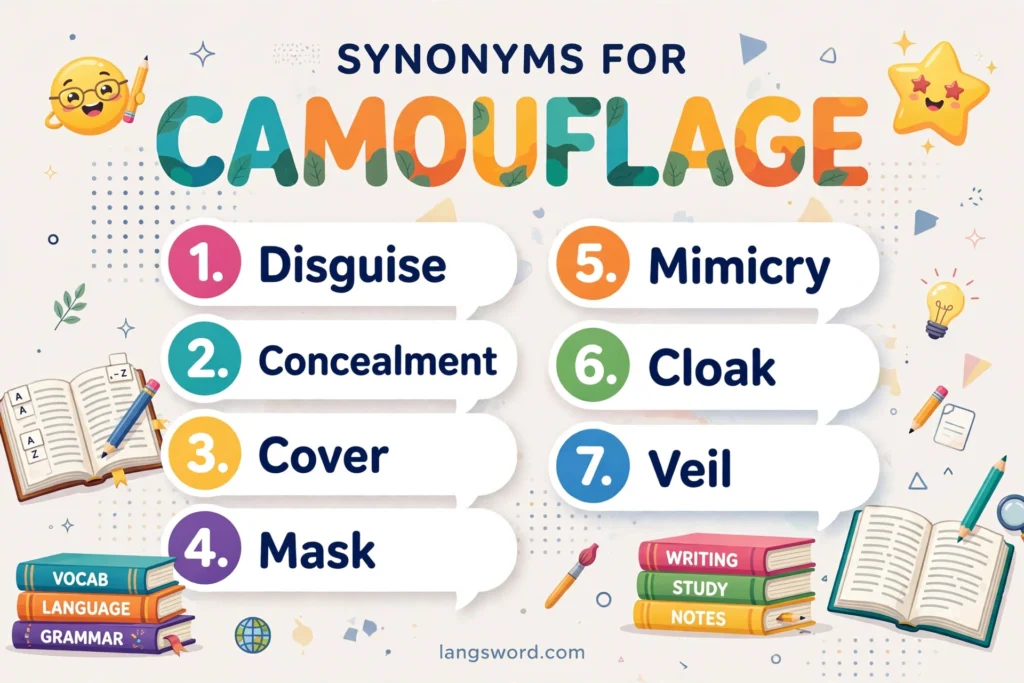

Camouflage is the art of hiding by blending in. A soldier in a green and brown uniform can stand still in a forest and almost disappear. A brown moth on tree bark does the same trick in nature. People use this word every day for clothes, animals, cars, and even makeup. It is common in news, movies, and army stories. Learning synonyms for camouflage helps English learners grow their word power. It also helps writers say the same idea in fresh ways. In this article, you will learn the meaning of camouflage, 30 synonyms with simple meanings and examples, plus its grammar, history, pronunciation, and word groups in easy words.
Meaning of Camouflage
Definition
Camouflage (Noun): Colors, patterns, or materials that help a person, animal, or object blend with what is around it, so it is hard to see.
Examples
- The tiger’s stripes are natural camouflage in tall grass.
- The soldiers wore camouflage to stay hidden in the forest.
Connotative Meaning
- Positive tone: It can suggest smart planning and safety. A hidden animal stays safe from hunters.
- Negative tone: It can suggest tricks and lies. A cheater may use sweet words as camouflage for bad plans.
- Neutral tone: It is often a plain science or army word with no strong feeling.
(Connotation: the feelings and ideas a word brings to mind, apart from its plain meaning.)
Etymology
- Old English (450–1100): The word did not exist in Old English. People of that time had no single word for this idea.
- Middle English (1100–1500): The word was still not in English. It came much later, from French and Italian.
- Modern English (1500–Present): Camouflage comes from French camoufler, meaning to disguise. That French word came from Italian camuffare, meaning to trick or hide. English took the word around 1917, during World War I, when armies needed new ways to hide men, guns, and ships.
Pronunciation (IPA)
- IPA: /ˈkæməflɑːʒ/
- Syllables: cam · ou · flage (3 syllables)
Affixation Pattern of Camouflage
- Root: camouflage (borrowed whole from French camoufler, to disguise)
- Prefix: None
- Suffix: -age (a noun suffix that means an action, result, or thing)
- Word formations:
- camouflaged (Adjective)
- camouflaging (Verb)
- camouflages (Verb, third person)
- camouflages (Noun, plural)
30 Synonyms of Camouflage With Meaning & Examples
1. Disguise (Noun)
Meaning: Clothes or colors that change how someone or something looks, so others cannot know it.
Examples:
- The spy wore a wig and glasses as a disguise.
- The green paint is a disguise for the jungle truck.
2. Concealment (Noun)
Meaning: The act of hiding something so that no one can find or see it.
Examples:
- The nest’s concealment kept the baby birds safe.
- The soldiers used thick bushes for concealment.
3. Cover (Noun)
Meaning: Something that hides or protects a person or thing from view.
Examples:
- The deer ran for cover in the long grass.
- Clouds gave the plane cover from watchers below.
4. Cloak (Noun)
Meaning: Something that covers and hides the truth or the real form of a thing.
Examples:
- Night was a cloak for the fleeing fox.
- His smile was a cloak for his anger.
5. Mask (Noun)
Meaning: A cover that hides the face or the true nature of something.
Examples:
- The pattern on the frog’s skin is a mask made by nature.
- She wore a calm mask, but inside she was scared.
6. Veil (Noun)
Meaning: A thin cover that partly hides something from sight.
Examples:
- A veil of mist hid the valley from the road.
- The leaves formed a veil over the hidden bird.
7. Screen (Noun)
Meaning: Something placed in front of a person or thing to block the view of it.
Examples:
- The tall grass acted as a screen for the lion.
- Smoke rose as a screen in front of the camp.
8. Blind (Noun)
Meaning: A shelter or cover, often used for hunting, that hides a person from animals.
Examples:
- The hunter waited quietly in his blind.
- They built a blind out of sticks and leaves.
9. Cover-Up (Noun)
Meaning: An attempt to hide the truth about something wrong or secret.
Examples:
- The fake story was just a cover-up for the theft.
- His loud laugh was a cover-up for his fear.
10. Masquerade (Noun)
Meaning: A false show or act meant to make people believe something untrue.
Examples:
- Her kind words were a masquerade; she wanted his money.
- The plain box was a masquerade for the costly gift inside.
11. Mimicry (Noun)
Meaning: Copying the look or sound of another animal or thing to stay safe or to trick others.
Examples:
- The harmless fly uses mimicry and looks like a bee.
- Mimicry helps weak animals fool hungry hunters.
12. Blending (Noun)
Meaning: Mixing into the surroundings so smoothly that the eye cannot pick you out.
Examples:
- Blending with the sand kept the crab safe.
- The art of blending takes time and skill.
13. Hiding (Noun)
Meaning: Staying in a secret place where others cannot see or find you.
Examples:
- The kitten’s hiding place was under the old stairs.
- Hiding is the first rule of the game.
14. Secrecy (Noun)
Meaning: Keeping something hidden from the knowledge of other people.
Examples:
- The plan worked in secrecy for many weeks.
- Secrecy guarded the nest from passing eyes.
15. Pretense (Noun)
Meaning: A way of behaving that hides the truth and makes people believe something false.
Examples:
- His pretense of sleep fooled the guard.
- The party was a pretense; the real meeting was later.
16. Facade (Noun)
Meaning: A false front that hides what is really behind it.
Examples:
- The old shop’s bright facade hid its empty rooms.
- His brave facade fell away when he got home.
17. Guise (Noun)
Meaning: An outer look or form that hides the true person or thing.
Examples:
- The wolf came in the guise of a friendly dog.
- Under the guise of a gift, the box held a trick.
18. Veneer (Noun)
Meaning: A thin outer layer that covers and hides what lies beneath.
Examples:
- A veneer of snow hid the black ice on the road.
- Her cool veneer hid a warm and kind heart.
19. Shroud (Noun)
Meaning: A cover that hides something from sight, often fully.
Examples:
- A shroud of fog hid the ships at sea.
- The moth rested under a shroud of dry leaves.
20. Protective Coloring (Noun)
Meaning: Natural colors on an animal that help it blend in and stay safe.
Examples:
- The frog’s protective coloring matches the wet leaves.
- Protective coloring keeps many small animals alive.
21. Cryptic Coloring (Noun)
Meaning: Colors and patterns that help an animal hide by matching its home ground.
Examples:
- Cryptic coloring makes the moth vanish on the bark.
- The bird’s cryptic coloring fooled my eyes twice.
22. Coloration (Noun)
Meaning: The natural colors and marks on a living thing, which may help it hide.
Examples:
- The fish’s coloration changes with the seasons.
- Bright coloration warns hunters to stay away.
23. Natural Disguise (Noun)
Meaning: A built-in look that helps a living thing hide in nature.
Examples:
- The stick insect’s natural disguise is its thin body.
- Spots are the deer’s natural disguise in the woods.
24. Subterfuge (Noun)
Meaning: A trick or secret plan used to hide the truth and reach a goal.
Examples:
- He used subterfuge to sneak past the guards.
- The game was won by smart subterfuge.
25. Deception (Noun)
Meaning: The act of making someone believe something that is not true.
Examples:
- The fake nest is pure deception for hungry snakes.
- His whole story was a work of deception.
26. False Front (Noun)
Meaning: A fake outer look built to hide what is really behind it.
Examples:
- The shed was a false front for the hidden lab.
- She put up a false front of joy at the party.
27. Smokescreen (Noun)
Meaning: Something said or done to hide the truth or to draw eyes away from it.
Examples:
- The jokes were a smokescreen for his real plan.
- The army laid a smokescreen over the road.
28. Cover Story (Noun)
Meaning: A false story told to hide the real facts about a person or act.
Examples:
- His cover story fooled the guards at the gate.
- The cover story fell apart in one day.
29. Invisibility (Noun)
Meaning: The state of being impossible to see.
Examples:
- The pale moth has near invisibility on white bark.
- Invisibility is a dream power in many tales.
30. Disguise (Verb)
Meaning: To change the look of a person or thing so it cannot be known.
Examples:
- They disguise the tank with nets and leaves.
- She can disguise her voice on the phone.
Prototype Meaning
When people hear the word camouflage, they picture a soldier in a green and brown uniform standing still in the woods, or a small animal whose skin matches the leaves around it. The core idea is simple: a look that stops the eye from finding you. It is about colors and patterns that break up a shape and melt it into the world behind it. Safety is the heart of this picture, because the hidden one lives, and the seen one is caught.
Prototype Categorization
- Everyday hiding: Disguise, Concealment, Hiding, Blending — use these for plain, daily talk about staying out of sight.
- Things that cover: Cover, Cloak, Mask, Veil, Screen, Blind, Shroud — use these when something sits in front and blocks the view.
- Nature’s built-in tricks: Mimicry, Protective Coloring, Cryptic Coloring, Coloration, Natural Disguise, Invisibility — use these for animals, plants, and science writing.
- False looks: Masquerade, Facade, Guise, Veneer, False Front — use these when a person or thing shows a fake outer face.
- Tricks and lies: Pretense, Secrecy, Cover-Up, Subterfuge, Deception, Smokescreen, Cover Story — use these for plans, spies, and stories where the truth is hidden on purpose.
These groups help writers pick the best word fast. A word from the wrong group can sound odd, but a word from the right group fits the scene like a key in a lock.
Antonyms of Camouflage
Exposure (Noun)
Being open to view, with nothing to hide behind.
Reveal (Noun)
An act of showing something that was hidden.
Visibility (Noun)
The state of being easy and clear to see.
Disclosure (Noun)
The act of telling or showing a secret fact.
Openness (Noun)
A way of acting with nothing kept hidden.
Plainness (Noun)
The quality of being simple, clear, and easy to see.
Display (Noun)
A clear show that is made for all to see.
Short Questions and Answers
What does camouflage mean?
Camouflage means colors, patterns, or covers that help a person, animal, or thing blend in and stay hard to see.
When should camouflage be used?
Use it when you talk about hiding in nature, army life, hunting, or any smart trick that hides the truth from the eye.
Is camouflage positive or negative?
It can be both. It is positive when it keeps animals and soldiers safe. It is negative when people use it to lie or cheat.
How is it different from similar words?
Camouflage blends a thing into its surroundings. A disguise changes how a thing looks. A mask only covers the face or the truth.
Conclusion
Camouflage is a rich word, and its many synonyms make your English rich too. Each new word you learn adds a fresh brush to your writing and speaking. With words like disguise, veil, and mimicry, you can paint clear pictures and never repeat yourself. Strong word power builds real trust in your skills, step by step. So make it a habit: learn one new word every day, say it out loud, and use it in a line of your own. Small daily steps turn into big gains, and soon you will write and speak with ease, color, and confidence.