

A documentary is a film, video, or program that presents real people, events, facts, or issues. For example, you might watch a documentary about wildlife, history, science, or a famous person.
The word is common because it clearly describes content based on real life rather than an invented story. Still, using the same word again and again can make writing sound dull.
Learning synonyms for documentary helps English learners build a wider vocabulary and helps content writers choose words that fit different contexts. Some alternatives focus on facts, while others highlight education, journalism, records, or real-life stories.
In this article, we explore the meaning of documentary, its synonyms, examples, grammar, history, pronunciation, word formation, antonyms, and semantic categories. This guide will help you understand which alternative works best in different situations.
Meaning of documentary
Definition
Documentary (Noun/Adjective):
A documentary is a film, program, or piece of media that presents real people, events, facts, or information; as an adjective, it describes something based on real facts or records.
Examples
- We watched a documentary about climate change last night.
- The filmmaker created a documentary about life in the Arctic.
- The report contains documentary evidence of the event.
Connotative Meaning
Connotation (the feeling or idea that a word suggests beyond its basic meaning):
- Positive tone: Can suggest truth, education, accuracy, and serious research.
- Negative tone: In some contexts, it may suggest something dry, serious, or less entertaining.
- Neutral tone: Simply describes media or information based on real events and facts.
Etymology
The word documentary comes from document, which ultimately comes from the Latin docēre, meaning “to teach.” The word developed through French and English before gaining its modern media-related meaning.
- Old English (450–1100): The modern word documentary was not used in Old English. Related ideas of teaching, recording, and showing evidence existed through other words.
- Middle English (1100–1500): Document entered English through Anglo-French and Latin influences and referred to written evidence or something that taught.
- Modern English (1500–Present): Documentary developed from document and later became strongly associated with films, radio programs, and television programs based on real events. The film sense became especially common during the 20th century.
Pronunciation (IPA)
- IPA: /ˌdɒkjʊˈmentəri/ (British English), /ˌdɑːkjəˈmentəri/ (American English)
- Syllables: doc-u-men-ta-ry
Affixation Pattern of documentary
- Root: document
- Prefix: None
- Suffix: -ary
- Word formations:
- document — noun/verb
- documented — adjective/past participle
- documenting — present participle/gerund
- documentation — noun
- documentary — noun/adjective
- documentarian — noun
- documentarist — noun
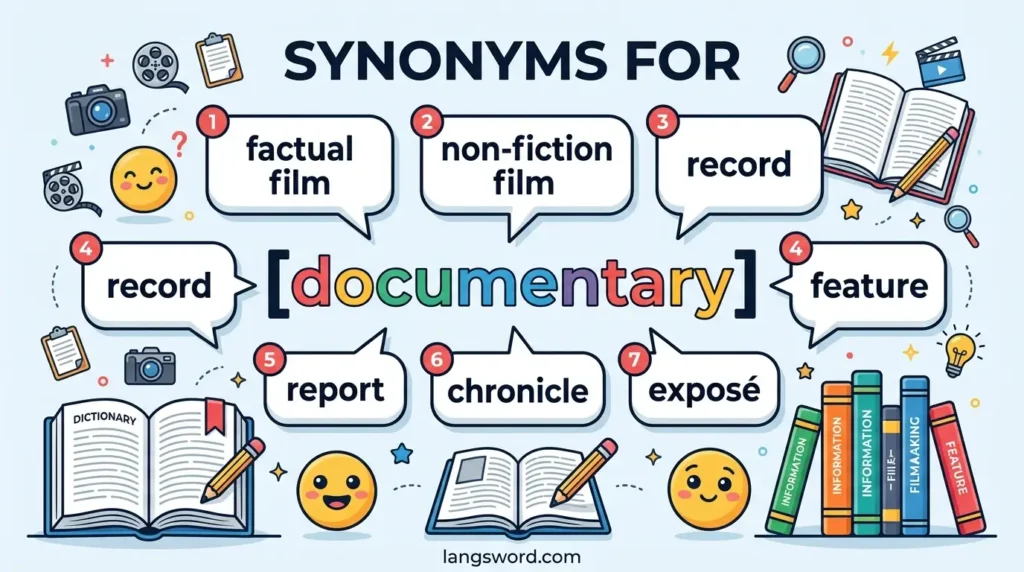
30 Synonyms of documentary With Meaning & Examples
1. Nonfiction Film (Noun)
Meaning: A film that presents real people, events, or information rather than an invented story.
Examples:
- We watched a nonfiction film about ocean pollution.
- Her latest nonfiction film explores life in rural communities.
2. Factual Film (Noun)
Meaning: A film that focuses on real facts and events.
Examples:
- The channel showed a factual film about ancient Egypt.
- This factual film explains how earthquakes happen.
3. Doc (Noun)
Meaning: An informal short form of the word documentary.
Examples:
- I watched a great doc about space exploration.
- The new doc follows a group of young athletes.
4. Film (Noun)
Meaning: A recorded visual production, especially one that tells or presents a story.
Examples:
- The film examines the history of the city.
- We saw a film about endangered animals.
5. Nonfiction (Noun)
Meaning: Writing, media, or content based on real facts rather than fiction.
Examples:
- She enjoys reading nonfiction about history.
- The channel produces nonfiction about science and nature.
6. Factual Program (Noun)
Meaning: A television or media program that gives information about real subjects.
Examples:
- The factual program examines modern farming.
- I watched a factual program about space travel.
7. Informational Film (Noun)
Meaning: A film created mainly to provide facts or useful information.
Examples:
- The school showed an informational film about road safety.
- This informational film teaches viewers about recycling.
8. Educational Film (Noun)
Meaning: A film designed to teach people about a subject.
Examples:
- The teacher showed an educational film about biology.
- We watched an educational film about World War II.
9. Instructional Film (Noun)
Meaning: A film that teaches people how something works or how to do something.
Examples:
- The company made an instructional film for new workers.
- The instructional film explains basic laboratory safety.
10. Reportage (Noun)
Meaning: Detailed reporting about real events, often through journalism or media.
Examples:
- The program offered powerful reportage from the disaster area.
- Her reportage covered the lives of displaced families.
11. Video Report (Noun)
Meaning: A recorded report that presents information about a real event or issue.
Examples:
- The journalist prepared a video report about the flood.
- The video report showed the effects of the storm.
12. Feature (Noun)
Meaning: A longer media piece that explores a particular real-life subject.
Examples:
- The newspaper published a feature about local farmers.
- The television feature explored the history of the town.
13. Exposé (Noun)
Meaning: A report that reveals hidden facts, problems, or wrongdoing.
Examples:
- The journalist published an exposé on unsafe working conditions.
- The exposé revealed serious problems within the industry.
14. Investigation (Noun)
Meaning: A detailed examination that seeks to discover facts or the truth.
Examples:
- The documentary was based on a long investigation.
- The investigation uncovered new information.
15. Journalistic Report (Noun)
Meaning: A report that presents information about real events using journalistic methods.
Examples:
- The channel released a detailed journalistic report.
- Her journalistic report focused on housing problems.
16. Historical Record (Noun)
Meaning: A record that preserves information about past events.
Examples:
- The film serves as a valuable historical record.
- These photographs provide a historical record of the town.
17. Visual Record (Noun)
Meaning: Images or video that preserve evidence or information about real events.
Examples:
- The footage provides a visual record of the ceremony.
- The film became an important visual record of the conflict.
18. Factual Account (Noun)
Meaning: A description of events based on facts rather than imagination.
Examples:
- The book gives a factual account of the expedition.
- The film presents a factual account of the scientist’s life.
19. Real-Life Account (Noun)
Meaning: A description or presentation based on actual experiences or events.
Examples:
- The program tells a moving real-life account of survival.
- Her story became the basis of a real-life account.
20. Case Study (Noun)
Meaning: A detailed study of a real person, group, event, or situation.
Examples:
- The film presents a case study of a successful community project.
- We watched a case study about workplace safety.
21. Profile (Noun)
Meaning: A detailed presentation of a person, organization, or subject.
Examples:
- The channel produced a profile of the famous artist.
- The profile examines her career and personal life.
22. Portrait (Noun)
Meaning: A detailed representation or description of a person, place, or situation.
Examples:
- The film offers a powerful portrait of village life.
- The program presents a portrait of the artist as a young man.
23. Chronicle (Noun)
Meaning: A detailed record of events in the order they happened.
Examples:
- The film is a chronicle of the country’s changing history.
- The book chronicles the family’s journey.
24. Account (Noun)
Meaning: A description or report of an event or experience.
Examples:
- The documentary provides an account of the accident.
- His account of the event was supported by evidence.
25. Record (Noun)
Meaning: Information preserved as evidence of something that happened.
Examples:
- The video is an important record of the historic event.
- The photographs form a record of the old neighborhood.
26. Presentation (Noun)
Meaning: A structured display or explanation of information.
Examples:
- The film is a clear presentation of scientific facts.
- The program offers a visual presentation of the research.
27. Report (Noun)
Meaning: A spoken, written, or visual description of facts or events.
Examples:
- The report examines pollution in major cities.
- The television report showed the damage caused by the storm.
28. Fact-Based Film (Noun)
Meaning: A film that uses real facts and events as its main content.
Examples:
- They produced a fact-based film about the explorer.
- The fact-based film attracted many history students.
29. Reality-Based Production (Noun)
Meaning: A media production that uses real events, people, or situations as its subject.
Examples:
- The reality-based production follows several families.
- The director created a reality-based production about modern farming.
30. True-Life Film (Noun)
Meaning: A film based on real people or real events.
Examples:
- We watched a true-life film about a famous athlete.
- The true-life film tells the story of a family overcoming hardship.
Prototype Meaning
The most typical meaning of documentary is a film or video about real people, events, places, or issues.
When people hear the word, they often imagine a serious or informative program that uses interviews, photographs, recordings, narration, and real footage. Unlike a fictional movie, a documentary aims to present or explore something from real life.
Prototype Categorization
The 30 synonyms can be grouped into several semantic categories. This helps writers select a word based on the exact meaning they want.
- Film and media terms: nonfiction film, factual film, doc, film, informational film, educational film, instructional film, fact-based film, and true-life film focus on visual productions.
- Journalism and reporting terms: reportage, video report, exposé, investigation, journalistic report, and report emphasize research, news, and factual reporting.
- Record and evidence terms: historical record, visual record, factual account, account, and record highlight the preservation or presentation of information.
- Study and analysis terms: case study, profile, and presentation focus on examining or explaining a particular subject.
- Descriptive and historical terms: portrait and chronicle emphasize a detailed representation or record of people, places, or events.
- Reality-focused terms: nonfiction, real-life account, and reality-based production stress the connection to real life.
This categorization helps writers avoid choosing a synonym that sounds natural but changes the intended meaning. For example, exposé suggests revealed information, while educational film suggests teaching.
Antonyms of documentary
Fiction (Noun)
Meaning: A story or work created from imagination rather than presented as factual reality.
Fictional (Adjective)
Meaning: Created from imagination rather than based on real events.
Imaginary (Adjective)
Meaning: Existing only in the imagination.
Invented (Adjective)
Meaning: Created rather than discovered or recorded as real.
Dramatic (Adjective)
Meaning: Designed mainly for entertainment or emotional storytelling rather than factual presentation.
Short Questions and Answers
What does documentary mean?
A documentary is a film, program, or media work that presents real people, events, facts, or issues.
When should documentary be used?
Use documentary when you are talking about factual media or something based on real records, events, or evidence.
Is documentary positive or negative?
Documentary is usually neutral. It can have a positive feeling when it suggests useful information and truth, but the tone depends on the context.
How is it different from similar words?
A documentary is usually a factual media work. Report is broader and can be written, spoken, or visual. Exposé usually reveals hidden problems or wrongdoing, while educational film focuses on teaching.
Conclusion
Learning documentary and its synonyms can make your English more flexible and precise. The word usually describes media based on real people, events, facts, or issues, but different alternatives highlight different ideas.
For example, nonfiction film stresses the difference from fiction, educational film stresses teaching, reportage highlights journalism, and historical record focuses on preserving information.
Knowing these differences helps you avoid repetition in writing and choose words that match your meaning. A wider vocabulary also makes speaking and writing clearer and more natural.
English learners can build confidence by studying a few new words each day and using them in original sentences. Regular practice will help you remember these alternatives and use them correctly in real conversations, essays, articles, and professional writing.


