
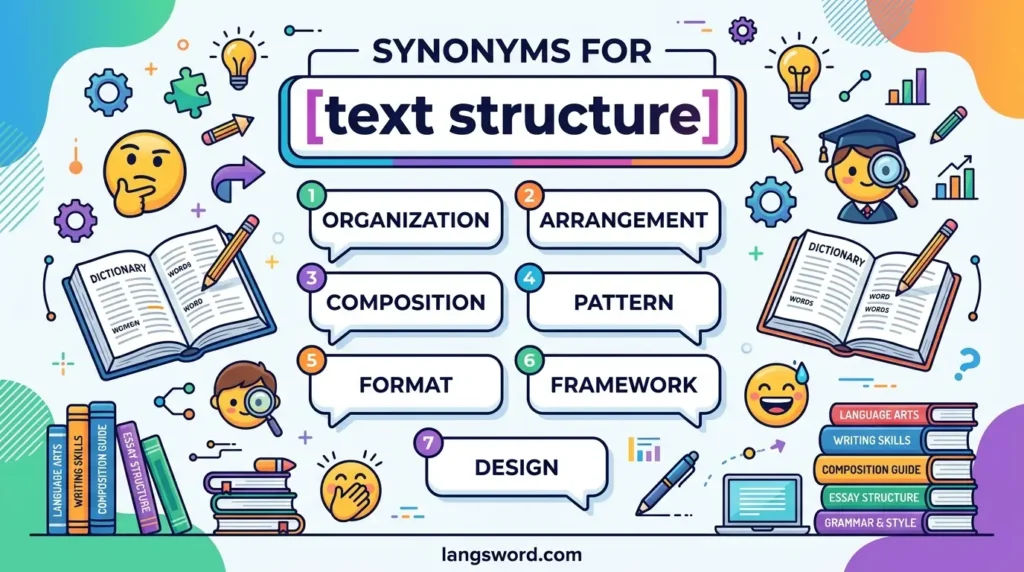

Text structure means the way ideas, facts, and details are arranged in a written text. Imagine reading a story where the beginning, middle, and ending are mixed up. It would be hard to follow.
A clear text structure helps readers understand the writer’s message with ease. The term is commonly used in schools, academic writing, books, articles, and online content.
Learning synonyms for text structure is useful for English learners because it builds vocabulary and helps them describe writing more clearly. It also helps content writers avoid repeating the same phrase in every paragraph.
In this guide, we will explore the meaning of text structure and its synonyms, with simple examples, grammar, history, pronunciation, word formation, and semantic categories. You will also learn how similar words can fit different writing situations.
Meaning of Text Structure
Definition
Text structure (Noun):
Text structure is the way a written text is organized and arranged so that its ideas are clear and easy to follow.
Examples
- The text structure makes the article easy to read.
- Students should understand the text structure before writing an essay.
Connotative Meaning
Connotation: the feeling or idea that a word suggests beyond its basic meaning.
- Positive tone: A clear text structure can suggest order, logic, clarity, and good writing.
- Negative tone: A poor text structure can suggest confusion, disorder, or weak organization.
- Neutral tone: Text structure can simply describe how information is arranged, without praise or criticism.
Etymology
The phrase text structure is made from the words text and structure.
- Old English (450–1100): Text comes through Latin textus, meaning “a woven thing” or “something woven.” Structure comes from Latin structura, meaning “a building” or “arrangement.”
- Middle English (1100–1500): Text entered English through Old French and Latin and was used for written words or passages. Structure developed as a word for the way something was built or arranged.
- Modern English (1500–Present): Both words became common in academic and general English. Text structure developed as a common term for the organization of ideas within written material.
Pronunciation (IPA)
- IPA: /tɛkst ˈstrʌktʃər/
- Syllables: text / struc-ture
Affixation Pattern of Text Structure
- Root: text and struct
- Prefix: None in the phrase text structure
- Suffix: -ure in structure
- Word formations:
- text — noun
- textual — adjective
- textually — adverb
- texting — noun/verb form
- structure — noun
- structured — adjective/past participle
- structural — adjective
- structurally — adverb
- restructure — verb
- restructured — adjective/past participle
- restructuring — noun/verb form
30 Synonyms of Text Structure With Meaning & Examples
1. Organization (Noun)
Meaning: The way parts of a text are arranged in a clear order.
Examples:
- The organization of the essay is easy to follow.
- Good organization helps readers understand complex ideas.
2. Arrangement (Noun)
Meaning: The way ideas or parts are placed in a particular order.
Examples:
- The arrangement of the paragraphs improves the article.
- The writer changed the arrangement of the main points.
3. Structure (Noun)
Meaning: The basic way in which parts of a text are connected and ordered.
Examples:
- The structure of the essay is simple.
- This structure helps readers follow the argument.
4. Framework (Noun)
Meaning: A basic system that supports and organizes ideas.
Examples:
- The writer created a framework for the report.
- This framework gives the article a logical shape.
5. Format (Noun)
Meaning: The particular way written information is presented.
Examples:
- The article uses a simple format.
- The format makes the information easy to scan.
6. Layout (Noun)
Meaning: The way text and other elements are positioned on a page.
Examples:
- The layout of the article is clean.
- A good layout makes online content easier to read.
7. Organization Pattern (Noun Phrase)
Meaning: A repeated method used to arrange ideas in a text.
Examples:
- The writer uses a cause-and-effect organization pattern.
- Students should identify the organization pattern of a passage.
8. Composition (Noun)
Meaning: The way different parts are combined to form a complete piece of writing.
Examples:
- The composition of the essay is balanced.
- Good composition gives the story a natural flow.
9. Design (Noun)
Meaning: The planned arrangement of elements in a written work.
Examples:
- The design of the report supports its main message.
- The writer used a simple design for the guide.
10. Form (Noun)
Meaning: The overall shape or type of a piece of writing.
Examples:
- The form of the poem affects how it should be read.
- The writer chose a suitable form for the story.
11. Pattern (Noun)
Meaning: A regular way in which ideas or information are organized.
Examples:
- The passage follows a chronological pattern.
- The pattern helps readers predict what comes next.
12. Sequence (Noun)
Meaning: The order in which events, facts, or ideas appear.
Examples:
- The sequence of events is easy to understand.
- The writer changed the sequence to improve clarity.
13. Order (Noun)
Meaning: The position of ideas or details in a particular arrangement.
Examples:
- Put the paragraphs in the correct order.
- The order of the points makes the argument stronger.
14. Outline (Noun)
Meaning: A basic plan showing the main parts and ideas of a text.
Examples:
- She made an outline before writing her essay.
- The outline shows the structure of the report.
15. Plan (Noun)
Meaning: A set of ideas showing how a piece of writing will be developed.
Examples:
- The writer created a plan before starting the article.
- A good plan can prevent unclear writing.
16. Framework of Ideas (Noun Phrase)
Meaning: The organized system that connects the main ideas in a text.
Examples:
- The framework of ideas is easy to understand.
- The writer built a strong framework of ideas.
17. Architecture (Noun)
Meaning: The overall design and arrangement of the parts of a text.
Examples:
- The article has a clear information architecture.
- Good content architecture helps readers find important points.
18. Flow (Noun)
Meaning: The smooth movement of ideas from one part of a text to another.
Examples:
- The flow of the essay is natural.
- Better transitions improved the flow of the article.
19. Progression (Noun)
Meaning: The way ideas develop and move forward through a text.
Examples:
- The progression of ideas is logical.
- The writer improved the progression of the argument.
20. Development (Noun)
Meaning: The way an idea or topic grows and becomes more detailed.
Examples:
- The development of the main idea is clear.
- Strong development gives the essay more depth.
21. Organization Scheme (Noun Phrase)
Meaning: A planned method for arranging information.
Examples:
- The writer chose a problem-solution organization scheme.
- This organization scheme works well for informative texts.
22. Content Structure (Noun Phrase)
Meaning: The way the information inside a piece of content is organized.
Examples:
- The website has a clear content structure.
- A strong content structure improves readability.
23. Narrative Structure (Noun Phrase)
Meaning: The way events and parts of a story are organized.
Examples:
- The novel uses a simple narrative structure.
- The narrative structure moves between past and present.
24. Logical Order (Noun Phrase)
Meaning: An arrangement in which ideas appear in a sensible order.
Examples:
- The writer presents the facts in logical order.
- Logical order makes the explanation easier to understand.
25. Hierarchy (Noun)
Meaning: An arrangement that places ideas or information at different levels of importance.
Examples:
- Headings create a clear hierarchy in the article.
- The information hierarchy helps readers find key facts.
26. Blueprint (Noun)
Meaning: A basic plan showing how a piece of writing will be built.
Examples:
- The outline acted as a blueprint for the report.
- A good blueprint can guide the entire writing process.
27. Template (Noun)
Meaning: A fixed pattern that can be used to organize similar texts.
Examples:
- The writer used a template for each product description.
- The template keeps the content structure consistent.
28. Scheme (Noun)
Meaning: A planned system for arranging information or ideas.
Examples:
- The passage follows a clear organizational scheme.
- The scheme helps readers understand the relationship between ideas.
29. Construction (Noun)
Meaning: The way a written work is built from its different parts.
Examples:
- The construction of the essay is effective.
- Careful construction makes the argument easier to follow.
30. Textual Organization (Noun Phrase)
Meaning: The way words, sentences, paragraphs, and ideas are organized within a text.
Examples:
- Textual organization is important in academic writing.
- Strong textual organization makes a long article easier to read.
Prototype Meaning
The most typical meaning of text structure is the organized arrangement of ideas in a piece of writing. When people hear this phrase, they usually imagine the way a text moves from one part to another, such as an introduction, main ideas, supporting details, and conclusion.
In stories, they may think about a beginning, middle, and ending. In informational writing, they may think about cause and effect, comparison, sequence, or problem and solution.
Prototype Categorization
The 30 synonyms can be grouped into several semantic categories. This helps writers choose a word that matches the exact meaning they want.
- General organization: organization, arrangement, structure, composition, order, scheme, and textual organization focus on how parts are placed together.
- Planning and support: framework, outline, plan, blueprint, and template focus on preparing or supporting a text before or during writing.
- Presentation and appearance: format, layout, design, and form focus more on how a text is presented to readers.
- Idea movement: sequence, flow, progression, and development focus on how information moves and grows through a text.
- Information systems: content structure, hierarchy, and organization pattern focus on how information is grouped and prioritized.
- Story and writing construction: narrative structure, construction, and architecture focus on how a larger written work is built.
- Logical arrangement: logical order and framework of ideas emphasize clear connections between ideas.
This categorization helps writers avoid using every synonym as if it had exactly the same meaning. For example, layout is useful when discussing page design, while sequence is better when discussing the order of events.
Antonyms of Text Structure
1. Disorganization (Noun)
Meaning: A lack of clear order or arrangement.
2. Disorder (Noun)
Meaning: A state in which parts are not arranged clearly or logically.
3. Confusion (Noun)
Meaning: A lack of clarity that makes information difficult to understand.
4. Chaos (Noun)
Meaning: A complete lack of clear order.
5. Fragmentation (Noun)
Meaning: A condition in which information is divided into disconnected parts.
6. Randomness (Noun)
Meaning: An arrangement without a clear or planned order.
7. Disarray (Noun)
Meaning: A messy or confused arrangement.
Short Questions and Answers
What does text structure mean?
Text structure means the way ideas, information, sentences, and paragraphs are organized in a written text.
When should text structure be used?
Use text structure when talking about how a piece of writing is organized. It is common in education, academic writing, content writing, and reading analysis.
Is text structure positive or negative?
The phrase is neutral. Its meaning depends on context. A clear structure may suggest good organization, while a poor structure may suggest confusion.
How is it different from similar words?
Text structure is a broad term for the organization of a written text. Layout focuses more on visual placement, sequence focuses on order, framework focuses on the supporting system, and flow focuses on the smooth movement of ideas.
Conclusion
Learning text structure and its synonyms can make your English stronger and more flexible. These words help you describe how ideas, facts, paragraphs, and stories are arranged. They also help writers avoid repeating the same phrase.
Knowing the difference between words such as organization, framework, layout, sequence, and flow lets you choose a word that fits the context. This is useful for students, teachers, bloggers, copywriters, and anyone who writes in English.
A wider vocabulary can also make speaking more natural because you can explain the same idea in different ways. Practice a few new synonyms each day and use them in your own sentences. Over time, this simple habit can improve your vocabulary, strengthen your writing and speaking, and build greater confidence in English.


