
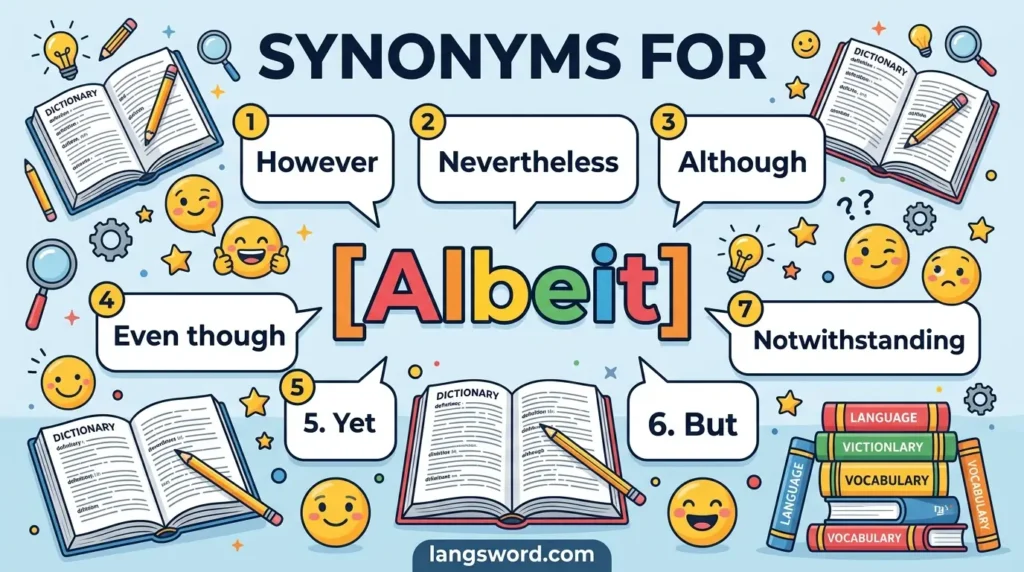

Albeit is a formal English word that means “although” or “even though.” Imagine saying, “The weather was cold, albeit sunny.” The sentence tells us that the weather was sunny despite being cold. You may see albeit in books, articles, essays, news reports, and formal writing.
It is useful because it joins two ideas that seem to contrast. Learning synonyms for albeit helps English learners understand different ways to show contrast and concession. It also helps content writers avoid using the same word again and again.
In this guide, we will explore the meaning of albeit, its synonyms, examples, grammar, history, pronunciation, word formation, and semantic categories. The examples will also show which alternatives work best in formal, neutral, and everyday English.
Meaning of Albeit
Definition
Albeit (conjunction):
A formal word meaning although, even though, or despite the fact that.
Examples
- The meal was delicious, albeit expensive.
- He accepted the job, albeit with some doubts.
Connotative Meaning
Albeit usually has a formal and neutral tone. It introduces a fact that contrasts with the main idea.
- Positive tone: It can highlight a good quality despite a small problem.
- Negative tone: It can introduce a weakness or limitation.
- Neutral tone: It simply shows contrast without strong emotion.
(Connotation: the feeling or idea that a word suggests beyond its basic meaning.)
Etymology
The word albeit developed from the older phrase “all be it,” which meant roughly “even though it be so” or “although it may be so.”
- Old English (450–1100): The exact modern form did not exist. The word developed from older expressions involving all, be, and it.
- Middle English (1100–1500): The phrase “al be it” or similar forms became used to introduce a concession.
- Modern English (1500–Present): The phrase gradually became the single word albeit. Today, it is mainly used in formal or literary English.
Pronunciation (IPA)
- IPA: /ɔːlˈbiːɪt/
- Syllables: al-beit
Affixation Pattern of Albeit
- Root: The word comes from the phrase all be it.
- Prefix: None in the modern word.
- Suffix: None in the modern word.
- Word formations:
- albeit — conjunction
Note: Albeit is not normally used to form a family of modern words through prefixes or suffixes. It developed through the joining and shortening of an older phrase.
30 Synonyms of Albeit With Meaning & Examples
Grammar note: Not every synonym below can replace albeit in every sentence. Some are close alternatives, while others express a similar idea of contrast or concession in a different grammatical structure.
1. Although (Conjunction)
Meaning: Used to introduce a fact that contrasts with another fact.
Examples:
- Although it was raining, we went outside.
- The room was small, although it was comfortable.
2. Though (Conjunction)
Meaning: A common word used to show contrast or concession.
Examples:
- Though he was tired, he kept working.
- The plan worked, though it was expensive.
3. Even though (Conjunction)
Meaning: Used to emphasize a strong contrast between two facts.
Examples:
- Even though she was nervous, she gave the speech.
- He went running even though it was cold.
4. Despite the fact that (Conjunctional phrase)
Meaning: Used to show that something happened despite another fact.
Examples:
- We went hiking despite the fact that it was raining.
- She succeeded despite the fact that she had little experience.
5. Notwithstanding that (Conjunctional phrase)
Meaning: Used formally to mean despite the fact that.
Examples:
- Notwithstanding that the task was difficult, they finished it.
- He continued notwithstanding that the risks were high.
6. While (Conjunction)
Meaning: Can introduce a contrasting fact or idea.
Examples:
- While the house is old, it is well maintained.
- While I understand your point, I disagree.
7. Whereas (Conjunction)
Meaning: Used to show a clear difference between two facts or situations.
Examples:
- John prefers tea, whereas Mary prefers coffee.
- The first plan is cheap, whereas the second is faster.
8. Even if (Conjunction)
Meaning: Introduces a possible condition that would not change the main result.
Examples:
- I will go even if it rains.
- She will finish the project even if it takes all night.
9. Granted that (Conjunctional phrase)
Meaning: Used to accept one fact before presenting a different point.
Examples:
- Granted that the plan is expensive, it may still be useful.
- Granted that he made mistakes, he worked hard.
10. Granted (Conjunction)
Meaning: Used to admit that something is true before making a contrasting statement.
Examples:
- Granted, the car is old, but it still runs well.
- Granted, the task was difficult, but we completed it.
11. Admittedly (Adverb)
Meaning: Used to accept that something is true before adding another point.
Examples:
- Admittedly, the price is high, but the quality is excellent.
- Admittedly, he was late, but he had a good reason.
12. Nevertheless (Adverb)
Meaning: Used to show that something remains true despite another fact.
Examples:
- The journey was difficult; nevertheless, we enjoyed it.
- It was expensive. Nevertheless, I bought it.
13. Nonetheless (Adverb)
Meaning: Means despite that or in spite of that.
Examples:
- The task was challenging; nonetheless, she finished it.
- The room was small; nonetheless, it felt comfortable.
14. Still (Adverb)
Meaning: Used to show that a fact remains true despite another fact.
Examples:
- It was raining, but we still went out.
- The book was long. Still, I enjoyed reading it.
15. However (Adverb)
Meaning: Used to introduce a contrasting idea.
Examples:
- The hotel was expensive. However, it was very comfortable.
- He was tired; however, he continued working.
16. Yet (Conjunction/Adverb)
Meaning: Used to introduce an unexpected contrast.
Examples:
- The task was difficult, yet she completed it.
- He is young, yet very experienced.
17. But (Conjunction)
Meaning: Used to connect two contrasting ideas.
Examples:
- The car is old, but it works well.
- She was tired, but she continued.
18. In spite of (Prepositional phrase)
Meaning: Used to show that something happens despite a difficulty.
Examples:
- In spite of the rain, we went outside.
- He succeeded in spite of his lack of experience.
19. Despite (Preposition)
Meaning: Used to show that something happens even when another fact might prevent it.
Examples:
- Despite the rain, the match continued.
- She smiled despite her worries.
20. Regardless of (Prepositional phrase)
Meaning: Used to say that something does not change because of another condition.
Examples:
- We will continue regardless of the cost.
- He treats everyone fairly regardless of their background.
21. In spite of the fact that (Conjunctional phrase)
Meaning: Used to introduce a contrasting fact.
Examples:
- In spite of the fact that it was late, they continued talking.
- She went to work in spite of the fact that she was ill.
22. Notwithstanding (Preposition/Adverb)
Meaning: Means despite or in spite of something.
Examples:
- Notwithstanding the difficulties, the team succeeded.
- The result was positive, notwithstanding the high cost.
23. Even so (Adverbial phrase)
Meaning: Used to say that something remains true despite what was just mentioned.
Examples:
- The road was dangerous. Even so, they continued.
- The exam was difficult. Even so, most students passed.
24. All the same (Adverbial phrase)
Meaning: Used to show that something remains true despite another fact.
Examples:
- It was expensive, but I bought it all the same.
- He knew the risks. All the same, he accepted the offer.
25. For all that (Prepositional phrase)
Meaning: Used to mean despite everything that has been mentioned.
Examples:
- For all that he had done, she still trusted him.
- The project had problems, but for all that, it was successful.
26. Be that as it may (Concessive phrase)
Meaning: Used formally to accept a fact before presenting another point.
Examples:
- Be that as it may, we must continue.
- Be that as it may, the decision has already been made.
27. Despite this (Adverbial phrase)
Meaning: Used to introduce a result that contrasts with a previous statement.
Examples:
- The task was difficult. Despite this, we finished it.
- The weather was poor. Despite this, the event continued.
28. With that said (Discourse phrase)
Meaning: Used to introduce a contrasting or balancing point.
Examples:
- The plan has some flaws. With that said, it has many benefits.
- The book is quite long. With that said, it is easy to read.
29. On the other hand (Discourse phrase)
Meaning: Used to introduce a different or contrasting point.
Examples:
- The apartment is small. On the other hand, it is affordable.
- Online learning is flexible. On the other hand, it requires discipline.
30. That said (Discourse phrase)
Meaning: Used to introduce a statement that contrasts with what was just said.
Examples:
- The course is challenging. That said, it is very useful.
- The phone is expensive. That said, its features are excellent.
Prototype Meaning
The prototype meaning of albeit is “although” or “even though.” When people hear albeit, they usually imagine a formal sentence that presents one fact and then adds a contrasting fact.
For example, in “The house is beautiful, albeit small,” the house is beautiful, but its small size is a limitation.
Prototype Categorization
The 30 alternatives can be grouped by their main semantic function:
- Direct concession: although, though, even though, despite the fact that, in spite of the fact that, and notwithstanding that. These are useful when one fact contrasts directly with another.
- Simple contrast: but, yet, however, while, and whereas. These work well when two ideas need to be compared or contrasted.
- Admission before contrast: granted, granted that, admittedly, and be that as it may. These are useful when a writer accepts one point before presenting another.
- Despite or resistance: despite, in spite of, notwithstanding, and regardless of. These are useful when something happens despite a difficulty or condition.
- Formal linking expressions: nevertheless, nonetheless, even so, for all that, and all the same. These help connect contrasting ideas across sentences.
- Balancing expressions: with that said, that said, and on the other hand. These are useful in essays, articles, reviews, and discussions when writers want to add another side of an issue.
This categorization helps writers choose a word based on grammar, tone, and context instead of treating every synonym as an exact replacement for albeit.
Antonyms of Albeit
There is no perfect one-word antonym for albeit because it is a conjunction that expresses concession. However, words and phrases that express cause, agreement, or straightforward continuation can contrast with its function.
Because (Conjunction)
Meaning: Gives the reason why something happens.
Since (Conjunction)
Meaning: Introduces a reason or cause.
As (Conjunction)
Meaning: Can introduce a reason for an action or event.
Therefore (Adverb)
Meaning: Shows a result that follows from a previous fact.
Consequently (Adverb)
Meaning: Shows that something happens as a result of another fact.
Short Questions and Answers
What does albeit mean?
Albeit means although, even though, or despite the fact that. It is usually used in formal writing.
When should albeit be used?
Use albeit when you want to introduce a contrasting fact or limitation. For example: “The plan was successful, albeit expensive.”
Is albeit positive or negative?
Albeit is neutral by itself. Its tone depends on the information that follows it. It can introduce either a positive or negative detail.
How is it different from similar words?
Albeit is more formal than common words such as although and though. It often appears after a statement rather than at the beginning of a sentence. It is also commonly followed by a phrase rather than a complete clause, as in “successful, albeit expensive.”
Conclusion
Learning albeit and its synonyms can make your English more flexible and precise. The word means “although” or “even though” and is especially common in formal writing. Its alternatives include simple choices such as although, though, and but, as well as formal expressions such as notwithstanding, nevertheless, and admittedly.
Knowing the difference between these words helps you choose the right expression for each sentence. It also improves vocabulary, strengthens writing and speaking, and reduces repetition.
For English learners, studying synonyms is a useful way to understand tone, grammar, and context. Content writers can use the same skill to create clearer and more engaging articles. Try learning a few new words each day and use them in your own sentences.


