
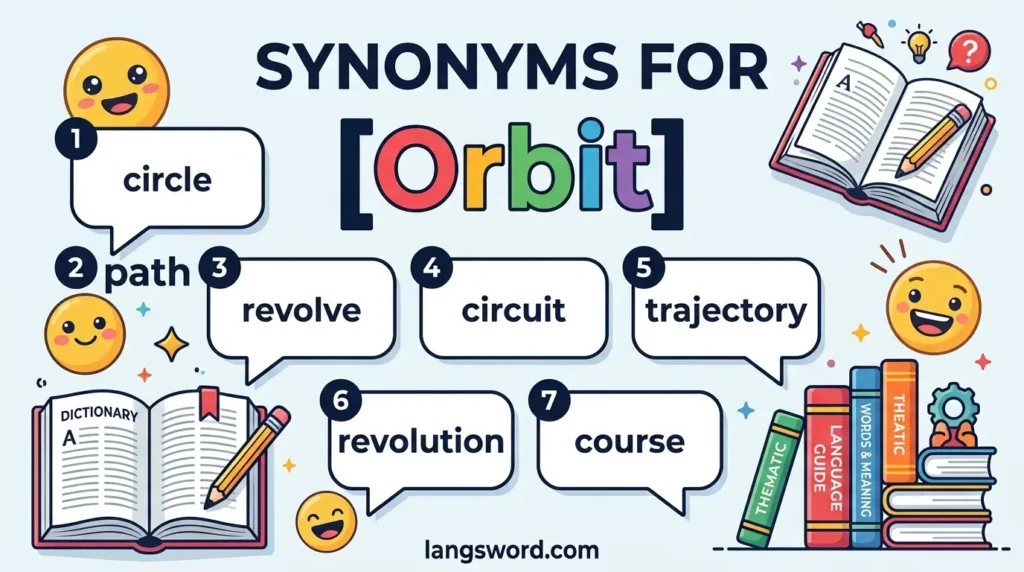

Orbit means to move around a planet, star, or other object in space. It can also mean a curved path that an object follows. For example, Earth travels around the Sun in an orbit. Imagine watching the night sky and learning that the Moon follows a regular path around Earth.
This simple idea helps us understand the word orbit. The word is common in science, astronomy, and everyday writing. Learning synonyms for orbit helps English learners express ideas in fresh and clear ways. It also helps content writers avoid repeating the same word.
In this article, we will explore the meaning of orbit, its synonyms, examples, grammar, history, pronunciation, and word formation. We will also examine its connotations, antonyms, and semantic categories to help you choose the right word for each situation.
Meaning of Orbit
Definition
Orbit (Noun and Verb):
As a noun, orbit means the curved path followed by a planet, moon, satellite, or other object around another object in space.
As a verb, orbit means to move around a planet, star, or another object in space.
Examples
- Earth travels in an orbit around the Sun.
- The satellite orbits Earth every 90 minutes.
- The Moon follows a regular orbit around our planet.
Connotative Meaning
Connotation (the feeling or idea that a word suggests beyond its basic meaning) describes the emotional tone linked to a word.
- Positive tone: Orbit may suggest order, balance, harmony, and stability.
- Negative tone: In some contexts, orbit may suggest dependence or being too focused on someone.
- Neutral tone: In science, orbit usually describes a path or movement without expressing emotion.
Etymology
The word orbit comes from the Latin word orbita, meaning “track,” “course,” or “wheel track.” It is related to orbis, meaning “circle” or “disk.”
- Old English (450–1100): The modern word orbit was not commonly used in Old English. Ideas about circular paths were expressed through other words.
- Middle English (1100–1500): Latin-based scientific vocabulary began entering English through French and scholarly writing. The concept of circular movement was discussed in astronomy.
- Modern English (1500–Present): Orbit entered English as a scientific term. It later became common in astronomy, space travel, physics, and everyday speech.
Pronunciation (IPA)
- IPA: /ˈɔːr.bɪt/
- Syllables: or-bit
The first syllable receives the main stress.
Affixation Pattern of Orbit
- Root: orbit
- Prefix: None
- Suffix: None in the basic word
Word Formations
- Orbit (noun): A curved path around an object.
- Orbit (verb): To move around an object.
- Orbited (verb): Moved around an object in the past.
- Orbiting (verb/adjective): Moving around an object.
- Orbiter (noun): An object or spacecraft that orbits another object.
- Orbital (adjective): Related to an orbit.
- Orbitally (adverb): In a way related to an orbit.
- Orbitality (noun): The quality or condition of being orbital.
30 Synonyms of Orbit With Meaning & Examples
Note: Orbit has different meanings as a noun and a verb. Some alternatives below describe a physical path, while others describe circular movement or a person’s area of influence. They are related words, but they are not interchangeable in every sentence.
1. Circle (Noun)
Meaning: A round path or course around a central point.
Examples:
- The spacecraft followed a wide circle around the planet.
- The moon moved in a circle around the Earth.
2. Circuit (Noun)
Meaning: A complete journey around a place or object.
Examples:
- The satellite completed a circuit around Earth.
- The runners made one circuit of the track.
3. Trajectory (Noun)
Meaning: The path followed by a moving object through space.
Examples:
- Scientists calculated the spacecraft’s trajectory.
- The rocket changed its trajectory after launch.
4. Path (Noun)
Meaning: The route or line along which something moves.
Examples:
- The Moon follows a path around Earth.
- The satellite stayed on its planned path.
5. Course (Noun)
Meaning: The direction or route followed by a moving object.
Examples:
- The spacecraft changed its course near Mars.
- The planet follows a regular course around the Sun.
6. Track (Noun)
Meaning: The route or line that an object follows during movement.
Examples:
- The satellite stayed on its track around Earth.
- Astronomers studied the comet’s track.
7. Ring (Noun)
Meaning: A circular path or band around something.
Examples:
- The planet has a ring of dust around it.
- The spacecraft moved along a ring-shaped path.
8. Loop (Noun)
Meaning: A curved route that returns toward its starting point.
Examples:
- The drone made a loop around the tower.
- The aircraft completed a loop during the show.
9. Round (Noun)
Meaning: A complete movement around a place or object.
Examples:
- The satellite made a round around the planet.
- We took a round of the park before going home.
Note: “Revolution” or “circuit” is often more natural than “round” in technical astronomy.
10. Revolution (Noun)
Meaning: One complete movement of an object around another object.
Examples:
- Earth completes one revolution around the Sun each year.
- The satellite makes many revolutions around Earth.
11. Rotation (Noun)
Meaning: The turning of an object around its own axis or center.
Examples:
- Earth’s rotation causes day and night.
- The machine uses rotation to create movement.
Note: Rotation usually means spinning around an axis, while revolution means moving around another object.
12. Circumference (Noun)
Meaning: The distance around the outside of a circle.
Examples:
- The scientist measured the circumference of the circular path.
- The wheel has a large circumference.
Note: Circumference is a measurement, not a direct synonym for orbit.
13. Circuitry (Noun)
Meaning: A system of connected circuits, especially in electronics.
Examples:
- The satellite contains complex circuitry.
- Engineers checked the spacecraft’s circuitry.
Note: Circuitry is not a direct synonym for orbit. It is related to the word “circuit” but has a different meaning.
14. Encircle (Verb)
Meaning: To form a circle around something.
Examples:
- The rings encircle the planet.
- Tall trees encircle the small lake.
15. Circle Around (Verb)
Meaning: To move around something in a circular route.
Examples:
- The helicopter circled around the building.
- The bird circled around the mountain.
16. Revolve (Verb)
Meaning: To move around a central point or object.
Examples:
- Earth revolves around the Sun.
- The Moon revolves around Earth.
17. Rotate (Verb)
Meaning: To turn around a central point or axis.
Examples:
- The wheel rotates smoothly.
- The planet rotates on its axis.
18. Circle Back (Verb)
Meaning: To return to a place, subject, or point after moving away.
Examples:
- The aircraft circled back toward the airport.
- Let’s circle back to the main topic later.
19. Loop Around (Verb)
Meaning: To move in a curved route around something.
Examples:
- The road loops around the hill.
- The spacecraft looped around the smaller object.
20. Wind Around (Verb)
Meaning: To move or extend in a twisting or curved direction.
Examples:
- The road winds around the mountain.
- A narrow path winds around the lake.
21. Encapsulation (Noun)
Meaning: The act of enclosing something within a surrounding structure.
Examples:
- The protective casing provides encapsulation for the device.
- The design uses encapsulation to protect the internal parts.
Note: Encapsulation is not a direct synonym for orbit. It is included as a related concept of surrounding or enclosing.
22. Sphere (Noun)
Meaning: An area of influence, activity, or interest around a person or group.
Examples:
- The scientist worked within the sphere of space research.
- The company expanded its sphere of influence.
23. Domain (Noun)
Meaning: An area of knowledge, activity, or influence.
Examples:
- Astronomy is his main domain of study.
- The company entered a new domain of technology.
24. Realm (Noun)
Meaning: An area of activity, thought, or experience.
Examples:
- The discovery opened a new realm of science.
- She works in the realm of space exploration.
25. Circle of Influence (Noun)
Meaning: The group of people or area affected by someone or something.
Examples:
- The leader had a wide circle of influence.
- The scientist’s ideas reached a growing circle of influence.
26. Sphere of Influence (Noun)
Meaning: An area where a person, group, or object has power or effect.
Examples:
- The organization expanded its sphere of influence.
- The planet’s gravity creates a sphere of influence.
27. Vicinity (Noun)
Meaning: The area near a particular place or object.
Examples:
- Several satellites operate in the vicinity of Earth.
- We saw stars in the vicinity of the Moon.
28. Surround (Verb)
Meaning: To be or move all around something.
Examples:
- Clouds surrounded the mountain.
- The spacecraft’s path surrounded the central object.
29. Encompass (Verb)
Meaning: To include or cover a wide area or range.
Examples:
- The course encompasses many areas of astronomy.
- Her interests encompass science, art, and history.
30. Hover (Verb)
Meaning: To remain in one place or nearby without moving far away.
Examples:
- The drone hovered above the field.
- The spacecraft appeared to hover near the station.
Note: Hovering is not the same as orbiting. An object in orbit follows a curved path around another object, while a hovering object stays nearly in one place.
Prototype Meaning
The prototype meaning of orbit is the curved path followed by a planet, moon, satellite, or other object around a central body. When people hear the word, they usually imagine Earth moving around the Sun, the Moon moving around Earth, or a satellite traveling through space.
This is the most common scientific meaning of the word. In everyday language, orbit can also describe a person or group that stays close to someone or something influential.
Prototype Categorization
The 30 related words can be grouped into several semantic categories. This helps writers choose a word that matches the exact meaning and context.
- Circular paths and routes: Circle, circuit, path, course, track, ring, loop, round. These words describe routes that curve around a place or object.
- Astronomical movement: Revolution, rotation, revolve, rotate, trajectory. These words are useful in science and space-related writing. Their meanings are not identical, so choose them carefully.
- Circular or surrounding movement: Encircle, circle around, loop around, wind around, surround. These words describe movement or position around something.
- Areas of influence or activity: Sphere, domain, realm, circle of influence, sphere of influence. These words are useful when orbit describes someone’s social, professional, or personal environment.
- Nearby location or stationary movement: Vicinity, hover. These words describe being near something or staying close to a position.
- Related concepts of covering or enclosing: Circumference, circuitry, encapsulation, encompass. These words have specific meanings and should not replace orbit in ordinary astronomy sentences.
Why this categorization matters: It helps writers avoid choosing a word that sounds similar but has a different meaning. For example, revolve works well for planetary movement, while sphere of influence works better for social or political relationships.
Antonyms of Orbit
There is no single opposite of orbit in every context. The correct antonym depends on whether the word describes movement, a path, or an area of influence.
1. Straight Line (Noun)
Meaning: A direct line without a curve.
- The spacecraft moved in a straight line rather than following an orbit.
2. Depart (Verb)
Meaning: To move away from a place or object.
- The spacecraft departed from the station.
3. Escape (Verb)
Meaning: To move away from a controlling force or place.
- The object escaped the planet’s gravitational influence.
4. Separate (Verb)
Meaning: To move apart or become distant.
- The two objects separated after the collision.
5. Distance (Verb)
Meaning: To move away from someone or something.
- The satellite distanced itself from the main spacecraft.
6. Remain Stationary (Verb Phrase)
Meaning: To stay in one position without moving.
- The instrument remained stationary while the planet moved.
7. Independence (Noun)
Meaning: Freedom from control or influence.
- The group sought independence from the larger organization.
Short Questions and Answers
What does orbit mean?
Orbit means the curved path of an object around another object. As a verb, it means to move around something, such as a planet or star.
When should orbit be used?
Use orbit when discussing space, planets, satellites, or objects moving around a central body. It can also describe someone or something that stays close to an influential person or group.
Is orbit positive or negative?
Orbit is usually neutral in science. In social situations, it may suggest closeness or support, but it can also suggest dependence. The meaning depends on the context.
How is orbit different from similar words?
Orbit describes a curved path or movement around something. Revolve means to move around a central object, while rotate usually means to spin around an axis. Trajectory describes the path of a moving object, which may or may not be an orbit.
Conclusion
Learning orbit and its synonyms can improve your English vocabulary and communication skills. The word is useful in astronomy, science, technology, and everyday descriptions of movement or influence.
Its related words, such as revolve, circuit, trajectory, and sphere of influence, help you express ideas with greater accuracy. Understanding the difference between these words also prevents mistakes.
For example, rotate and revolve do not always mean the same thing, and hover is different from orbit. Using synonyms can make your writing more interesting, reduce repetition, and strengthen your speaking skills.
It can also help you feel more confident when learning new words. Try practicing one synonym each day. Write a sentence, read it aloud, and use the word in a real conversation.