
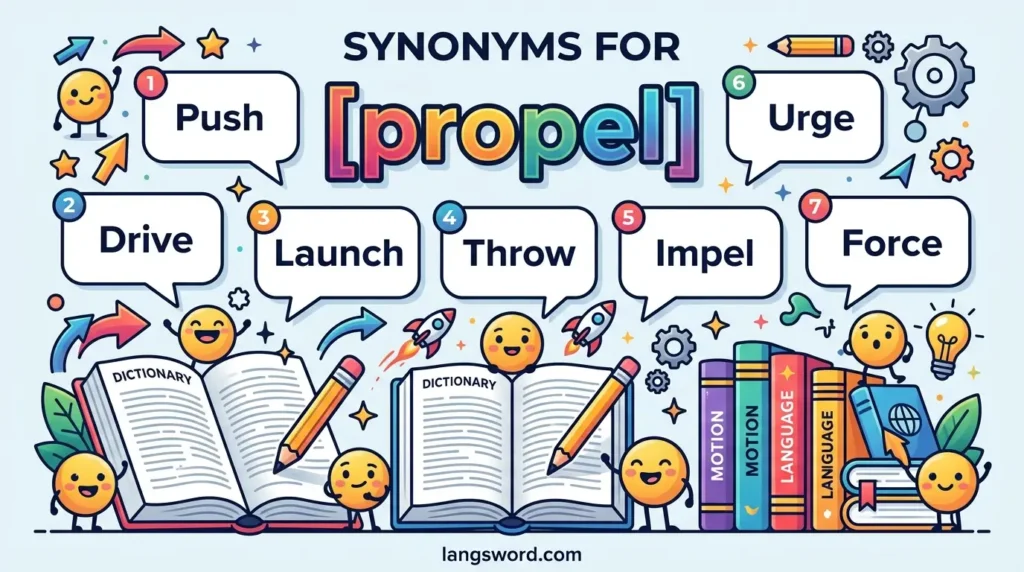

Propel means to push or move something forward, often with force. Imagine a child riding a bicycle downhill. The pedals propel the bike forward, while the wheels carry it along the road. We also use propel in a figurative way.
For example, hard work can propel a person toward success. The word is common because it clearly describes forward movement, both physical and figurative. Learning synonyms for propel helps English learners use more precise words in speaking and writing.
It also helps content writers avoid repeating the same word. In this guide, we explore the meaning, grammar, history, pronunciation, word formation, and semantic groups of propel.
You will also find 30 useful synonyms with simple meanings and examples, making it easier to choose the right word for each context.
Meaning of propel
Definition
Propel (verb):
To push, drive, or cause something or someone to move forward. It can also mean to cause someone or something to move toward a goal, position, or situation.
Examples
- The engine propels the boat across the lake.
- Her strong results propelled her to a higher position at work.
Connotative Meaning
Connotation (the feeling or idea a word suggests beyond its basic meaning) describes the emotional tone connected with a word.
- Positive tone: Propel can suggest progress, growth, success, and forward movement.
- Negative tone: It can suggest being pushed into something without much choice.
- Neutral tone: It can simply describe physical movement caused by force or energy.
Etymology
Propel comes from Latin propellere, meaning “to push forward,” “drive forward,” or “drive forth.” It entered English in the mid-15th century as propellen, meaning “to drive away” or “expel.”
The modern sense of causing something to move forward developed in the 1650s. The Latin word combines pro-, meaning “forward,” with pellere, meaning “to push” or “drive.”
- Old English (450–1100): There was no direct English form of propel. The word has a Latin origin and entered English later.
- Middle English (1100–1500): Propellen appeared in the mid-15th century with the sense “to drive away” or “expel.”
- Modern English (1500–Present): The meaning developed toward “to drive or move forward,” with this sense recorded from the 1650s.
Pronunciation (IPA)
- IPA: /prəˈpel/
- Syllables: pro-pel
The main stress falls on the second syllable. Cambridge gives /prəˈpel/ for both British and American English.
Affixation Pattern of propel
- Root: pell — from Latin pellere, “to push” or “drive”
- Prefix: pro- — meaning “forward”
- Suffix: None in the basic word
- Word formations:
- propel — verb
- propelled — verb, past tense/past participle
- propelling — verb, present participle
- propeller — noun
- propellant — noun/adjective
- propulsion — noun
- propulsive — adjective
Related forms such as propeller, propellant, propulsion, and propulsive developed from the same word family.
30 Synonyms of propel With Meaning & Examples
1. Push (Verb)
Meaning: To make something or someone move forward by applying force.
Examples:
- She pushed the cart toward the door.
- The current pushed the boat downstream.
2. Drive (Verb)
Meaning: To force or cause something to move in a particular direction.
Examples:
- The motor drives the wheels.
- Strong winds drove the boat toward the shore.
3. Move (Verb)
Meaning: To cause something to change position or go forward.
Examples:
- The engine moves the machine.
- The force moved the object across the floor.
4. Thrust (Verb)
Meaning: To push something forward suddenly or strongly.
Examples:
- The rocket thrust upward into the sky.
- He thrust the door open.
5. Impel (Verb)
Meaning: To force or strongly encourage someone or something to move or act.
Examples:
- Curiosity impelled her to ask questions.
- The motor impels the wheels forward.
6. Force (Verb)
Meaning: To make something or someone move or act through strong pressure.
Examples:
- The wind forced the door open.
- The current forced the boat toward the rocks.
7. Launch (Verb)
Meaning: To send something into motion or into the air.
Examples:
- The system launched the spacecraft into orbit.
- The machine launches the ball forward.
8. Project (Verb)
Meaning: To throw or send something forward with force.
Examples:
- The device projects the ball across the field.
- The explosion projected debris into the air.
9. Send (Verb)
Meaning: To cause something or someone to go from one place to another.
Examples:
- The motor sends water through the pipes.
- The wave sent the boat toward the beach.
10. Accelerate (Verb)
Meaning: To make something move faster or increase its speed.
Examples:
- The driver accelerated the car.
- New technology accelerated the project.
11. Spur (Verb)
Meaning: To encourage someone or something to act or progress faster.
Examples:
- The award spurred him to work harder.
- New demand spurred the company to expand.
12. Urge (Verb)
Meaning: To strongly encourage someone to do something.
Examples:
- Her teacher urged her to apply.
- The coach urged the team to keep moving.
13. Motivate (Verb)
Meaning: To give someone a reason or desire to act.
Examples:
- The goal motivated him to practice daily.
- Good feedback motivated the team to improve.
14. Prompt (Verb)
Meaning: To cause someone to do or say something.
Examples:
- The question prompted her to think deeply.
- The news prompted the company to act.
15. Encourage (Verb)
Meaning: To give someone support or confidence to do something.
Examples:
- Her parents encouraged her to study.
- The results encouraged the team to continue.
16. Stimulate (Verb)
Meaning: To encourage activity, growth, or development.
Examples:
- The program stimulated economic growth.
- Exercise stimulates the body and mind.
17. Boost (Verb)
Meaning: To increase or improve something.
Examples:
- The campaign boosted sales.
- The scholarship boosted his confidence.
18. Advance (Verb)
Meaning: To move something forward or help it progress.
Examples:
- The research advanced medical knowledge.
- The new plan advanced the project.
19. Further (Verb)
Meaning: To help something develop or progress.
Examples:
- The project furthered scientific research.
- Her work furthered the cause of education.
20. Promote (Verb)
Meaning: To help something develop, grow, or become more successful.
Examples:
- The program promotes healthy habits.
- The campaign promoted public awareness.
21. Propel Forward (Phrasal Verb)
Meaning: To push or drive something ahead.
Examples:
- The strong engine propelled the vehicle forward.
- Her determination propelled her forward.
22. Drive Forward (Phrasal Verb)
Meaning: To make something progress or move ahead.
Examples:
- New ideas drove the project forward.
- The team drove the plan forward.
23. Move Forward (Phrasal Verb)
Meaning: To continue toward a new stage or position.
Examples:
- The company is ready to move forward.
- We need to move the project forward.
24. Catapult (Verb)
Meaning: To suddenly push or move someone or something into a new position.
Examples:
- The victory catapulted her into the spotlight.
- The invention catapulted the company to fame.
25. Hurl (Verb)
Meaning: To throw something with great force.
Examples:
- He hurled the ball across the field.
- The blast hurled pieces of metal into the air.
26. Fling (Verb)
Meaning: To throw something suddenly and with force.
Examples:
- She flung the bag onto the table.
- The machine flung the object several meters.
27. Shove (Verb)
Meaning: To push something or someone with force.
Examples:
- He shoved the box across the floor.
- The crowd shoved the gate open.
28. Carry (Verb)
Meaning: To move something or someone from one place to another.
Examples:
- The river carried the leaves downstream.
- The wind carried the seeds across the field.
29. Transport (Verb)
Meaning: To move people or things from one place to another.
Examples:
- Trucks transport goods across the country.
- The system transports water to nearby farms.
30. Power (Verb)
Meaning: To provide the energy that makes a machine or vehicle move.
Examples:
- Electric motors power the train.
- Solar energy powers the small vehicle.
Prototype Meaning
The most typical meaning of propel is to push or drive something forward with force or energy. When people hear the word, they often imagine a rocket, boat, vehicle, ball, or other object being moved forward by an engine, force, or pressure. The word can also describe figurative progress, such as an achievement that propels someone toward success.
Prototype Categorization
The 30 synonyms can be grouped by their main meaning. This helps writers select a word that matches the exact situation instead of treating every synonym as interchangeable.
- Physical pushing and force: push, shove, thrust, force, drive, move describe direct physical movement.
- Throwing or sending: hurl, fling, project, launch, send focus on making something travel through space.
- Movement and speed: accelerate, advance, carry, transport, move forward focus on progress, speed, or changing position.
- Motivation and influence: impel, spur, urge, motivate, prompt, encourage are mainly useful when a person is influenced to act.
- Growth and progress: boost, further, promote, stimulate, drive forward, propel forward often describe development or improvement.
- Sudden advancement: catapult suggests a rapid movement into a new position, especially in figurative writing.
- Energy and machinery: power is useful when an energy source makes a machine or vehicle operate.
This grouping shows why synonyms are not always exact replacements. For example, hurl works well for a physical object, while motivate works better for a person. Choosing by meaning makes writing clearer and more natural.
Antonyms of propel
1. Stop (Verb)
Meaning: To prevent movement or bring something to an end.
2. Halt (Verb)
Meaning: To stop movement or activity.
3. Restrain (Verb)
Meaning: To prevent someone or something from moving or acting freely.
4. Hold Back (Phrasal Verb)
Meaning: To prevent something from moving or progressing.
5. Slow (Verb)
Meaning: To reduce the speed of something.
6. Block (Verb)
Meaning: To prevent movement or progress.
7. Hinder (Verb)
Meaning: To make movement, progress, or success more difficult.
8. Retreat (Verb)
Meaning: To move backward or away from something.
Short Questions and Answers
What does propel mean?
Propel means to push, drive, or cause something to move forward. It can describe physical movement or progress toward a goal.
When should propel be used?
Use propel when you want to describe strong forward movement or progress. It works well for machines, vehicles, objects, people, ideas, careers, and events.
Is propel positive or negative?
Propel is usually neutral. Its meaning depends on context. It can suggest positive progress, as in “propel her career,” but it can also describe being pushed into an unwanted situation.
How is it different from similar words?
Propel usually emphasizes forward movement caused by force or energy. Push is more general, thrust suggests strong or sudden force, motivate focuses on a person’s reason for acting, and accelerate focuses on increasing speed.
Conclusion
Learning propel and its synonyms can make your English more accurate and flexible. Instead of using one word again and again, you can choose a synonym that fits the exact meaning you want.
Words such as push, drive, thrust, impel, accelerate, motivate, boost, advance, and catapult each add a slightly different idea. Understanding these differences strengthens both writing and speaking. It also helps English learners describe movement, progress, motivation, and change with greater confidence.
For content writers, a wider vocabulary can make articles smoother and reduce repetition. The best way to learn these words is to practice them in real sentences every day.
Read, write, speak, and review new words often. With regular practice, choosing the right synonym will become faster and more natural.