
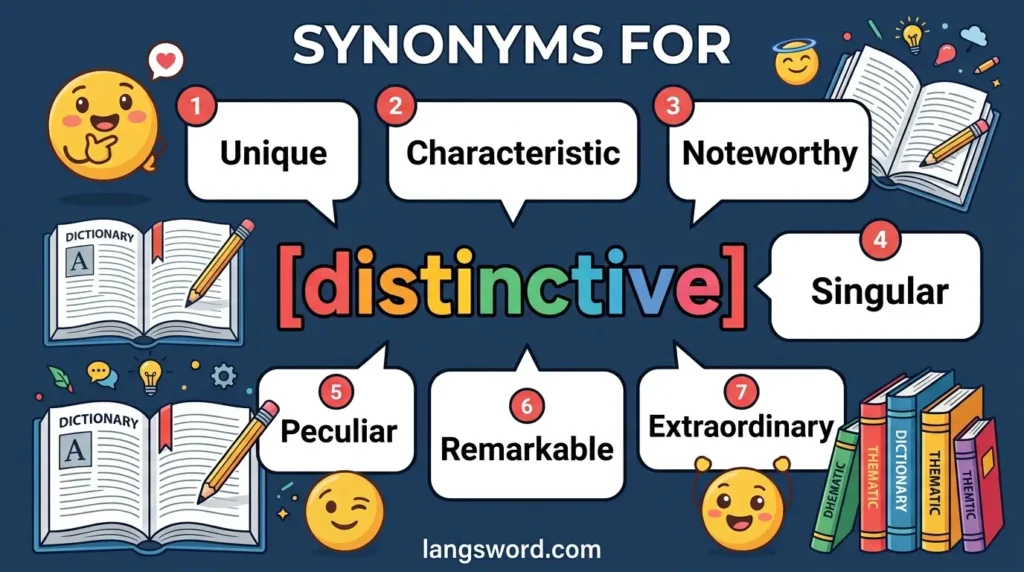

Distinctive means easy to recognize because it has a special or unusual quality. Imagine walking into a room and seeing a chair with a bright shape and unusual design. You can spot it at once because it looks different from all the others.
That chair has a distinctive design. The word is common in everyday English because people often need to describe things, people, sounds, styles, or features that stand out. Learning synonyms for distinctive helps English learners add variety to their speech and writing.
It also helps content writers choose words that fit the exact meaning and tone they want. In this guide, we will explore the meaning of distinctive and 30 useful alternatives with examples. We will also cover grammar, etymology, pronunciation, word formation, antonyms, and semantic categories so you can use each word with confidence.
Meaning of Distinctive
Definition
Distinctive (Adjective):
Having a quality or feature that makes someone or something easy to recognize or different from others.
Examples
- Her distinctive voice made her easy to recognize on the phone.
- The building has a distinctive curved roof.
Connotative Meaning
Connotation: The feeling or idea that a word suggests beyond its basic meaning.
- Positive tone: Distinctive can suggest originality, beauty, style, or individuality.
- Negative tone: In some contexts, it can suggest that something is strange or unusual.
- Neutral tone: It can simply mean that something is clearly different or recognizable.
Etymology
The word distinctive comes from distinct, which comes through French and Latin from distinguere, meaning “to separate” or “to mark off.”
- Old English (450–1100): The modern word distinctive was not part of Old English. English used other words to express ideas such as being separate or different.
- Middle English (1100–1500): Latin- and French-based forms related to distinct entered English. The idea of separation or clear difference became established.
- Modern English (1500–Present): Distinctive developed as an adjective meaning “serving to distinguish” or “marking something as different.”
Pronunciation (IPA)
- IPA: /dɪˈstɪŋktɪv/
- Syllables: dis-tinc-tive
Affixation Pattern of Distinctive
- Root: stinct / related to the Latin root stinguere, associated with marking or distinguishing
- Prefix: dis- — often expresses separation or apartness
- Suffix: -ive — forms adjectives meaning “having the nature of” or “relating to”
Word formations:
- distinct — adjective
- distinctly — adverb
- distinctness — noun
- distinction — noun
- distinguish — verb
- distinguishable — adjective
- distinctive — adjective
- distinctively — adverb
- distinctiveness — noun
30 Synonyms of Distinctive With Meaning & Examples
1. Unique (Adjective)
Meaning: Being the only one of its kind or very different from others.
Examples:
- The artist has a unique style.
- Each handmade bowl has a unique shape.
2. Characteristic (Adjective)
Meaning: Typical of a person, place, thing, or group.
Examples:
- The warm climate is characteristic of the region.
- Her calm manner is characteristic of her personality.
3. Individual (Adjective)
Meaning: Different from others in a personal or particular way.
Examples:
- Every student has an individual learning style.
- The designer gave the rooms an individual look.
4. Special (Adjective)
Meaning: Different from what is usual or ordinary.
Examples:
- The restaurant has a special atmosphere.
- She has a special talent for music.
5. Unusual (Adjective)
Meaning: Not common or not normally seen.
Examples:
- He has an unusual way of solving problems.
- The painting uses unusual colors.
6. Remarkable (Adjective)
Meaning: Unusually good, interesting, or noticeable.
Examples:
- She made remarkable progress in English.
- The building has a remarkable design.
7. Notable (Adjective)
Meaning: Worth noticing or remembering.
Examples:
- The town is known for its notable architecture.
- His most notable feature is his bright smile.
8. Recognizable (Adjective)
Meaning: Easy to identify or know because of familiar features.
Examples:
- Her voice is instantly recognizable.
- The company’s logo is highly recognizable.
9. Characteristic (Adjective)
Meaning: Showing a quality that is typical of someone or something.
Examples:
- The painting uses colors characteristic of the artist.
- His distinctive laugh is characteristic of his personality.
10. Individualistic (Adjective)
Meaning: Showing a strong personal style or independence.
Examples:
- She has an individualistic approach to fashion.
- His individualistic designs attract young buyers.
11. Original (Adjective)
Meaning: New, creative, or not copied from another source.
Examples:
- The writer developed an original idea.
- Her original artwork attracted many visitors.
12. Singular (Adjective)
Meaning: Very unusual, special, or unlike others.
Examples:
- He has a singular talent for storytelling.
- The building has a singular beauty.
13. Uncommon (Adjective)
Meaning: Not often found, seen, or experienced.
Examples:
- The flower has an uncommon shape.
- Her uncommon style attracted attention.
14. Striking (Adjective)
Meaning: Very noticeable because of an unusual or powerful quality.
Examples:
- She wore a striking red dress.
- The house has a striking modern design.
15. Noticeable (Adjective)
Meaning: Easy to see, hear, or recognize.
Examples:
- There was a noticeable change in his voice.
- The new design has a noticeable pattern.
16. Conspicuous (Adjective)
Meaning: Very easy to see or notice.
Examples:
- The bright sign was conspicuous from the road.
- His bright jacket made him conspicuous in the crowd.
17. Pronounced (Adjective)
Meaning: Very clear, strong, or noticeable.
Examples:
- The region has a pronounced cultural identity.
- There is a pronounced difference between the two designs.
18. Marked (Adjective)
Meaning: Clearly noticeable or different.
Examples:
- The study found a marked difference between the groups.
- There was a marked improvement in her writing.
19. Distinguishing (Adjective)
Meaning: Helping to show how someone or something is different.
Examples:
- The distinguishing feature of the phone is its camera.
- Color is a distinguishing feature of the two species.
20. Defining (Adjective)
Meaning: Showing an important quality that identifies something.
Examples:
- Creativity is a defining feature of her work.
- Trust is a defining quality of a strong friendship.
21. Identifiable (Adjective)
Meaning: Easy to recognize or identify.
Examples:
- The bird has several identifiable features.
- His writing style is easily identifiable.
22. Standout (Adjective)
Meaning: Clearly better, more noticeable, or more interesting than others.
Examples:
- The blue building is a standout feature of the street.
- Her standout performance impressed the audience.
23. Memorable (Adjective)
Meaning: Easy to remember because it is interesting or unusual.
Examples:
- The singer gave a memorable performance.
- The trip was memorable because of its unusual scenery.
24. Eye-catching (Adjective)
Meaning: Attracting attention because of its appearance.
Examples:
- The website uses an eye-catching design.
- She chose an eye-catching poster for the event.
25. Specialised (Adjective)
Meaning: Designed for a particular purpose, field, or group.
Examples:
- The museum has a specialised collection.
- The company produces specialised equipment.
26. Peculiar (Adjective)
Meaning: Strange or unusual, especially in a noticeable way.
Examples:
- The machine made a peculiar sound.
- He has a peculiar habit of tapping the table.
27. Exclusive (Adjective)
Meaning: Limited to a particular person, group, or purpose.
Examples:
- The club has an exclusive design.
- The store sells exclusive handmade products.
28. Differentiated (Adjective)
Meaning: Made clearly different from other similar things.
Examples:
- The brand has a differentiated market position.
- The products are differentiated by their features.
29. Iconic (Adjective)
Meaning: Widely recognized as a powerful or important example of something.
Examples:
- The building has an iconic shape.
- The company created an iconic logo.
30. Unmistakable (Adjective)
Meaning: So clear or special that it cannot easily be confused with something else.
Examples:
- Her unmistakable voice filled the room.
- The team’s unmistakable style has many fans.
Prototype Meaning
The most typical meaning of distinctive is clearly different and easy to recognize. When people hear the word, they often imagine a feature that makes something stand out from similar things. It can describe a person’s voice, a building’s design, a brand’s style, a smell, a sound, or a physical feature.
Prototype Categorization
The 30 synonyms can be grouped by their main semantic use. This helps writers select a word that matches the exact situation instead of using every synonym as if it had the same meaning.
- Uniqueness and originality: unique, individual, individualistic, original, singular, uncommon. These words focus on being different from others.
- Recognition and identification: recognizable, identifiable, unmistakable, distinguishing, characteristic. These words focus on features that help people identify something.
- Noticeability: striking, noticeable, conspicuous, pronounced, marked, eye-catching, standout. These words focus on something that attracts attention.
- Importance and memorability: remarkable, notable, memorable, iconic. These words suggest that something deserves attention or is easy to remember.
- Special qualities: special, defining, differentiated, specialised, exclusive. These words highlight a particular quality, purpose, or position.
- Unusual or strange qualities: unusual, peculiar. These words emphasize that something is outside the normal range.
This grouping shows why synonyms are not always interchangeable. For example, recognizable focuses on identification, while striking focuses on strong visual or sensory impact.
Antonyms of Distinctive
1. Common (Adjective)
Meaning: Found or seen often and not unusual.
2. Ordinary (Adjective)
Meaning: Normal and not especially unusual.
3. Typical (Adjective)
Meaning: Showing the usual qualities of a person, group, or thing.
4. Similar (Adjective)
Meaning: Almost the same as another person or thing.
5. Indistinguishable (Adjective)
Meaning: Not clearly different from something else.
6. Generic (Adjective)
Meaning: General and lacking special or identifying features.
7. Conventional (Adjective)
Meaning: Following common or accepted ideas and practices.
8. Unremarkable (Adjective)
Meaning: Not unusual, interesting, or noticeable.
Short Questions and Answers
What does distinctive mean?
Distinctive means noticeably different in a way that makes a person or thing easy to recognize.
When should distinctive be used?
Use distinctive when you want to describe a clear feature, quality, style, sound, appearance, or characteristic that separates something from similar things.
Is distinctive positive or negative?
It is usually neutral or positive. It can suggest originality or attractiveness, but the meaning depends on the context.
How is it different from similar words?
Distinctive focuses on a quality that makes something recognizable or different. Unique suggests that something is one of a kind, while striking focuses more on something that strongly attracts attention. Characteristic often means typical rather than simply unusual.
Conclusion
Learning distinctive and its synonyms can make your English more precise and flexible. Instead of using the same word again and again, you can choose words such as unique, recognizable, original, striking, notable, or unmistakable based on your meaning.
These words can strengthen both writing and speaking by helping you describe people, objects, styles, sounds, and ideas more clearly. Understanding their small differences is important because not every synonym works in every sentence.
Regular vocabulary practice can help you remember these differences and use them naturally. Try choosing one new synonym each day and writing two sentences with it. Over time, this simple habit can improve your vocabulary, reduce repetition, and build greater confidence in English.