
Intention means a plan, purpose, or decision to do something. Imagine telling a friend, “My intention is to call you tonight.” You are explaining what you plan or mean to do.
The word is common in everyday speech, school writing, business, and formal communication because it clearly shows a person’s purpose or planned action. Learning synonyms for intention helps English learners express ideas with more accuracy and confidence.
It also helps content writers avoid using the same word again and again. In this guide, you will learn the meaning of intention and 30 useful synonyms with simple examples. You will also explore its grammar, connotative meaning, history, pronunciation, word formation, prototype meaning, and semantic categories. These details can help you choose the right word for each situation.
Meaning of Intention
Definition
Intention (Noun):
Intention means a plan, purpose, or desire to do something.
Examples
- My intention is to finish the project today.
- She had no intention of hurting anyone.
Connotative Meaning
The emotional tone of intention depends on the situation.
- Positive tone: It can suggest a good purpose, such as helping someone.
- Negative tone: It can suggest harmful or dishonest plans.
- Neutral tone: It can simply describe what someone plans or means to do.
(Connotation: the feeling or idea that a word suggests beyond its basic meaning.)
Etymology
The word intention comes from Latin intentio, meaning “a stretching toward,” “purpose,” or “aim.” It developed through Old French before entering English.
- Old English (450–1100): The modern word intention was not commonly used in Old English. Related ideas were expressed through native words meaning purpose, will, or thought.
- Middle English (1100–1500): Intention entered English through Old French, from Latin intentio, and was used for a purpose, aim, or mental determination.
- Modern English (1500–Present): Intention became a common English noun meaning a plan, purpose, or aim behind an action.
Pronunciation (IPA)
- IPA: /ɪnˈten.ʃən/
- Syllables: in-ten-tion
Affixation Pattern of Intention
- Root: tend — related to the Latin tendere, meaning “to stretch” or “to direct toward.”
- Prefix: in- — conveys the idea of directing toward or into.
- Suffix: -tion — forms a noun connected with an action, process, or result.
- Word formations:
- intend — verb
- intended — adjective / past participle
- intending — verb / present participle
- intention — noun
- intentional — adjective
- intentionally — adverb
- intentionality — noun
- unintentional — adjective
- unintentionally — adverb
30 Synonyms of Intention With Meaning & Examples
1. Intent (Noun)
Meaning: The purpose or plan behind an action.
Examples:
- His intent was to help the team.
- The police wanted to understand her intent.
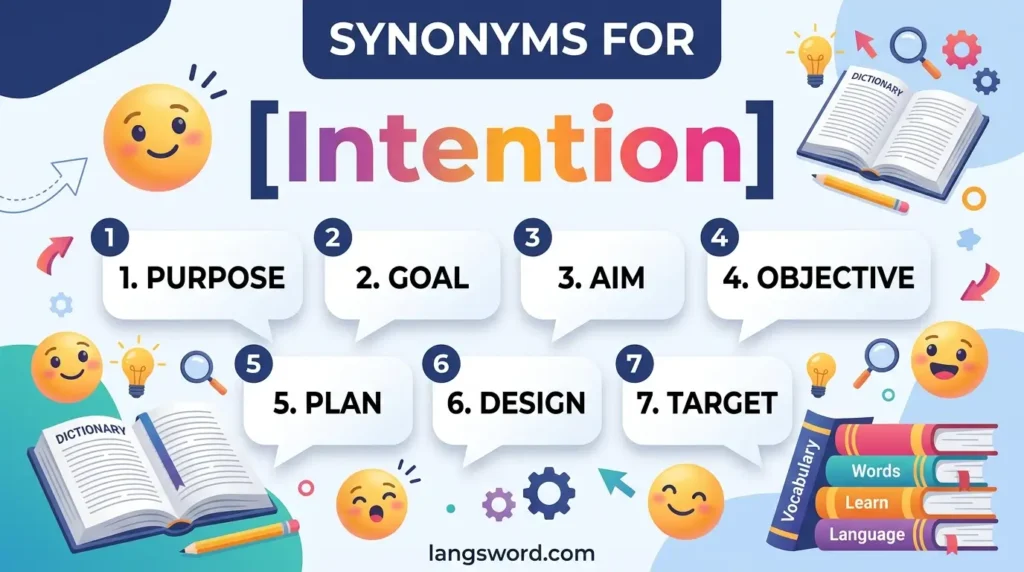
2. Purpose (Noun)
Meaning: The reason why someone does something.
Examples:
- The purpose of the meeting is to solve the problem.
- What is the purpose of this exercise?
3. Aim (Noun)
Meaning: A result that someone wants to achieve.
Examples:
- Our aim is to improve customer service.
- Her main aim was to win the competition.
4. Goal (Noun)
Meaning: Something that a person wants to achieve.
Examples:
- My goal is to learn English.
- The team reached its goal.
5. Objective (Noun)
Meaning: A specific result that someone plans to achieve.
Examples:
- Our main objective is to reduce costs.
- The project has three clear objectives.
6. Plan (Noun)
Meaning: An idea about what someone will do in the future.
Examples:
- My plan is to study abroad.
- She made a plan to save money.
7. Design (Noun)
Meaning: A purpose or plan behind an action, especially in a formal context.
Examples:
- The law was designed to protect workers.
- He acted by design, not by accident.
8. Motive (Noun)
Meaning: The reason that causes someone to act.
Examples:
- The police searched for his motive.
- Her motive was to protect her family.
9. Resolve (Noun)
Meaning: A firm decision to do something.
Examples:
- She showed great resolve to finish the course.
- His resolve remained strong during the crisis.
10. Determination (Noun)
Meaning: A strong decision to achieve something.
Examples:
- Her determination helped her succeed.
- He showed determination despite many problems.
11. Aspiration (Noun)
Meaning: A strong hope or desire to achieve something important.
Examples:
- Her aspiration is to become a doctor.
- He has strong career aspirations.
12. Ambition (Noun)
Meaning: A strong desire to achieve success or reach a goal.
Examples:
- His ambition is to start a company.
- She has the ambition to become a leader.
13. Desire (Noun)
Meaning: A strong wish to have or do something.
Examples:
- She has a strong desire to travel.
- His desire to learn never disappeared.
14. Wish (Noun)
Meaning: A feeling of wanting something to happen.
Examples:
- Her wish is to visit Italy.
- I have no wish to argue with you.
15. Hope (Noun)
Meaning: A feeling that something good may happen.
Examples:
- My hope is to find a better job.
- He expressed hope for a peaceful solution.
16. Will (Noun)
Meaning: The power or decision to choose and do something.
Examples:
- She has the will to succeed.
- His strong will helped him continue.
17. Decision (Noun)
Meaning: A choice that someone makes after thinking about something.
Examples:
- His decision was to leave early.
- She made a decision to change careers.
18. Commitment (Noun)
Meaning: A firm promise or decision to do something.
Examples:
- Her commitment is to provide excellent service.
- He showed commitment to the project.
19. Inclination (Noun)
Meaning: A natural feeling or tendency to do something.
Examples:
- I have no inclination to complain.
- She felt an inclination to help him.
20. Enterprise (Noun)
Meaning: A planned or purposeful effort, especially one that involves work or risk.
Examples:
- The new business was a bold enterprise.
- They began the enterprise with clear goals.
21. Endeavor (Noun)
Meaning: A serious attempt or effort to achieve something.
Examples:
- Learning a language is a worthwhile endeavor.
- Their endeavor was intended to help the community.
22. Pursuit (Noun)
Meaning: The act of trying to achieve or obtain something.
Examples:
- Education is an important pursuit.
- His pursuit of knowledge continued for years.
23. Mission (Noun)
Meaning: A specific task or purpose that someone is determined to complete.
Examples:
- Our mission is to help young learners.
- She accepted the mission with confidence.
24. Object (Noun)
Meaning: A goal or purpose that someone wants to achieve.
Examples:
- The object of the meeting was to reach an agreement.
- The main object of the exercise is practice.
25. Reason (Noun)
Meaning: The cause or purpose behind an action.
Examples:
- What was your reason for leaving?
- His reason was to protect his family.
26. Meaning (Noun)
Meaning: The idea, purpose, or significance intended by a person.
Examples:
- I understand the meaning behind her words.
- His actions had a clear meaning.
27. Thought (Noun)
Meaning: An idea or plan that exists in someone’s mind.
Examples:
- The thought of helping others motivated her.
- I had no thought of leaving early.
28. Expectation (Noun)
Meaning: A belief about what someone plans or expects to happen.
Examples:
- We had the expectation of a quick response.
- His expectation was to finish before noon.
29. Scheme (Noun)
Meaning: A carefully planned idea or action, often with a negative suggestion.
Examples:
- They created a scheme to increase sales.
- His secret scheme was eventually discovered.
30. Proposition (Noun)
Meaning: A suggested plan or idea for consideration.
Examples:
- She presented a proposition to the board.
- His proposition was accepted by the group.
Prototype Meaning
The most typical meaning of intention is a person’s plan or purpose to do something. When people hear the word, they usually imagine an action that has not happened yet but is planned or wanted.
For example, if someone says, “My intention is to study tonight,” the listener understands that studying is the person’s planned action.
Prototype Categorization
The 30 synonyms can be grouped into semantic categories. This helps writers select a word that matches the exact meaning and tone they need.
- Purpose and reason: purpose, motive, reason, object, meaning — useful when explaining why someone does something.
- Goals and targets: aim, goal, objective, aspiration, ambition — best for desired results or achievements.
- Plans and decisions: plan, intent, design, decision, proposition — useful when discussing planned actions or choices.
- Strong determination: resolve, determination, commitment, will — emphasize firmness and dedication.
- Desire and hope: desire, wish, hope, inclination, expectation — focus on feelings, wishes, or likely outcomes.
- Effort and action: endeavor, pursuit, mission, enterprise — highlight purposeful effort toward a result.
- Potentially negative planning: scheme — often suggests secretive, dishonest, or complicated planning.
This categorization helps writers avoid choosing a synonym that sounds unnatural. For example, ambition works well for a major life goal, while motive is better when explaining the reason behind an action.
Antonyms of Intention
1. Accident (Noun)
An event that happens without being planned.
2. Chance (Noun)
Something that happens without deliberate planning or control.
3. Spontaneity (Noun)
Action that happens naturally without prior planning.
4. Aimlessness (Noun)
A lack of purpose, direction, or clear goals.
5. Unwillingness (Noun)
A lack of desire or readiness to do something.
6. Indifference (Noun)
A lack of interest, concern, or purpose toward something.
7. Impulse (Noun)
A sudden urge to act without careful planning.
Short Questions and Answers
What does intention mean?
Intention means a plan, purpose, or desire to do something.
When should intention be used?
Use intention when you want to describe what someone plans, means, or wants to do. It works well in both everyday and formal English.
Is intention positive or negative?
Intention is neutral by itself. Its tone depends on the action or purpose being described. A good intention can sound positive, while a harmful intention can sound negative.
How is it different from similar words?
Similar words have slightly different meanings. Purpose focuses on the reason for an action, goal focuses on a desired result, motive focuses on the reason behind behavior, and plan focuses on what someone expects to do.
Conclusion
Learning intention and its synonyms can make your English clearer, stronger, and more flexible. Words such as purpose, aim, goal, objective, motive, desire, resolve, and determination can express different shades of meaning.
Using the right synonym also helps writers avoid repetition and make their sentences more precise. English learners can use these words to improve both speaking and writing. Content writers can use them to create natural, varied, and engaging content.
The key is to understand the small difference between each word before using it. Try learning two or three new synonyms each day and use them in your own sentences. With regular practice, your vocabulary will grow, your writing will become more natural, and your confidence in English will improve.