
Every company needs people to do the work. The word workforce means all the people who work for a company, an industry, or a country. Think of a big hospital. It has doctors, nurses, cleaners, and office staff. Together, they are the hospital’s workforce. A factory, a school, and a farm all have a workforce too. Learning synonyms for workforce helps English learners and writers talk about workers in fresh ways. You can pick a formal word for a report or a simple word for daily talk. In this article, you will learn the meaning of workforce, study 30 synonyms with meanings and examples, and explore its grammar, history, pronunciation, and semantic categories in simple words.
Meaning of Workforce
Definition
Workforce (Noun): The total number of people working or able to work for a company, an industry, or a country.
Examples
- The factory has a workforce of five hundred people.
- Many women joined the workforce last year.
Connotative Meaning
- Positive tone: It sounds strong and active, like a team of people who build and grow things.
- Negative tone: It can sound cold, as if people are just numbers in a big system.
- Neutral tone: In news and reports, it is a plain word for all working people.
(Connotation: the feelings and ideas a word brings to mind, apart from its plain meaning.)
Etymology
- Old English (450–1100): The word workforce did not exist in Old English. But its first part is old: weorc was the Old English word for work or a deed.
- Middle English (1100–1500): The compound still did not exist in this period. The word force entered English now, from Old French force, which came from Latin fortis, meaning strong.
- Modern English (1500–Present): The two words joined as one compound, workforce, in the early 1900s. It became common from the 1940s, when governments and companies began to count and plan their workers as one group.
Pronunciation (IPA)
- IPA: /ˈwɜːrkfɔːrs/
- Syllables: work · force (2 syllables)
Affixation Pattern of Workforce
- Root: work + force (a compound of two full words)
- Prefix: None
- Suffix: None — the word is a compound, not a base with an ending
- Word formations:
- workforces (Noun, plural)
- workforce planning (Noun Phrase)
- workforce development (Noun Phrase)
- workforce management (Noun Phrase)
30 Synonyms of Workforce With Meaning & Examples
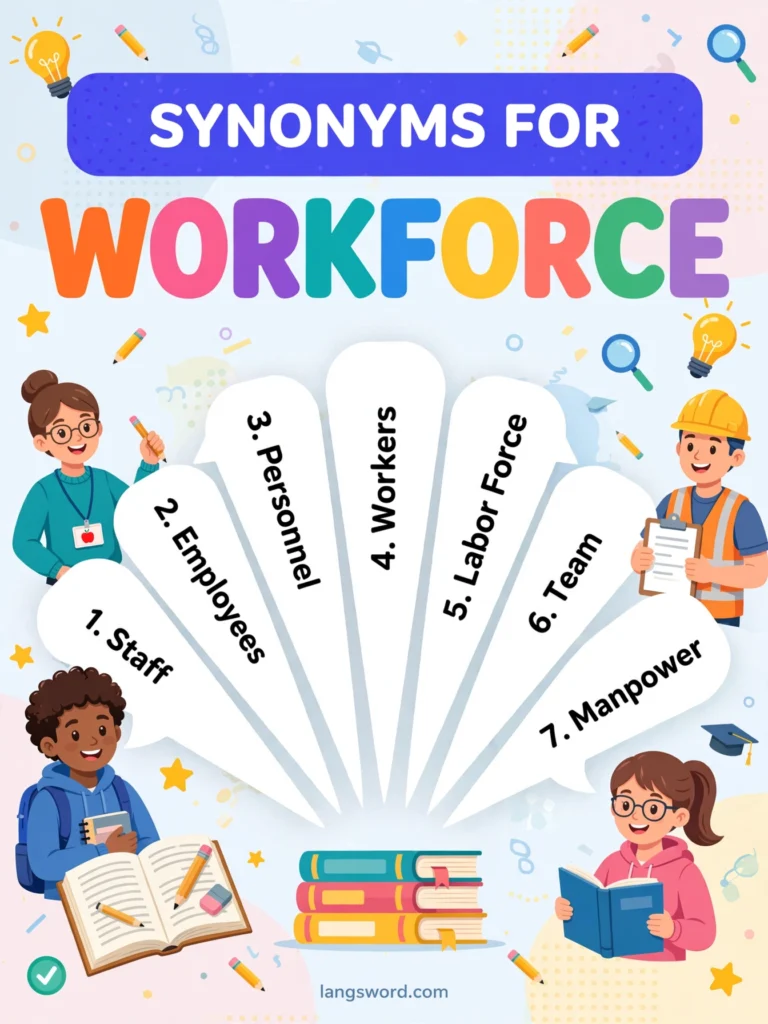
1. Staff (Noun)
Meaning: All the people who work for one company or place.
Examples:
- The hotel staff is kind to every guest.
- Our staff meets every Monday morning.
2. Employees (Noun)
Meaning: People who are paid to work for a company or a boss.
Examples:
- The company gives its employees free lunch.
- New employees get training in the first week.
3. Personnel (Noun)
Meaning: The people who work for an organization, used in formal speech.
Examples:
- Only personnel may enter this room.
- The army sent more personnel to the base.
4. Workers (Noun)
Meaning: People who do jobs, often with their hands or in factories.
Examples:
- The workers start their shift at six.
- Happy workers do better work.
5. Labor Force (Noun)
Meaning: All the people in a country who work or can work.
Examples:
- The labor force grew this year.
- Young people are joining the labor force.
6. Manpower (Noun)
Meaning: The number of people needed or ready to do work.
Examples:
- The farm needs more manpower for the harvest.
- The project failed for lack of manpower.
7. Team (Noun)
Meaning: A group of people who work together on a shared task.
Examples:
- Our team finished the project on time.
- She leads a small sales team.
8. Crew (Noun)
Meaning: A group of people who work together, often on a ship, plane, or job site.
Examples:
- The ship’s crew sailed for six months.
- A road crew fixed the street today.
9. Human Resources (Noun)
Meaning: The people of a company seen as its key strength; also the office that hires them.
Examples:
- Good human resources make a company strong.
- She works in human resources and hires new staff.
10. Labor (Noun)
Meaning: Workers as a group, or the work they do.
Examples:
- The factory needs skilled labor.
- Labor costs rose this year.
11. Hands (Noun)
Meaning: Workers, counted by the hands that do the work.
Examples:
- The farmer hired extra hands for the season.
- All hands helped to lift the heavy box.
12. Labor Pool (Noun)
Meaning: The group of people in an area who are ready to take jobs.
Examples:
- The town has a large labor pool.
- New factories draw workers from the labor pool.
13. Associates (Noun)
Meaning: People who work at a company, often used as a kind word for staff.
Examples:
- Our associates wear blue shirts.
- The store trains its associates well.
14. Colleagues (Noun)
Meaning: People who work with you in the same job or office.
Examples:
- My colleagues are friendly and helpful.
- He shares lunch with his colleagues daily.
15. Work Team (Noun)
Meaning: A set group of workers who do a job together.
Examples:
- The work team meets every Friday.
- Each work team has its own leader.
16. Rank and File (Noun)
Meaning: The ordinary workers of a group, not the leaders.
Examples:
- The rank and file asked for better pay.
- Leaders must listen to the rank and file.
17. Operators (Noun)
Meaning: People who run machines or systems at work.
Examples:
- Machine operators wear safety gloves.
- The operators keep the plant running all night.
18. Talent Pool (Noun)
Meaning: A group of skilled people a company can hire from.
Examples:
- The city has a deep talent pool of engineers.
- Good firms build a strong talent pool.
19. Work Group (Noun)
Meaning: A small group of people who work on the same task.
Examples:
- Our work group has five members.
- The work group shared the hard task fairly.
20. Blue-Collar Workers (Noun)
Meaning: Workers who do physical jobs, often in factories or building work.
Examples:
- Blue-collar workers built the new bridge.
- Many blue-collar workers start work at dawn.
21. White-Collar Workers (Noun)
Meaning: Workers who do office jobs, not physical work.
Examples:
- White-collar workers fill the tall office towers.
- The white-collar workers use computers all day.
22. Laborers (Noun)
Meaning: People who do hard physical work that needs strength more than skill.
Examples:
- Laborers carried bricks at the building site.
- The laborers rested in the shade at noon.
23. Jobholders (Noun)
Meaning: People who have jobs.
Examples:
- Most jobholders work five days a week.
- The plan helps jobholders save money.
24. Wage Earners (Noun)
Meaning: People who earn pay for their work.
Examples:
- Wage earners pay taxes each month.
- Both parents are wage earners in this family.
25. Working Population (Noun)
Meaning: All the people in a place who work or are of working age.
Examples:
- The working population of the city is growing.
- A young working population helps the economy.
26. Staff Members (Noun)
Meaning: Each person who belongs to a company’s staff.
Examples:
- All staff members wear a name badge.
- Staff members got a bonus this year.
27. Employee Base (Noun)
Meaning: The full group of employees a company has.
Examples:
- The firm has an employee base of two thousand.
- A happy employee base stays for years.
28. Human Capital (Noun)
Meaning: The skills, health, and knowledge of workers, seen as wealth.
Examples:
- Training grows a nation’s human capital.
- The company invests in its human capital.
29. Working People (Noun)
Meaning: Ordinary people who work for a living.
Examples:
- Working people need rest on weekends.
- The new law helps working people.
30. Members (Noun)
Meaning: People who belong to a staff, team, or group.
Examples:
- All members of the team joined the meeting.
- New members learn the rules fast.
Prototype Meaning
When people hear the word workforce, they first picture a large group of people at work. They see factory workers at machines, nurses in a hospital, and clerks at desks. It is not one person or two. It is the whole crowd of people whose hands and minds keep a company, or a whole country, running each day.
Prototype Categorization
- Everyday staff words: Staff, Employees, Personnel, Associates, Colleagues, Members, Staff Members, Employee Base — use these for the people of one company or office.
- Whole-country words: Labor Force, Labor, Working Population, Working People, Labor Pool, Talent Pool — use these when you talk about all workers in a city, industry, or nation.
- Team words: Team, Crew, Work Team, Work Group, Rank and File — use these for a smaller group that works together on one task.
- Hands-on work words: Workers, Manpower, Laborers, Hands, Operators, Blue-Collar Workers — use these when the work is physical, like building, farming, or running machines.
- Formal business words: Human Resources, Human Capital, White-Collar Workers, Wage Earners, Jobholders — use these in reports, news, and business writing.
These groups help writers pick the best word for each job. A news report on a country needs a whole-country word like labor force. A note about your own office needs a simple word like staff or team. The right group makes your meaning clear at once.
Antonyms of Workforce
Unemployment (Noun)
The state of not having a job when you want one; the opposite of a working group.
Joblessness (Noun)
The condition of people having no work at all.
Management (Noun)
The people who lead and direct a company, in contrast to the workers they lead.
Employers (Noun)
The people or companies who hire workers, standing on the other side from the workforce.
Retirees (Noun)
People who have stopped working because of age; they have left the workforce.
Students (Noun)
People who study full time and have not yet joined the workforce.
Layoffs (Noun)
Workers being let go from jobs, which shrinks the workforce.
Short Questions and Answers
What does workforce mean?
Workforce means all the people who work, or are able to work, for a company, an industry, or a country. It counts the workers as one whole group.
When should workforce be used?
Use workforce in news, reports, and business talk about workers as a group. It fits best when you talk about the size, skills, or growth of all the workers together.
Is workforce positive or negative?
It is mostly neutral, and often positive. It shows people as a strong force that builds things. It can feel cold when it treats people as mere numbers.
How is it different from similar words?
Workforce is the whole group of working people. Staff is only the people of one company. Team is a small group on one task. Employees are people hired by one boss.
Conclusion
Workforce is a useful word for talking about people at work as one strong group. The 30 synonyms in this guide give you many ways to name that group. Words like staff and team fit daily talk about one office, while words like labor force and working population fit news about a whole country. Learning these synonyms improves your vocabulary and makes your writing rich and fresh. It also helps you avoid repeating the same word again and again, and it builds real confidence in your English. So keep practicing every day. Read one new word, say it aloud, and use it in a sentence of your own.