
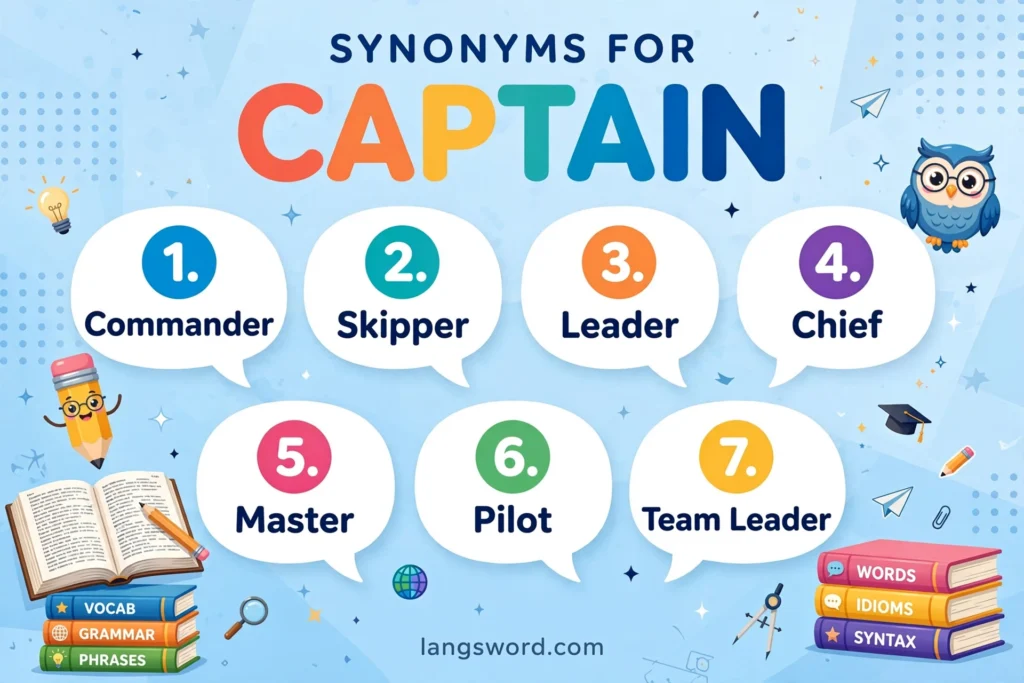

A captain is the leader of a ship, a plane, a team, or a group. Picture a ship captain on a dark, stormy night. The wind is strong, the waves are high, and the crew looks at one person for orders. That person is the captain, calm and brave at the wheel. On a sports field, the team captain does the same job and guides the players. People use this word every day for ships, planes, armies, and games. Learning synonyms for captain helps English learners speak with power and variety. It also helps writers avoid the same word again and again. In this article, you will learn the meaning of captain, 30 synonyms with meanings and examples, and its grammar, history, pronunciation, and word groups in simple words.
Meaning of Captain
Definition
Captain (Noun): The leader of a ship, a plane, a team, or a group; a person who is in charge and gives orders.
Examples
- The captain sailed the ship safely through the storm.
- Our team captain scored the winning goal in the final match.
Connotative Meaning
- Positive tone: It suggests a brave, wise, and respected leader. People trust a captain and follow his or her orders with pride.
- Negative tone: In rare casual use, it can sound bossy, like a person who orders others around too much.
- Neutral tone: In news and reports, it is a plain job title for the person in charge of a ship, plane, or unit.
(Connotation: the feelings and ideas a word brings to mind, apart from its plain meaning.)
Etymology
- Old English (450–1100): The word did not exist in Old English. English had no form of this word in that period.
- Middle English (1100–1500): The word entered English around the 1300s and 1400s, from Old French capitaine. The French word came from Latin capitaneus, meaning chief, which came from caput, meaning head.
- Modern English (1500–Present): The word grew in use for ship leaders, army officers, and later for sports team leaders and pilots.
Pronunciation (IPA)
- IPA: /ˈkæptɪn/
- Syllables: cap · tain (2 syllables)
Affixation Pattern of Captain
- Root: captain
- Prefix: None
- Suffix: None in the base word; the suffix -cy forms the noun captaincy
- Word formations:
- captaincy (Noun)
- captained (Verb, past form)
- captaining (Verb, -ing form)
- co-captain (Noun)
- vice-captain (Noun)
- captainship (Noun)
30 Synonyms of Captain With Meaning & Examples
1. Leader (Noun)
Meaning: A person who guides a group and shows the way to others.
Examples:
- A good leader listens to the team before giving orders.
- She is the leader of the school music group.
2. Commander (Noun)
Meaning: A person who is in charge of a group of soldiers or a military unit.
Examples:
- The commander ordered the soldiers to guard the bridge.
- Our commander is brave and fair with every soldier.
3. Chief (Noun)
Meaning: The main person in charge of a group, a tribe, or an office.
Examples:
- The fire chief led the team into the burning house.
- The village chief welcomed the guests with a speech.
4. Head (Noun)
Meaning: The person at the top of a group or an office who makes the final choices.
Examples:
- The head of the school spoke to all the students.
- He is the head of a large family of ten.
5. Boss (Noun)
Meaning: The person in charge at a job who tells workers what to do.
Examples:
- My boss asked me to finish the report today.
- The boss of the shipyard checks every ship with care.
6. Skipper (Noun)
Meaning: The captain of a small ship or a boat; also used in sports for a team captain.
Examples:
- The skipper steered the small boat back to shore.
- Our skipper won the toss and chose to bat first.
7. Master (Noun)
Meaning: The captain of a merchant ship; also a person with full control or great skill.
Examples:
- The master of the ship signed the travel papers.
- He is a master of his craft after years of hard work.
8. Pilot (Noun)
Meaning: The person who flies and controls a plane; a plane’s captain.
Examples:
- The pilot landed the plane safely in heavy rain.
- Our pilot spoke to the passengers in a calm voice.
9. Officer (Noun)
Meaning: A person with a position of power in the army, navy, or police.
Examples:
- The officer led his men with courage.
- A police officer must be honest and calm.
10. Commanding Officer (Noun)
Meaning: The officer who is in full charge of a military unit or a ship.
Examples:
- The commanding officer inspected the ship at dawn.
- Every sailor reports to the commanding officer.
11. Commodore (Noun)
Meaning: A naval officer of high rank, above a captain, who leads a group of ships.
Examples:
- The commodore led the fleet of warships.
- She rose from captain to commodore after long service.
12. Chieftain (Noun)
Meaning: The leader or chief of a tribe or a clan.
Examples:
- The chieftain wore a bright feather crown.
- Every warrior in the tribe obeyed the old chieftain.
13. Team Leader (Noun)
Meaning: The person who leads a sports team or a work team, like a captain.
Examples:
- Our team leader plans every practice session.
- The team leader cheered the players after the loss.
14. Squad Leader (Noun)
Meaning: The person in charge of a small group of soldiers or players.
Examples:
- The squad leader checked each soldier’s gear.
- Our squad leader is quick and smart in a game.
15. Helmsman (Noun)
Meaning: The person who steers a ship; he works under the captain’s orders.
Examples:
- The helmsman turned the wheel to miss the rocks.
- A good helmsman keeps the ship on a straight path.
16. Navigator (Noun)
Meaning: The person on a ship or plane who plans the route and finds the way.
Examples:
- The navigator used the stars to find the path.
- Our navigator read the map and guided the pilot.
17. Director (Noun)
Meaning: A person who leads and manages a company, a film, or a project.
Examples:
- The director told the actors how to play the scene.
- She is the director of a big travel company.
18. Manager (Noun)
Meaning: A person who runs a business, a team, or a group of workers.
Examples:
- The team manager chose the players for the match.
- Our manager solved the problem in one meeting.
19. Supervisor (Noun)
Meaning: A person who watches over workers and checks their work.
Examples:
- The supervisor walked through the factory each morning.
- My supervisor helped me learn the new job.
20. Overseer (Noun)
Meaning: A person who watches and directs the work of others, often on a farm or a big project.
Examples:
- The overseer made sure the harvest finished on time.
- Workers asked the overseer for a short rest.
21. Foreman (Noun)
Meaning: The leader of a group of workers, often in a factory or on a building site.
Examples:
- The foreman showed the new worker how to use the tools.
- Our foreman is strict but kind to everyone.
22. Conductor (Noun)
Meaning: The leader of an orchestra or choir who directs the music; also a person in charge on a train.
Examples:
- The conductor raised his stick and the music began.
- The train conductor checked every ticket with a smile.
23. Ruler (Noun)
Meaning: A person who governs a country, like a king or a queen.
Examples:
- The ruler of the land was wise and just.
- A good ruler cares for poor and rich alike.
24. Governor (Noun)
Meaning: The leader of a state or a region who runs its government.
Examples:
- The governor opened the new school in our town.
- Our governor works hard to build new roads.
25. Admiral (Noun)
Meaning: A naval officer of very high rank, higher than a captain, who leads a whole fleet.
Examples:
- The admiral commanded the entire fleet from his ship.
- After many years, the captain became an admiral.
26. Captain of Industry (Noun)
Meaning: A powerful leader of a big business or industry.
Examples:
- He is a captain of industry with factories in five cities.
- The old captain of industry gave money to build schools.
27. Maestro (Noun)
Meaning: A master of music who leads an orchestra; used in a figurative way for a great leader of any art.
Examples:
- The maestro led the orchestra with grace and fire.
- She is a maestro of the kitchen, a true artist of food.
28. Figurehead (Noun)
Meaning: A leader in name only, with a title but little real power.
Examples:
- The old king was a figurehead; others ruled the land.
- He is just a figurehead of the club, with no real say.
29. Guide (Noun)
Meaning: A person who leads others and shows them the way, often in travel or in life.
Examples:
- Our guide led us safely through the dark cave.
- A teacher is a guide who lights the path of learning.
30. Coach (Noun)
Meaning: The leader of a sports team who trains the players and plans the game, much like a captain off the field.
Examples:
- The coach praised the captain and the whole team.
- Our coach teaches us to play fair and never give up.
Prototype Meaning
When people hear the word captain, they first picture a ship captain at the wheel. He wears a neat uniform and a white cap. His eyes are on the sea, and his hands are firm. The crew trusts him in every storm. Many people also picture a team captain with a band on his arm, leading his players onto the field with pride.
Prototype Categorization
- Sea and air leaders: Skipper, Master, Pilot, Commodore, Admiral, Helmsman, Navigator. Use these for ships, boats, planes, and the people who steer or plan the route.
- Army and uniform leaders: Commander, Officer, Commanding Officer, Squad Leader. Use these for soldiers and officers who give and follow orders.
- Sports leaders: Team Leader, Coach. Use these for games, matches, and team practice.
- Work and group leaders: Boss, Manager, Director, Supervisor, Overseer, Foreman, Conductor. Use these for offices, factories, building sites, trains, and music groups.
- General words for a leader: Leader, Chief, Head, Chieftain, Ruler, Governor, Guide. Use these in daily speech and writing for any person in charge.
- Special and figurative uses: Captain of Industry, Maestro, Figurehead. Use these for business leaders, great artists, or a leader with a title but no real power.
These groups help writers choose the best word for each scene. A sea story needs skipper or master, a match report needs team leader, and an office story needs boss or manager.
Antonyms of Captain
Follower (Noun)
A person who follows a leader and takes orders instead of giving them.
Subordinate (Noun)
A person of lower rank who works under the orders of a senior person.
Crew Member (Noun)
An ordinary worker on a ship or plane who helps the captain but does not lead.
Private (Noun)
The lowest rank of a soldier in an army, far below a captain.
Passenger (Noun)
A person who travels on a ship or plane and has no duty or command.
Recruit (Noun)
A new member of an army or team who is still learning and has no power.
Assistant (Noun)
A helper who supports a leader with small tasks but makes no final choices.
Short Questions and Answers
What does captain mean?
A captain is the leader of a ship, a plane, a team, or a group. He or she is in charge and gives the orders that others follow.
When should captain be used?
Use captain for the person in command of a ship or plane, for an army officer of that rank, and for the leader of a sports team.
Is captain positive or negative?
It is mostly positive. It suggests courage, skill, and trust. Only in rare casual use can it sound bossy, when a person gives too many orders.
How is it different from similar words?
A captain leads one ship, plane, or team. An admiral leads a whole fleet and holds a higher rank. A skipper is a friendly word for the captain of a small boat or a team.
Conclusion
In short, captain is a strong word for a trusted leader, and its 30 synonyms open many doors for your English. Ship words like skipper and master fit sea stories. Words like commander and officer fit army tales. Team leader and coach fit the sports page. Learning these words improves your vocabulary and makes your writing rich and clear. It also helps you avoid dull repetition and speak with real confidence. So keep a small habit each day. Learn one new word, say it out loud, and use it in a sentence of your own. Step by step, your English will grow strong, brave, and ready to lead, just like a good captain.