
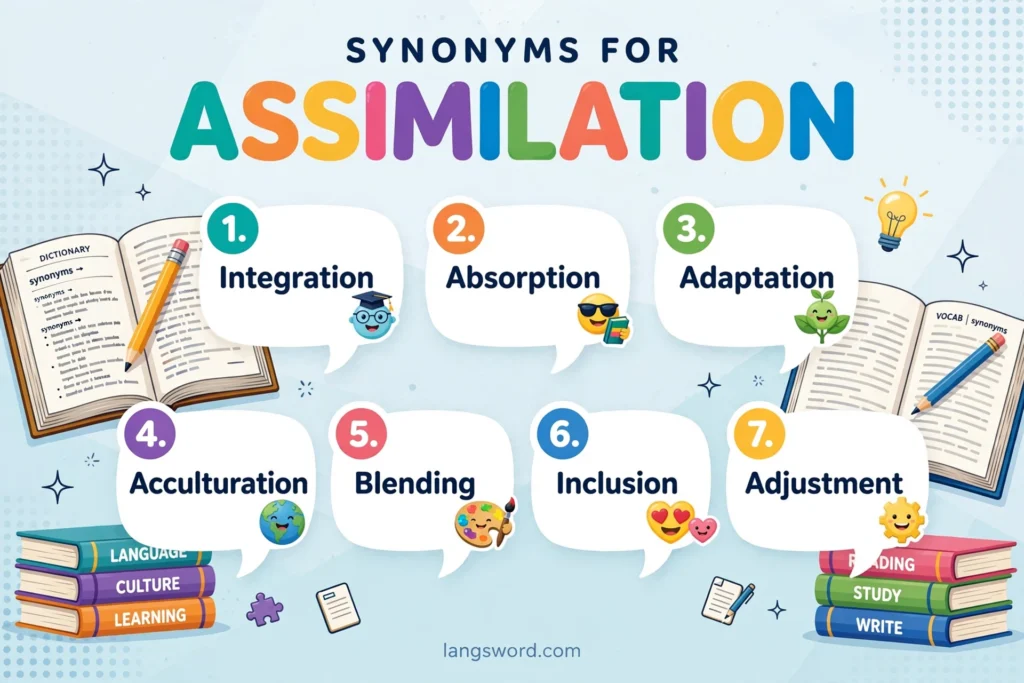

Assimilation is the process of becoming part of a new group. Think of a new student who moves to a school in a new country. On the first day, everything feels strange: the food, the jokes, and the way of life. Slowly, she learns the new ways and makes new friends. Soon, she feels at home. This slow change is assimilation. People use this word in talks about society and culture. It is also used in science, where it means the body taking in food. Learning synonyms for assimilation helps English learners speak with care and skill. It also helps writers avoid dull repetition. In this article, you will learn the meaning of assimilation and its history. You will also learn 30 synonyms with examples, grammar, pronunciation, and word groups.
Meaning of Assimilation
Definition
Assimilation (Noun): The process of becoming part of a group or taking something in fully. A new person slowly joins a new culture, or the body takes in food and uses it.
Examples
- The family’s assimilation into the new town took two full years.
- Good assimilation of food keeps the body strong and full of energy.
Connotative Meaning
- Positive tone: It can suggest unity, peace, and belonging. A new person is welcomed and feels like one of the group.
- Negative tone: It can suggest loss. Some people fear that a group must give up its own culture, food, and language to fit in.
- Neutral tone: In science and school books, it is a plain process word with no good or bad feeling.
(Connotation: the feelings and ideas a word brings to mind, apart from its plain meaning.)
Etymology
- Old English (450–1100): The word did not exist in Old English. People of that time had no word like this in their language.
- Middle English (1100–1500): Near the end of this period, a verb form began to appear. It came from Latin assimilare, meaning “to make like,” and passed through French into English.
- Modern English (1500–Present): The noun assimilation appeared in the early 1600s. Later, in the 1800s and 1900s, it gained its social meaning for people and cultures joining a new society. Science also uses it for the body taking in food.
Pronunciation (IPA)
- IPA: /əˌsɪməˈleɪʃən/
- Syllables: as · sim · i · la · tion (5 syllables)
Affixation Pattern of Assimilation
- Root: assimilate (from Latin assimilare, “to make like”)
- Prefix: as- (a form of ad-, meaning “to” or “toward”)
- Suffix: -tion (a noun suffix that turns a verb into the name of a process)
- Word formations:
- assimilate (Verb)
- assimilated (Adjective)
- assimilable (Adjective)
- assimilative (Adjective)
- assimilator (Noun)
- assimilating (Verb form)
30 Synonyms of Assimilation With Meaning & Examples
1. Integration (Noun)
Meaning: The act of joining a group fully and becoming an equal part of it.
Examples:
- The school worked hard for the integration of new students.
- Integration helps new families feel welcome in a town.
2. Absorption (Noun)
Meaning: The act of taking something in fully, like a sponge takes in water.
Examples:
- The small village saw the slow absorption of new families into its life.
- The absorption of food takes place in the stomach and the gut.
3. Incorporation (Noun)
Meaning: The act of adding a person or thing into a larger group or body.
Examples:
- The incorporation of new members made the club stronger.
- The city planned the incorporation of the small village nearby.
4. Acculturation (Noun)
Meaning: The process of learning and taking on the ways of a new culture.
Examples:
- Acculturation can be slow for older people in a new land.
- Food, dress, and songs all change during acculturation.
5. Adaptation (Noun)
Meaning: The process of changing to fit new conditions or a new place.
Examples:
- Her adaptation to the cold weather took one full winter.
- Plants show adaptation when they grow in dry lands.
6. Adjustment (Noun)
Meaning: A small change made to fit a new place, group, or way of life.
Examples:
- The new job needed a short period of adjustment.
- A small adjustment to his daily plan made life easy.
7. Blending (Noun)
Meaning: Mixing two or more things or groups together in a smooth way.
Examples:
- The blending of two cultures gave the city rich food and music.
- Blending of colors made the painting soft and calm.
8. Merging (Noun)
Meaning: The act of joining two or more things into one whole.
Examples:
- The merging of the two schools took place last year.
- Traffic grew slow at the merging of the two roads.
9. Inclusion (Noun)
Meaning: The act of letting a person join and take part in a group.
Examples:
- The team believes in the inclusion of every child in games.
- Inclusion makes new workers feel safe and valued.
10. Acceptance (Noun)
Meaning: The act of taking someone or something as welcome and good.
Examples:
- The new girl found quick acceptance among her classmates.
- His acceptance of the new rules surprised everyone.
11. Naturalization (Noun)
Meaning: The legal process of becoming a citizen of a new country.
Examples:
- After five years, he applied for naturalization.
- The naturalization ceremony was full of joy and pride.
12. Acclimatization (Noun)
Meaning: The process of getting used to a new climate or new conditions.
Examples:
- Acclimatization to the high hills took the climbers three days.
- The animals need time for acclimatization in their new home.
13. Familiarization (Noun)
Meaning: The process of learning about something new until it feels known.
Examples:
- The first week was for the familiarization of new staff with the office.
- Familiarization with the map helped the driver feel calm.
14. Socialization (Noun)
Meaning: The process of learning the rules and ways of a society or group.
Examples:
- Socialization starts at home when a child is very young.
- The socialization of new students happens in the first month.
15. Unification (Noun)
Meaning: The act of joining many parts or groups into one united whole.
Examples:
- The unification of the two lands brought peace at last.
- The team worked for the unification of all small clubs.
16. Fusion (Noun)
Meaning: The joining of two or more things into one strong whole.
Examples:
- The dish is a fusion of two food cultures.
- The fusion of the two bands made a new, rich sound.
17. Amalgamation (Noun)
Meaning: The act of mixing or joining different things into one united whole.
Examples:
- The amalgamation of the two firms took a full year.
- The town is an amalgamation of three old villages.
18. Adoption (Noun)
Meaning: The act of taking something new, like an idea or a custom, as your own.
Examples:
- Her adoption of local dress helped her fit in fast.
- The adoption of new tools made farm work easy.
19. Embracement (Noun)
Meaning: The act of taking an idea, a change, or a group gladly into your life.
Examples:
- His embracement of the new culture surprised his friends.
- The embracement of change is the first step to growth.
20. Accommodation (Noun)
Meaning: A change made to fit in with new people or new conditions.
Examples:
- The school made an accommodation for the new student’s needs.
- A small accommodation in the plan pleased everyone.
21. Digestion (Noun)
Meaning: The process by which the body breaks down food and takes in its goodness.
Examples:
- Good digestion keeps a person active and healthy.
- A light meal helps digestion before sleep.
22. Intake (Noun)
Meaning: The amount of food, drink, or air that the body takes in.
Examples:
- The doctor asked about her daily intake of water.
- A high intake of salt is bad for health.
23. Soaking Up (Noun)
Meaning: The act of taking in liquid, facts, or ideas like a sponge.
Examples:
- The dry soil’s soaking up of rain saved the crops.
- The child spent the day soaking up new words.
24. Harmonization (Noun)
Meaning: The act of making different parts, rules, or people work together in peace.
Examples:
- The harmonization of rules helped trade between the two lands.
- The choir worked on the harmonization of their voices.
25. Mainstreaming (Noun)
Meaning: The act of bringing a person or group into the main flow of society.
Examples:
- The mainstreaming of new students helped them learn fast.
- The program supports the mainstreaming of workers with special needs.
26. Orientation (Noun)
Meaning: The process of getting used to a new place, job, or group.
Examples:
- The new workers had a full day of orientation.
- A short orientation helped the students find their classes.
27. Conversion (Noun)
Meaning: A full change from one way of life, belief, or use to a new one.
Examples:
- His conversion to the local way of life took many years.
- The conversion of the old house into a school took one summer.
28. Habituation (Noun)
Meaning: The process of getting used to something by meeting it again and again.
Examples:
- Habituation to city noise took her a few weeks.
- The birds showed habituation to people in the park.
29. Taking In (Noun)
Meaning: The act of receiving and holding something, like food, air, or new facts.
Examples:
- The taking in of fresh air made him feel strong again.
- Her quick taking in of facts amazed the teacher.
30. Uptake (Noun)
Meaning: The taking in of a substance by a living thing, used mostly in science.
Examples:
- Plants need a steady uptake of water from the soil.
- The uptake of iron keeps the blood healthy.
Prototype Meaning
When people hear the word assimilation, they first picture a newcomer in a strange land. Day by day, this person learns the new language, new food, and new ways. Slowly, the strange place starts to feel like home, and the person becomes part of the new community. This picture of a person gently becoming one of the group is the heart of the word.
Prototype Categorization
- Joining a group: Integration, Acculturation, Inclusion, Socialization, Naturalization, Mainstreaming — use these when a person or group becomes part of a society or community.
- Mixing into one: Fusion, Blending, Merging, Unification, Amalgamation, Incorporation — use these when two or more things join and become one whole.
- Getting used to the new: Adaptation, Adjustment, Acclimatization, Familiarization, Orientation, Habituation, Accommodation — use these when someone slowly fits into a new place, climate, or way of life.
- Taking in with body or mind: Digestion, Absorption, Intake, Uptake, Taking In, Soaking Up — use these for the body taking in food or a person taking in facts and ideas.
- Accepting fully: Acceptance, Adoption, Embracement, Conversion, Harmonization — use these when someone takes in a new idea, custom, or way of life with an open heart.
These groups help writers pick the best word fast. A culture topic needs a group word, a health topic needs a body word, and a change topic needs a “getting used to” word. The right group gives you the right word every time.
Antonyms of Assimilation
Separation (Noun)
The act of keeping people or things apart from each other.
Segregation (Noun)
The forced separation of groups of people, often by race or class.
Exclusion (Noun)
The act of keeping a person out of a group or place.
Isolation (Noun)
The state of being alone and cut off from others.
Rejection (Noun)
The act of refusing to accept a person, idea, or thing.
Division (Noun)
The act of splitting one group or thing into parts.
Alienation (Noun)
The feeling of being a stranger, cut off from a group or society.
Short Questions and Answers
What does assimilation mean?
Assimilation means the process of becoming part of a group. A new person slowly learns the ways of a new culture, or the body takes in food and uses it.
When should assimilation be used?
Use it when you talk about people joining a new society, groups mixing together, or the body taking in food. It fits topics about culture, migration, and health.
Is assimilation positive or negative?
It can be both. It sounds positive when it means welcome, unity, and belonging. It sounds negative when a group must lose its own culture to fit in.
How is it different from similar words?
Integration means joining a group while keeping your own identity. Assimilation often means becoming like the group in full. Adaptation is wider; it means changing to fit any new condition.
Conclusion
In the end, assimilation is a word about change, growth, and belonging. Its 30 synonyms give you many ways to talk about joining a group, mixing with others, or taking in new ideas and food. Learning these words improves your vocabulary step by step. It also makes your writing and speaking stronger, because you can pick the exact word for each idea. You avoid dull repetition and sound more natural in English. Each new word adds power to your voice and builds your confidence. So keep a small daily habit. Learn one new word each day, say it out loud, and use it in a sentence. With time, your English will grow rich, clear, and strong.