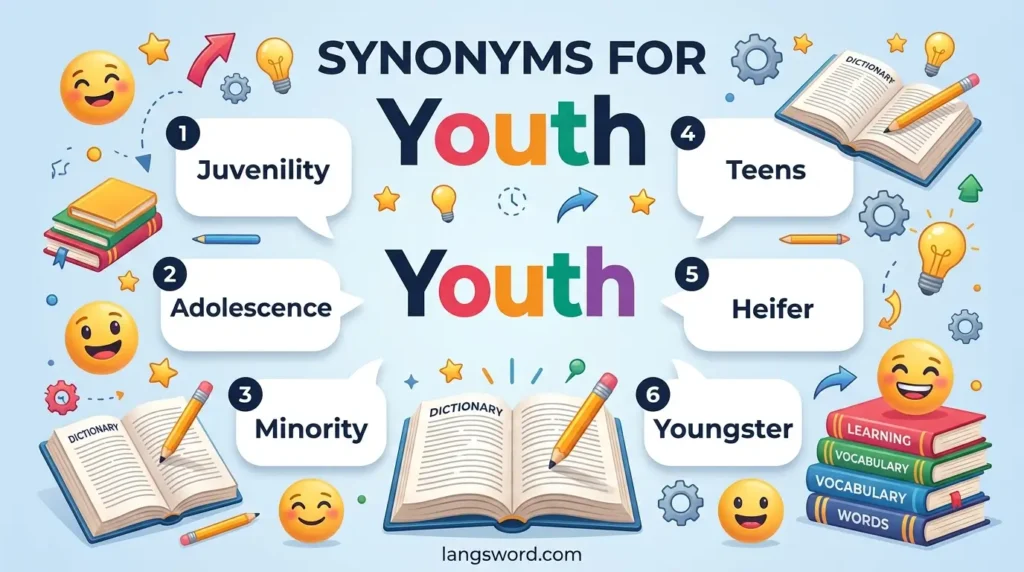

Youth means the period of life when a person is young. Imagine a teenager starting a first job, making new friends, or learning to drive. We often call this exciting stage youth. The word is common because it can describe both a young age and young people as a group.
Learning synonyms for youth helps English learners speak and write with more variety. It also helps content writers avoid using the same word again and again.
However, not every synonym fits every situation. Some words describe age, while others describe young people, energy, or the early stage of life. In this article, we explore the meaning of youth, its 30 useful synonyms, examples, grammar, history, pronunciation, word formation, antonyms, and semantic categories.
Meaning of Youth
Definition
Youth (Noun):
The period of life when a person is young, or young people considered as a group.
Examples
- She spent her youth in a small village.
- The program gives youth new opportunities to learn.
Connotative Meaning
Connotation (the feeling or idea that a word suggests beyond its basic meaning):
- Positive tone: Youth can suggest energy, hope, beauty, freedom, and new beginnings.
- Negative tone: It can sometimes suggest inexperience, immaturity, or lack of wisdom.
- Neutral tone: It can simply describe a young age or young people.
Etymology
The word youth has a long history in English and is related to the word young.
- Old English (450–1100): geoguth meant “youth” or “young age.” It came from an older Germanic word related to young.
- Middle English (1100–1500): The word appeared in forms such as youthe and became closer to the modern spelling.
- Modern English (1500–Present): Youth developed its modern meanings: the period of being young, the qualities of being young, and young people as a group.
Pronunciation (IPA)
- IPA: /juːθ/
- Syllables: youth (1 syllable)
Affixation Pattern of Youth
- Root: youth
- Prefix: None in modern English
- Suffix: None in modern English
Word Formations
- Youthful — adjective: having the qualities of a young person
- Youthfully — adverb: in a youthful way
- Youthfulness — noun: the quality of being youthful
- Youth-oriented — adjective: designed for or aimed at young people
- Youth culture — noun phrase: the customs, interests, and styles associated with young people
- Youthhood — noun: the state or period of being young; less common
30 Synonyms of Youth With Meaning & Examples
1. Adolescence (Noun)
Meaning: The stage of life between childhood and adulthood.
Examples:
- She became interested in music during adolescence.
- Friendships are important during adolescence.
2. Teenage Years (Noun Phrase)
Meaning: The years when a person is between thirteen and nineteen.
Examples:
- He spent his teenage years playing football.
- Her teenage years were full of new experiences.
3. Teens (Noun)
Meaning: The period or years when a person is thirteen to nineteen.
Examples:
- She learned to paint in her teens.
- He moved abroad in his teens.
4. Young Age (Noun Phrase)
Meaning: A time when someone is still young.
Examples:
- He started reading at a young age.
- She showed great talent at a young age.
5. Younghood (Noun)
Meaning: The period of being young.
Examples:
- He remembered the adventures of his younghood.
- Many people look back on their younghood fondly.
6. Childhood (Noun)
Meaning: The early period of a person’s life before adulthood.
Examples:
- She spent her childhood near the sea.
- His childhood memories remain strong.
7. Adolescents (Noun)
Meaning: Young people who are developing from children into adults.
Examples:
- The center offers support to adolescents.
- Many adolescents experience major changes.
8. Teenagers (Noun)
Meaning: People aged thirteen to nineteen.
Examples:
- Many teenagers enjoy social media.
- The club provides activities for teenagers.
9. Youngsters (Noun)
Meaning: Young people, especially children or teenagers.
Examples:
- The coach teaches youngsters how to play.
- Local youngsters joined the event.
10. Young People (Noun Phrase)
Meaning: People who are young.
Examples:
- The library offers free courses for young people.
- Many young people use technology every day.
11. Juveniles (Noun)
Meaning: Young people who are not yet adults; often used in formal contexts.
Examples:
- The center provides services for juveniles.
- The study examined behavior among juveniles.
12. Minors (Noun)
Meaning: People below the legal adult age.
Examples:
- Minors must have permission to join the program.
- The law gives special protection to minors.
13. Young Adults (Noun Phrase)
Meaning: People who are young adults, usually in their late teens or twenties.
Examples:
- The course is designed for young adults.
- Many young adults move away from home.
14. Junior Generation (Noun Phrase)
Meaning: A younger generation compared with an older group.
Examples:
- The junior generation is learning new skills.
- Leaders want to involve the junior generation.
15. New Generation (Noun Phrase)
Meaning: A newer group of young people.
Examples:
- The new generation has different interests.
- Schools help prepare the new generation for the future.
16. Young Generation (Noun Phrase)
Meaning: Young people viewed as a group.
Examples:
- Education can empower the young generation.
- The campaign aims to reach the young generation.
17. Early Life (Noun Phrase)
Meaning: The earlier part of a person’s life.
Examples:
- He spent his early life in the countryside.
- Her early life influenced her career.
18. Formative Years (Noun Phrase)
Meaning: The years when a person’s character and ideas develop.
Examples:
- She spent her formative years abroad.
- Teachers can influence children during their formative years.
19. Growing Years (Noun Phrase)
Meaning: The years when a person is growing and developing.
Examples:
- Sports were important during his growing years.
- She developed a love of books in her growing years.
20. Juvenescence (Noun)
Meaning: The state or period of being young.
Examples:
- The poem celebrates the beauty of juvenescence.
- Juvenescence is often linked with energy and discovery.
21. Youthfulness (Noun)
Meaning: The quality of looking or feeling young.
Examples:
- Exercise helped maintain her youthfulness.
- His youthfulness made him seem energetic.
22. Youngness (Noun)
Meaning: The quality or state of being young.
Examples:
- The painting captures the youngness of the characters.
- Her youngness was clear from her excitement.
23. Freshness (Noun)
Meaning: A quality suggesting newness, energy, or youthful appeal.
Examples:
- His ideas brought freshness to the project.
- The design has a sense of freshness.
24. Vitality (Noun)
Meaning: Great energy and strength.
Examples:
- The dancer performed with great vitality.
- Her vitality impressed everyone.
25. Energy (Noun)
Meaning: Physical or mental strength and activity.
Examples:
- The children were full of energy.
- His energy helped the team finish early.
26. Springtime of Life (Noun Phrase)
Meaning: A poetic expression for the early and youthful period of life.
Examples:
- He remembered the springtime of life with joy.
- The novel explores the springtime of life.
27. Prime of Life (Noun Phrase)
Meaning: A period when a person is considered to be at a strong or active stage of life.
Examples:
- She traveled widely in the prime of life.
- He achieved many goals in the prime of life.
28. Youth Era (Noun Phrase)
Meaning: A particular period associated with someone’s young life.
Examples:
- Music shaped his youth era.
- The film recalls the director’s youth era.
29. Young Days (Noun Phrase)
Meaning: The earlier days of a person’s life.
Examples:
- She often talks about her young days.
- He learned many lessons in his young days.
30. Young Spirit (Noun Phrase)
Meaning: A lively, energetic, and youthful attitude.
Examples:
- Her young spirit keeps her active.
- He has a young spirit despite his age.
Prototype Meaning
The most typical meaning of youth is the period when a person is young, especially the years between childhood and adulthood. When people hear the word, they often imagine teenagers or young adults, energy, learning, freedom, friendships, and the early stages of life. In another common use, youth refers to young people as a group, such as in the phrase “youth employment.”
Prototype Categorization
The 30 alternatives can be grouped by meaning. This helps writers choose a word that matches the exact context instead of treating every synonym as interchangeable.
- Life-stage words: adolescence, teenage years, teens, young age, younghood, childhood, early life, and growing years describe a period of life.
- Words for young people: adolescents, teenagers, youngsters, young people, juveniles, minors, young adults, and young generation refer mainly to people.
- Development-focused terms: formative years and new generation highlight growth, development, or change.
- Youth-quality words: youthfulness, youngness, freshness, vitality, and energy describe qualities connected with being young.
- Poetic or expressive terms: juvenescence, springtime of life, young days, and young spirit can add a literary or emotional tone.
- Broader life-stage expressions: prime of life and youth era can describe a particular period of life, depending on context.
Antonyms of Youth
1. Old Age (Noun)
Meaning: The later stage of human life.
2. Adulthood (Noun)
Meaning: The stage of life when a person is legally and socially an adult.
3. Maturity (Noun)
Meaning: The state of being fully developed or adult.
4. Aging (Noun)
Meaning: The natural process of becoming older.
5. Seniority (Noun)
Meaning: A state of being older or having a higher position based on length of service or experience.
6. Elderly Age (Noun Phrase)
Meaning: A later period of life associated with old age.
Short Questions and Answers
What does youth mean?
Youth means the period of life when a person is young. It can also mean young people as a group.
When should youth be used?
Use youth when talking about a person’s young years or about young people collectively. For example, “She spent her youth in Lahore” refers to a life stage, while “The program supports local youth” refers to young people.
Is youth positive or negative?
Youth is usually neutral. It can have a positive meaning when it suggests energy, hope, and opportunity. It can also have a negative meaning when it suggests inexperience or immaturity.
How is it different from similar words?
Youth is broader than words such as teenager, adolescence, or minor. Teenager identifies a person aged thirteen to nineteen, while adolescence describes a developmental life stage. Youth can refer to both a period of life and young people collectively.
Conclusion
Learning youth and its synonyms can make your English clearer and more flexible. Words such as adolescence, teenagers, youngsters, and youthfulness are related to youth, but each has a slightly different meaning or use.
Choosing the right word helps you describe age, people, development, energy, or emotion more accurately. These alternatives also help writers avoid repetition and make their content more natural.
English learners can build confidence by learning words in groups and using them in real sentences. Try practicing a few youth-related words each day. Write a sentence, read it aloud, and use the word in a conversation. With regular practice, your vocabulary, writing, and speaking skills will grow.