
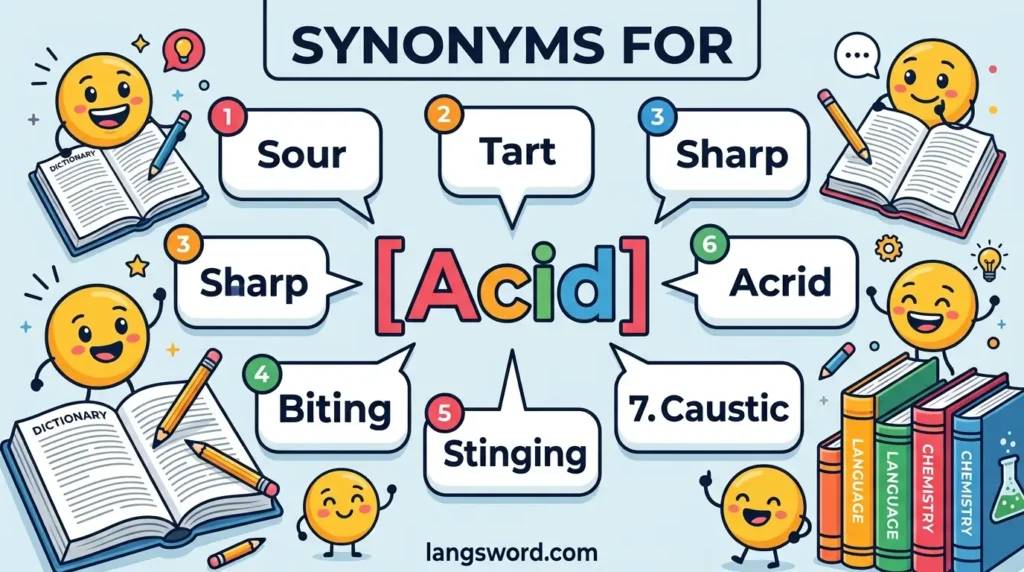

Acid usually describes a substance that has a sour taste or a chemical property that can react with certain materials. For example, when you taste a lemon, its sharp, sour flavor comes from citric acid.
The word is also used in phrases such as “acid rain” and “acidic soil.” Because acid has both scientific and everyday uses, it is a common word in English. Learning its synonyms helps English learners understand different shades of meaning and helps content writers avoid using the same word again and again.
In this guide, we will explain the meaning of acid, its synonyms, examples, grammar, history, pronunciation, word formation, and semantic categories. These related words can help you choose the right expression for science, food, taste, personality, writing, and other contexts.
Meaning of Acid
Definition
Acid (Noun/Adjective):
As a noun, an acid is a chemical substance that can react with bases and often has a sour taste. As an adjective, acid can describe something that contains acid or has a sour, sharp, or biting quality.
Examples
- Lemon juice contains a natural acid called citric acid.
- The soil became too acid for some plants to grow well.
Connotative Meaning
Connotation means the feeling or idea that a word suggests beyond its basic meaning.
- Positive tone: In some contexts, acid can suggest sharpness, energy, or strong flavor.
- Negative tone: It can suggest something harsh, bitter, corrosive, or unpleasant.
- Neutral tone: In science, acid is usually a neutral technical term describing a chemical substance.
Etymology
The word acid comes from Latin acidus, meaning “sour” or “sharp.” It entered English through French and developed from a word connected with the idea of sourness.
- Old English (450–1100): The modern word acid was not commonly used in Old English. Related ideas were expressed through words meaning sour or sharp.
- Middle English (1100–1500): Forms related to French and Latin began influencing English scientific and learned vocabulary.
- Modern English (1500–Present): Acid became established as a scientific term for substances with acidic properties. It later developed wider uses in chemistry, medicine, food, environmental science, and figurative language.
Pronunciation (IPA)
- IPA: /ˈæsɪd/
- Syllables: ac-id
Affixation Pattern of Acid
- Root: acid
- Prefix: None in the modern English word.
- Suffix: None in the basic word acid.
Word Formations
- acidic — adjective: containing or having the properties of an acid
- acidity — noun: the state or degree of being acidic
- acidify — verb: to make something acidic
- acidified — adjective/verb form: made acidic
- acidification — noun: the process of becoming or making something acidic
- acidifier — noun: a substance or agent that makes something acidic
- acidulous — adjective: slightly sour or acidic
- acidly — adverb: in a sharp, sour, or biting manner
30 Synonyms of Acid With Meaning & Examples
1. Sour (Adjective)
Meaning: Having a sharp taste like lemon or vinegar.
Examples:
- The lemon had a very sour taste.
- The milk smelled sour after being left outside.
2. Acidic (Adjective)
Meaning: Having the chemical properties of an acid.
Examples:
- Lemon juice is naturally acidic.
- The soil is too acidic for this plant.
3. Acidulous (Adjective)
Meaning: Slightly sour or acidic.
Examples:
- The drink had an acidulous flavor.
- An acidulous taste made the fruit refreshing.
4. Tart (Adjective)
Meaning: Having a sharp and pleasantly sour taste.
Examples:
- The apple had a tart flavor.
- She enjoys tart berries in her breakfast.
5. Sharp (Adjective)
Meaning: Strong and biting in taste, smell, or expression.
Examples:
- The sauce had a sharp taste.
- The cheese had a sharp flavor.
6. Tangy (Adjective)
Meaning: Having a strong, pleasantly sour flavor.
Examples:
- The yogurt had a tangy taste.
- I like the tangy flavor of orange dressing.
7. Zesty (Adjective)
Meaning: Having a lively, fresh, and slightly sharp flavor.
Examples:
- The salad had a zesty lemon dressing.
- The chef added a zesty sauce to the dish.
8. Vinegary (Adjective)
Meaning: Tasting or smelling strongly like vinegar.
Examples:
- The sauce had a vinegary taste.
- A vinegary smell filled the kitchen.
9. Bitter (Adjective)
Meaning: Having a strong unpleasant taste that is not sweet.
Examples:
- The medicine tasted bitter.
- The dark chocolate had a slightly bitter flavor.
10. Sourish (Adjective)
Meaning: Somewhat sour in taste.
Examples:
- The fruit had a sourish flavor.
- The sauce tasted sourish after adding the vinegar.
11. Acrid (Adjective)
Meaning: Having a strong, harsh, and irritating taste or smell.
Examples:
- An acrid smell came from the burning plastic.
- The smoke had an acrid odor.
12. Pungent (Adjective)
Meaning: Having a strong and sharp smell or taste.
Examples:
- The cheese had a pungent smell.
- Garlic can have a very pungent flavor.
13. Harsh (Adjective)
Meaning: Strong, rough, or unpleasant to the senses.
Examples:
- The chemical had a harsh odor.
- The cleaner has a harsh smell.
14. Caustic (Adjective)
Meaning: Able to burn or damage living tissue or materials through chemical action.
Examples:
- Workers handled the caustic chemical carefully.
- The laboratory stores caustic substances safely.
15. Corrosive (Adjective)
Meaning: Able to slowly damage or destroy materials through chemical action.
Examples:
- The liquid is highly corrosive.
- Wear gloves when handling corrosive chemicals.
16. Reactive (Adjective)
Meaning: Likely to react chemically with another substance.
Examples:
- Some acids are highly reactive.
- The scientist stored the reactive material carefully.
17. Chemical (Noun)
Meaning: A substance with a particular chemical composition and properties.
Examples:
- The laboratory tested the chemical.
- This chemical reacts with water.
18. Compound (Noun)
Meaning: A substance made from two or more elements chemically joined together.
Examples:
- Water is a chemical compound.
- The scientist studied the new compound.
19. Reagent (Noun)
Meaning: A substance used to cause or detect a chemical reaction.
Examples:
- The scientist added a reagent to the solution.
- The laboratory uses this reagent for testing.
20. Substance (Noun)
Meaning: A particular type of matter with specific properties.
Examples:
- The unknown substance was tested in the lab.
- The container held a dangerous substance.
21. Solution (Noun)
Meaning: A mixture in which one substance is evenly dissolved in another.
Examples:
- The acid was added to the solution.
- The scientist prepared a dilute solution.
22. Acidity (Noun)
Meaning: The level or quality of being acidic.
Examples:
- The test measures the acidity of the water.
- Soil acidity can affect plant growth.
23. Sourness (Noun)
Meaning: The quality or taste of being sour.
Examples:
- The sourness of the lemon was strong.
- Sugar can reduce the sourness of some foods.
24. Tartness (Noun)
Meaning: The quality of having a sharp, sour taste.
Examples:
- The tartness of the fruit made it refreshing.
- The sauce gets its tartness from vinegar.
25. Sharpness (Noun)
Meaning: The quality of having a strong or biting taste, smell, or character.
Examples:
- The cheese has a noticeable sharpness.
- The sharpness of the vinegar stood out.
26. Bitterness (Noun)
Meaning: The quality of having a strong, unpleasant taste.
Examples:
- The bitterness of the medicine was difficult to hide.
- Coffee can have a pleasant bitterness.
27. Acidity Level (Noun Phrase)
Meaning: The amount or degree of acid present in a substance.
Examples:
- The acidity level of the soil was measured.
- Farmers monitor the acidity level of their fields.
28. Sour (Noun)
Meaning: A sour taste or flavor.
Examples:
- The dish has a strong sour.
- A little sour can balance a sweet dessert.
29. Vinegar-like (Adjective)
Meaning: Similar to vinegar in taste or smell.
Examples:
- The liquid had a vinegar-like smell.
- The sauce developed a vinegar-like flavor.
30. Acid-forming (Adjective)
Meaning: Producing or tending to produce acidic conditions.
Examples:
- Some materials have an acid-forming effect on soil.
- The diet included several acid-forming foods.
Prototype Meaning
The most typical meaning of acid is a chemical substance with acidic properties. When people hear the word, they often imagine a laboratory liquid that has a low pH and can react with other substances. In everyday life, they may also connect it with sour foods such as lemons, oranges, vinegar, and some types of fruit.
Prototype Categorization
The 30 related words can be grouped by their main meaning. This helps writers choose a word that fits the exact situation instead of treating every synonym as interchangeable.
- Taste and flavor: sour, sourish, tart, tangy, zesty, vinegary, bitter, sourness, tartness, sharpness, and vinegar-like. These words work best when describing food, drinks, or taste.
- Chemical properties: acidic, acidulous, caustic, corrosive, reactive, and acid-forming. These are useful in scientific, environmental, and technical writing.
- Chemical substances: chemical, compound, reagent, substance, and solution. These words describe materials involved in chemistry, but they are not exact substitutes for acid in every sentence.
- Strong or unpleasant qualities: sharp, acrid, pungent, and harsh. These words can describe strong smells, tastes, or sensations.
- Levels and qualities of acidity: acidity, acidity level, and bitterness. These nouns describe qualities or measurements rather than directly naming an acid.
Antonyms of Acid
1. Alkaline (Adjective)
Meaning: Having a pH above 7 and showing properties opposite to those of an acid.
2. Basic (Adjective)
Meaning: Having chemical properties associated with a base rather than an acid.
3. Sweet (Adjective)
Meaning: Having a sugary taste rather than a sour taste.
4. Mild (Adjective)
Meaning: Having a gentle taste or effect rather than a strong or harsh one.
5. Neutral (Adjective)
Meaning: Having neither acidic nor alkaline properties, especially around pH 7.
Short Questions and Answers
What does acid mean?
Acid is a chemical substance with acidic properties. In everyday language, it can also describe something sour, sharp, or biting.
When should acid be used?
Use acid when discussing a chemical substance, acidic conditions, or something related to acidity. In food descriptions, use it when the context involves sour or acidic qualities.
Is acid positive or negative?
Acid is usually neutral in scientific writing. Its emotional meaning depends on context. It can describe a useful chemical, a sour flavor, or something harsh and damaging.
How is it different from similar words?
Acidic usually describes something that has acid properties, while sour focuses on taste. Corrosive focuses on chemical damage, and tart usually describes a pleasant sharp taste. Therefore, these words are related but are not always interchangeable.
Conclusion
Learning acid and its synonyms can make your English more precise and flexible. The word has important uses in science, food, environmental studies, and everyday speech.
Knowing related words such as acidic, sour, tart, tangy, corrosive, caustic, and acidity helps you describe the exact idea you want to express. Synonyms also reduce repetition and make writing more natural.
For English learners, studying these words builds a stronger vocabulary and improves both speaking and writing. Content writers can use them to create clearer and more varied articles without changing the intended meaning.
Try learning a few new words each day and use them in your own sentences. Regular practice will help you remember them and speak English with greater confidence.