
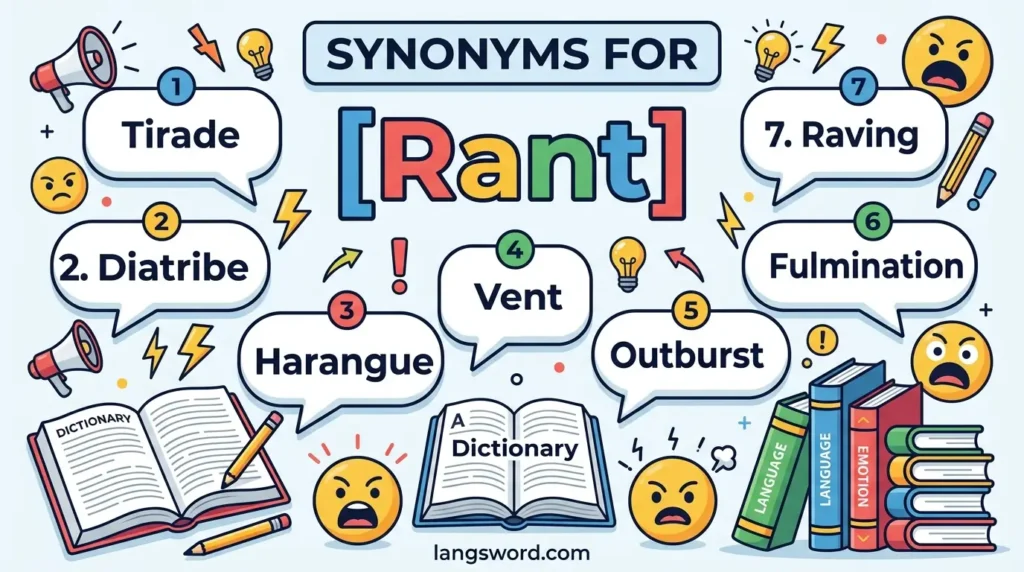

Rant means to speak or write in a long, loud, and often angry way about something. Imagine someone stuck in traffic after a long day. They get home and spend ten minutes complaining about careless drivers, bad roads, and traffic lights.
That strong, emotional speech is a rant. The word is common in everyday English, especially when people express anger, frustration, or strong opinions. Learning synonyms for rant helps English learners understand different shades of meaning.
It also helps writers avoid repeating the same word. A writer may need a word that sounds mild, formal, emotional, or strongly negative. This article explains the meaning of rant, its synonyms, examples, grammar, history, pronunciation, word formation, and semantic categories.
By learning these related words, you can choose the right expression for each situation and make your English more natural.
Meaning of Rant
Definition
Rant (Noun/Verb):
As a noun, a rant is a long, angry, or emotional speech or piece of writing. As a verb, rant means to speak or write in an angry, loud, or uncontrolled way.
Examples
- My brother went on a rant about the poor service at the restaurant.
- She ranted about the unfair rules for nearly an hour.
Connotative Meaning
Connotation means the feeling or idea that a word suggests beyond its basic meaning.
- Positive tone: Rant can sometimes suggest passionate and energetic expression, especially when someone speaks strongly about an important issue.
- Negative tone: Rant usually suggests uncontrolled anger, excessive complaining, or an unreasonable speech.
- Neutral tone: In some contexts, rant can simply describe a long and passionate expression of strong feelings.
Etymology
The exact history of rant is not completely certain. The word appeared in English in the early modern period and was used for loud, extravagant, or wild speech. It is often linked to Dutch ranten, meaning to rave, talk wildly, or speak foolishly.
- Old English (450–1100): There is no established Old English form of the modern word rant.
- Middle English (1100–1500): The modern word is not clearly established in Middle English. Its later history is connected with Germanic forms found in Dutch.
- Modern English (1500–Present): Rant became established in English with the sense of speaking loudly, wildly, or extravagantly. Today, it commonly means an angry or passionate speech or complaint.
Pronunciation (IPA)
- IPA: See the pronunciation card above.
- Syllables: rant — 1 syllable
Affixation Pattern of Rant
- Root: rant
- Prefix: none
- Suffix: none in the basic word
- Word formations:
- rant — noun/verb
- ranted — verb, past tense/past participle
- ranting — verb, present participle; also noun/adjective
- ranter — noun, a person who rants
- ranty — adjective, informal; characterized by ranting
30 Synonyms of Rant With Meaning & Examples
1. Tirade (Noun)
Meaning: A long and angry speech that strongly attacks someone or something.
Examples:
- The manager gave a tirade about the team’s poor performance.
- His angry tirade lasted for several minutes.
2. Diatribe (Noun)
Meaning: A bitter and forceful speech or piece of writing that strongly criticizes someone or something.
Examples:
- The article was a harsh diatribe against modern politics.
- She delivered a long diatribe about poor customer service.
3. Harangue (Noun/Verb)
Meaning: A long, forceful speech that criticizes or pressures someone.
Examples:
- We had to listen to his harangue about office rules.
- The coach harangued the players after the defeat.
4. Outburst (Noun)
Meaning: A sudden and strong expression of emotion.
Examples:
- His angry outburst shocked everyone.
- She apologized for her emotional outburst.
5. Complaint (Noun)
Meaning: A statement that says something is wrong or unsatisfactory.
Examples:
- The customer made a complaint about the delayed order.
- Her main complaint was the poor service.
6. Grievance (Noun)
Meaning: A formal or serious complaint about something considered unfair.
Examples:
- The workers filed a grievance about their working conditions.
- He explained his grievance to the manager.
7. Grumble (Noun/Verb)
Meaning: To complain quietly or repeatedly about something.
Examples:
- He began to grumble about the rising prices.
- Her constant grumbling annoyed her coworkers.
8. Grouse (Noun/Verb)
Meaning: To complain about something, often repeatedly.
Examples:
- He likes to grouse about his neighbors.
- Her biggest grouse was the long commute.
9. Gripe (Noun/Verb)
Meaning: To complain about something that annoys you.
Examples:
- He always gripes about his workload.
- My main gripe is the slow internet.
10. Protest (Noun/Verb)
Meaning: A strong statement or action showing opposition to something.
Examples:
- She protested against the unfair decision.
- His speech was a strong protest against the new rule.
11. Objection (Noun)
Meaning: A statement showing that you disagree with something.
Examples:
- She raised an objection to the proposed plan.
- His main objection was the extra cost.
12. Complaint-Fest (Noun)
Meaning: An informal situation in which people complain repeatedly about many things.
Examples:
- The meeting turned into a complaint-fest.
- Our lunch became a complaint-fest about the new system.
13. Vent (Verb/Noun)
Meaning: To express strong feelings, especially anger or frustration.
Examples:
- She needed to vent after a difficult day.
- He used the meeting to vent his frustration.
14. Fume (Verb)
Meaning: To feel or show intense anger.
Examples:
- He fumed after receiving the unfair bill.
- She was fuming over the mistake.
15. Rage (Verb/Noun)
Meaning: To express extreme anger or to show very strong anger.
Examples:
- He raged against the unfair treatment.
- Her speech was full of rage.
16. Rail (Verb)
Meaning: To complain or speak angrily and strongly against something.
Examples:
- The writer railed against government waste.
- He often rails against unfair rules.
17. Inveigh (Verb)
Meaning: To speak or write strongly against something, usually in a formal way.
Examples:
- The speaker inveighed against corruption.
- She often inveighs against social inequality.
18. Fulminate (Verb)
Meaning: To express strong anger or criticism in an intense way.
Examples:
- The columnist fulminated against the new policy.
- He fulminated about the company’s decision.
19. Denounce (Verb)
Meaning: To publicly criticize something or someone very strongly.
Examples:
- The leader denounced the violent attack.
- She denounced the unfair treatment of workers.
20. Rebuke (Verb/Noun)
Meaning: To criticize someone sharply for doing something wrong.
Examples:
- The teacher rebuked the student for being disrespectful.
- His manager gave him a sharp rebuke.
21. Lecture (Verb/Noun)
Meaning: To speak to someone for a long time in a way that tells them how they should behave.
Examples:
- My father lectured me about being responsible.
- We received a long lecture about workplace safety.
22. Preach (Verb)
Meaning: To strongly tell others what they should believe or do.
Examples:
- He likes to preach about healthy living.
- She spent the evening preaching about personal responsibility.
23. Sermonize (Verb)
Meaning: To give unwanted advice or moral instruction in a serious way.
Examples:
- He began to sermonize about good manners.
- I do not want to sermonize, but we should be more careful.
24. Rave (Verb/Noun)
Meaning: To speak or write with great excitement or emotion, sometimes in an uncontrolled way.
Examples:
- He raved about how unfair the decision was.
- Her angry raving disturbed the other guests.
25. Fuss (Verb/Noun)
Meaning: To complain or worry too much about something small.
Examples:
- Don’t fuss about a little mistake.
- She made a fuss over the delayed delivery.
26. Moan (Verb/Noun)
Meaning: To complain in an unhappy or annoyed way.
Examples:
- He always moans about his job.
- Her constant moaning became irritating.
27. Whine (Verb/Noun)
Meaning: To complain in an annoying or childish way.
Examples:
- Stop whining about the weather.
- His constant whining frustrated everyone.
28. Bluster (Verb/Noun)
Meaning: To speak loudly and aggressively, often without much real power or reason.
Examples:
- The politician blustered about taking action.
- His angry bluster did not frighten anyone.
29. Roar (Verb/Noun)
Meaning: To speak or shout very loudly and forcefully.
Examples:
- The angry customer roared at the cashier.
- He roared his objections across the room.
30. Rail Against (Phrasal Verb)
Meaning: To speak strongly and angrily against something.
Examples:
- She often rails against unfair treatment.
- The writer railed against the rising cost of living.
Prototype Meaning
The most typical meaning of rant is an angry or highly emotional speech that goes on for some time. When people hear the word, they often imagine someone speaking loudly and passionately about a problem.
The person may repeat points, use strong language, and show clear frustration. A rant can happen in person, online, in a speech, or in writing. The key idea is not simply speaking but expressing strong feelings in a long and forceful way.
Prototype Categorization
The 30 synonyms can be grouped by their main meaning and emotional strength. This helps writers select a word that matches the exact situation instead of using rant for every type of strong speech.
- Angry speeches: tirade, diatribe, harangue, rage, fulminate, and bluster describe forceful or highly emotional speech.
- Complaints: complaint, gripe, grumble, grouse, moan, and whine focus more on dissatisfaction than on a long angry speech.
- Strong opposition: protest, objection, denounce, rebuke, rail, and inveigh are useful when someone strongly opposes or criticizes something.
- Emotional release: vent, outburst, and fume focus on feelings such as anger or frustration.
- Moral or instructional speech: lecture, preach, and sermonize suggest telling others what they should do or believe.
- Excessive worry or complaint: fuss is useful when the issue is relatively small but someone reacts too strongly.
- Loud expression: roar emphasizes volume and force rather than the content of the speech.
- Informal complaint situations: complaint-fest is casual and humorous, while gripe and grouse are common informal choices.
This categorization helps writers choose a synonym based on tone, intensity, purpose, and context. For example, complaint sounds more neutral than tirade, while whine adds a negative judgment about the speaker’s manner.
Antonyms of Rant
1. Praise (Noun/Verb)
Meaning: To express approval or admiration.
2. Compliment (Noun/Verb)
Meaning: To say something positive about someone or something.
3. Applaud (Verb)
Meaning: To show approval or praise.
4. Agree (Verb)
Meaning: To have the same opinion or accept an idea.
5. Approve (Verb)
Meaning: To accept or support something positively.
6. Praise (Noun/Verb)
Meaning: Words that express admiration or approval.
7. Silence (Noun/Verb)
Meaning: The absence of speech or noise.
8. Calm Discussion (Noun)
Meaning: A peaceful exchange of ideas without angry or uncontrolled speech.
Short Questions and Answers
What does rant mean?
Rant means to speak or write at length in a loud, angry, or highly emotional way, often because of frustration or strong disagreement.
When should rant be used?
Use rant when someone expresses strong feelings in a long and forceful way. It is common in informal conversations, social media, blogs, and everyday speech.
Is rant positive or negative?
Rant is usually negative because it often suggests anger, excessive complaining, or uncontrolled speech. However, context can make it less negative when it simply describes passionate expression.
How is it different from similar words?
A rant usually combines strong emotion with lengthy speech. A complaint can be short and neutral. A tirade is usually more aggressive. A gripe is often a small or informal complaint. A protest focuses on opposition, while a vent focuses on releasing emotion.
Conclusion
Learning rant and its synonyms can make your English more precise and flexible. Instead of using rant every time someone speaks angrily, you can choose words such as tirade, diatribe, complaint, gripe, protest, or vent based on the exact meaning.
These words also help you show different levels of emotion, formality, and criticism. For English learners, studying synonyms improves vocabulary and makes speaking and writing more natural.
For content writers, varied vocabulary reduces repetition and makes articles easier to read. The key is to learn each synonym with its meaning and a real example. Try using one new word each day in a sentence, short paragraph, or conversation. With regular practice, you can build stronger vocabulary, clearer communication, and greater confidence in English.