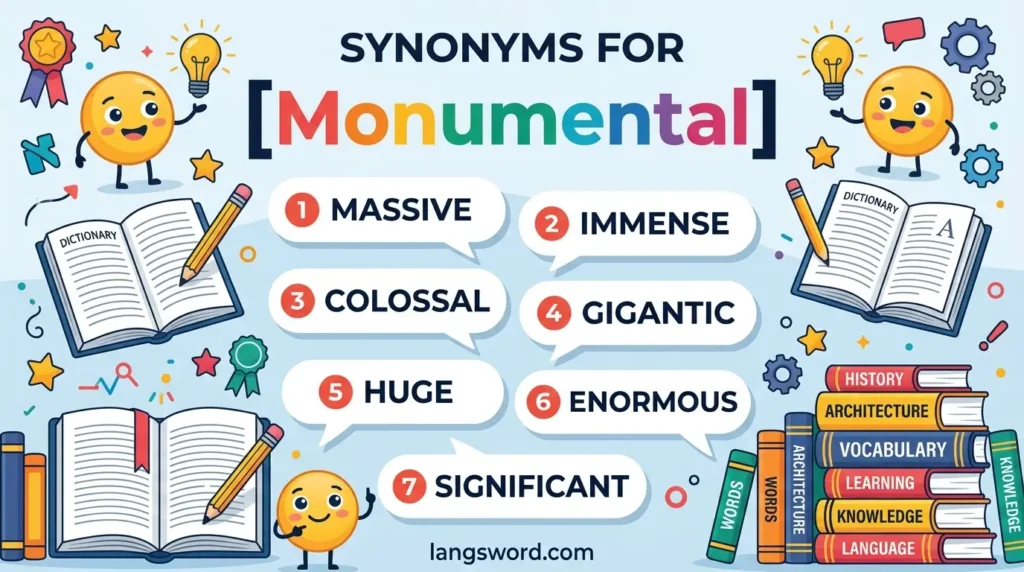

Monumental means very large, important, or impressive. Imagine a team finishing a huge project after years of hard work. Someone may call that achievement monumental because it is far more important than an ordinary success.
The word is common in news, academic writing, business, history, and everyday speech when people want to stress great size or importance. Learning synonyms for monumental helps English learners express ideas with more precision and avoid using the same word again and again.
It also helps content writers create clear and engaging text for different audiences. In this guide, we explain the meaning of monumental, its synonyms, examples, grammar, history, pronunciation, word formation, and semantic categories. These categories show how similar words can differ in meaning, tone, size, importance, and context.
Meaning of Monumental
Definition
Monumental (Adjective):
Very large, important, impressive, or significant, especially in a way that is remembered for a long time.
Examples
- The scientist made a monumental contribution to modern medicine.
- Building the bridge was a monumental task.
Connotative Meaning
Connotation: The feeling or idea that a word suggests beyond its basic meaning.
- Positive tone: It often suggests greatness, importance, achievement, or lasting value.
- Negative tone: In some contexts, it can suggest something excessively large, difficult, or serious.
- Neutral tone: It can simply describe something of very great size, scale, or importance.
Etymology
The word monumental comes from monument, which ultimately comes from Latin monumentum, meaning “a reminder,” “memorial,” or “something that preserves a memory.” The Latin word is related to monere, meaning “to remind” or “to warn.” English developed monument through French and Latin influence before forming the adjective monumental.
- Old English (450–1100): Monumental was not an Old English word. The concept of a memorial or lasting reminder existed, but the modern word had not yet entered English.
- Middle English (1100–1500): Monument entered English through French and Latin influence. It referred to a memorial, tomb, or structure that preserved a person’s memory.
- Modern English (1500–Present): Monumental developed as an adjective meaning “related to a monument.” It later gained the broader sense of something exceptionally large, important, or lasting.
Pronunciation (IPA)
- IPA: /ˌmɒn.jəˈmen.təl/
- Syllables: mon-u-men-tal
Affixation Pattern of Monumental
- Root: monument
- Prefix: None
- Suffix: -al
- Word formations:
- monument — noun: a structure or object that commemorates a person or event
- monumental — adjective: very large, important, or impressive
- monumentally — adverb: in a monumental or extremely significant way
30 Synonyms of Monumental With Meaning & Examples
1. Colossal (Adjective)
Meaning: Extremely large or great in size, degree, or importance.
Examples:
- The company faced a colossal challenge.
- They built a colossal statue near the city center.
2. Gigantic (Adjective)
Meaning: Extremely large in size.
Examples:
- A gigantic ship entered the harbor.
- The project required a gigantic amount of effort.
3. Huge (Adjective)
Meaning: Very large in size, amount, or degree.
Examples:
- The discovery had a huge impact.
- They made a huge improvement to the system.
4. Enormous (Adjective)
Meaning: Extremely large or great.
Examples:
- The team made an enormous contribution.
- An enormous crowd gathered outside.
5. Immense (Adjective)
Meaning: Extremely large or great in size, amount, or importance.
Examples:
- The project required immense patience.
- She showed immense courage during the crisis.
6. Tremendous (Adjective)
Meaning: Very great in size, strength, importance, or effect.
Examples:
- The new plan brought tremendous benefits.
- He made a tremendous effort to finish on time.
7. Vast (Adjective)
Meaning: Extremely large in area, amount, or range.
Examples:
- The country has vast natural resources.
- The project opened a vast range of possibilities.
8. Mammoth (Adjective)
Meaning: Extremely large, difficult, or demanding.
Examples:
- Writing the book was a mammoth task.
- The team completed a mammoth construction project.
9. Herculean (Adjective)
Meaning: Requiring extraordinary strength, effort, or courage.
Examples:
- Cleaning the damaged building was a Herculean task.
- She made a Herculean effort to meet the deadline.
10. Monumentous (Adjective)
Meaning: Very important or having a major effect.
Examples:
- The agreement was a monumentous event.
- The invention marked a monumentous change in the industry.
11. Momentous (Adjective)
Meaning: Very important and likely to have lasting effects.
Examples:
- The country faced a momentous decision.
- It was a momentous day in the company’s history.
12. Historic (Adjective)
Meaning: Important enough to be remembered as part of history.
Examples:
- The scientists made a historic discovery.
- The agreement was a historic achievement.
13. Epochal (Adjective)
Meaning: Important enough to mark a major period in history.
Examples:
- The invention had an epochal effect on communication.
- The event represented an epochal change.
14. Landmark (Adjective)
Meaning: Extremely important because it introduces a major change or development.
Examples:
- The court made a landmark decision.
- The study was a landmark piece of research.
15. Significant (Adjective)
Meaning: Important enough to deserve attention.
Examples:
- The research produced significant results.
- There was a significant change in public behavior.
16. Substantial (Adjective)
Meaning: Large in amount, size, or importance.
Examples:
- The project received substantial funding.
- They made substantial progress this year.
17. Major (Adjective)
Meaning: Very important, serious, or large compared with others.
Examples:
- The company announced a major change.
- The discovery became a major scientific breakthrough.
18. Important (Adjective)
Meaning: Having great value, influence, or effect.
Examples:
- This is an important step forward.
- Her research made an important contribution.
19. Profound (Adjective)
Meaning: Having a deep and powerful effect or meaning.
Examples:
- The experience had a profound effect on him.
- The book offers profound insights into human behavior.
20. Far-reaching (Adjective)
Meaning: Having effects that extend over a large area, group, or period.
Examples:
- The law had far-reaching effects.
- The invention brought far-reaching changes to society.
21. Transformative (Adjective)
Meaning: Causing a major change in something.
Examples:
- The program had a transformative effect on education.
- Technology can have a transformative impact on business.
22. Groundbreaking (Adjective)
Meaning: Completely new and likely to influence future developments.
Examples:
- The scientist published groundbreaking research.
- The company introduced a groundbreaking technology.
23. Revolutionary (Adjective)
Meaning: Causing a major and fundamental change.
Examples:
- The invention was revolutionary for its time.
- The treatment introduced a revolutionary approach to care.
24. Pivotal (Adjective)
Meaning: Extremely important because it strongly affects what happens next.
Examples:
- She played a pivotal role in the project.
- The meeting was a pivotal moment for the organization.
25. Influential (Adjective)
Meaning: Having a strong effect on people, ideas, or events.
Examples:
- He was an influential figure in modern literature.
- The book became highly influential among young writers.
26. Distinguished (Adjective)
Meaning: Respected and admired because of achievement or quality.
Examples:
- She had a distinguished career in science.
- The award recognized his distinguished service.
27. Grand (Adjective)
Meaning: Impressive in size, appearance, style, or ambition.
Examples:
- They created a grand plan for the new museum.
- The building has a grand entrance.
28. Majestic (Adjective)
Meaning: Very impressive, beautiful, or powerful in appearance.
Examples:
- The mountain looked majestic at sunrise.
- Visitors admired the building’s majestic design.
29. Impressive (Adjective)
Meaning: Causing admiration because of size, quality, skill, or achievement.
Examples:
- The athlete gave an impressive performance.
- The museum has an impressive collection.
30. Monumental-scale (Adjective)
Meaning: Extremely large in physical size or visual scale.
Examples:
- The artist created a monumental-scale sculpture.
- The exhibition featured monumental-scale paintings.
Prototype Meaning
The most typical meaning of monumental is something very large, highly important, and difficult to overlook. When people hear the word, they often imagine a huge monument, a historic achievement, a major decision, or a task that requires enormous effort.
The word can describe both physical size and abstract importance. For example, a monumental building may be physically huge, while a monumental achievement may be important because of its lasting impact.
Prototype Categorization
The 30 synonyms can be grouped by their strongest shared meaning:
- Extreme physical size: colossal, gigantic, huge, enormous, immense, vast, and mammoth focus mainly on great size or quantity.
- Great effort or difficulty: Herculean emphasizes an unusually difficult task that requires exceptional effort.
- Historical importance: momentous, historic, epochal, and landmark focus on events or decisions that may have lasting historical effects.
- Importance and effect: significant, substantial, major, important, profound, and far-reaching describe strong importance or influence.
- Major change: transformative, groundbreaking, and revolutionary suggest that something creates a major change or new direction.
- Critical influence: pivotal and influential focus on the power of a person, event, or decision to affect later results.
- Greatness and admiration: distinguished, grand, majestic, and impressive highlight quality, status, appearance, or admiration.
- Large artistic or physical scale: monumental-scale focuses specifically on unusually large physical dimensions.
This categorization helps writers choose a synonym based on meaning rather than simply replacing one word with another. For example, momentous works well for an important decision, while gigantic is better for physical size.
Antonyms of Monumental
1. Small (Adjective)
Meaning: Limited in physical size or amount.
2. Tiny (Adjective)
Meaning: Extremely small.
3. Minor (Adjective)
Meaning: Not very important or serious.
4. Insignificant (Adjective)
Meaning: Not important or meaningful.
5. Trivial (Adjective)
Meaning: Of very little importance or value.
6. Modest (Adjective)
Meaning: Not large, extreme, or impressive.
7. Ordinary (Adjective)
Meaning: Normal and not unusual or remarkable.
8. Negligible (Adjective)
Meaning: So small or unimportant that it can almost be ignored.
Short Questions and Answers
What does monumental mean?
Monumental means very large, important, impressive, or significant, especially when something has a lasting effect.
When should monumental be used?
Use monumental when you want to emphasize exceptional size, importance, difficulty, achievement, or lasting impact.
Is monumental positive or negative?
It is usually positive when describing a great achievement or important contribution. However, it can be neutral or negative when describing something extremely large, difficult, or serious.
How is it different from similar words?
Monumental can describe both physical size and great importance. Gigantic mainly describes size, while momentous mainly describes importance. Herculean focuses on difficulty and effort, and historic focuses on lasting historical importance.
Conclusion
Learning monumental and its synonyms can greatly improve English vocabulary. The word can describe something huge, important, impressive, difficult, or historically significant. Its synonyms give writers more precise choices.
For example, colossal highlights size, momentous highlights importance, Herculean highlights effort, and groundbreaking highlights new ideas. Using these words correctly can make writing more varied and help speakers express their thoughts with greater accuracy.
It also prevents repetition and makes descriptions stronger and clearer. English learners can build confidence by studying a few useful synonyms each day and using them in original sentences. Read, write, speak, and review new words regularly. With daily practice, choosing the right synonym becomes easier and more natural.