
You are on a trip to Mexico. The sun is going down over the sea. Your friend takes a photo, and you want to say it is beautiful. But how? In Spanish, there is not just one word for beautiful.
You may know bonita, but Spanish speakers use many more words. Each word fits a different thing. One word is best for a woman. One word is best for a sunset.
One word is soft, and one word is strong. When you learn more words, you can say just what you feel. In this article, you will learn 30 Spanish words for beautiful, with simple meanings and easy examples.
Meaning of Beautiful in Spanish
Definition
Beautiful (Adjective): Very pleasing to the eyes or the heart. In Spanish, there is no single word for beautiful. The word you pick depends on who or what you describe, and on how strong you want to sound.
Examples
- She said “¡Qué bonita!” when she saw the dress in the shop.
- He called the old town hermosa as the sun went down.
Connotative Meaning
- Positive tone: These words give warm praise. They show love, joy, and respect for a person, a place, or a thing.
- Negative tone: The words are almost never negative. But a word that is too strong can sound false if you do not mean it.
- Neutral tone: Soft words like bonita are plain, daily words. You can use them any time, with any person.
(Connotation: the feelings and ideas a word brings to mind, apart from its plain meaning.)
Etymology
- Old English (450–1100): The word beautiful did not exist in Old English. English speakers of that time used other words, like wlitig, for a fair and lovely look.
- Middle English (1100–1500): The word beauty came into English from Old French beaute, which came from Latin bellus, meaning “pretty.” In the 1400s, English speakers added the ending -ful to beauty, and the word beautiful was born.
- Modern English (1500–Present): Beautiful grew into the most common English word for great loveliness. Most Spanish words in this list come from Latin too. For example, hermosa comes from Latin formosus, which means “well-formed.”
Pronunciation
- Hermosa: ehr-MOH-sah — say it with the stress on “MOH.”
- Bonita: boh-NEE-tah — say it with the stress on “NEE.”
- Good news: Spanish words are said much as they are spelled. Each letter has one clear sound, so you can read new words out loud with ease.
Affixation Pattern of Beautiful
- Root: beauty (a noun, from Old French beaute, from Latin bellus, “pretty”)
- Prefix: None
- Suffix: -ful (an adjective suffix that means “full of”)
- Word formations:
- beauty (Noun)
- beautiful (Adjective)
- beautifully (Adverb)
- beautify (Verb)
- beautician (Noun)
30 Spanish Synonyms for Beautiful With Meaning & Examples
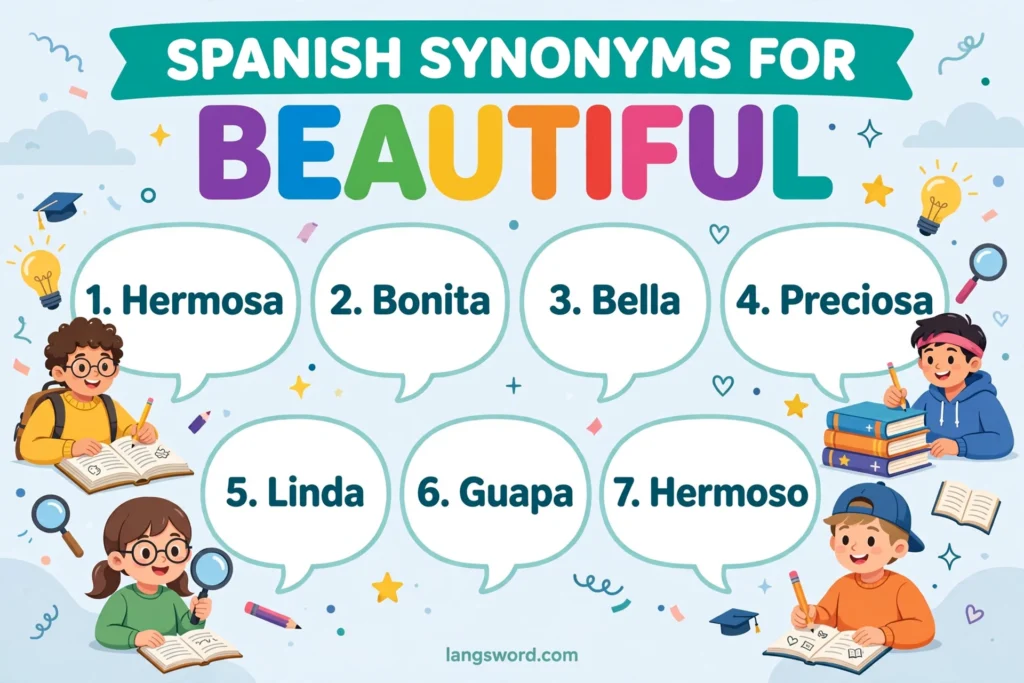
1. Hermosa (Adjective)
Meaning: A strong, warm word for a very beautiful woman, child, place, or thing; it is the feminine form.
Examples:
- La playa es hermosa. (The beach is beautiful.)
- Tu hija es hermosa. (Your daughter is beautiful.)
2. Hermoso (Adjective)
Meaning: The masculine form of hermosa; use it for a beautiful man, boy, day, or thing.
Examples:
- El jardín es hermoso. (The garden is beautiful.)
- Es un día hermoso. (It is a beautiful day.)
3. Bonita (Adjective)
Meaning: A soft, daily word that means pretty; use it for a woman, a girl, or a thing, in a kind and gentle way.
Examples:
- La casa es bonita. (The house is pretty.)
- Ella tiene una sonrisa bonita. (She has a pretty smile.)
4. Bonito (Adjective)
Meaning: The masculine form of bonita; use it when you call a man, a boy, or a thing pretty or nice-looking.
Examples:
- El perro es bonito. (The dog is pretty.)
- Qué sombrero tan bonito. (What a pretty hat.)
5. Bella (Adjective)
Meaning: A fine, slightly poetic word for a beautiful woman; it sounds elegant and is used in songs and poems.
Examples:
- Ella es una mujer bella. (She is a beautiful woman.)
- La bella ciudad duerme. (The beautiful city sleeps.)
6. Bello (Adjective)
Meaning: The masculine form of bella; an elegant word for a beautiful man, place, or work of art.
Examples:
- Es un bello lugar. (It is a beautiful place.)
- El poema es bello. (The poem is beautiful.)
7. Preciosa (Adjective)
Meaning: A warm word that means precious and lovely; mothers often use it for a dear child or a loved person.
Examples:
- Tu bebé es preciosa. (Your baby is precious.)
- La joya es preciosa. (The jewel is lovely.)
8. Precioso (Adjective)
Meaning: The masculine form of preciosa; use it for a lovely man, boy, or a fine, dear thing.
Examples:
- El anillo es precioso. (The ring is lovely.)
- Tu hijo es precioso. (Your son is precious.)
9. Linda (Adjective)
Meaning: A sweet word that means pretty or lovely; it is very common in Latin America for women, girls, and things.
Examples:
- La niña es muy linda. (The girl is very pretty.)
- Qué linda flor. (What a pretty flower.)
10. Lindo (Adjective)
Meaning: The masculine form of linda; use it for a pretty boy, man, place, or thing in Latin America.
Examples:
- El pueblo es lindo. (The town is pretty.)
- Tu gato es lindo. (Your cat is cute.)
11. Guapa (Adjective)
Meaning: A strong daily word in Spain for a good-looking woman; it can also mean brave or bold.
Examples:
- Ella es muy guapa. (She is very good-looking.)
- La actriz es guapa. (The actress is beautiful.)
12. Guapo (Adjective)
Meaning: The masculine form of guapa; the top word in Spain for a handsome man.
Examples:
- Él es un hombre guapo. (He is a handsome man.)
- El novio es guapo. (The groom is handsome.)
13. Atractiva (Adjective)
Meaning: A word that means attractive; it says a woman draws the eye and is pleasant to look at.
Examples:
- Ella es una mujer atractiva. (She is an attractive woman.)
- Su voz es atractiva. (Her voice is attractive.)
14. Atractivo (Adjective)
Meaning: The masculine form of atractiva; use it for an attractive man or a thing that draws interest.
Examples:
- Él es un joven atractivo. (He is an attractive young man.)
- El precio es atractivo. (The price is attractive.)
15. Encantadora (Adjective)
Meaning: A word that means charming and lovely; it joins good looks with a sweet and kind manner.
Examples:
- Ella es encantadora. (She is charming.)
- La abuela es encantadora. (The grandmother is lovely.)
16. Encantador (Adjective)
Meaning: The masculine form of encantadora; use it for a charming man, boy, or place.
Examples:
- El niño es encantador. (The boy is charming.)
- Es un lugar encantador. (It is a charming place.)
17. Radiante (Adjective)
Meaning: A word for a person who glows with joy and health; it is the same for men and women.
Examples:
- La novia está radiante. (The bride is radiant.)
- Él se ve radiante hoy. (He looks radiant today.)
18. Deslumbrante (Adjective)
Meaning: A strong word that means dazzling; use it when beauty is bright and hard to miss, for men and women alike.
Examples:
- Ella se ve deslumbrante. (She looks dazzling.)
- La fiesta fue deslumbrante. (The party was dazzling.)
19. Espléndida (Adjective)
Meaning: A grand word that means splendid; use it for a woman, a view, or a thing of great beauty.
Examples:
- La vista es espléndida. (The view is splendid.)
- Ella tiene una salud espléndida. (She has splendid health.)
20. Magnífica (Adjective)
Meaning: A formal word that means magnificent; use it for a place, a work of art, or a thing of top quality.
Examples:
- La catedral es magnífica. (The cathedral is magnificent.)
- Es una obra magnífica. (It is a magnificent work.)
21. Divina (Adjective)
Meaning: A word that means divine, like a gift from heaven; young people use it to praise a woman or a fine thing.
Examples:
- Ella se ve divina. (She looks divine.)
- La comida está divina. (The food is divine.)
22. Divino (Adjective)
Meaning: The masculine form of divina; use it for a man or a thing that seems perfect, like a gift from heaven.
Examples:
- El postre es divino. (The dessert is divine.)
- Él tiene un talento divino. (He has a divine talent.)
23. Agraciada (Adjective)
Meaning: A polite, soft word for a woman with grace and good looks; it is gentle and a bit formal.
Examples:
- Ella es una joven agraciada. (She is a graceful young woman.)
- La cantante es agraciada. (The singer is graceful and lovely.)
24. Mona (Adjective)
Meaning: A cute, friendly word used a lot in Spain for a pretty girl or a sweet, cute thing.
Examples:
- La niña es muy mona. (The girl is very cute.)
- Qué mona es tu casa. (How cute your house is.)
25. Chula (Adjective)
Meaning: A fun, casual word in Mexico for a pretty woman or a cool, cute thing; it is warm and playful.
Examples:
- Ella es muy chula. (She is very pretty.)
- Qué chula es tu blusa. (How pretty your blouse is.)
26. Graciosa (Adjective)
Meaning: A gentle word that means graceful and pretty; it praises a woman or girl who moves and acts with charm.
Examples:
- La bailarina es graciosa. (The dancer is graceful.)
- Ella tiene una risa graciosa. (She has a pretty laugh.)
27. Bellísima (Adjective)
Meaning: The strongest form of bella; it means most beautiful, and it is used for a woman, a city, or a grand view.
Examples:
- La ciudad es bellísima. (The city is most beautiful.)
- Ella es bellísima. (She is most beautiful.)
28. Hermosísima (Adjective)
Meaning: The strongest form of hermosa; it means extremely beautiful and gives top praise to a woman or a place.
Examples:
- La playa es hermosísima. (The beach is extremely beautiful.)
- Tu madre es hermosísima. (Your mother is extremely beautiful.)
29. Guapísima (Adjective)
Meaning: The strongest form of guapa; in Spain, it means very, very good-looking, and it is full of warmth.
Examples:
- Ella está guapísima hoy. (She looks gorgeous today.)
- La novia está guapísima. (The bride looks gorgeous.)
30. Espectacular (Adjective)
Meaning: A bright, strong word that means spectacular; use it for a person, a view, or an event that takes your breath away.
Examples:
- La vista es espectacular. (The view is spectacular.)
- Ella se ve espectacular. (She looks spectacular.)
Prototype Meaning
When people hear the word beautiful, they first picture a face that makes them stop and smile. They may think of a sunset over the sea, or of a mother with her child in soft light.
Spanish does not keep all this beauty in one word. It splits it into soft words and strong words. Bonita is a soft pat on the back. Hermosa is a warm hug. Bellísima is a loud cheer. Each word paints the same bright picture, but with a bigger or smaller brush.
Prototype Categorization
- For women: Hermosa, Bonita, Bella, Preciosa, Linda, Guapa, Agraciada, Mona, Chula, Atractiva, Encantadora, Graciosa use these when you praise a woman or a girl and want the word to match her with the feminine form.
- For men: Hermoso, Bonito, Bello, Precioso, Lindo, Guapo, Atractivo, Encantador, Divino use these when you praise a man or a boy and need the masculine form.
- For places and things: Bonita, Hermosa, Linda, Magnífica, Espléndida, Espectacular — use these for a town, a house, a view, a dress, or any fine thing.
- Soft and pretty words: Bonita, Linda, Mona, Chula, Preciosa — use these for light, sweet praise in daily talk with friends and family.
- Strong and gorgeous words: Hermosa, Deslumbrante, Espectacular, Divina, Radiante — use these when the beauty is great and you want your praise to shine.
- Top praise words: Bellísima, Hermosísima, Guapísima — use these when “beautiful” is not enough and you want to give the highest praise of all.
These groups help learners in a simple way. First, pick the group: is it a woman, a man, a place, or a thing? Next, pick the strength: soft praise or strong praise? With these two steps, you will choose the right word each time, and your Spanish will sound natural and kind.
Antonyms (Spanish Opposites of Beautiful)
Fea (Adjective)
Ugly; the plain opposite of beautiful, for a woman or a feminine thing. It is a strong word, so use it with care.
Feo (Adjective)
Ugly; the masculine form of fea, for a man or a masculine thing.
Horrible (Adjective)
Horrible or very ugly; a strong word for a person, place, or thing that looks very bad.
Desagradable (Adjective)
Unpleasant; it is used for a look, a smell, or a feel that you do not like.
Ordinaria (Adjective)
Plain or common-looking; it says a woman or thing has no special beauty.
Sin Gracia (Adjective)
Without grace or charm; it is a soft way to say someone lacks beauty and charm.
Desaliñada (Adjective)
Untidy or messy in dress and hair; it speaks of a rough, unkept look, not true ugliness.
Short Questions and Answers
What does beautiful mean in Spanish?
There is no one word. Spanish has many words for beautiful, like hermosa, bonita, bella, and guapa. Each word fits a person, a place, or a thing in its own way.
When should these Spanish words be used?
Use them when you praise a person, a photo, a town, a dress, or a view. Pick the feminine form for women and feminine things, and the masculine form for men and masculine things.
Is beautiful positive or negative?
It is positive. All these words give praise and show warm feelings. A word that is too strong may sound false, but the words themselves are kind and good.
How are these words different from each other?
They differ in strength and in use. Bonita is soft and daily. Hermosa is strong and warm. Guapa is the top word in Spain. Bellísima gives the highest praise of all.
Conclusion
Spanish gives you many ways to say beautiful, and each word has its own place. Soft words like bonita and linda are best for daily praise.
Strong words like hermosa, deslumbrante, and espectacular fit great beauty. Sweet words like preciosa and chula add warmth and fun. And when you want top praise, bellísima and hermosísima say it all.
The key is to match the word to the person, the place, or the thing, and to pick the right strength. Keep this list near you, try one new word each day, and soon your praise in Spanish will sound rich, warm, and true.