
Have you ever had a friend who only talks about himself? He tells you about his day, his wins, and his problems. But he never asks how you are. You feel unseen and unheard.
Such a person is called self-centered. A self-centered person thinks only about himself and his own needs. He gives little care to the feelings of others. Words matter because not all such people are the same. Some are just a bit selfish. Some are deeply proud and full of self-love.
The right synonym helps you say the exact idea. In this article, you will learn the meaning of self-centered, its history, its sound, and 30 simple synonyms with clear meanings and easy examples.
Meaning of Self Centered
Definition
Self-Centered (Adjective): Thinking only about yourself and your own needs, with little care for the feelings of others. The word is written with a hyphen: self-centered.
Examples
- He is so self-centered that he never asks about my day.
- A self-centered player does not pass the ball to his team.
Connotative Meaning
- Positive tone: It is almost never positive. At most, it can hint that a person knows his own worth.
- Negative tone: It sounds rude and cold. It paints a person who does not care about anyone else.
- Neutral tone: In books on the mind, it is a plain word for a mind fixed on the self.
(Connotation: the feelings and ideas a word brings to mind, apart from its plain meaning.)
Etymology
- Old English (450–1100): The word “self” is a true Old English word, written self or seolf in that time. It meant the person himself. But the full word “self-centered” did not exist yet.
- Middle English (1100–1500): The word “center” came into English in this period. It came from Latin centrum, through French. It meant the middle point of a circle.
- Modern English (1500–Present): English speakers joined the two words in the 1600s and made the compound “self-centered.” It named a person whose thoughts turn around himself, like a circle around its center point.
Pronunciation (IPA)
- IPA: /ˌself ˈsentərd/
- Syllables: self · cen · tered (3 syllables)
Affixation Pattern of Self Centered
- Root: center (from Latin centrum, meaning the middle point)
- Prefix: self- (a prefix that points back to the person himself)
- Suffix: -ed (an ending that means “having the quality of”)
- Word formations:
- self-centeredness (Noun)
- self-centeredly (Adverb)
- self-centred (Adjective, British spelling)
- center (Noun)
- centered (Adjective)
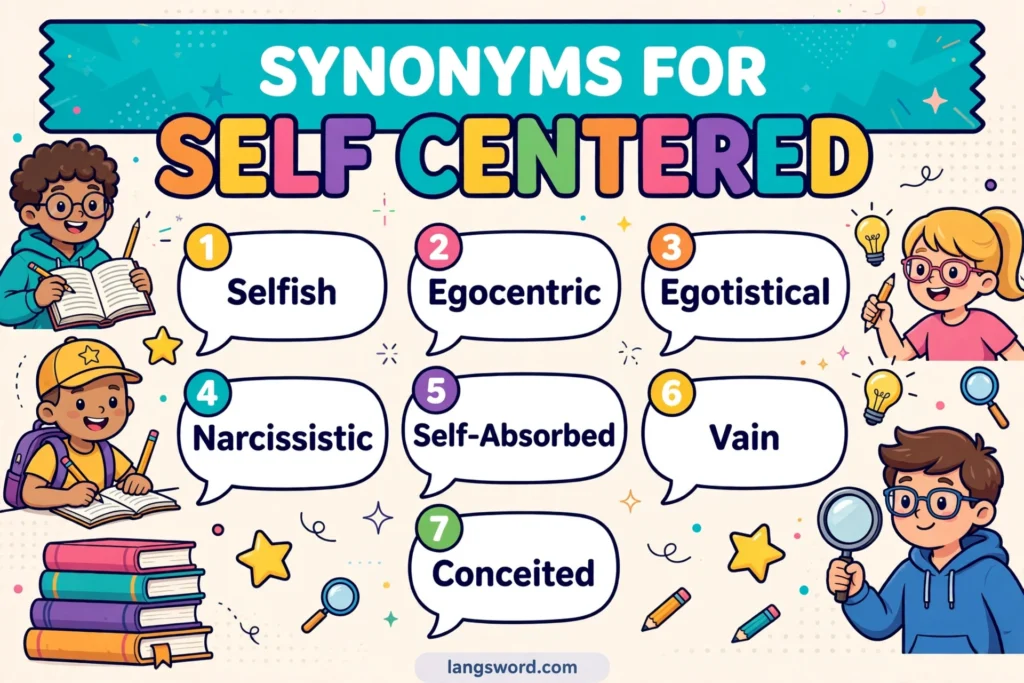
30 Synonyms of Self Centered With Meaning & Examples
1. Selfish (Adjective)
Meaning: Caring only about your own needs and wants, not about others. It is the most common word of this group.
Examples:
- The selfish boy ate all the cake himself.
- Do not be selfish; share your toys with your sister.
2. Egocentric (Adjective)
Meaning: Seeing the world only from your own side, as if you are the center of all things.
Examples:
- His egocentric view made group work very hard.
- An egocentric child thinks the moon follows her car.
3. Egotistical (Adjective)
Meaning: Full of talk and pride about yourself and your own worth. It is stronger than self-centered.
Examples:
- The egotistical singer praised himself all night.
- No one likes an egotistical boss who takes all the credit.
4. Egoistic (Adjective)
Meaning: Thinking of your own good first in all you do; close in sense to egocentric, but about acts more than views.
Examples:
- His egoistic choice hurt the whole team.
- An egoistic man asks, “What do I gain?” before he helps.
5. Narcissistic (Adjective)
Meaning: In love with yourself, your looks, and your image. It is a strong word, taken from the old tale of Narcissus, a youth who fell in love with his own face in the water.
Examples:
- The narcissistic actor checked his face in every mirror.
- Her narcissistic posts showed only her own photos.
6. Self-Absorbed (Adjective)
Meaning: So deep in your own thoughts that you do not see or hear others around you.
Examples:
- He was too self-absorbed to note her sad face.
- A self-absorbed writer forgets his readers.
7. Self-Obsessed (Adjective)
Meaning: Unable to stop thinking about yourself. It is stronger than self-absorbed.
Examples:
- The self-obsessed star talked of fame day and night.
- She is self-obsessed with her looks and her clothes.
8. Self-Involved (Adjective)
Meaning: Wrapped up in your own life and problems, with no room for others.
Examples:
- He is too self-involved to help his old parents.
- A self-involved teen may ignore her friends for weeks.
9. Self-Focused (Adjective)
Meaning: With your mind set on your own goals and needs. It is a soft word, close to neutral.
Examples:
- The self-focused runner trained alone each dawn.
- A self-focused student may miss the needs of his group.
10. Self-Preoccupied (Adjective)
Meaning: With your mind full of your own worries and plans, so others feel left out.
Examples:
- The self-preoccupied man did not hear the question.
- She was self-preoccupied during the whole trip.
11. Self-Seeking (Adjective)
Meaning: Always hunting for your own gain or praise in every act.
Examples:
- The self-seeking officer took gifts for each favor.
- Voters dislike self-seeking leaders.
12. Self-Serving (Adjective)
Meaning: Done only to help yourself, even if you claim it helps others.
Examples:
- His self-serving gift was really an ad for his shop.
- A self-serving excuse fools no one for long.
13. Self-Interested (Adjective)
Meaning: Guided by your own gain. It is a mild word, often used in talks on money and trade.
Examples:
- The self-interested seller raised the price at once.
- Man is self-interested, yet he can still be fair.
14. Self-Indulgent (Adjective)
Meaning: Giving yourself every pleasure you want, with no self-control.
Examples:
- The self-indulgent king spent gold on feasts each week.
- A self-indulgent guest ordered the costliest dish.
15. Self-Regarding (Adjective)
Meaning: Thinking of yourself and your own name first. It is a formal word, used in books.
Examples:
- The self-regarding poet wrote only of his own fame.
- A self-regarding act may look kind but seeks praise.
16. Self-Consumed (Adjective)
Meaning: Fully taken up by your own thoughts and needs, with nothing left for others. It is a strong word.
Examples:
- Grief made him self-consumed for a time.
- A self-consumed boss drains the joy of his team.
17. Vain (Adjective)
Meaning: Too proud of your looks or skills. It is most often about pride in how you look.
Examples:
- The vain girl spent an hour on her hair.
- He is vain about his fine clothes.
18. Conceited (Adjective)
Meaning: Too proud of your looks, mind, or skills, and sure you are better than others.
Examples:
- The conceited boy bragged about his marks all day.
- A conceited singer will not take advice.
19. Self-Important (Adjective)
Meaning: Acting as if you are of great worth and rank, more than you truly are.
Examples:
- The self-important guest demanded the best seat.
- His self-important tone annoyed the whole office.
20. Bigheaded (Adjective)
Meaning: Sure that you are great and clever, in a proud way. It is an informal word, used in daily talk.
Examples:
- Do not get bigheaded just because you won one game.
- The bigheaded player stopped training hard.
21. Arrogant (Adjective)
Meaning: Proud and rude, sure that you are above others. It is stronger and harsher than self-centered.
Examples:
- The arrogant man spoke down to the waiter.
- An arrogant leader will not hear the truth.
22. Haughty (Adjective)
Meaning: Proud in a way that looks down on others as low or small.
Examples:
- She gave a haughty look and walked past us.
- The haughty queen seldom smiled at her maids.
23. Pompous (Adjective)
Meaning: Full of grand talk and show, as if you are a person of high rank.
Examples:
- The pompous guest used big words to seem wise.
- His pompous speech bored the whole hall.
24. Smug (Adjective)
Meaning: Too pleased with yourself, in a way that annoys others.
Examples:
- He gave a smug smile when others failed the test.
- Her smug tone made her friends turn away.
25. Self-Satisfied (Adjective)
Meaning: Fully pleased with yourself, with no wish to grow or change.
Examples:
- The self-satisfied cat sat in the sun all day — and the man was no different.
- A self-satisfied worker stops learning new skills.
26. Self-Admiring (Adjective)
Meaning: Full of praise and love for yourself and your own acts.
Examples:
- The self-admiring poet read his own poems aloud each night.
- She posed in a self-admiring way before the glass.
27. Egomaniacal (Adjective)
Meaning: Mad with love of self and power; a very strong word for extreme self-focus.
Examples:
- The egomaniacal ruler built statues of himself in each town.
- An egomaniacal boss treats the firm as his own toy.
28. Inconsiderate (Adjective)
Meaning: Not thinking of the feelings or needs of others. It is a mild word, softer than self-centered.
Examples:
- It was inconsiderate to play loud music at night.
- An inconsiderate guest ate the last slice without asking.
29. Greedy (Adjective)
Meaning: Always wanting more food, money, or things for yourself.
Examples:
- The greedy man took both shares of the land.
- A greedy child grabs all the sweets at once.
30. Self-Righteous (Adjective)
Meaning: Sure that you are always right and good, and others are wrong. It is about moral pride.
Examples:
- His self-righteous talk made him judge each small fault.
- A self-righteous tone can spoil a good point.
Prototype Meaning
When people hear the word self-centered, they first picture a person at the center of a circle. All eyes, all talk, and all plans turn around him. He speaks of his own day, his own pain, and his own joy. The needs of others sit far outside the circle. This picture of a man who is the center of his own world is the heart of the word.
Prototype Categorization
- Everyday selfish words: Selfish, Inconsiderate, Greedy, Self-Interested — use these in daily talk for common acts of not sharing or not caring.
- Mind fixed on self words: Egocentric, Egoistic, Self-Absorbed, Self-Involved, Self-Focused, Self-Preoccupied, Self-Obsessed, Self-Consumed, Self-Regarding — use these when a person’s thoughts never leave himself.
- Pride and looks words: Vain, Conceited, Self-Admiring, Self-Satisfied, Smug, Bigheaded — use these when pride is about looks, skill, or self-praise.
- Proud and superior words: Arrogant, Haughty, Pompous, Self-Important, Self-Righteous — use these when a person looks down on others.
- Strong and extreme words: Narcissistic, Egotistical, Egomaniacal — use these for the deepest and most extreme self-love.
- Acts for own gain words: Self-Seeking, Self-Serving, Self-Indulgent — use these when a person acts only for his own gain or pleasure.
These groups help writers pick the exact word for each person. A child who will not share is selfish. A proud queen is haughty. A ruler lost in self-love is egomaniacal. The right group keeps your meaning sharp and clear.
Antonyms of Self Centered
Selfless (Adjective)
Thinking of others first, with no thought of your own gain.
Generous (Adjective)
Happy to give your time, money, or things to others.
Caring (Adjective)
Full of care for the feelings and needs of others.
Thoughtful (Adjective)
Kind and careful about what others feel and need.
Humble (Adjective)
Not proud; aware of your own faults and limits.
Altruistic (Adjective)
Living for the good of others, even at cost to yourself.
Modest (Adjective)
Quiet about your own worth and worth of your work; not eager for praise.
Short Questions and Answers
What does self centered mean?
Self-centered means thinking only about yourself and your own needs. A self-centered person gives little care to the feelings of others. The word is written with a hyphen: self-centered.
When should self centered be used?
Use self-centered when you describe a person who always puts himself first. It fits daily talk, stories, and lessons about character. For formal writing, words like egocentric may fit better.
Is self centered positive or negative?
It is negative. It names a fault in a person’s character. It almost never praises a person, though mild words like self-focused can sound softer.
How is it different from similar words?
Selfish is about not sharing things or help. Vain and conceited are about pride in looks or skill. Narcissistic is a much stronger word for deep self-love. Self-centered is the broad word for a mind fixed on the self.
Conclusion
A self-centered person sees himself at the center of all things. But not all such people are the same. Some are just selfish in small ways. Some are proud, vain, or deeply lost in self-love.
The 30 synonyms in this guide help you name each shade with care. Soft words like inconsiderate fit small faults. Strong words like narcissistic fit deep self-love. Learning these words makes your English rich and exact.
You can describe people with truth and skill. So keep learning, one word at a time. Read the examples, say the words aloud, and use them in your own lines each day.