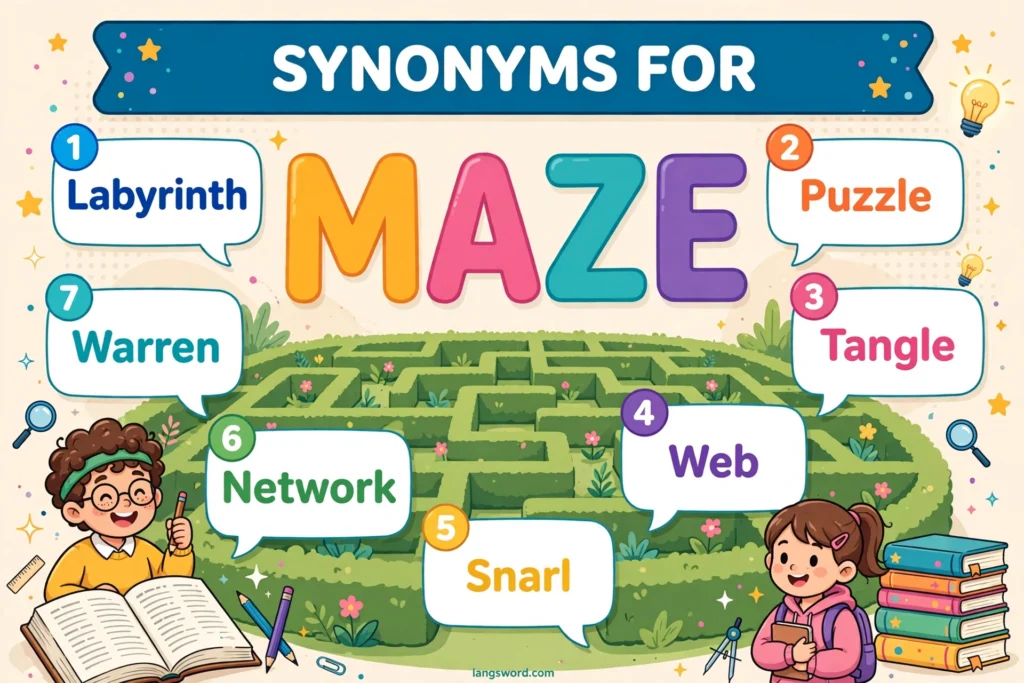

A maze is a network of paths and walls where you can easily lose your way. Picture this: you are at a fair, and you walk into a tall garden maze with green hedges on both sides. You turn left, then right, then left again. Soon, every path looks the same, and you cannot find the way out.
That lost and puzzled feeling is the heart of the word maze. We also use the word in a wider way, for any tangled or confusing thing, like a maze of rules or a maze of small streets. Learning synonyms for maze helps you pick the best word for each job. Some words fit a real path puzzle. Some fit a messy tangle.
Some fit a confused mind. In this article, you will learn the meaning of maze, its history, its sound, its word parts, and 30 synonyms with meanings and examples, plus word groups, antonyms, and short answers to common questions.
Meaning of Maze
Definition
Maze (Noun): A network of paths and walls where it is hard to find the way out. In a wider sense, it is anything tangled and confusing, like a maze of rules.
Examples
- The children got lost in the garden maze.
- The old town is a maze of small streets.
Connotative Meaning
- Positive tone: It can feel fun and full of adventure, like a game or a puzzle to solve.
- Negative tone: It can feel stressful and scary, like being lost with no way out.
- Neutral tone: In gardens, parks, and maps, it is a plain word for a path puzzle with no good or bad feeling.
(Connotation: the feelings and ideas a word brings to mind, apart from its plain meaning.)
Etymology
- Old English (450–1100): The root of the word is the Old English verb amasian, which meant “to bewilder” or “to confuse.” It is the same root that gives us the word “amaze.”
- Middle English (1100–1500): The noun mase appeared in this period. It meant a delirium, a wild confusion, or a state of being lost in the mind.
- Modern English (1500–Present): In the 1500s, the word grew its famous sense: a network of paths and walls that confuses the walker. From there, people began to use “maze” for any tangled, confusing thing.
Pronunciation (IPA)
- IPA: /meɪz/
- Syllables: maze (1 syllable)
Affixation Pattern of Maze
- Root: maze (from the Old English verb amasian, “to bewilder”)
- Prefix: None
- Suffix: None in the base word
- Word formations:
- mazes (Noun, plural)
- mazed (Adjective — confused or bewildered)
- maze-like (Adjective — like a maze, full of turns)
- mazey / mazy (Adjective — winding and confusing)
30 Synonyms of Maze With Meaning & Examples
1. Labyrinth (Noun)
Meaning: A maze of paths, often old and famous; it is the closest and most classic word for a maze.
Examples:
- The king built a labyrinth under his palace.
- We walked for an hour in the stone labyrinth.
2. Tangle (Noun)
Meaning: A messy knot of things twisted together, like wires, hair, or lies.
Examples:
- The wires behind the desk were a tangle.
- His story was a tangle of lies.
3. Web (Noun)
Meaning: A net of threads or links spread out in all ways; often used for a trap or a set of joined things.
Examples:
- The spider sat in the middle of its web.
- The city is a web of roads and rail lines.
4. Puzzle (Noun)
Meaning: A game or problem that is hard to solve; a close cousin, since it names the riddle or game, not the paths.
Examples:
- This puzzle has a thousand small pieces.
- The map was a puzzle no one could read.
5. Snarl (Noun)
Meaning: A twisted mess, like traffic or thread, that is hard to undo.
Examples:
- Traffic was in a snarl near the bridge.
- The rope fell into a snarl on the floor.
6. Network (Noun)
Meaning: A large set of joined paths, lines, or people; it can sound planned, not messy.
Examples:
- A network of tunnels runs under the city.
- The cave has a network of dark halls.
7. Warren (Noun)
Meaning: A set of burrows where rabbits live; by extension, a building or area full of small, tight paths and rooms.
Examples:
- Rabbits ran in and out of the warren.
- The old offices were a warren of tiny rooms.
8. Jungle (Noun)
Meaning: Thick, wild land full of plants; in a wider sense, any wild, lawless, hard-to-cross place.
Examples:
- The path cut through a dark jungle.
- The market was a jungle of stalls and carts.
9. Knot (Noun)
Meaning: A tight twist in a rope or string; also a hard problem that is not easy to undo.
Examples:
- She could not undo the knot in the cord.
- The talks ended in a knot of old anger.
10. Complexity (Noun)
Meaning: The state of having many parts joined in a hard way; a plain, formal word for a hard set-up.
Examples:
- The complexity of the rules slowed the work.
- No one liked the complexity of the form.
11. Intricacy (Noun)
Meaning: Fine, small details woven together in a complex way; it often praises skill and craft.
Examples:
- We admired the intricacy of the old clock.
- The lace showed great intricacy.
12. Convolution (Noun)
Meaning: A twist, fold, or coil; used for a winding shape or a hard, twisted idea.
Examples:
- The road had many convolutions on the hill.
- His plan had one convolution too many.
13. Meander (Noun)
Meaning: A winding path or bend, often of a river; as a noun it names the curve itself.
Examples:
- The river made a wide meander near the farm.
- Each meander of the trail slowed the walk.
14. Rat’s Nest (Noun)
Meaning: A very messy tangle, like wires or paper in a wild heap; an informal phrase.
Examples:
- The drawer was a rat’s nest of old cables.
- Her desk was a rat’s nest of notes and pens.
15. Honeycomb (Noun)
Meaning: The wax home of bees, full of small cells; used for any place cut into many small parts or holes.
Examples:
- Bees filled the honeycomb with gold honey.
- The cliff was a honeycomb of small caves.
16. Catacomb (Noun)
Meaning: An underground set of tunnels and rooms, often old burial places; a cousin word for tunnel mazes.
Examples:
- Tourists walked through the dark catacomb.
- A catacomb of halls lay under the church.
17. Grid (Noun)
Meaning: A set of straight lines that cross to form squares; for streets it can feel too neat to be a true maze, but a huge grid can still confuse.
Examples:
- The new town was built on a grid of roads.
- She marked each grid square on the map.
18. Mesh (Noun)
Meaning: A net of wires or threads with small holes; a fine, close web.
Examples:
- The fence was made of steel mesh.
- A mesh of vines covered the old wall.
19. Thicket (Noun)
Meaning: A dense group of bushes and small trees that is hard to walk through.
Examples:
- The deer hid in a thicket near the stream.
- We pushed through a thorny thicket.
20. Wilderness (Noun)
Meaning: Wild land with no paths or people; in a wider sense, a confusing mass of things.
Examples:
- They were lost in the wilderness for days.
- His inbox was a wilderness of unread mail.
21. Confusion (Noun)
Meaning: A state of not knowing or not understanding; the feeling a maze gives, rather than the paths themselves.
Examples:
- There was confusion at the gate.
- The new rules caused great confusion.
22. Perplexity (Noun)
Meaning: A state of being fully puzzled; a formal word for deep confusion.
Examples:
- He stared at the form in perplexity.
- Her answer only added to our perplexity.
23. Muddle (Noun)
Meaning: A messy, mixed-up state with no clear order.
Examples:
- The papers were in a muddle on the desk.
- The plan fell into a muddle at the last step.
24. Jumble (Noun)
Meaning: A mixed heap of things with no order at all.
Examples:
- The box held a jumble of old toys.
- His words came out in a jumble.
25. Hodgepodge (Noun)
Meaning: A wild mix of unlike things thrown together; a fun, informal word.
Examples:
- The meal was a hodgepodge of leftovers.
- The show was a hodgepodge of songs and jokes.
26. Morass (Noun)
Meaning: Wet, soft ground that traps your feet; in a wider sense, a bad tangle you cannot escape.
Examples:
- The cart sank into the morass.
- The case became a morass of forms and fees.
27. Quagmire (Noun)
Meaning: Soft, sinking mud; also a hard spot or problem that pulls you deeper the more you fight.
Examples:
- The cows got stuck in the quagmire.
- The talks sank into a quagmire of blame.
28. Labyrinthine System (Noun)
Meaning: A big, maze-like set-up of parts, rules, or offices; a formal phrase for an official maze.
Examples:
- A labyrinthine system of rules governs the port.
- She got lost in the labyrinthine system of forms.
29. Twist (Noun)
Meaning: A bend or turn in a path, rope, or story; a single curve, not the whole maze.
Examples:
- The path made a sharp twist near the well.
- The story had a twist at the end.
30. Winding Path (Noun)
Meaning: A path that turns and curves again and again instead of going straight.
Examples:
- A winding path led up the hill.
- We followed the winding path by the river.
Prototype Meaning
When people hear the word maze, they first picture a garden of tall green hedges. The paths split left and right at every step. Each turn looks the same as the last. You walk, you guess, and you hit a dead end. Then you turn back and try again. At the center there may be a bench or a small fountain, and the way out feels far away. This picture of green walls, false turns, and a hidden exit is the heart of the word.
Prototype Categorization
- Real path mazes: Labyrinth, Honeycomb, Catacomb, Warren, Winding Path, Twist, Meander — use these for true places made of paths, tunnels, and turns.
- Tangles and webs: Tangle, Web, Snarl, Knot, Mesh, Rat’s Nest — use these for things twisted or netted together, like wires, rope, or thread.
- Joined systems: Network, Grid, Labyrinthine System, Complexity, Intricacy, Convolution — use these for big sets of joined parts, roads, or rules.
- Wild and messy places: Jungle, Thicket, Wilderness, Jumble, Hodgepodge, Muddle — use these for thick, wild growth or a heap with no order.
- Traps and confused minds: Morass, Quagmire, Puzzle, Confusion, Perplexity — use these for bad spots that trap you, or for the puzzled feeling itself.
These groups help writers pick the exact word fast. A garden scene needs a path word. A desk full of wires needs a tangle word. A fight with office rules needs a system word. The right group gives the right picture every time.
Antonyms of Maze
Straight Path (Noun)
A path that goes in one line with no turns, so you cannot get lost.
Open Road (Noun)
A wide, clear road with a plain view ahead.
Direct Route (Noun)
The shortest and clearest way from one place to another.
Clarity (Noun)
The state of being clear and easy to understand.
Order (Noun)
A neat set-up where each thing has its place.
Simplicity (Noun)
The state of being simple, with few parts and no confusion.
Open Plain (Noun)
Flat, open land where you can see far in every direction.
Short Questions and Answers
What does maze mean?
A maze is a network of paths and walls where it is hard to find the way out. We also use it for anything tangled and confusing, like a maze of rules or a maze of streets.
When should maze be used?
Use maze for garden path puzzles, hedge puzzles at fairs, and corn mazes in the fall. Use it in a wider way for old towns, office rules, or any hard, tangled set-up.
Is maze positive or negative?
It can be both. It sounds positive and fun for a game or a garden puzzle. It sounds negative when it means stress, delay, or being truly lost. In maps and garden talk, it is neutral.
How is it different from similar words?
A maze is made to confuse, with many false turns. A labyrinth in old stories often has one winding path to the center. A puzzle is a game or riddle. A tangle is a mess of things, not paths.
Conclusion
A maze is more than a garden game. It is the picture of every path that twists, every rule set that confuses, and every mess that hides the way out. The 30 synonyms in this guide give you a word for each kind of tangle. Labyrinth fits an old path puzzle.
Tangle and snarl fit messy wires and ropes. Morass and quagmire fit traps that pull you down. Confusion and perplexity name the feeling in your mind. Word groups help you choose with care.
Learning these words makes your writing clear, rich, and exact. Keep this list near you. Use one new word each day, and your English will find its way out of any maze.