
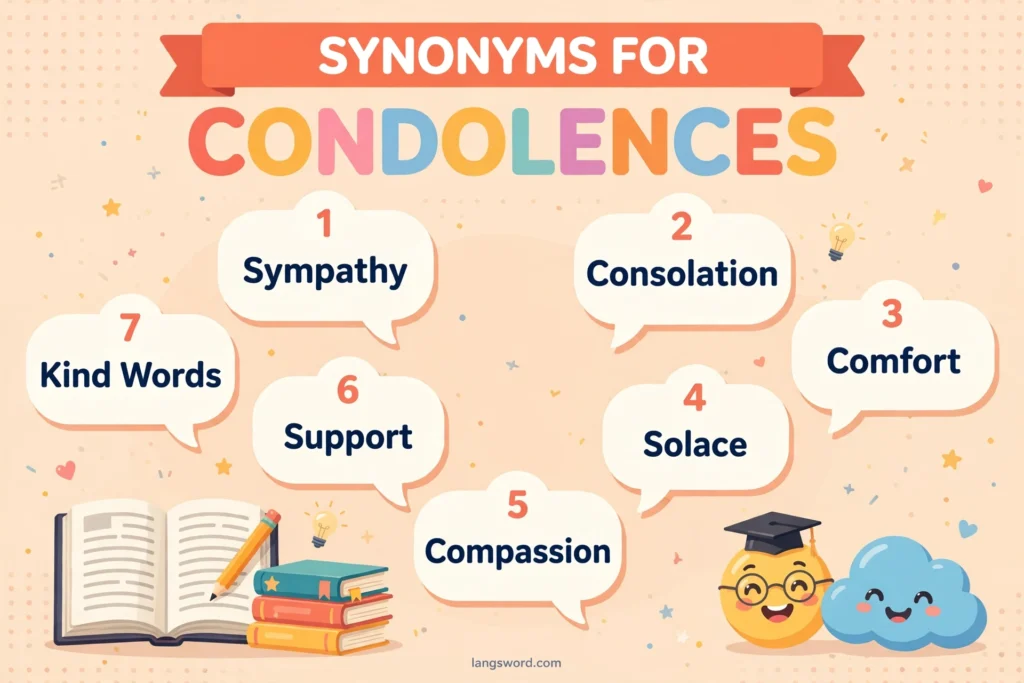

When a friend loses a loved one, the heart feels heavy. We want to help, but the right words are hard to find. At such a time, people share condolences.
Condolences are kind words of sympathy and comfort for a person in grief. A simple card, a soft hug, or a short message can give real strength. Learning synonyms for condolences helps you speak with care. You can choose soft words that fit the moment and the person.
In this article, you will learn the meaning of condolences, its history and sound, and 30 kind synonyms with meanings, examples, and easy word groups.
Meaning of Condolences
Definition
Condolences (Noun, plural): Words or messages of sympathy and comfort given to a person who has lost a loved one.
Examples
- We sent our condolences to the family after their loss.
- Please accept my condolences for the loss of your father.
Connotative Meaning
- Positive tone: It feels warm, loving, and kind. It tells a sad person that others care and stand with them.
- Negative tone: It can feel cold or empty if the words are said without true feeling, just as a duty.
- Neutral tone: In cards, letters, and news reports, it is a standard and polite word for sympathy.
(Connotation: the feelings and ideas a word brings to mind, apart from its plain meaning.)
Etymology
- Old English (450–1100): The word did not exist in Old English. Its roots are Latin, not English.
- Middle English (1100–1500): The word still did not exist in Middle English. People of that time used other words for grief and comfort.
- Modern English (1500–Present): The verb “condole” came into English in the late 1500s, from French, from Latin condolere, meaning “to suffer with” (com-, with + dolere, to grieve). The noun “condolence” came in the 1600s, and the plural “condolences” became the common form for messages of sympathy.
Pronunciation (IPA)
- IPA: /kənˈdoʊlənsɪz/
- Syllables: con · do · lenc · es (4 syllables)
Affixation Pattern of Condolences
- Root: condole (from Latin condolere, “to suffer with”)
- Prefix: con- (a form of com-, meaning “with” or “together”)
- Suffix: -ence (a noun suffix that names a state or act) and -s (the plural ending)
- Word formations:
- condolence (Noun, singular)
- condolences (Noun, plural)
- condole (Verb)
- condolement (Noun)
- condolatory (Adjective)
- condoling (Adjective)
30 Synonyms of Condolences With Meaning & Examples
1. Sympathy (Noun)
Meaning: A kind feeling of sorrow shared with a person who has lost someone dear.
Examples:
- The teacher showed great sympathy to the boy who lost his mother.
- A card of sympathy can mean a lot to a sad family.
2. Consolation (Noun)
Meaning: Comfort given to a person in sadness to ease their pain.
Examples:
- Her kind words were a great consolation to the old man.
- He found consolation in the love of his family.
3. Comfort (Noun)
Meaning: Words or actions that make a sad person feel safe and less alone.
Examples:
- Your visit was a true comfort to her.
- Words of comfort helped him sleep that night.
4. Solace (Noun)
Meaning: Peace and relief found in a time of grief.
Examples:
- She found solace in quiet prayer.
- The old songs gave him solace after the loss.
5. Compassion (Noun)
Meaning: A deep wish to help a person who is suffering.
Examples:
- The nurse showed compassion to every sad family.
- His compassion moved him to stay and help.
6. Empathy (Noun)
Meaning: The power to feel and understand the pain of another person.
Examples:
- Her empathy helped her friend open up and cry.
- A kind boss shows empathy in hard times.
7. Support (Noun)
Meaning: Help and care given to a person so they do not face grief alone.
Examples:
- The whole town gave support to the family.
- Thank you for your support in this sad time.
8. Encouragement (Noun)
Meaning: Kind words that give a sad person hope and strength to go on.
Examples:
- His words of encouragement helped her start again.
- A little encouragement can lift a heavy heart.
9. Kind Words (Noun Phrase)
Meaning: A short phrase for the gentle words said to comfort a person; it names the words themselves, not a feeling.
Examples:
- Thank you for your kind words about my father.
- A few kind words can heal a sad heart.
10. Understanding (Noun)
Meaning: A warm feeling that you know and accept the pain of another person.
Examples:
- She thanked them for their kind understanding.
- His quiet understanding meant more than long speeches.
11. Concern (Noun)
Meaning: Care and worry for the well-being of a person in a hard time.
Examples:
- Neighbors showed concern and brought food each day.
- Her concern for the family was clear and true.
12. Care (Noun)
Meaning: Love and attention given to a person who is sad or weak.
Examples:
- He spoke with care to the crying child.
- Your care and love helped us through the week.
13. Pity (Noun)
Meaning: A feeling of sorrow for the pain of others; it can sound kind, but at times a bit cold or distant.
Examples:
- She felt pity for the poor family.
- His eyes were full of pity as he heard the sad news.
14. Commiseration (Noun)
Meaning: A formal word for sharing sorrow with a person who suffers.
Examples:
- He sent a note of commiseration to his old friend.
- Words of commiseration came from all over the town.
15. Sorrow (Noun)
Meaning: Deep sadness that you share with a person who has lost someone.
Examples:
- We share your sorrow in this time of loss.
- Her letter was full of love and sorrow.
16. Kindness (Noun)
Meaning: The quality of being gentle and good to a person in pain.
Examples:
- Your kindness will never be forgotten.
- Small acts of kindness help a grieving heart.
17. Warmth (Noun)
Meaning: A friendly, loving feeling shown in words and actions.
Examples:
- The warmth in her voice calmed the family.
- He thanked them for their warmth and love.
18. Tenderness (Noun)
Meaning: Soft, gentle care shown to a person who is hurt or sad.
Examples:
- She spoke to the old woman with great tenderness.
- His tenderness helped his wife smile again.
19. Gentleness (Noun)
Meaning: A soft and calm way of speaking and acting with a sad person.
Examples:
- Her gentleness made the hard talk easy.
- Speak with gentleness to a heart in pain.
20. Strength (Noun)
Meaning: The power and courage that kind words wish for a person in grief, as in the wish to “stay strong.”
Examples:
- We pray that you find strength in this hard time.
- Her faith gave her strength after the loss.
21. Words of Comfort (Noun Phrase)
Meaning: A full phrase for the gentle words spoken or written to ease grief.
Examples:
- The priest spoke words of comfort to the family.
- Words of comfort filled the small card.
22. Deepest Sympathy (Noun Phrase)
Meaning: A fixed phrase used in cards to show very strong sympathy; it is a whole message, not one plain word.
Examples:
- Please accept our deepest sympathy for your loss.
- With deepest sympathy, we stand with you.
23. Heartfelt Sympathy (Noun Phrase)
Meaning: A phrase for sympathy that comes truly from the heart, often used in cards and letters.
Examples:
- We send our heartfelt sympathy to you and your family.
- Her heartfelt sympathy touched everyone in the room.
24. Thoughts and Prayers (Noun Phrase)
Meaning: A common message phrase that says you keep the sad person in your mind and in your prayers.
Examples:
- Our thoughts and prayers are with you.
- She sent her thoughts and prayers to the family.
25. Condolence Message (Noun Phrase)
Meaning: A short written or spoken message of sympathy; the phrase names the whole message itself.
Examples:
- He wrote a short condolence message in the card.
- A kind condolence message can mean so much.
26. Condolence Note (Noun Phrase)
Meaning: A brief letter of sympathy, often sent by hand or by post.
Examples:
- She sent a condolence note with fresh flowers.
- His condolence note was short and full of love.
27. Sympathy Card (Noun)
Meaning: A card sent to a grieving person; it carries the message of sympathy inside it.
Examples:
- The whole class signed a sympathy card for their teacher.
- A sympathy card sat on the table next to the flowers.
28. Message of Sympathy (Noun Phrase)
Meaning: Any spoken or written words that show sorrow and care for a loss.
Examples:
- The mayor sent a message of sympathy to the family.
- Each message of sympathy gave the family new strength.
29. Love and Support (Noun Phrase)
Meaning: A warm phrase that sends both love and help to a person in grief.
Examples:
- We send you all our love and support.
- Love and support from friends helped her heal.
30. Fond Memories (Noun Phrase)
Meaning: Happy memories of the lost person, often shared in a message to bring soft comfort.
Examples:
- We hold fond memories of your kind mother.
- Fond memories of him will live in our hearts.
Prototype Meaning
When people hear the word condolences, they first picture a quiet, kind scene. A friend sits beside a sad person and holds their hand. A card with soft words rests near fresh flowers. No one speaks loudly. The words are few, but they carry love. This picture of gentle comfort in a time of loss is the heart of the word.
Prototype Categorization
- Feelings of shared sorrow: Sympathy, Empathy, Compassion, Pity, Commiseration, Sorrow, Concern, Care, Understanding — use these when you name the feeling in your heart for the sad person.
- Comfort and strength words: Consolation, Comfort, Solace, Encouragement, Support, Strength — use these when your words aim to ease pain and give hope.
- Gentle heart words: Kindness, Warmth, Tenderness, Gentleness — use these to describe a soft and loving way of speaking and acting.
- Phrases for cards and messages: Kind Words, Words of Comfort, Deepest Sympathy, Heartfelt Sympathy, Thoughts and Prayers, Love and Support, Fond Memories — use these ready phrases when you write a card or a short message.
- Written forms: Condolence Message, Condolence Note, Sympathy Card, Message of Sympathy — use these when you talk about the note or card itself.
These groups help writers pick the best word for each moment. A feeling word fits your own heart. A phrase fits a card. A written-form word names the note you send. The right group keeps your words warm, clear, and kind.
Antonyms of Condolences
Congratulations (Noun)
Words of joy for a happy event; the opposite spirit of sympathy words.
Celebration (Noun)
A happy party or event; a time of joy, not of grief.
Insensitivity (Noun)
A lack of care for the feelings of other people.
Coldness (Noun)
A lack of warmth or kindness toward a person in pain.
Indifference (Noun)
No interest or care about what happens to others.
Mockery (Noun)
Cruel jokes or laughter at the pain of another person.
Joy (Noun)
A happy, bright feeling; the opposite mood of grief and loss.
Short Questions and Answers
What does condolences mean?
Condolences are words or messages of sympathy and comfort. People give them to a person who has lost a loved one, to show love and to share the pain.
When should condolences be used?
Use condolences after a death, in a card, a letter, a message, or in soft speech at a visit or a funeral. Keep the words short, warm, and honest.
Is condolences positive or negative?
It is a kind and positive act, but it belongs to a sad time. The feeling is warm and caring, even though the reason for it is grief and loss.
How is it different from similar words?
Condolences are the words or messages you give. Sympathy is the feeling behind them. Comfort and solace name the peace those kind words bring to the sad person.
Conclusion
Condolences are small words with a big heart. They tell a sad friend, “You are not alone.” The 30 synonyms in this guide give you many kind ways to say it.
Words like sympathy and compassion share the feeling. Words like comfort and solace give peace. Soft phrases like deepest sympathy and thoughts and prayers fit cards and messages.
Learning these words helps you speak with care in a hard time. It also grows your English, word by word. Be gentle, be honest, and keep your words short and warm. So practice one kind word each day. A few kind words can light a dark day.