
Your friend falls off his bike and holds his arm in pain. You ask if he is fine, and he says, “I am seriously hurt.” One small word, seriously, shows that this is no joke.
We use seriously in a few ways. It can show a grave face with no smile. It can show that a thing is bad to a great degree, like a seriously ill child. It can also show that we speak the truth, as in “Seriously, I did not take your pen.”
Learning synonyms for seriously helps you pick the best word for each use. In this article, you will learn its meaning, history, sound, and 30 synonyms with meanings and examples.
Meaning of Seriously
Definition
Seriously (Adverb): In a serious, grave way, with no joking. It can also mean to a severe or great degree, as in “seriously hurt.” People also use it to stress that a thing is true, as in “Seriously, I mean it.”
Examples
- The teacher spoke seriously about the rules of the test.
- He was seriously ill and stayed in bed all week.
Connotative Meaning
- Positive tone: It can show care, truth, and trust. A person who speaks seriously is taken at his word.
- Negative tone: It can feel heavy or scary, like bad news about health or a hard talk with no smiles.
- Neutral tone: In daily chat, it is a plain stress word, as when a teen asks, “Seriously?” to show surprise.
(Connotation: the feelings and ideas a word brings to mind, apart from its plain meaning.)
Etymology
- Old English (450–1100): Neither “serious” nor “seriously” existed in Old English. There is no Old English form of this word.
- Middle English (1100–1500): The word was still not part of English for most of this time. Its root is the Latin word serius, which means weighty, grave, and important. Near the very end of this period, in the late 1400s, “serious” reached English from Latin, perhaps through French.
- Modern English (1500–Present): English speakers formed “seriously” in the 1500s by adding the adverb ending -ly to “serious.” Over time it gained its degree sense (“seriously hurt”) and its truth-stressing use in daily speech.
Pronunciation (IPA)
- IPA: /ˈsɪəriəsli/
- Syllables: se · ri · ous · ly (4 syllables)
Affixation Pattern of Seriously
- Root: serious (from Latin serius, meaning weighty and grave)
- Prefix: None
- Suffix: -ly (the ending that turns an adjective into an adverb)
- Word formations:
- serious (Adjective)
- seriousness (Noun)
- overserious (Adjective)
- serious-minded (Adjective)
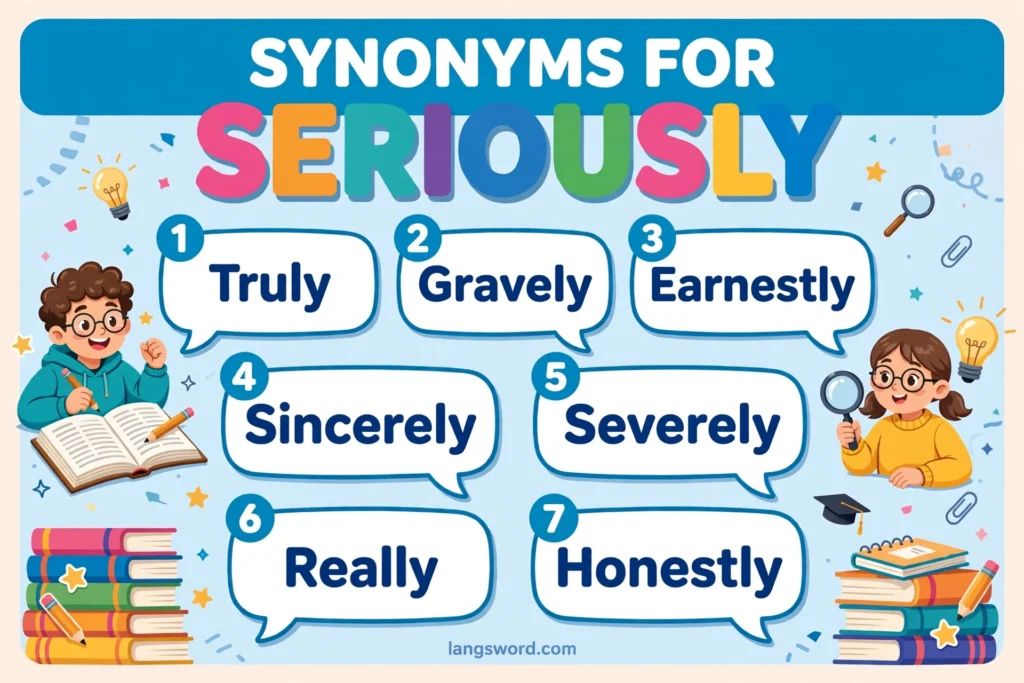
30 Synonyms of Seriously With Meaning & Examples
1. Gravely (Adverb)
Meaning: In a very serious and grave way, often about bad news.
Examples:
- The doctor nodded gravely and gave us the news.
- She spoke gravely about the coming storm.
2. Solemnly (Adverb)
Meaning: In a deep, formal, and serious way, with no smiles.
Examples:
- He solemnly promised to keep the secret.
- The flag was raised solemnly at dawn.
3. Earnestly (Adverb)
Meaning: In a sincere and serious way, with real feeling.
Examples:
- She asked earnestly for one more chance.
- He spoke earnestly about his wish to help.
4. Soberly (Adverb)
Meaning: In a calm, serious, and clear-headed way.
Examples:
- She soberly told us her plan for the trip.
- The judge listened soberly to both sides.
5. Grimly (Adverb)
Meaning: In a harsh and stern way, with no hope or joy in the voice.
Examples:
- “We have no food left,” he said grimly.
- She grimly held on to the rope in the storm.
6. Sternly (Adverb)
Meaning: In a strict and firm way that shows no softness.
Examples:
- The teacher looked at him sternly.
- “Stop that at once,” she said sternly.
7. Somberly (Adverb)
Meaning: In a dark, sad, and serious way.
Examples:
- The crowd walked somberly behind the coffin.
- He somberly read the names of the lost men.
8. Thoughtfully (Adverb)
Meaning: In a deep-thinking way, with care and full attention.
Examples:
- She nodded thoughtfully at his words.
- He thoughtfully weighed each choice before he spoke.
9. Resolutely (Adverb)
Meaning: In a firm and decided way, with no doubt at all.
Examples:
- She resolutely said no to the bad plan.
- He resolutely kept his word, come what may.
10. Severely (Adverb)
Meaning: To a very bad or harsh degree.
Examples:
- The roof was severely damaged by the storm.
- He was severely hurt in the crash.
11. Badly (Adverb)
Meaning: To a great or serious degree of harm.
Examples:
- The car was badly bent in the crash.
- She was badly hurt and went to hospital.
12. Greatly (Adverb)
Meaning: To a large degree; very much.
Examples:
- The news greatly shocked the whole town.
- His health greatly improved with rest.
13. Deeply (Adverb)
Meaning: To a strong and far-down degree of feeling.
Examples:
- She was deeply moved by the kind letter.
- The loss cut him deeply.
14. Terribly (Adverb)
Meaning: To a very great or bad degree.
Examples:
- He felt terribly sick after the meal.
- The plan went terribly wrong.
15. Extremely (Adverb)
Meaning: To the highest or a very high degree.
Examples:
- The road is extremely rough after the rains.
- She was extremely tired after the long walk.
16. Critically (Adverb)
Meaning: To a degree so bad that life or success is at risk.
Examples:
- He was critically ill in the hospital.
- The bridge was critically weak and had to close.
17. Intensely (Adverb)
Meaning: With great force or to a strong degree.
Examples:
- She disliked the noise intensely.
- The sun shone intensely at noon.
18. Profoundly (Adverb)
Meaning: To a deep and great degree, in feeling or thought.
Examples:
- The book profoundly changed her life.
- He was profoundly sorry for his mistake.
19. Truly (Adverb)
Meaning: In a true and real way; in fact.
Examples:
- I truly did not see your keys.
- She is truly sorry for the late reply.
20. Really (Adverb)
Meaning: In truth; used to stress that a thing is so.
Examples:
- I really mean it this time.
- He really did lock the door.
21. Honestly (Adverb)
Meaning: In a truthful way, with no lies.
Examples:
- Honestly, I forgot about the meeting.
- She answered honestly, though it was hard.
22. Sincerely (Adverb)
Meaning: In a true and heartfelt way, with real feeling.
Examples:
- I sincerely hope you feel better soon.
- He sincerely asked for pardon.
23. Indeed (Adverb)
Meaning: In truth; used to stress or agree with a fact.
Examples:
- It was indeed a hard test for us all.
- Yes, indeed, I saw it with my own eyes.
24. Frankly (Adverb)
Meaning: In an open and direct way, hiding nothing.
Examples:
- Frankly, the soup needs more salt.
- He spoke frankly about his fears.
25. Actually (Adverb)
Meaning: In fact; used to stress what is true.
Examples:
- I actually finished the work last night.
- She actually won the race by a full lap.
26. Genuinely (Adverb)
Meaning: In a real and true way, not false or fake.
Examples:
- He is genuinely glad for your success.
- She genuinely did not know the answer.
27. Certainly (Adverb)
Meaning: Without doubt; for sure.
Examples:
- I will certainly help you move.
- She certainly earned that prize.
28. Definitely (Adverb)
Meaning: Without any doubt; clearly and surely.
Examples:
- We will definitely come to the party.
- He definitely heard a noise upstairs.
29. Literally (Adverb)
Meaning: In the exact and true sense of the words.
Examples:
- He literally ran all the way home.
- The box was literally too heavy to lift.
30. Positively (Adverb)
Meaning: In a sure and firm way, with no doubt.
Examples:
- I am positively sure the shop is closed.
- She positively refused to lie.
Prototype Meaning
When people hear the word seriously, they first picture a face with no smile. A person leans in, looks you in the eye, and speaks in a low, grave voice. There is no joke in the room. The words carry weight, like news about a sick friend or a firm promise that must be kept. That grave, no-joke picture is the heart of the word.
Prototype Categorization
- Grave face words: Gravely, Solemnly, Soberly, Grimly, Somberly, Sternly — use these when the voice and face show no joking, often with sad or bad news.
- Sincere and firm manner words: Earnestly, Thoughtfully, Resolutely — use these when a person speaks with real feeling, deep thought, or a firm mind.
- Great degree words: Severely, Badly, Greatly, Deeply, Terribly, Extremely, Critically, Intensely, Profoundly — use these when a thing is bad, strong, or big to a high degree, like pain, harm, or deep feeling.
- Honest truth words: Truly, Honestly, Sincerely, Frankly, Genuinely, Indeed — use these when you stress that your words are true and from the heart.
- Stress and certainty words: Really, Actually, Certainly, Definitely, Literally, Positively — use these in daily speech when you stress a fact or clear away all doubt.
These groups help writers pick the best word fast. Bad news needs a grave word, a strong degree needs a degree word, and a true claim needs a truth word. The right group gives you the right word every time.
Antonyms of Seriously
Jokingly (Adverb)
In a joking way, not meant to be taken as true or grave.
Lightly (Adverb)
In a light way, with little care, weight, or harm.
Playfully (Adverb)
In a fun and playful way, like a game.
Casually (Adverb)
In a relaxed way, with no stress or deep thought.
Cheerfully (Adverb)
In a happy and bright way, full of good spirits.
Mildly (Adverb)
To a small degree; only a little.
Insincerely (Adverb)
In a false way, without true feeling behind the words.
Short Questions and Answers
What does seriously mean?
Seriously is an adverb. It means in a grave way with no joking, or to a severe degree, or it stresses that a thing is true.
When should seriously be used?
Use it when you speak about grave news, strong harm, or a true claim. It fits talks about health, rules, promises, and honest speech.
Is seriously positive or negative?
It can be both. It is positive when it shows care, truth, and trust. It is negative when it points to bad news, deep harm, or a heavy mood.
How is it different from similar words?
Seriously covers three uses: a grave manner, a great degree, and truth stress. Gravely fits only the manner. Severely fits only the degree. Truly fits only the truth use.
Conclusion
Seriously is a small word that carries great weight. It can show a grave face, mark a deep harm, or stress a true word. The 30 synonyms in this guide give you a word for each use.
Grave words like solemnly fit sad news. Degree words like severely fit strong harm. Truth words like honestly fit open speech. Learning these synonyms improves your vocabulary and makes your writing rich and clear.
You also avoid dull repetition and sound more natural. So keep a small daily habit. Learn one new word, say it aloud, and use it in a sentence of your own.