

You land in a new country for a trip. Your pockets are full of rupees, but the shops here take dollars. So your first stop is a money shop, where you trade your old notes for new ones.
This system of notes and coins that a country uses is called its currency. Every country has its own currency, with its own name and value. Learning synonyms for currency helps you talk about money in fresh and clear ways. You can pick a formal word for news or a simple word for daily talk.
In this article, you will learn the meaning of currency, study 30 synonyms with meanings and examples, and explore its history, pronunciation, grammar, and word groups in simple words.
Meaning of Currency
Definition
Currency (Noun): The money system used in a country; its notes and coins. It can also mean the state of being widely used, known, or accepted at a time.
Examples
- The euro is the common currency of many lands in Europe.
- That old idea no longer has currency with young people.
Connotative Meaning
- Positive tone: It suggests trust and value, like money that people accept with faith and pride.
- Negative tone: It can suggest loss of worth, as when weak money buys less and less each year.
- Neutral tone: In news and banks, it is a plain word for a country’s money system, with no good or bad feel.
(Connotation: the feelings and ideas a word brings to mind, apart from its plain meaning.)
Etymology
- Old English (450–1100): The word currency did not exist in Old English. English had no word like this in that period.
- Middle English (1100–1500): The base word current came into English in this period, from Old French corant, which came from Latin currere, meaning “to run.” At first it named anything that flows or runs, like water.
- Modern English (1500–Present): The word currency itself was formed in English in the 1650s, from current plus the ending -cy. It first meant a flow or a running state. In the 1700s, it gained its main sense: money that runs from hand to hand, the notes and coins in use.
Pronunciation (IPA)
- IPA: /ˈkʌrənsi/
- Syllables: cur · ren · cy (3 syllables)
Affixation Pattern of Currency
- Root: current (from Latin currere, meaning “to run”)
- Prefix: None
- Suffix: -cy (a noun suffix that means a state or quality)
- Word formations:
- currencies (Noun, plural)
- current (Adjective)
- current (Noun)
- currently (Adverb)
- currency exchange (Noun Phrase)
- foreign currency (Noun Phrase)
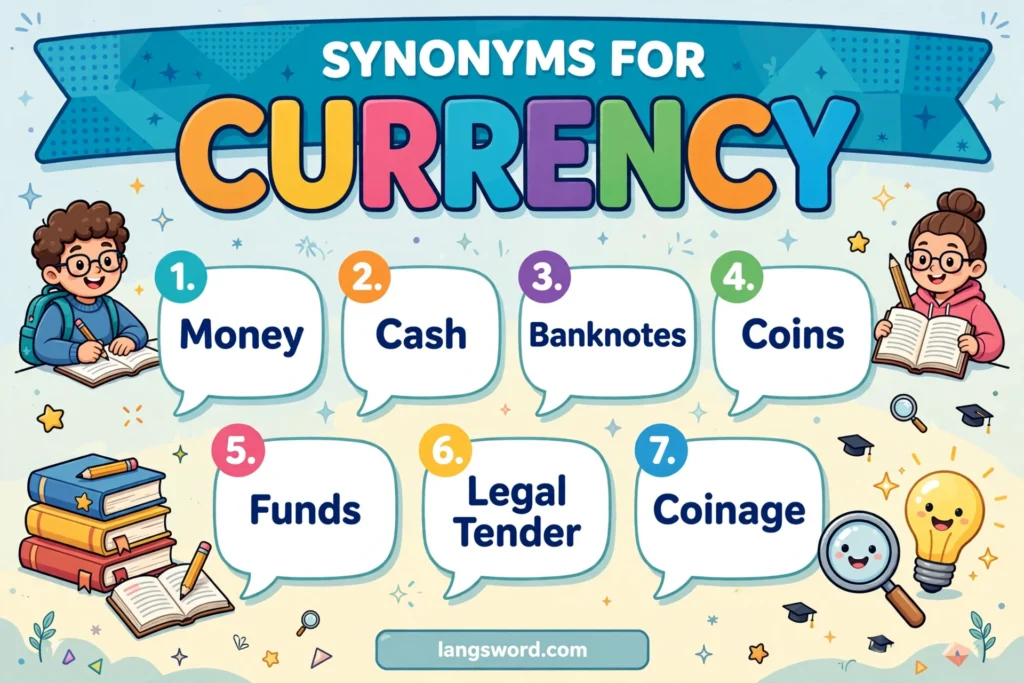
30 Synonyms of Currency With Meaning & Examples
1. Money (Noun)
Meaning: The general word for the notes, coins, and value that people use to buy things.
Examples:
- She keeps her money in a small cloth bag.
- He saved his money to buy a new bike.
2. Cash (Noun)
Meaning: Money in the form of notes and coins, ready in the hand.
Examples:
- The shop takes cash only, no cards.
- He paid cash for the old car.
3. Banknotes (Noun)
Meaning: Paper money printed by a bank, used as notes of value.
Examples:
- The banknotes in his wallet are new and crisp.
- Old banknotes can be traded at the central bank.
4. Coins (Noun)
Meaning: Small round pieces of metal used as money.
Examples:
- She dropped some coins into the poor man’s bowl.
- The child found old coins in the garden soil.
5. Legal Tender (Noun)
Meaning: The money that must be accepted by law when a debt is paid.
Examples:
- These notes are legal tender in the whole country.
- The shop must take legal tender for the bill.
6. Funds (Noun)
Meaning: Sums of money saved or ready for a clear use.
Examples:
- The school raised funds for a new library.
- We have no funds left for the trip.
7. Coinage (Noun)
Meaning: The coins of a country as a whole system, or the making of coins.
Examples:
- The coinage of this land shows the king’s face.
- The mint is in charge of coinage.
8. Notes (Noun)
Meaning: Paper money; short name for banknotes.
Examples:
- He paid with two large notes.
- The notes in this country are bright and green.
9. Specie (Noun)
Meaning: Money in the form of metal coins, not paper.
Examples:
- In old times, taxes were paid in specie.
- The ship’s chest was full of gold specie.
10. Tender (Noun)
Meaning: Money offered in payment, most often in the phrase legal tender.
Examples:
- He offered tender for the land he wished to buy.
- This note is valid tender in all shops here.
11. Capital (Noun)
Meaning: Money or wealth that a person or firm owns and uses to grow more.
Examples:
- She used her capital to open a small shop.
- The firm needs more capital to grow.
12. Finances (Noun)
Meaning: The money a person, firm, or state has and how it is handled.
Examples:
- The firm’s finances are in good shape this year.
- He keeps a close eye on his home finances.
13. Dough (Noun)
Meaning: A slang word for money, used in fun and casual talk.
Examples:
- That new phone costs a lot of dough.
- He made some quick dough at the fair.
14. Bucks (Noun)
Meaning: A slang word for dollars, used mostly in the United States.
Examples:
- The toy costs ten bucks.
- She earns a few bucks by teaching kids.
15. Change (Noun)
Meaning: Small coins, or the small money given back after a payment.
Examples:
- He keeps loose change in his coat pocket.
- The bus driver had no change for a large note.
16. Medium of Exchange (Noun)
Meaning: The thing people accept in trade for goods; money in its main job.
Examples:
- Gold was once the chief medium of exchange.
- Notes and coins are our medium of exchange today.
17. Circulating Medium (Noun)
Meaning: The money that passes from hand to hand in daily trade.
Examples:
- Paper notes are the main circulating medium here.
- Old coins left the circulating medium long ago.
18. Paper Money (Noun)
Meaning: Money printed on paper as notes, not metal coins.
Examples:
- Paper money is light and easy to carry.
- The bank checks each piece of paper money with care.
19. Hard Cash (Noun)
Meaning: Real notes and coins in the hand, not a card or a promise.
Examples:
- The farmer wants hard cash for his land.
- She paid hard cash at the market stall.
20. Gold (Noun)
Meaning: A costly yellow metal long used as money and a store of value.
Examples:
- In past times, men paid in gold.
- The crown was made of pure gold.
21. Silver (Noun)
Meaning: A white metal once used widely for coins and trade.
Examples:
- Old coins of silver were found in the field.
- He was paid in silver for his work.
22. Bread (Noun)
Meaning: A slang word for money, from the idea that money buys food.
Examples:
- He works hard to earn his bread.
- That job brings in good bread.
23. Greenbacks (Noun)
Meaning: A slang name for United States paper dollars, from their green back side.
Examples:
- He flashed a roll of greenbacks at the shop.
- Tourists come here with greenbacks in hand.
24. Loot (Noun)
Meaning: A slang word for money, often money gained in a bold or wrong way.
Examples:
- The gang hid the loot in an old barn.
- He spent all the loot in one wild week.
25. Wealth (Noun)
Meaning: A large amount of money and things of value that a person owns.
Examples:
- His wealth grew from trade and hard work.
- The family’s wealth is in land and gold.
26. Circulation (Noun)
Meaning: For the acceptance sense: the state of money or ideas passing from person to person and being in wide use.
Examples:
- The old notes are still in circulation in small towns.
- The tale gained wide circulation in the press.
27. Popularity (Noun)
Meaning: For the acceptance sense: the state of being liked and used by many people.
Examples:
- The song rose in popularity in one week.
- That style lost popularity years ago.
28. Acceptance (Noun)
Meaning: For the acceptance sense: the act of taking a thing as true, good, or fit for use.
Examples:
- The new coin met quick acceptance in all shops.
- Her ideas won acceptance with the team.
29. Prevalence (Noun)
Meaning: For the acceptance sense: the state of being common and found in many places.
Examples:
- The prevalence of card payment grows each year.
- No one can doubt the prevalence of phones today.
30. Vogue (Noun)
Meaning: For the acceptance sense: the fashion or wide use of a thing at a set time.
Examples:
- Small cars are in vogue in the city now.
- That dance came into vogue last spring.
Prototype Meaning
When people hear the word currency, they first picture paper notes and coins in a hand. They see a traveler at a small exchange desk, trading home notes for new ones with bright colors and strange words. They may also picture the flag and face printed on a bill. The heart of the word is simple: the money that a whole country trusts and uses each day.
Prototype Categorization
- Everyday money words: Money, Cash, Notes, Change, Hard Cash, Paper Money — use these in daily talk about buying, paying, and saving.
- Formal and bank words: Banknotes, Legal Tender, Coinage, Specie, Tender, Medium of Exchange, Circulating Medium — use these in news, law, and bank writing.
- Money as a store: Funds, Capital, Finances, Wealth, Gold, Silver — use these when money is saved, owned, or used to grow a shop or a firm.
- Slang words: Dough, Bucks, Bread, Greenbacks, Loot — use these in fun, casual talk and stories, never in formal writing.
- Wide use and acceptance: Circulation, Popularity, Acceptance, Prevalence, Vogue — use these for the second sense: an idea, word, or style that is in wide use at a time.
- Coins and metal words: Coins, Coinage, Specie, Gold, Silver — use these when the talk is about metal money, old times, or the mint.
These groups help writers pick the best word for each job. A bank report needs a formal word like legal tender. A story about friends needs a simple word like cash. A slang word like dough can make a tale fun, but it will spoil a grave report.
Antonyms of Currency
Barter (Noun)
A system of trade where goods are swapped for goods, with no money used at all.
Worthlessness (Noun)
The state of having no value, so no one will accept the thing in trade.
Obsolescence (Noun)
The state of being out of date and no longer in use.
Debt (Noun)
Money that is owed to another person; the opposite side of having money in hand.
Poverty (Noun)
The state of having little or no money at all.
Counterfeit (Noun)
Fake money made to look real; it has no true value and is against the law.
Demonetization (Noun)
The act of ending a note or coin as legal money, so it stops being currency.
Short Questions and Answers
What does currency mean?
Currency means the money system of a country: the notes and coins that people use each day. It can also mean how widely a word, idea, or style is used and accepted at a time.
When should currency be used?
Use currency when you talk about a country’s money, travel, trade, or banks. Use it in news and reports. For small daily talk, simple words like money or cash often fit better.
Is currency positive or negative?
It is mostly neutral. It is a plain word for a money system. It can feel positive when the money is strong and trusted, and negative when the money is weak and buys less each year.
How is it different from similar words?
Currency is one country’s whole money system. Money is the broad word for all of it. Cash is only the notes and coins in your hand. Capital is money used to grow a business.
Conclusion
Currency is a key word for travel, trade, and daily life. It names the notes and coins that a whole country trusts and uses. The 30 synonyms in this guide give you many ways to talk about money.
Words like cash and notes fit daily talk, while words like legal tender and coinage fit news and bank work. Learning these words improves your vocabulary and makes your writing clear and rich.
It also helps you avoid repeating the same word again and again, and it builds real confidence in your English. So keep practicing every day. Read one new word, say it aloud, and use it in a sentence of your own.