
A ravine is a deep, narrow cut in the land with steep sides. Imagine a group of hikers on a hill path. They stop and look down. Far below them, a small stream runs through a deep crack in the earth. The walls are too steep to climb.
That deep cut is a ravine. Rain and rivers make ravines over many years as water wears the land away. Writers, hikers, and geography students use this word often, but English has many other words for the same kind of land. Learning synonyms for ravine helps you pick the best word for a big canyon, a small gully, or a dry desert bed.
In this article, you will learn the meaning of ravine, its history, its pronunciation, 30 synonyms with meanings and examples, word groups, antonyms, and answers to common questions.
Meaning of Ravine
Definition
Ravine (Noun): A deep, narrow valley with steep sides, usually cut into the land by running water.
Examples
- A thin stream ran at the bottom of the ravine.
- The hikers crossed the ravine on a wooden bridge.
Connotative Meaning
- Positive tone: It can suggest wild beauty, adventure, and untouched nature.
- Negative tone: It can suggest danger, a steep fall, or a wild flood rushing through.
- Neutral tone: In geography, it is a plain word for a land shape, with no good or bad feeling.
(Connotation: the feelings and ideas a word brings to mind, apart from its plain meaning.)
Etymology
- Old English (450–1100): The word did not exist in Old English. English speakers of that time used other words, like dene, for a valley.
- Middle English (1100–1500): The word still did not exist in English in this period. It had not yet come from French.
- Modern English (1500–Present): The word entered English in the early 1700s, from French ravine, meaning a violent rush of water or a gully cut by a torrent. The French word came from Old French and is rooted in Latin rapina, meaning rushing and seizing, from rapere, to seize. The idea is of water rushing in and tearing the land open.
Pronunciation (IPA)
- IPA: /rəˈviːn/
- Syllables: ra · vine (2 syllables)
Affixation Pattern of Ravine
- Root: ravine (the whole word came into English from French as one piece)
- Prefix: None
- Suffix: None
- Word formations:
- ravines (Noun, plural)
- ravined (Adjective — cut or marked by ravines, as in “a ravined hillside”)
30 Synonyms of Ravine With Meaning & Examples
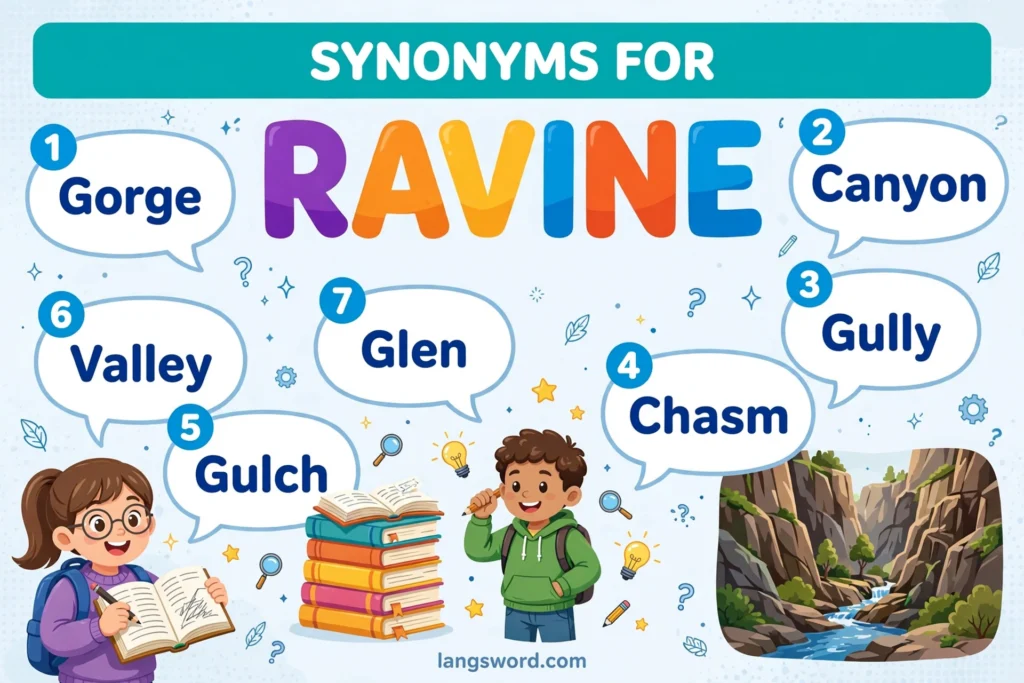
1. Gorge (Noun)
Meaning: A deep, narrow valley with steep rocky walls, often with a river at the bottom; very close in meaning to ravine.
Examples:
- A wild river flowed through the gorge.
- The road ran along the edge of the gorge.
2. Canyon (Noun)
Meaning: A very deep, wide valley with steep sides; a canyon is much bigger than a ravine.
Examples:
- The Grand Canyon is famous all over the world.
- We watched the sun set over the canyon.
3. Gully (Noun)
Meaning: A small, narrow channel cut in the land by rain water; a gully is smaller and shallower than a ravine.
Examples:
- Rain had washed a gully down the side of the hill.
- The path crossed a small gully after the storm.
4. Chasm (Noun)
Meaning: A deep crack or opening in the earth; it stresses how deep and sudden the drop is.
Examples:
- A dark chasm opened at the foot of the cliff.
- No one dared to jump over the chasm.
5. Gulch (Noun)
Meaning: A narrow, deep ravine, often dry, with a stream that runs only after rain; a word used in the western United States.
Examples:
- The old miners searched the gulch for gold.
- A dry gulch cut through the dusty plain.
6. Valley (Noun)
Meaning: Low land between hills or mountains; a valley is wider and gentler than a ravine, so it is a broader cousin, not an exact match.
Examples:
- A small village sat in the green valley.
- The river wound slowly through the valley.
7. Crevasse (Noun)
Meaning: A deep crack in ice or in the ground; climbers fear it in snow and glaciers.
Examples:
- The climber fell into a hidden crevasse.
- A wide crevasse split the ice field.
8. Glen (Noun)
Meaning: A small, narrow valley, often green and with a stream; a soft, gentle word used a lot in Scotland.
Examples:
- A quiet glen lay hidden between the hills.
- Deer drank from the stream in the glen.
9. Ditch (Noun)
Meaning: A narrow channel dug in the ground by people, often beside a road; a ditch is man-made and much smaller than a ravine.
Examples:
- Water ran in the ditch beside the road.
- The farmer dug a ditch to drain the field.
10. Trench (Noun)
Meaning: A long, narrow cut dug in the ground; a trench is man-made, often for pipes, wires, or war.
Examples:
- Workers dug a trench for the new water pipe.
- Soldiers once hid in a deep trench.
11. Coulee (Noun)
Meaning: A deep ravine or gully, often dry; a word used in Canada and the northern United States.
Examples:
- A coulee cut deep into the dry plain.
- Cattle rested in the shade of the coulee.
12. Arroyo (Noun)
Meaning: A dry creek bed in dry lands that fills with water only after heavy rain; a Spanish word used in the southwest United States.
Examples:
- The arroyo stayed dry for most of the year.
- After the storm, water rushed down the arroyo.
13. Wadi (Noun)
Meaning: A dry riverbed in a desert that holds water only after rain; an Arabic word used for desert lands.
Examples:
- The travelers rested in the shade of the wadi.
- A sudden flood can fill a wadi in minutes.
14. Dell (Noun)
Meaning: A small, quiet valley with trees; a dell is smaller and softer than a ravine.
Examples:
- A dell full of flowers lay below the hill.
- The old house stood in a green dell.
15. Dale (Noun)
Meaning: A valley; a word used in northern England, close to valley and a bit wider than a ravine.
Examples:
- Farms spread across the wide dale.
- A river ran through the dale.
16. Hollow (Noun)
Meaning: A small, low area or dip in the land; a hollow is shallower than a ravine.
Examples:
- Mist filled the hollow at dawn.
- Their cabin stood in a hollow between two hills.
17. Vale (Noun)
Meaning: A valley; an old, poetic word, used in poems and stories more than in daily talk.
Examples:
- The vale was green in the spring light.
- Songs tell of knights who rode through the vale.
18. Fissure (Noun)
Meaning: A long, narrow crack in rock or in the ground; thinner than a ravine, with no room to walk in.
Examples:
- Steam rose from a fissure in the rock.
- A deep fissure ran across the dry earth.
19. Cleft (Noun)
Meaning: A narrow opening or split in a rock; small, like a crack you can see into but not enter.
Examples:
- A thin plant grew in a cleft of the rock.
- Water dripped from a cleft above the path.
20. Abyss (Noun)
Meaning: A very deep space or hole that seems to have no bottom; far deeper and scarier than a ravine.
Examples:
- He stood at the edge and stared into the abyss.
- The abyss below the cliff made her dizzy.
21. Rift (Noun)
Meaning: A crack or split in the ground or in rock, made when the land pulls apart.
Examples:
- A rift split the plain after the earthquake.
- The Great Rift Valley runs through East Africa.
22. Defile (Noun)
Meaning: A narrow pass or gorge between mountains that people and armies can walk through.
Examples:
- The army marched through the narrow defile.
- A stream ran along the floor of the defile.
23. Notch (Noun)
Meaning: A V-shaped cut or narrow pass in a mountain ridge; smaller and higher than a ravine.
Examples:
- The trail led up through a notch in the ridge.
- Wind blew hard through the notch.
24. Combe (Noun)
Meaning: A short, deep valley on the side of a hill; a British word, also spelled coombe.
Examples:
- A small combe hid the village from the road.
- Sheep grazed in the green combe.
25. Kloof (Noun)
Meaning: A deep, steep ravine; a word from South Africa, from the Dutch and Afrikaans language.
Examples:
- A stream ran at the bottom of the kloof.
- Hikers climbed down into the shady kloof.
26. Barranca (Noun)
Meaning: A steep ravine or a deep gully in dry land; a Spanish word used in Mexico and the southwest United States.
Examples:
- The road skirted the edge of a deep barranca.
- Dry brush grew along the barranca.
27. Nullah (Noun)
Meaning: A dry stream bed or a watercourse that can turn into a small ravine after rain; a word used in India.
Examples:
- The nullah filled fast during the monsoon rain.
- Children played in the dry nullah.
28. Ghyll (Noun)
Meaning: A deep ravine with a stream running through woods; a word used in northern England, also spelled gill.
Examples:
- A cool ghyll ran under the tall trees.
- The path followed the ghyll down the hill.
29. Draw (Noun)
Meaning: A small, shallow gully or dry low place on a plain; an American word, gentler than a ravine.
Examples:
- Deer hid in a draw on the open plain.
- Rain water ran down the draw after the storm.
30. Swale (Noun)
Meaning: A low, shallow dip in the land, often wet or grassy; a swale is soft and gentle, not steep like a ravine.
Examples:
- Ducks nested in the wet swale.
- A green swale ran between the low hills.
Prototype Meaning
When people hear the word ravine, they first picture a deep, narrow cut in a hillside. The walls drop steeply on both sides, too steep to climb. At the bottom, a small stream runs over stones. Trees lean over the top edge, and the floor of the ravine sits in cool shade. It is land that water has torn open over a long, long time.
Prototype Categorization
- Deep and steep cuts: Gorge, Canyon, Chasm, Abyss, Crevasse — use these when the land drops deep and steep and looks grand or scary.
- Small water-cut channels: Gully, Gulch, Draw, Ditch, Trench — use these for small cuts made by rain or by people.
- Gentle valleys: Valley, Glen, Dell, Dale, Vale, Hollow, Swale, Combe use these when the low land is wide, soft, or green rather than steep.
- Dry-land and world words: Arroyo, Wadi, Coulee, Kloof, Barranca, Nullah, Ghyll use these for dry beds and for the special words of deserts, regions, and countries.
- Cracks and passes: Fissure, Cleft, Rift, Defile, Notch use these for thin cracks in rock or narrow ways through mountains.
These groups help writers pick the exact word for the land in front of them. A travel story about the desert needs a dry-land word. A mountain tale needs a pass word. A science lesson needs the right crack or cut word. The right group gives you the right size, the right shape, and the right feel every time.
Antonyms of Ravine
Hill (Noun)
Land that rises above the area around it; the opposite of a low cut in the land.
Peak (Noun)
The pointed top of a mountain; the highest part, far above any ravine.
Ridge (Noun)
A long, narrow line of high land along the top of hills or mountains.
Plateau (Noun)
A wide, flat area of high land with steep sides.
Plain (Noun)
A wide, flat area of low land with no deep cuts.
Summit (Noun)
The very top of a mountain or hill.
Upland (Noun)
High land or hills, far above valleys and ravines.
Short Questions and Answers
What does ravine mean?
A ravine is a deep, narrow valley with steep sides. Running water cuts it into the land over many years. It is smaller than a canyon but bigger than a gully.
When should ravine be used?
Use ravine when you talk or write about a deep cut in hills or wild land, in nature stories, travel writing, geography lessons, and hiking tales.
Is ravine positive or negative?
It is mostly neutral. It can feel positive when it means wild beauty and adventure. It can feel negative when it means danger, a steep drop, or a sudden flood.
How is it different from similar words?
A ravine is deep and narrow with steep sides. A canyon is much bigger. A gully is smaller and made by rain. A valley is wider and gentler, with room for farms and villages.
Conclusion
A ravine is a deep, narrow cut in the land, and English gives you many ways to name it. Big words like canyon and gorge fit huge land cuts. Small words like gully and draw fit tiny channels.
Dry-land words like arroyo and wadi fit desert beds. Knowing these synonyms for ravine makes your writing clear and rich. You can paint the exact picture in a reader’s mind instead of using the same word again and again.
Keep learning one new word each day. Say it out loud, write it in a sentence, and use it when you talk about hills, rivers, and wild places. Step by step, your English will grow strong and sure, like a river cutting its own path through stone.