
Have you ever seen someone treated in an unfair way and felt a hot anger rise in your chest? That strong feeling has a name. The word indignant means feeling angry because something seems unfair, unkind, or rude. Think of a worker who does all the hard jobs but gets no thanks.
Or a student who gets blamed for a mistake she did not make. Both have a right to feel indignant. Learning synonyms for indignant helps you name this feeling with care. You can pick a soft word or a strong word for each moment.
In this article, you will learn the meaning of indignant, study 30 synonyms with meanings and examples, and explore its history, pronunciation, word parts, and word groups in simple words.
Meaning of Indignant
Definition
Indignant (Adjective): Feeling angry because something seems unfair, unkind, or insulting.
Examples
- She felt indignant when her brother took her book and said it was his.
- The fans were indignant when the referee gave a wrong call.
Connotative Meaning
- Positive tone: It can show a strong sense of right and wrong, like standing up for a person who was treated badly.
- Negative tone: It can sound proud or touchy, as if a person gets angry too fast at a small slight.
- Neutral tone: It is often a plain word for anger that comes from unfair treatment.
(Connotation: the feelings and ideas a word brings to mind, apart from its plain meaning.)
Etymology
- Old English (450–1100): The word did not exist in Old English. Its roots come from Latin indignari, meaning to deem a thing unworthy.
- Middle English (1100–1500): The word was not used in Middle English either. The Latin root stayed in use in French as indigné during this time.
- Modern English (1500–Present): The word entered English in the late 1500s from French and Latin. It comes from Latin indignans, from indignari, made of in- (not) and dignari (to deem worthy), from dignus (worthy). It still means anger at something seen as unworthy or unfair.
Pronunciation (IPA)
- IPA: /ɪnˈdɪɡnənt/
- Syllables: in · dig · nant (3 syllables)
Affixation Pattern of Indignant
- Root: dign (from Latin dignus, meaning worthy)
- Prefix: in- (meaning not)
- Suffix: -ant (an adjective suffix that means having a quality)
- Word formations:
- indignantly (Adverb)
- indignation (Noun)
- indignity (Noun)
- indignant (Adjective)
30 Synonyms of Indignant With Meaning & Examples
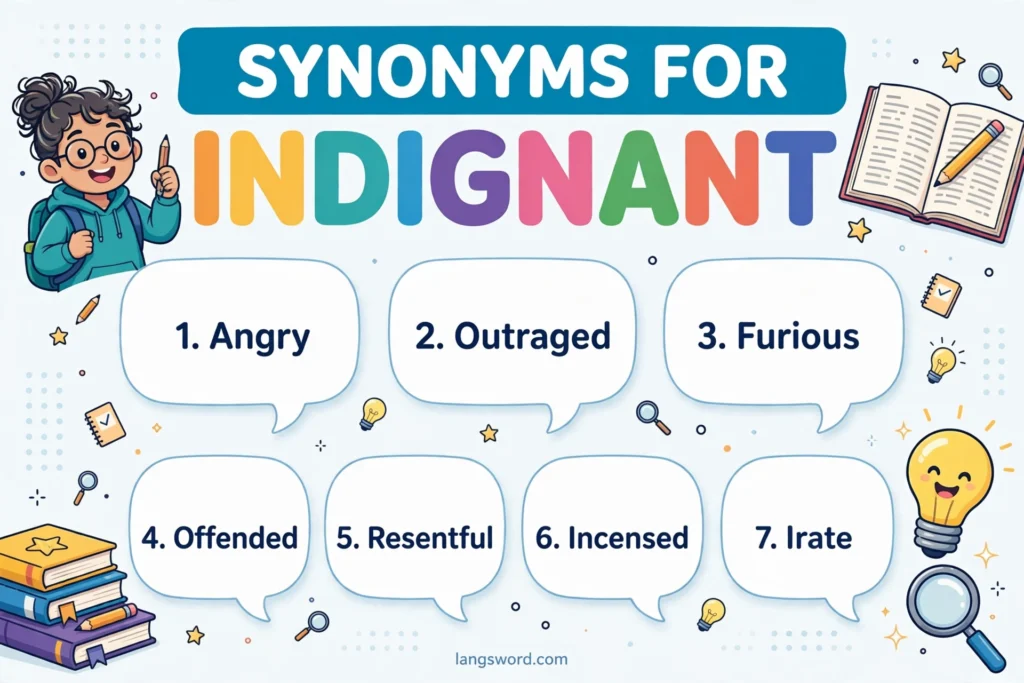
1. Angry (Adjective)
Meaning: Feeling strong displeasure or rage at someone or something.
Examples:
- He was angry when his friend broke his toy.
- The angry crowd shouted at the gate.
2. Outraged (Adjective)
Meaning: Very angry because of something unfair or shocking.
Examples:
- The town was outraged by the cruel act.
- She felt outraged when she heard the lie.
3. Furious (Adjective)
Meaning: Extremely angry, full of wild rage.
Examples:
- Dad was furious when the car got a scratch.
- The furious dog barked at the stranger.
4. Offended (Adjective)
Meaning: Hurt or upset because someone was rude or unkind.
Examples:
- She felt offended by his cold words.
- He was offended when no one said thanks.
5. Resentful (Adjective)
Meaning: Feeling bitter anger because you were treated unfairly.
Examples:
- She felt resentful when her sister got all the praise.
- He grew resentful of the extra work with no pay.
6. Incensed (Adjective)
Meaning: Very angry about something unfair or wrong.
Examples:
- The workers were incensed by the pay cut.
- She was incensed at the rude note.
7. Irate (Adjective)
Meaning: Very angry and upset.
Examples:
- An irate customer shouted at the clerk.
- He was irate when the train left early.
8. Annoyed (Adjective)
Meaning: A little angry because something keeps bothering you.
Examples:
- She was annoyed by the loud music.
- He felt annoyed when his brother kept teasing him.
9. Mad (Adjective)
Meaning: Angry in a common, everyday sense.
Examples:
- Mom was mad when we broke the vase.
- He got mad at the bad news.
10. Wrathful (Adjective)
Meaning: Full of strong, fierce anger.
Examples:
- The wrathful king sent the guards away.
- She gave him a wrathful look.
11. Fuming (Adjective)
Meaning: So angry that you seem to steam with rage.
Examples:
- He sat fuming after the unfair loss.
- She was fuming when she heard the insult.
12. Livid (Adjective)
Meaning: Extremely angry, as if your face changed color.
Examples:
- She was livid when she found the broken phone.
- The livid coach yelled at the team.
13. Enraged (Adjective)
Meaning: Filled with very strong anger.
Examples:
- The enraged bull charged at the fence.
- He was enraged by the cruel joke.
14. Infuriated (Adjective)
Meaning: Made extremely angry.
Examples:
- She was infuriated by the long lie.
- The infuriated fans left the hall.
15. Aggrieved (Adjective)
Meaning: Feeling that you have been treated unfairly and have a right to complain.
Examples:
- The aggrieved worker asked for a fair hearing.
- She felt aggrieved when her work was ignored.
16. Insulted (Adjective)
Meaning: Feeling hurt because someone spoke or acted in a rude way.
Examples:
- He felt insulted by the mean comment.
- The insulted guest left the party early.
17. Affronted (Adjective)
Meaning: Offended by something rude said or done to you.
Examples:
- She felt affronted by his harsh words.
- The affronted teacher asked for respect.
18. Disgruntled (Adjective)
Meaning: Unhappy and annoyed because things did not go fairly.
Examples:
- The disgruntled fans booed the call.
- He was disgruntled with the late pay.
19. Bitter (Adjective)
Meaning: Angry and hurt for a long time because of unfair treatment.
Examples:
- She felt bitter after losing the prize unfairly.
- He grew bitter about the broken promise.
20. Hostile (Adjective)
Meaning: Angry and ready to fight or oppose someone.
Examples:
- The hostile crowd blocked the road.
- He gave her a hostile stare.
21. Seething (Adjective)
Meaning: Full of anger that is held in but ready to burst out.
Examples:
- She sat seething after the unfair remark.
- He was seething with quiet rage.
22. Riled (Adjective)
Meaning: Made angry or annoyed.
Examples:
- He got riled by the teasing.
- The riled cat hissed at the dog.
23. Cross (Adjective)
Meaning: Angry or annoyed, often used in mild talk.
Examples:
- Mom was cross when we came home late.
- He felt cross about the mix-up.
24. Upset (Adjective)
Meaning: Unhappy and troubled, with some anger mixed in.
Examples:
- She was upset by the unfair grade.
- He felt upset when his plan was mocked.
25. Scandalized (Adjective)
Meaning: Shocked and angry because something seems very wrong.
Examples:
- The town was scandalized by the theft.
- She felt scandalized by the rude act.
26. Displeased (Adjective)
Meaning: Not pleased and somewhat angry.
Examples:
- The boss was displeased with the late report.
- She felt displeased by his tone.
27. Heated (Adjective)
Meaning: Angry and excited in a strong, warm rush of feeling.
Examples:
- The talk grew heated after the unfair rule.
- He spoke in a heated voice.
28. Exasperated (Adjective)
Meaning: Very annoyed because the same bad thing keeps happening.
Examples:
- She was exasperated by the endless noise.
- The exasperated teacher asked for quiet.
29. Vexed (Adjective)
Meaning: Annoyed, frustrated, or worried by a problem.
Examples:
- He felt vexed by the hard puzzle.
- She was vexed at the delay.
30. Provoked (Adjective)
Meaning: Made angry by someone’s words or acts.
Examples:
- He was provoked by the taunt.
- The provoked dog barked loudly.
Prototype Meaning
When people hear the word indignant, they first picture a person standing tall with a firm face after being treated unfairly. The person may cross their arms, lift their chin, and speak in a clear, strong voice. It is not wild rage. It is anger mixed with pride and a sense of right. The clear picture is someone saying, “That was not fair, and I will not accept it.”
Prototype Categorization
- Mild annoyance: Annoyed, Cross, Upset, Displeased, Vexed, Riled — use these when the anger is small and calm.
- Hurt and offended feelings: Offended, Insulted, Affronted, Aggrieved, Disgruntled — use these when rude words or unfair acts hurt a person’s pride.
- Strong moral anger: Indignant-type feelings like Outraged, Incensed, Scandalized, Irate — use these when something seems truly wrong or unfair to many people.
- Very strong rage: Furious, Enraged, Infuriated, Livid, Wrathful, Fuming, Seething — use these when anger is at its peak and hard to control.
- Long-held anger: Resentful, Bitter, Hostile — use these when anger stays for a long time after unfair treatment.
- Everyday and reactive anger: Angry, Mad, Heated, Exasperated, Provoked — use these in daily talk when a person reacts at once to a bother or slight.
These groups help writers pick the exact shade of anger. A mild word keeps a friendly tone, while a strong word adds drama. The right group helps you show how deep the anger is and why it started.
Antonyms of Indignant
Calm (Adjective)
Peaceful and not angry or upset.
Pleased (Adjective)
Happy and satisfied with something.
Content (Adjective)
Happy with what you have and not wanting more.
Delighted (Adjective)
Very happy and full of joy.
Satisfied (Adjective)
Happy because a need or wish has been met.
Grateful (Adjective)
Thankful for something kind that was done.
Serene (Adjective)
Calm, quiet, and free from worry.
Short Questions and Answers
What does indignant mean?
Indignant means feeling angry because something seems unfair, unkind, or insulting. It is anger that comes from a sense of right and wrong.
When should indignant be used?
Use indignant when a person feels anger at unfair treatment. It fits stories, news, and talks about rights, respect, and fair play.
Is indignant positive or negative?
It is mostly negative because it names anger. But it can have a positive side when it shows a person standing up against wrong or unfair acts.
How is it different from similar words?
Indignant is anger at unfairness. Angry is the general word for any anger. Annoyed is much milder, and furious is much stronger and wilder.
Conclusion
Indignant is a strong and useful word for anger that comes from unfair treatment. The 30 synonyms in this guide give you many ways to show this feeling.
Mild words like annoyed and cross fit small problems. Strong words like outraged and furious fit big wrongs. Hurt words like offended and resentful show pain in the heart.
Learning these synonyms improves your vocabulary and makes your writing clear and rich. It also helps you avoid using the same word again and again, and it builds real confidence in your English. So keep practicing every day. Read one new word, say it aloud, and use it in a sentence of your own.