
Entertaining means enjoyable, amusing, or interesting enough to keep your attention. Imagine watching a movie with your friends after a busy day. If everyone laughs, stays interested, and enjoys the story, you can say the movie is entertaining.
This word is common in everyday English because we use it to describe movies, books, shows, games, people, stories, and events. Learning synonyms for entertaining helps English learners use more varied and natural words.
It also helps content writers avoid repetition and make their writing more engaging. However, each synonym can have a slightly different meaning or feeling.
In this guide, you will learn the meaning of entertaining, its grammar, history, pronunciation, word formation, 30 useful synonyms, examples, antonyms, and semantic categories. These details will help you choose the right word for each situation.
Meaning of Entertaining
Definition
Entertaining (Adjective):
Entertaining means enjoyable, amusing, or interesting enough to keep someone interested.
Examples
- The movie was very entertaining from beginning to end.
- She gave an entertaining speech at the school event.
Connotative Meaning
Connotation (the feeling or idea that a word suggests beyond its basic meaning) can change slightly depending on context.
- Positive tone: It suggests fun, enjoyment, humor, or strong interest.
- Negative tone: In some contexts, it may suggest that something is amusing but not serious or meaningful.
- Neutral tone: It can simply describe something that keeps people interested or occupied.
Etymology
The word entertaining comes from the verb entertain, which entered English through Anglo-French and Old French. The older word was related to the idea of holding, maintaining, or keeping someone.
- Old English (450–1100): The modern word entertain was not part of Old English. Similar ideas were expressed through words meaning “hold,” “keep,” or “support.”
- Middle English (1100–1500): Forms such as enterten developed from Old French entretenir, meaning “to hold,” “maintain,” or “keep.”
- Modern English (1500–Present): Entertain developed meanings connected with providing amusement, hospitality, and enjoyment. Entertaining became an adjective for something that gives pleasure or holds attention.
Pronunciation (IPA)
- IPA: /ˌen.tərˈteɪ.nɪŋ/
- Syllables: en-ter-tain-ing
Affixation Pattern of Entertaining
- Root: tain/ten — connected historically with the idea of holding or keeping.
- Prefix: enter- — from a form related to Latin inter, meaning “between” or “among.”
- Suffix: -ing — forms a present participle and can also function as part of an adjective.
Word formations
- Entertain — verb
- Entertains — verb
- Entertained — verb/adjective
- Entertaining — adjective/verb
- Entertainment — noun
- Entertainer — noun
- Entertainingly — adverb
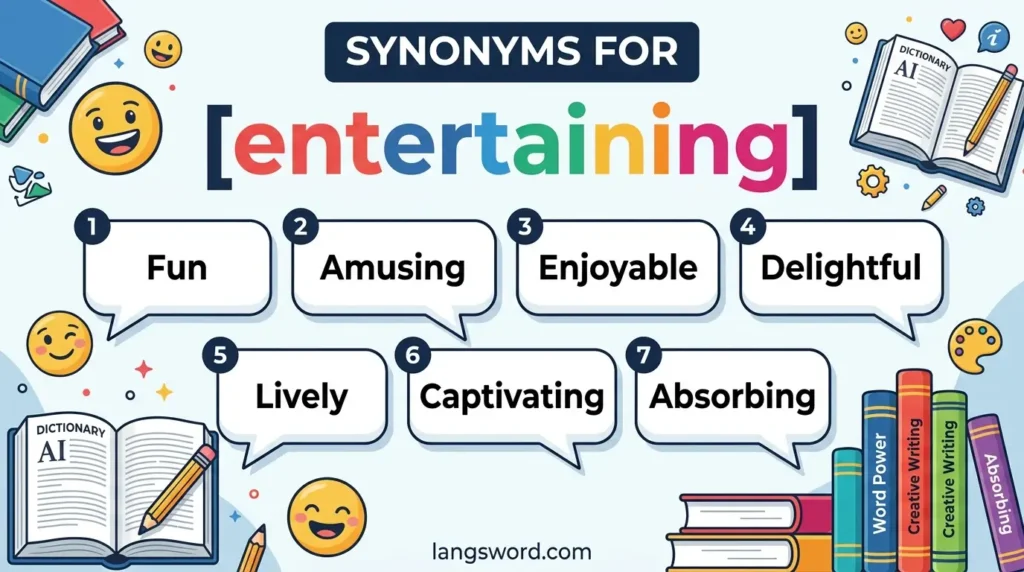
30 Synonyms of Entertaining With Meaning & Examples
1. Amusing (Adjective)
Meaning: Making people laugh or smile.
Examples:
- The comedian told an amusing story.
- His amusing comments made everyone laugh.
2. Enjoyable (Adjective)
Meaning: Giving pleasure or making someone feel happy.
Examples:
- We had an enjoyable evening at the theater.
- The book was simple and enjoyable to read.
3. Fun (Adjective)
Meaning: Pleasant, enjoyable, and often exciting.
Examples:
- We had a fun day at the beach.
- The game was really fun to play.
4. Engaging (Adjective)
Meaning: Interesting enough to hold someone’s attention.
Examples:
- The teacher gave an engaging lesson.
- Her presentation was clear and engaging.
5. Interesting (Adjective)
Meaning: Attracting attention because something is enjoyable, unusual, or useful.
Examples:
- He told us an interesting story.
- The documentary was very interesting.
6. Fascinating (Adjective)
Meaning: Extremely interesting and able to hold strong attention.
Examples:
- We watched a fascinating documentary.
- Her travel story was fascinating.
7. Captivating (Adjective)
Meaning: Holding someone’s attention in a powerful way.
Examples:
- The singer gave a captivating performance.
- The novel has a captivating plot.
8. Compelling (Adjective)
Meaning: Very interesting or powerful and difficult to ignore.
Examples:
- The film tells a compelling story.
- She gave a compelling presentation.
9. Absorbing (Adjective)
Meaning: So interesting that it takes all of your attention.
Examples:
- The mystery novel was absorbing.
- We found the documentary highly absorbing.
10. Riveting (Adjective)
Meaning: Extremely interesting and exciting.
Examples:
- The movie was riveting.
- She gave a riveting account of the journey.
11. Thrilling (Adjective)
Meaning: Causing great excitement or pleasure.
Examples:
- The final race was thrilling.
- We had a thrilling adventure.
12. Exciting (Adjective)
Meaning: Making someone feel eager, happy, or full of energy.
Examples:
- The concert was exciting.
- We planned an exciting weekend trip.
13. Lively (Adjective)
Meaning: Full of energy, activity, and enthusiasm.
Examples:
- The restaurant had a lively atmosphere.
- They had a lively conversation.
14. Humorous (Adjective)
Meaning: Funny or related to humor.
Examples:
- He wrote a humorous article.
- The speaker gave a humorous answer.
15. Comical (Adjective)
Meaning: Funny in a way that makes people laugh.
Examples:
- His facial expression was comical.
- The play included several comical scenes.
16. Hilarious (Adjective)
Meaning: Extremely funny.
Examples:
- The movie was hilarious.
- Her story was absolutely hilarious.
17. Delightful (Adjective)
Meaning: Very pleasant and enjoyable.
Examples:
- We had a delightful afternoon.
- The children’s show was delightful.
18. Pleasing (Adjective)
Meaning: Giving satisfaction or enjoyment.
Examples:
- The music was soft and pleasing.
- The film had a pleasing ending.
19. Charming (Adjective)
Meaning: Pleasant and attractive in a warm or appealing way.
Examples:
- She is a charming storyteller.
- The host was friendly and charming.
20. Stimulating (Adjective)
Meaning: Making someone think or feel mentally active.
Examples:
- The discussion was stimulating.
- We had a stimulating conversation.
21. Thought-provoking (Adjective)
Meaning: Making someone think deeply about an idea or subject.
Examples:
- The documentary was thought-provoking.
- She wrote a thought-provoking article.
22. Dramatic (Adjective)
Meaning: Full of action, emotion, or excitement.
Examples:
- The movie had a dramatic ending.
- The actor gave a dramatic performance.
23. Colorful (Adjective)
Meaning: Full of interesting, lively, or unusual details.
Examples:
- He told a colorful story about his childhood.
- The writer used colorful descriptions.
24. Vivacious (Adjective)
Meaning: Lively, energetic, and full of enthusiasm.
Examples:
- She has a vivacious personality.
- The host was vivacious and friendly.
25. Spirited (Adjective)
Meaning: Full of energy, enthusiasm, or strong feeling.
Examples:
- The children had a spirited game.
- They enjoyed a spirited discussion.
26. Entertaining (Adjective)
Meaning: Providing enjoyment, amusement, or interest.
Examples:
- The show was highly entertaining.
- He is an entertaining speaker.
27. Engrossing (Adjective)
Meaning: So interesting that it receives all of someone’s attention.
Examples:
- The book was completely engrossing.
- We watched an engrossing television series.
28. Recreational (Adjective)
Meaning: Done for enjoyment or relaxation rather than work.
Examples:
- Swimming is a popular recreational activity.
- The center offers many recreational programs.
29. Playful (Adjective)
Meaning: Light, cheerful, and full of fun.
Examples:
- The writer used a playful tone.
- His playful jokes made the meeting more relaxed.
30. Merry (Adjective)
Meaning: Happy, cheerful, and full of enjoyment.
Examples:
- The guests were in a merry mood.
- They spent a merry evening together.
Prototype Meaning
The prototype meaning of entertaining is something that gives pleasure while keeping people interested. When people hear this word, they often imagine a funny movie, an exciting show, an engaging story, or a lively person.
The word usually describes something that prevents boredom and makes an experience enjoyable.
Prototype Categorization
The 30 synonyms can be divided into several semantic groups. This helps writers select a word based on the exact type of enjoyment or interest they want to describe.
- Humor and laughter: amusing, fun, humorous, comical, hilarious, playful — these words work well for jokes, comedy, funny stories, and light situations.
- General enjoyment: enjoyable, delightful, pleasing, charming, merry — these describe experiences that create pleasure or happiness.
- Strong interest: engaging, interesting, fascinating, captivating, compelling, absorbing, riveting, engrossing — these are useful when something strongly holds attention.
- Excitement and energy: thrilling, exciting, lively, dramatic, spirited — these words fit events or experiences with action, energy, or strong emotion.
- Mental stimulation: stimulating, thought-provoking — these are useful for discussions, books, films, lessons, and ideas that make people think.
- Style and personality: colorful, vivacious, playful, charming — these can describe people, writing styles, stories, or communication.
- Leisure: recreational — this is more formal and is mainly used for activities done for pleasure or relaxation.
This grouping helps writers avoid using synonyms as if they were always interchangeable. For example, hilarious focuses on extreme humor, while fascinating focuses on strong interest. Thrilling suggests excitement, while delightful suggests pleasant enjoyment.
Antonyms of Entertaining
1. Boring (Adjective)
Meaning: Not interesting, enjoyable, or exciting.
2. Dull (Adjective)
Meaning: Lacking interest, excitement, or energy.
3. Tedious (Adjective)
Meaning: Long, repetitive, and boring.
4. Uninteresting (Adjective)
Meaning: Not attracting attention or curiosity.
5. Monotonous (Adjective)
Meaning: Repetitive and lacking variety.
6. Tiresome (Adjective)
Meaning: Causing boredom or tiredness.
7. Dreary (Adjective)
Meaning: Dull, gloomy, or lacking energy.
8. Unexciting (Adjective)
Meaning: Not producing interest or excitement.
Short Questions and Answers
What does entertaining mean?
Entertaining means enjoyable, amusing, or interesting enough to keep someone’s attention.
When should entertaining be used?
Use entertaining when describing something that gives pleasure or holds attention, such as a movie, book, speech, game, performance, or person.
Is entertaining positive or negative?
Entertaining is usually positive because it suggests that something is enjoyable. However, its exact feeling can depend on the context.
How is it different from similar words?
The synonyms have different shades of meaning. Amusing focuses on humor, fascinating focuses on strong interest, thrilling focuses on excitement, and delightful focuses on pleasant enjoyment.
Conclusion
Learning entertaining and its synonyms can make your English vocabulary richer and more flexible. Instead of repeating the same word, you can choose a synonym that gives your sentence a more exact meaning.
For example, hilarious works well for something extremely funny, while captivating is better for something that strongly holds attention. Thrilling suggests excitement, while delightful suggests warm and pleasant enjoyment.
These differences can improve both speaking and writing. A wider vocabulary also helps English learners understand books, movies, conversations, and online content more easily. Content writers can use these words to make articles more natural and reduce repetition.
Try learning a few synonyms every day, make your own sentences, and use new words in real conversations. With regular practice, your vocabulary, writing skills, and English confidence can grow.