
Introduction
Synonyms for good work ethic are words and phrases that describe a person who works hard, stays responsible, and takes their duties seriously. Imagine a team member who arrives on time, finishes tasks without being asked twice, and helps others when work gets busy.
You might say that this person is diligent, reliable, or dedicated. The phrase “good work ethic” is common in job interviews, resumes, school writing, and workplace reviews.
Learning synonyms helps English learners avoid repeating the same words and choose language that fits each situation. It also helps content writers make their writing clearer and more varied.
This article explains the meaning of good work ethic and presents useful synonyms with examples. It also covers grammar, etymology, pronunciation, word formation, prototype meaning, and semantic categories.
Meaning of synonyms for good work ethic
Definition
Synonyms for good work ethic (noun phrase): Words or phrases that describe positive qualities such as hard work, responsibility, discipline, reliability, and commitment to one’s duties.
Examples
- Her diligence shows that she has a good work ethic.
- His dedication and reliability make him a valuable team member.
Connotative Meaning
Connotation: The feeling or idea that a word suggests beyond its basic meaning.
- Positive tone: Hardworking, responsible, dedicated, disciplined, and dependable.
- Negative tone: Some related words can suggest excessive work, such as workaholic.
- Neutral tone: Terms such as professionalism can be neutral until the context shows whether the quality is positive or negative.
Etymology
The phrase good work ethic combines three common English words with different histories.
- Old English (450–1100): Good comes from Old English gōd, meaning morally valuable, desirable, or pleasing. Work comes from Old English weorc, meaning labor, activity, or deed.
- Middle English (1100–1500): The forms developed into Middle English good and werk/work. Their meanings remained closely connected to quality, labor, and activity.
- Modern English (1500–Present): Ethic comes through Latin ethica and Greek ēthikē, relating to character and moral principles. The modern phrase work ethic came to mean a person’s attitude toward work, especially ideas such as discipline, responsibility, and hard work.
Pronunciation (IPA)
synonyms for good work ethic (/ˈsɪnənɪmz fər ɡʊd wɝːk ˈɛθɪk/)
- IPA: /ˈsɪnənɪmz fər ɡʊd wɝːk ˈɛθɪk/
- Syllables: syn-o-nyms / for / good / work / eth-ic
Affixation Pattern of synonyms for good work ethic
Because synonyms for good work ethic is a phrase rather than one root word, it does not have one single affixation pattern.
- Root: The main lexical roots include synonym, good, work, and ethic.
- Prefix: syn- appears in synonym and comes from Greek, meaning “together” or “with.”
- Suffix: -ous forms synonymous; -ic forms ethic and related adjectives such as ethical.
- Word formations:
- synonym — noun
- synonymous — adjective
- good — adjective
- work — noun/verb
- worker — noun
- working — adjective/participle
- ethic — noun
- ethical — adjective
- ethically — adverb
- unethical — adjective
- work ethic — noun phrase
30 Synonyms of synonyms for good work ethic With Meaning & Examples
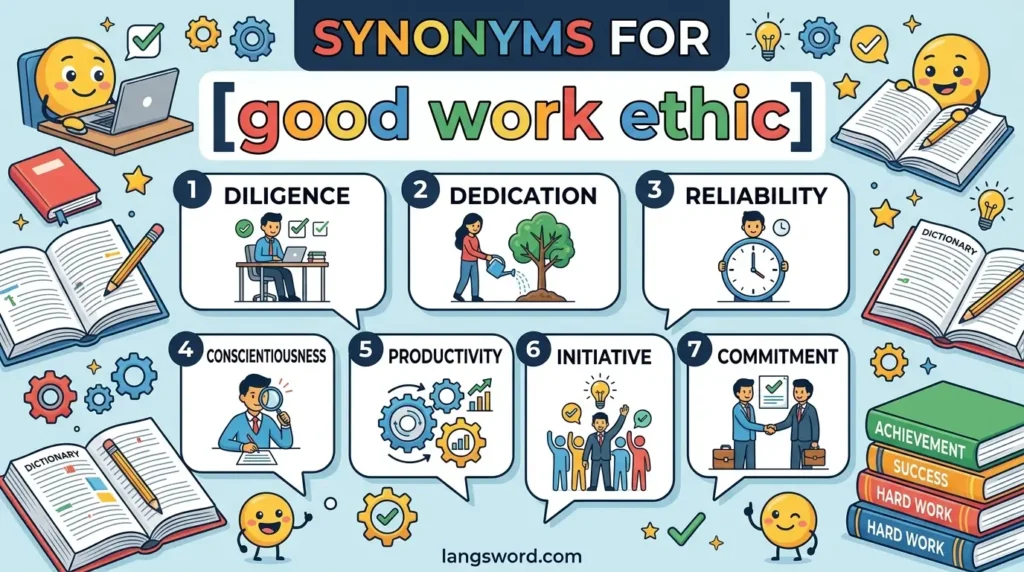
1. Diligence (Noun)
Meaning: Careful and steady effort in doing work.
Examples:
- Her diligence helped her finish the project early.
- The manager praised his diligence and attention to detail.
2. Dedication (Noun)
Meaning: Strong commitment to a task, goal, or duty.
Examples:
- Her dedication to her job is easy to see.
- His dedication helped the team meet its goal.
3. Hard work (Noun Phrase)
Meaning: Strong effort used to complete a task.
Examples:
- Her hard work earned her a promotion.
- Success often comes from patience and hard work.
4. Industriousness (Noun)
Meaning: The quality of working hard and productively.
Examples:
- His industriousness impressed his new employer.
- The company values industriousness in its employees.
5. Productivity (Noun)
Meaning: The ability to produce useful results efficiently.
Examples:
- Good planning can improve workplace productivity.
- Her productivity increased after she organized her schedule.
6. Reliability (Noun)
Meaning: The quality of being trusted to do what is expected.
Examples:
- His reliability makes him an important member of the team.
- Employers often look for reliability in new workers.
7. Dependability (Noun)
Meaning: The quality of being trustworthy and consistent.
Examples:
- Her dependability makes her a trusted colleague.
- The supervisor values his dependability.
8. Responsibility (Noun)
Meaning: The quality of taking duties seriously and completing them properly.
Examples:
- She shows great responsibility at work.
- His sense of responsibility helped the project succeed.
9. Discipline (Noun)
Meaning: The ability to control yourself and follow a plan or rules.
Examples:
- Discipline helps him stay focused during long projects.
- She has the discipline to finish difficult tasks.
10. Commitment (Noun)
Meaning: A strong promise or decision to support a task or goal.
Examples:
- Her commitment to the company is clear.
- The project requires strong commitment from everyone.
11. Perseverance (Noun)
Meaning: The ability to keep trying despite difficulty.
Examples:
- His perseverance helped him complete the difficult assignment.
- Perseverance is useful when work becomes challenging.
12. Persistence (Noun)
Meaning: Continuing to work toward something without giving up.
Examples:
- Her persistence finally solved the problem.
- His persistence impressed the whole team.
13. Professionalism (Noun)
Meaning: The behavior and skills expected from a responsible professional.
Examples:
- She handled the complaint with professionalism.
- His professionalism earned the client’s trust.
14. Punctuality (Noun)
Meaning: The habit of arriving or finishing at the expected time.
Examples:
- Her punctuality is appreciated by her manager.
- Punctuality is important in a busy workplace.
15. Conscientiousness (Noun)
Meaning: Careful attention to duties and a strong desire to do things well.
Examples:
- His conscientiousness is clear in every report he writes.
- The manager noticed her conscientiousness.
16. Attentiveness (Noun)
Meaning: Careful attention to people, tasks, or details.
Examples:
- His attentiveness helped prevent mistakes.
- Her attentiveness during meetings is valuable.
17. Thoroughness (Noun)
Meaning: Careful completion of all parts of a task.
Examples:
- The report was praised for its thoroughness.
- Her thoroughness helped uncover the error.
18. Efficiency (Noun)
Meaning: The ability to complete work well without wasting time or resources.
Examples:
- His efficiency makes him a strong employee.
- The new system improved office efficiency.
19. Motivation (Noun)
Meaning: The desire or reason that encourages someone to act.
Examples:
- Her motivation keeps her focused on her goals.
- Strong motivation can improve work performance.
20. Initiative (Noun)
Meaning: The ability to act without always waiting for instructions.
Examples:
- She showed initiative by solving the problem herself.
- His initiative helped the team save time.
21. Enthusiasm (Noun)
Meaning: Strong interest and energy for an activity.
Examples:
- He approaches every task with enthusiasm.
- Her enthusiasm makes team meetings more lively.
22. Eagerness (Noun)
Meaning: Strong interest and willingness to do something.
Examples:
- His eagerness to learn impressed his supervisor.
- She showed eagerness to take on new duties.
23. Tenacity (Noun)
Meaning: Strong determination to continue despite problems.
Examples:
- Her tenacity helped her complete the demanding project.
- His tenacity was clear when he faced setbacks.
24. Zeal (Noun)
Meaning: Great energy and enthusiasm for a task or cause.
Examples:
- She performs her duties with zeal.
- His zeal for improving the team was noticeable.
25. Thoroughgoingness (Noun)
Meaning: The quality of dealing with something fully and carefully.
Examples:
- The team’s thoroughgoingness improved the final report.
- Her thoroughgoingness helped identify every small issue.
26. Assiduity (Noun)
Meaning: Constant and careful effort in doing something.
Examples:
- His assiduity helped him master the new skill.
- The manager admired her assiduity.
27. Steadfastness (Noun)
Meaning: The quality of staying firm and committed.
Examples:
- Her steadfastness kept the project moving forward.
- His steadfastness was valuable during difficult times.
28. Workmanship (Noun)
Meaning: The quality and skill shown in making or doing something.
Examples:
- The quality of his workmanship was excellent.
- The client praised the careful workmanship.
29. Industrious (Adjective)
Meaning: Working hard and regularly.
Examples:
- She is an industrious employee who meets every deadline.
- He is known as an industrious worker.
30. Conscientious (Adjective)
Meaning: Careful, responsible, and serious about doing one’s duties well.
Examples:
- She is a conscientious employee.
- He is conscientious about checking every detail.
Prototype Meaning
The most typical meaning of good work ethic is the habit of working hard, responsibly, and consistently. When people hear this phrase, they often imagine someone who arrives on time, completes tasks, follows through on promises, stays focused, and takes pride in doing quality work. The central idea is not simply working for many hours. It is having a responsible and positive attitude toward one’s duties.
Prototype Categorization
The 30 synonyms can be grouped by their main meaning. This helps writers choose a word that gives the exact idea they want.
- Hard work and effort: diligence, hard work, industriousness, assiduity, and industrious describe strong and steady effort.
- Commitment and dedication: dedication, commitment, steadfastness, and zeal focus on strong attachment to a task or goal.
- Reliability and responsibility: reliability, dependability, and responsibility describe someone others can trust to do their duties.
- Discipline and careful work: discipline, conscientiousness, thoroughness, attentiveness, and conscientious highlight care, control, and attention to detail.
- Results and performance: productivity, efficiency, and workmanship focus on useful results and the quality of work.
- Determination: perseverance, persistence, tenacity, and steadfastness emphasize continuing despite problems.
- Energy and interest: motivation, enthusiasm, eagerness, and zeal describe energy and willingness to work.
- Professional behavior: professionalism, punctuality, and initiative are useful when describing workplace behavior and job performance.
This categorization helps writers avoid choosing a synonym only because it looks similar. For example, punctuality focuses on time, while perseverance focuses on continuing through difficulty.
Antonyms of synonyms for good work ethic
- Laziness (Noun): A lack of willingness to work or make an effort.
- Idleness (Noun): A state of doing little or no useful work.
- Negligence (Noun): Failure to give proper care or attention to a duty.
- Irresponsibility (Noun): Failure to take duties or obligations seriously.
- Unreliability (Noun): The quality of being difficult to trust or depend on.
- Carelessness (Noun): A lack of attention that can lead to mistakes.
- Procrastination (Noun): The habit of delaying work that should be done.
- Unprofessionalism (Noun): Behavior that does not meet expected professional standards.
Short Questions and Answers
What does synonyms for good work ethic mean?
It refers to words and phrases that describe positive work qualities, such as being hardworking, responsible, reliable, disciplined, and dedicated.
When should good work ethic be used?
Use good work ethic when discussing someone’s attitude toward work, duties, effort, and responsibility. It is common in resumes, interviews, workplace reviews, and professional writing.
Is good work ethic positive or negative?
It is normally positive. It describes desirable qualities such as effort, responsibility, discipline, and reliability.
How is it different from similar words?
Each synonym highlights a different quality. Diligence stresses careful effort, reliability stresses trust, punctuality stresses being on time, initiative stresses independent action, and perseverance stresses continuing despite difficulty.
Conclusion
Learning synonyms for good work ethic can make your English stronger and more flexible. Words such as diligence, dedication, reliability, discipline, commitment, perseverance, professionalism, and initiative let you describe work habits with greater accuracy.
Instead of repeating “good work ethic,” you can choose a word that shows the exact quality you mean. This is useful in resumes, cover letters, interviews, essays, reports, and everyday conversations.
These words can also help English learners understand the small differences between similar ideas. Good vocabulary is not only about knowing many words.
It is about knowing when and how to use each word. Practice a few synonyms each day, write your own example sentences, and use them in real conversations. With regular practice, your vocabulary, writing, speaking, and English confidence will grow.