
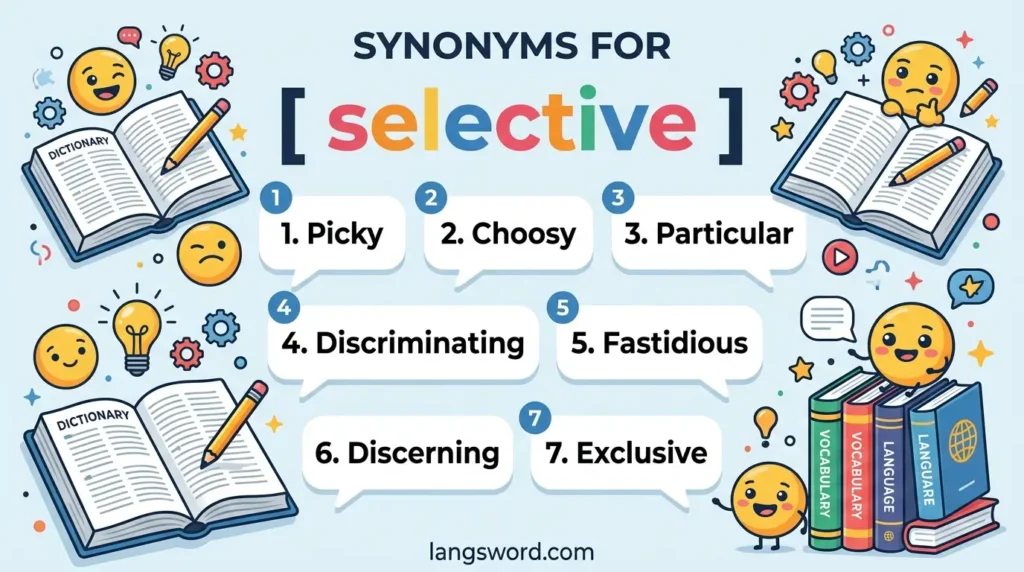

Selective means choosing only certain people, things, or options instead of accepting everything. Imagine a shopper looking for a new laptop. They compare the price, size, speed, and features before making a choice.
That shopper is being selective. We often use this word when talking about careful choices, limited groups, or personal preferences. Learning synonyms for selective helps English learners express ideas in more precise ways.
It also helps content writers avoid using the same word again and again. Some synonyms show careful judgment, while others suggest strong preferences or limited choice. This article explains the meaning of selective and explores 30 useful synonyms with examples.
It also covers connotation, etymology, pronunciation, grammar, word formation, prototype meaning, semantic categories, and antonyms. These details can help you choose the right word for each situation.
Meaning of selective
Definition
Selective (Adjective):
Choosing only certain people or things because they meet specific conditions, qualities, or preferences.
Examples
- She is very selective about the books she reads.
- The company is selective when hiring new employees.
Connotative Meaning
Connotation (the feeling or idea connected with a word beyond its basic meaning):
- Positive tone: It can suggest careful, wise, or thoughtful choice.
- Negative tone: It can suggest being too picky, narrow, or difficult to please.
- Neutral tone: It can simply describe choosing some options and rejecting others.
Etymology
The word selective comes from select, which traces back to Latin seligere, meaning “to choose” or “pick out.” It entered English through forms related to Latin and French.
- Old English (450–1100): The modern word selective was not part of Old English. Ideas of choosing and picking were expressed with native Germanic words such as ceosan, meaning “to choose.”
- Middle English (1100–1500): Words related to select entered English through French and Latin influence. The idea remained connected with choosing or picking out.
- Modern English (1500–Present): Select became established as a verb and adjective, while selective developed as an adjective meaning “characterized by choosing carefully or only certain things.”
Pronunciation (IPA)
- IPA: /sɪˈlektɪv/
- Syllables: se-lec-tive
Affixation Pattern of selective
- Root: select
- Prefix: None
- Suffix: -ive
- Word formations:
- select — verb/adjective
- selected — adjective/past participle
- selection — noun
- selective — adjective
- selectively — adverb
- selectiveness — noun
- selectivity — noun
- selector — noun
30 Synonyms of selective With Meaning & Examples
1. Choosy (Adjective)
Meaning: Careful about what you choose because you want something that meets your preferences.
Examples:
- My sister is very choosy about her clothes.
- He is choosy when picking a restaurant.
2. Picky (Adjective)
Meaning: Difficult to satisfy because you reject many choices.
Examples:
- The child is picky about food.
- She is picky when buying shoes.
3. Discerning (Adjective)
Meaning: Good at noticing important differences and choosing high-quality things.
Examples:
- He is a discerning customer.
- The restaurant attracts discerning diners.
4. Discriminating (Adjective)
Meaning: Able to notice small differences and make careful choices.
Examples:
- She has a discriminating eye for design.
- A discriminating buyer checks every detail.
5. Particular (Adjective)
Meaning: Very careful about what you accept or prefer.
Examples:
- He is particular about his coffee.
- She is particular about keeping her desk clean.
6. Fastidious (Adjective)
Meaning: Very careful about details and unwilling to accept anything imperfect.
Examples:
- She is fastidious about her work.
- He is fastidious when choosing materials.
7. Exacting (Adjective)
Meaning: Having very high standards for what is acceptable.
Examples:
- The manager has exacting standards.
- The job requires an exacting eye for detail.
8. Critical (Adjective)
Meaning: Careful and thoughtful when judging the quality or value of something.
Examples:
- She takes a critical approach to research.
- He is critical when reviewing new products.
9. Judicious (Adjective)
Meaning: Showing good judgment when making a choice.
Examples:
- The editor made a judicious selection of articles.
- Be judicious when choosing your sources.
10. Discriminatingly (Adverb)
Meaning: In a way that shows careful judgment between different choices.
Examples:
- She shops discriminatingly for expensive items.
- The collector chooses paintings discriminatingly.
11. Exclusive (Adjective)
Meaning: Limited to a particular person, group, or type.
Examples:
- The club has an exclusive membership.
- The store sells an exclusive collection.
12. Restricted (Adjective)
Meaning: Limited to certain people, places, or choices.
Examples:
- Access to the room is restricted.
- The program is available to a restricted group.
13. Limited (Adjective)
Meaning: Small in number, range, or availability.
Examples:
- We have a limited selection of colors.
- Only a limited number of seats are available.
14. Narrow (Adjective)
Meaning: Limited to a small range of choices or possibilities.
Examples:
- He has a narrow range of interests.
- The store serves a narrow market.
15. Restricted-choice (Adjective)
Meaning: Allowing or involving only a small number of possible choices.
Examples:
- The survey uses a restricted-choice format.
- Students completed a restricted-choice questionnaire.
16. Preferential (Adjective)
Meaning: Showing a preference for one person, thing, or option over others.
Examples:
- Members receive preferential treatment.
- The system gives preferential access to early applicants.
17. Discriminatory (Adjective)
Meaning: Showing unfair preference against a person or group.
Examples:
- The policy was criticized as discriminatory.
- Hiring decisions should not be discriminatory.
Note: Unlike neutral uses of selective, this word usually has a negative meaning when it describes unfair treatment.
18. Careful (Adjective)
Meaning: Taking time and thought before making a choice.
Examples:
- She is careful about the products she buys.
- Be careful when selecting a supplier.
19. Deliberate (Adjective)
Meaning: Done after careful thought rather than by accident.
Examples:
- It was a deliberate choice.
- He made a deliberate decision to change careers.
20. Considered (Adjective)
Meaning: Thought about carefully before a decision is made.
Examples:
- She made a considered choice.
- His response was calm and considered.
21. Thoughtful (Adjective)
Meaning: Showing careful attention and good judgment.
Examples:
- He made a thoughtful selection of gifts.
- Her thoughtful choice impressed everyone.
22. Refined (Adjective)
Meaning: Showing developed taste or a preference for high quality.
Examples:
- She has refined taste in art.
- The hotel has a refined style.
23. Cultivated (Adjective)
Meaning: Having developed knowledge, taste, or preferences through experience.
Examples:
- He has a cultivated taste in music.
- The gallery attracts people with cultivated interests.
24. Exclusive-minded (Adjective)
Meaning: Strongly focused on accepting only certain people or things.
Examples:
- The group has an exclusive-minded approach to membership.
- His exclusive-minded attitude limits new ideas.
25. Scrupulous (Adjective)
Meaning: Very careful and thorough when making decisions or following standards.
Examples:
- She is scrupulous about checking facts.
- The researcher was scrupulous in choosing reliable sources.
26. Meticulous (Adjective)
Meaning: Extremely careful about small details.
Examples:
- He is meticulous when choosing research materials.
- She made a meticulous selection of photographs.
27. Select (Adjective)
Meaning: Chosen from a larger group because of special quality or status.
Examples:
- Only a select group received invitations.
- The program is open to a select number of students.
28. Choice (Adjective)
Meaning: Of very good quality or specially chosen.
Examples:
- The shop sells choice cuts of meat.
- We selected a choice location for the event.
29. Pick-and-choose (Adjective)
Meaning: Involving freedom to choose only the options one prefers.
Examples:
- Customers can use a pick-and-choose system.
- The course offers a pick-and-choose approach to learning.
30. Selective-minded (Adjective)
Meaning: Inclined to choose only certain options based on personal standards or preferences.
Examples:
- She is selective-minded when choosing new projects.
- His selective-minded approach helps him focus on important tasks.
Prototype Meaning
The most typical meaning of selective is carefully choosing some options while rejecting others. When people hear this word, they often imagine someone looking at several choices and deciding that only a few are suitable. A selective person may consider quality, personal preference, usefulness, or specific requirements before making a choice. The word does not always mean being picky. It can simply describe a process where only certain items, people, or features are chosen.
Prototype Categorization
The 30 synonyms can be grouped into several semantic categories. This helps writers choose a word that matches the exact meaning and tone they want.
- Careful choice: careful, judicious, deliberate, considered, thoughtful, scrupulous, meticulous describe choices made with thought and attention.
- Strong personal preference: choosy, picky, particular, fastidious, exacting suggest that someone has strict or demanding preferences.
- Good taste and judgment: discerning, discriminating, refined, cultivated suggest an ability to recognize quality or subtle differences.
- Limited access or range: exclusive, restricted, limited, narrow, select focus on allowing only certain people, items, or possibilities.
- Preference or priority: preferential describes giving one choice or group an advantage over others.
- Negative or unfair selection: discriminatory describes selection based on unfair treatment or prejudice and therefore carries a much stronger negative meaning than selective.
- High-quality selection: choice can describe something specially chosen because it is considered desirable or high in quality.
- Flexible selection: pick-and-choose emphasizes the freedom to select preferred options.
Understanding these groups helps writers avoid using synonyms as if they were always interchangeable.
For example, discerning usually sounds positive, while picky often sounds negative or informal. Exclusive focuses on limited access, while judicious focuses on wise judgment.
Antonyms of selective
– Inclusive (Adjective)
Including many different people or things rather than limiting the group.
– Indiscriminate (Adjective)
Choosing or treating things without careful distinction.
– Unselective (Adjective)
Not making careful distinctions between available choices.
– General (Adjective)
Broad rather than limited to a specific group or category.
– Open (Adjective)
Available to many people or choices without strict restrictions.
– Broad (Adjective)
Covering a wide range rather than a narrow selection.
– Universal (Adjective)
Including everyone or everything within a particular group or category.
Short Questions and Answers
What does selective mean?
Selective means choosing only certain people or things because they meet specific standards, conditions, or preferences.
When should selective be used?
Use selective when you want to describe a careful or limited process of choosing. It works well for people, products, information, groups, opportunities, and decisions.
Is selective positive or negative?
Selective can be positive, negative, or neutral. It may suggest careful judgment, but it can also suggest being too picky or excluding others, depending on the context.
How is it different from similar words?
Words such as discerning, judicious, and careful often highlight good judgment. Picky and choosy emphasize personal preferences. Exclusive, restricted, and limited focus more on reducing access or range. Discriminatory usually refers to unfair selection.
Conclusion
Learning selective and its synonyms can make your English more flexible and precise. Instead of repeating the same word, you can choose a synonym that matches your exact meaning.
For example, discerning can describe someone with good taste, while picky can describe someone who rejects many options. Words such as judicious and careful highlight wise choices, while exclusive and restricted focus on limited access.
Knowing these differences improves both writing and speaking. It also helps English learners understand tone, context, and word choice more clearly.
For content writers, using suitable synonyms can make articles smoother and more engaging while avoiding unnecessary repetition. Practice these words in short sentences each day, and try using a different synonym whenever you describe a choice.
Regular vocabulary practice will gradually build stronger English confidence.